Sign in to mark it as listened, rate it and keep notes.
About the artist
Daft Punk, the French electronic music duo of Thomas Bangalter and Guy-Manuel de Homem-Christo, were pioneers of the French house movement. Known for their iconic robot personas, they blended house, funk, disco, techno, and rock, becoming one of electronic dance music's most influential acts.
About the album
Random Access Memories is Daft Punk's fourth and final studio album, released in 2013. It's a rich blend of disco, progressive rock, and pop, made distinct by its extensive use of live session musicians and limited electronic instruments, paying homage to 1970s and early 1980s American music.
Meanings
The album's title, Random Access Memories, draws a parallel between computer memory and the human brain, reflecting how memories are stored randomly. Daft Punk aimed to maximise the potential of infinite storage by recording a sprawling amount of elements, connecting random ideas to create a journey.
Why it's rated so high
The album received universal acclaim, earning Daft Punk's highest Metacritic score and five Grammy Awards, including Album of the Year. Critics praised its ambition, live instrumentation, and ability to breathe life into contemporary music, with 'Get Lucky' becoming a global smash.
Career and historical context
This album marked a significant shift for Daft Punk, moving away from the minimal production of their previous work and extensively using live musicians. It was their fourth and final studio album, released after composing the Tron: Legacy soundtrack, and saw them leave Virgin for Columbia Records.
Fun facts
The album cost over one million dollars to make, financed entirely by Daft Punk themselves.
Daft Punk wanted to create an album as if the Internet had never existed.
The sound of a busy restaurant was recorded by placing microphones in front of people's forks.
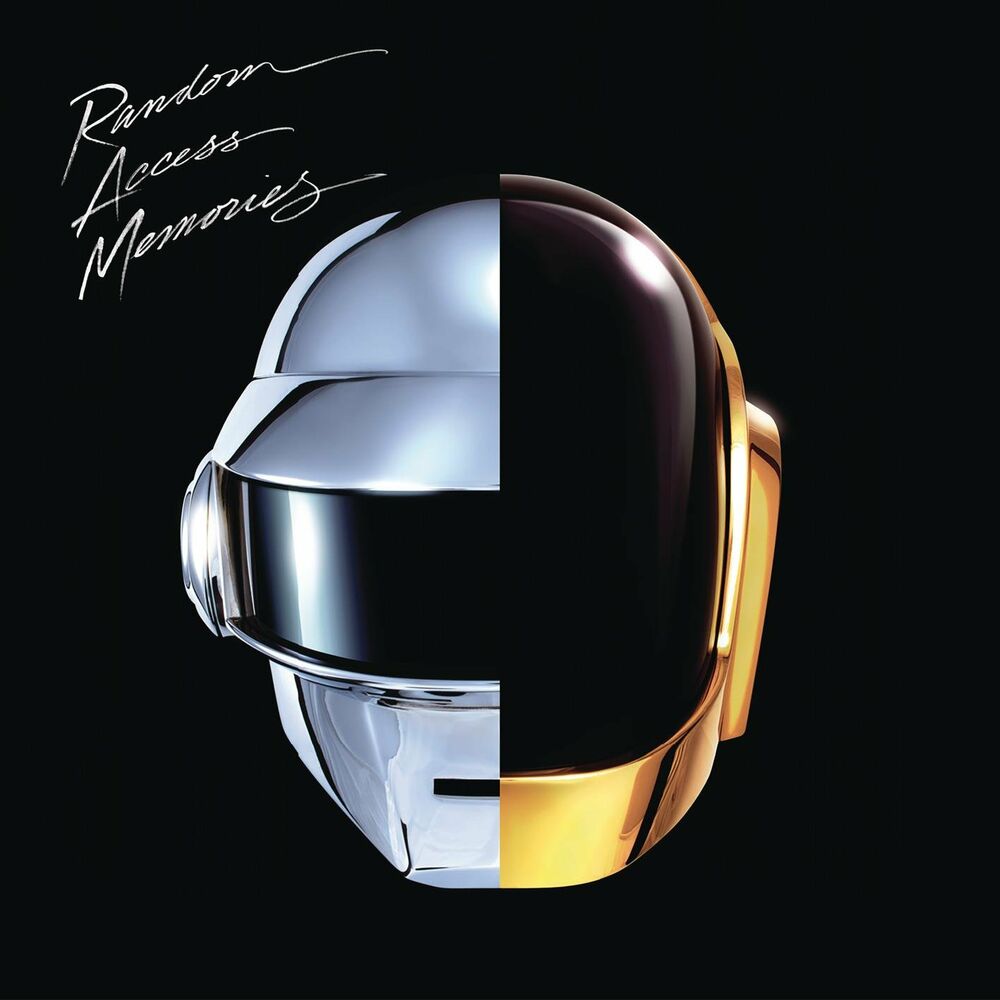
The album cover is the only one not to feature the band's wordmark, only their helmets.
Daft Punk's planned appearance on The Colbert Report was cancelled by MTV due to an exclusivity agreement.
Written by AI from the album's and artist's Wikipedia articles and the archive's notes. Double-check anything important.
The full story
Random Access Memories is the fourth and final studio album by the French electronic music duo Daft Punk. It was released on 17 May 2013 through Columbia Records. The album pays tribute to late 1970s and early 1980s American music, particularly from Los Angeles. This theme is reflected in the packaging and promotional campaign, which included billboards, television advertisements and a web series. Recording sessions took place from 2008 to 2012 at Henson, Conway and Capitol Studios in California, Electric Lady Studios in New York City, and Gang Recording Studio in Paris, France.
Following the minimal production of their previous album, Human After All (2005), Daft Punk recruited session musicians with the help of Chris Caswell to perform live instrumentation and limited the use of electronic instruments to drum machines, a custom-built modular synthesizer and vintage vocoders. It combines disco, progressive rock and pop, with contributions by Paul Jackson Jr., Giorgio Moroder, Chilly Gonzales, Julian Casablancas, Paul Williams, Caswell, Pharrell Williams, Nile Rodgers, Todd Edwards, Panda Bear and DJ Falcon.
Random Access Memories is the only Daft Punk album to top the US Billboard 200, and was certified platinum by the Recording Industry Association of America. It also topped the charts in twenty other countries. Its lead single, "Get Lucky", topped the charts in more than 30 countries and became one of the best-selling digital singles of all time. The album appeared on several year-end lists, and won in several categories at the 2014 Grammy Awards, including Album of the Year, Best Dance/Electronica Album, and Best Engineered Album, Non-Classical. "Get Lucky" also won the awards for Record of the Year and Best Pop Duo/Group Performance. In 2020, Rolling Stone ranked Random Access Memories number 295 on their list of the "500 Greatest Albums of All Time".
Background
In 2008, after finishing their Alive 2006/2007 tour, Daft Punk began working on new material in Paris, recording demos for approximately six months. They were pleased with the compositions, but dissatisfied with their process of sampling and looping, as they had done for their previous albums. As Thomas Bangalter of Daft Punk stated, "We could play some riffs and stuff but not keep it [up] for four minutes straight." Daft Punk put these demos aside and started work on the Tron: Legacy film soundtrack, which Bangalter described as "very humbling". For their next album, Daft Punk decided to work extensively with live musicians. They spoke with Chris Caswell, a well-connected musician in the industry who had previously composed arrangements for Legacy, and commissioned him to gather a group of experienced session artists to perform for the record. According to Bangalter, "We wanted to do what we used to do with machines and samplers, but with people." They avoided the use of samples, with the exception of the closing track "Contact".
The album features Chic frontman Nile Rodgers. According to Rodgers, the collaboration was "something we've talked about for a long time. We've respected each other endlessly." Daft Punk visited Rodgers' home for an informal jam session. Musician Paul Williams announced in a 2010 interview that he had worked with the group, after Daft Punk had been introduced to Williams by a sound engineer with whom they were mutually acquainted.
In May 2012, Daft Punk's collaboration with Giorgio Moroder was announced. Moroder had recorded a monologue about his life for use in a track on the album. Rodgers was also present during the Moroder recording session. Moroder clarified that he was not involved in the composition of the track or its use of a synthesizer: "They did not let me get involved at all. Thomas asked me if I wanted to tell the story of my life. Then they would know what to do with it." Daft Punk had been in contact with Moroder in relation to a possible contribution for the Tron: Legacy score, but this never happened.
Chilly Gonzales stated in an interview that his contribution was recorded in a one-day session: "I played for hours and they're gonna grab what they grab and turn it into whatever." He explained that Daft Punk prompted him at the piano in the same manner that a film director coaches an actor, and Gonzales left the Los Angeles studio without knowledge of what the final product would sound like. He had previously recorded a cover version of Daft Punk's song "Too Long" that appeared on their 2003 album Daft Club.
Pharrell Williams collaborated with Daft Punk and Rodgers by providing vocals for two tracks on Random Access Memories. As a member of the Neptunes, Pharrell had previously provided a remix of "Harder, Better, Faster, Stronger" that appeared on Daft Club. The Neptunes and Daft Punk also co-produced N.E.R.D.'s song "Hypnotize U".
Recording
Daft Punk recorded Random Access Memories in secrecy. Recording took place at Henson Recording Studios, Conway Recording Studios and Capitol Studios in California, Electric Lady Studios in New York City, and Gang Recording Studio in Paris. Having worked with keyboardist and arranger Chris Caswell on Tron: Legacy, Daft Punk enlisted him and connected with engineers and other session players. They wanted to avoid the more compressed sounds of drum machines in favor of "airy open" drum sets of the 1970s and 80s, which they considered the most appealing era of music. They said the session players were enthusiastic about reuniting in the context of the new album and the prestige of the studio locations.
Drummer Omar Hakim recalled being asked by Daft Punk to perform on the album, and was surprised by what they wanted of him. He at first assumed they wanted electronic drum work, since Hakim had done some drum programming in his career. Daft Punk instead specified that they were looking to record Hakim performing drum riffs that they had conceived. Rather than play out the entire structure of a song, Hakim would perform individual patterns for extended periods, creating a library for Daft Punk to cull from. They conveyed their ideas to session musicians via sheet music and in some instances by humming melodies. For example, Bangalter hummed a complex drum and bass line to Hakim, who replicated and improved upon it for "Giorgio by Moroder".
Most of the vocal sessions took place in Paris, whereas the rhythm sections were recorded in the United States. The album incorporates a variety of accompanying performances including a horn section, woodwind instruments, a string orchestra and choir. Orchestral parts were recorded for almost every track, but used for only a few on the completed album. Bangalter said that the use of such performers and studios for the sake of experimentation harkened to an earlier era, and came at great monetary expense. He estimated that it had cost more than one million dollars, but felt that the number was not important. The sessions were financed by Daft Punk themselves, which allowed them the luxury of abandoning the project if they wished. Bangalter said some songs had been recorded across five studios over two and a half years. Rodgers recalled that Daft Punk aimed to create an album as if the Internet had never existed.
Various sound effects were newly recorded with the help of film experts from Warner Bros. Bangalter noted one example in which the sound of a busy restaurant was achieved by placing microphones in front of the forks of a group of people. In another instance, the effect of dripping water was recorded on a soundstage. Use of electronics was limited to drum machines that appear on only two tracks, a large custom-built Modcan modular synthesizer performed live by Daft Punk, and vintage vocoders. When asked which Daft Punk member performed the robotic vocals, Bangalter said it did not matter. Daft Punk produced most of the vocoder tracks in their studio in Paris, with later processing by Mick Guzauski at Capitol. Moroder elaborated that Daft Punk would take "a week or so" to find an adequate vocoder sound, and an additional few days to record the lyrics.
Although Daft Punk felt that the presets and parameters of digital tools would inhibit creativity and innovation, they said Random Access Memories could not have been made without computer technology. The sessions were recorded simultaneously onto Ampex reels and as Pro Tools tracks; Daft Punk and Guzauski would then listen to each recording in both analogue and digital iterations, deciding which of the two they preferred. Subsequently, the elements were edited by Daft Punk with Pro Tools in a manner similar to how they would work with samples.
In an interview with Guitar World in November 2012, the Fourplay member Nathan East said he had contributed to the project. Pedal steel guitar was performed by Greg Leisz. Daft Punk sought to use it in a …
Music
Theme and influences
Bangalter said the title encapsulates Daft Punk's interest in the past, referencing both random-access memory technology and the human experience: "We were drawing a parallel between the brain and the hard drive–the random way that memories are stored." Daft Punk felt that while current technology allows for an unlimited capacity to store recorded material, the content produced by contemporary artists had diminished in quality. Their goal was to maximize the potential of infinite storage by recording a sprawling amount of elements. They connected this to the title, as they sought to make connections out of the random series of ideas.
Random Access Memories was described by music critics as a disco album. Daft Punk sought a "west coast vibe", referencing such acts as Fleetwood Mac, the Doobie Brothers and the Eagles. The record pays homage to Michael Jackson, the Cars, and Steely Dan. The recording of live synthesizers was inspired by progressive rock, with the pop sensibilities of Wizzard and the Move. Daft Punk looked to Rumours by Fleetwood Mac and The Dark Side of the Moon by Pink Floyd as models. Bangalter said "the most important records in music, whether it's Led Zeppelin [...] or The White Album or Sgt. Pepper's... or Quadrophenia or Tommy, are the ones that take you on a journey for miles and miles."
Composition
Daft Punk created demos for Random Access Memories without a clear plan for an album. Over the course of the sessions, numerous tracks were created and discarded. At one point Daft Punk considered sorting the album into one continuous track, similar to the Prince record Lovesexy. They also considered releasing it as a four-disc box set to accommodate the volume of content. The album lacked structure until the final months of production.
The opening track, "Give Life Back to Music", features guitar by Rodgers and Paul Jackson, Jr., keyboards by Chilly Gonzales, drums by John "J.R." Robinson, and vocals performed by Daft Punk using vocoders. The song reflects Daft Punk's goal to create a light yet polished and elegant record. According to NME, it begins with "a stupendously vast rock intro that obliterates any trace of Human After All's brittle techno". The following track, "The Game of Love", also features vocoded vocals. Bangalter said, "There's this thing today where the recorded human voice is processed to try to feel robotic." Their intent was to produce robotic vocals with expressiveness and emotion. "Giorgio by Moroder" was created as a metaphor about musical freedom, with Moroder's monologue about his career as analogue for music's history regarding exploration of genres and tastes. Moroder was not involved in the composition, and said that after he recorded the story of his life "they would know what to do with it". In the monologue, Moroder details the creative process behind Donna Summer's I Remember Yesterday (1977) and its closing track "I Feel Love".
"Within" was one of the first tracks recorded. It features Gonzales on piano with minimal accompaniment of bass, percussion, electric keyboard, and vocoder. "Within" transitions from the key of A minor of the previous three songs to the key of B-flat minor of subsequent tracks. Regarding the lyrics, the critic Nick Stevenson wrote, "A deep vocoder sings about not understanding the world, being lost and not even remembering his own name." Jeremy Abbott of Mixmag wrote: "So many things I don't understand is the prominent lyric and Chilly's chords combined with grazing cymbals make for a beautiful summer lullaby."
"Instant Crush" was based on a demo that Daft Punk presented to the Strokes singer Julian Casablancas; he became enthused upon hearing it and provided vocals. The song contains rock influences and a guitar solo. Casablancas noted that he ultimately combined the compositions of two separate Daft Punk demos, which serve as the verse and chorus respectively. The critic John Balfe considered the song "appropriately …
Promotion and release
In January 2013, de Homem-Christo revealed that Daft Punk were in the process of signing with Sony Music Entertainment through the Columbia Records label, and that the album would be released in early 2013. A report from The Guardian followed specifying a release date of May 2013. On 26 February 2013, Daft Punk's official website and Facebook page announced the signing to Columbia with a picture of their helmets and a Columbia logo. Billboards and posters featuring the helmets and logo then appeared in several major cities.
On 2 March, a 15-second television ad aired during Saturday Night Live (SNL) depicting an animated, stylized version of the band's logo and the aforementioned image of the helmets. The music featured in the ad was a result of the collaboration with Rodgers, who noted that various fan remixes of the clip appeared online after the airing. A second TV ad also premiered that was similar to the first on Saturday Night Live, but with a different music clip and the title Random Access Memories in place of the stylized Daft Punk logo. During the first night of Coachella Festival 2013, a third trailer debuted that featured Daft Punk, Pharrell Williams and Rodgers performing, as well as a list of collaborators. The trailer also aired during Saturday Night Live the following evening, but without a list of collaborators.
The gradual rollout of promotion was inspired by advertising of the past, reflecting the theme of the album. Daft Punk approached Columbia with a specific agenda for the campaign; Rob Stringer of the label recalled Daft Punk showing him the book Rock 'n' Roll Billboards of the Sunset Strip as an example of what they wanted. Bangalter felt that physical billboards are more affecting than banner ads and that "SNL is this part of American culture with a certain timelessness to it." The campaign was handled by a small group led by Daft Punk and manager Paul Hahn, with assistance from Kathryn Frazier of the public-relations firm Biz 3. The duo had pursued Columbia in particular because of its long-standing history, as expressed by Bangalter: "It felt interesting conceptually to write this story with a record company like Columbia, with a 125-year legacy."
Central to the promotion was the limiting of exposure to the album's content, as well as a focus on face-to-face contact for press previews. As Hahn stated, "There is a minimalism in our approach that creates an absence of information, and we notice our fans tend to throw themselves into the breach, or try to fill the empty spaces." Following a reported leak of the song days earlier, "Get Lucky" was released as a download single on 19 April 2013. On 13 May, a limited-time preview stream of the full album was launched via the iTunes Store. In May 2013, Random Access Memories was released on digital storefronts and streaming services.
Daft Punk were scheduled to appear on 6 August episode of The Colbert Report to promote Random Access Memories, but were unable because of conflicting obligations regarding their future appearance at the 2013 MTV Video Music Awards. According to Stephen Colbert, Daft Punk were unaware of any exclusivity agreement and were halted by MTV executives the morning prior to the taping. Colbert nevertheless broadcast an elaborate sketch of himself dancing to "Get Lucky" with various celebrities, including Hugh Laurie, Jeff Bridges, Jimmy Fallon, Bryan Cranston, Jon Stewart, Henry Kissinger, Matt Damon, and the Rockettes.
Artwork packaging
Unlike the previous studio albums that feature the band's wordmark as the cover art, Random Access Memories is the first and only one to not do so. Instead, it features the band members' signature helmets with the album title written on the top left. The title treatment is reminiscent to that of Michael Jackson's Thriller. The image of the helmets was first revealed on Daft Punk's website, and became a recurring symbol throughout the promotional campaign.
The track titles were initially withheld …
Critical reception
At Metacritic, which assigns a weighted mean rating out of 100 to reviews from mainstream critics, Random Access Memories has an average score of 87 based on 47 reviews, indicating "universal acclaim". It has the highest Metacritic score of any Daft Punk album. Q called it "by some margin Daft Punk's best album in a career that's already redefined dance music at least twice. It is, in short, a mind blower." The Independent stated, "Random Access Memories breathes life into the safe music that dominates today's charts, with its sheer ambition ... It's an exciting journey, and one that, for all its musical twists and turns, has its feet planted on the dancefloor." Melissa Maerz of Entertainment Weekly called it "a headphones album in an age of radio singles; a bravura live performance that stands out against pro forma knob-twiddling; a jazzy disco attack on the basic house beat; a full collaboration at a time when the superstar DJ stands alone." She concluded her review by saying that "if EDM is turning humans into robots, Daft Punk are working hard to make robot pop feel human again."
Several critics commented on the variety of content. NME said, "There's a creeping notion that every musical idea that's ever been so much as thought up is on this album." In addition, Random Access Memories is ranked No. 497 on NME's list, "The 500 Greatest Albums Of All Time". Mark Richardson of Pitchfork echoed this sentiment, calling the record "a mix of disco, soft rock, and prog-pop, along with some Broadway-style pop bombast and even a few pinches of their squelching stadium-dance aesthetic". Richardson praised the engineering and recording, but found that "though everything about RAM, from the session musicians to the guests to the means of production, is meant to sound more 'human,' the album at points sounds more sterile, almost too perfect." Pitchfork named the album the seventh-best of 2013.
DJ Magazine commented on the shift in Daft Punk's musical style: "While Daft Punk clearly want to move on and evolve, ditching the electronic beats, house and techno that first elevated them to fame, it's that music that forms the bedrock of their best tunes, and still, that's what they're best at making." Resident Advisor stated that "it's an album rooted in a now-ancient aesthetic", noting the influence of music born out of California and New York in the 1970s. In a five-star review, Heather Phares of AllMusic said that the record "taps into the wonder and excitement" of music from the 1970s and early 1980s. Phares concluded her review by saying, "Random Access Memories is also Daft Punk's most personal work, and richly rewarding for listeners willing to spend time with it."
Aaron Payne of musicOMH wrote, "Daft Punk somehow misplace the wit and the light touch that's pretty much their trademark. Instead, these long epics become somewhat tedious and there is a strong whiff of egoism and self-indulgence ... At over 70 minutes, the album feels rather bloated. Quite a few of the songs are too long, or too empty of ideas, or too willing to repeat themselves, or too willing to play to type". Dan Weiss of Paste noted that "none of the admittedly eclectic pilferings of Random Access Memories challenge or defy anything. They all evoke specific eras of film soundtrack or disco trend. The beats have grown less, not more, complex over time."
Retrospective reviews
In January 2015, Random Access Memories was placed at number 9 on Billboard's list of "The 20 Best Albums of 2010s (so far)". In 2020, it was ranked at 65 on the 100 Best Albums of the 21st Century list of Stacker. The same year, Rolling Stone ranked Random Access Memories number 295 on their list of the "500 Greatest Albums of All Time". In 2021, Pitchfork included Random Access Memories on its list of review scores they "would change if they could", adjusting its score from 8.8 out of 10 to 6.8. The Pitchfork critic Philip Sherburne wrote that it "doesn't feel pivotal in the same way that …