Tracklist
- Looking For Atlantis4:00
- Wild Horses3:43
- Machine Gun Ibiza3:43
- We Let The Stars Go (Single Version)3:34
- Carnival 2000 (Single Version)3:22
- Jordan: The Comeback (Single Version)4:11
- Jesse James Symphony2:15
- Jesse James Bolero4:09
- Moon Dog4:08
- All The World Loves Lovers3:50
- All Boys Believe Anything1:34
- The Ice Maiden (Single Version)3:20
- Paris Smith2:55
- The Wedding March2:47
- One of the Broken (Single Version)3:51
- Michael3:02
- Mercy1:22
- Scarlet Nights4:14
- Doo-Wop In Harlem3:43
Have you heard it?
Sign in to mark it as listened, rate it and keep notes.
The full story
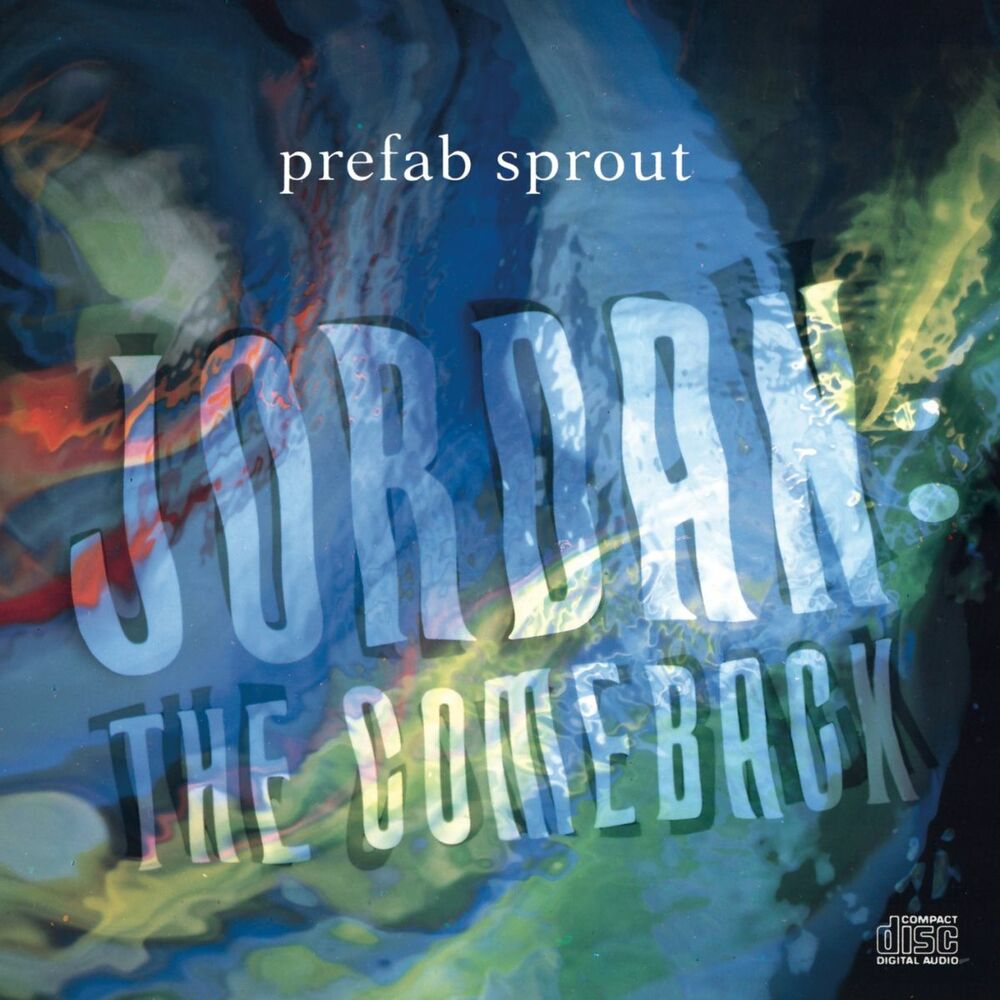
Jordan: The Comeback is the fifth studio album by English pop band Prefab Sprout, released by Kitchenware Records and CBS on 28 August 1990. Comprising 19 tracks and incorporating a range of musical styles and lyrical themes, the album has been regarded by both the band and critics as its most ambitious project. It was produced by Thomas Dolby, who had previously worked with the band on their 1985 album Steve McQueen but had been unable to participate fully in the production of its 1988 follow-up, From Langley Park to Memphis. Frontman Paddy McAloon divided the album thematically into four sections – conventional pop songs, a suite about Elvis Presley, love songs and material exploring "death and fate". The lyrics frequently address religion and celebrity, alluding to figures such as Jesse James, Agnetha Fältskog, God and the Devil. Upon its release, the album received widespread critical acclaim and achieved commercial success, reaching number 7 on the UK Albums Chart. Its singles performed less successfully – "Looking for Atlantis" and "We Let the Stars Go" peaked at number 51 and 50, respectively, on the UK Singles Chart while Jordan: The EP reached number 35. The album was nominated for Brit Award for British Album of the Year at the 1991 Brit Awards.
Background and recording
Following the release of the successful From Langley Park to Memphis (1988), frontman Paddy McAloon spent around a year writing and recording demos for Prefab Sprout's next album. He created home recordings more elaborate than those for previous albums and wished for the project to resemble a Disney movie soundtrack produced by Trevor Horn. McAloon kept in contact with collaborator Thomas Dolby, described by Giles Smith of The Independent as "a producer who works from a sound-library of other-wordly squeaks and shimmers". When Dolby received a demo tape, he considered many of the songs so complete that there was little he could do to improve them. McAloon, however, felt strongly that the album needed to be made in a professional recording studio. He ultimately considered Dolby's contribution in the studio so great that, barring a few tracks, he was a de facto band member on the album. Recording commenced in June 1989, with the album title announced the same month in the press release for Protest Songs. The band – Paddy and Martin McAloon, Wendy Smith and Neil Conti – initially recorded at Ridge Farm Studio, Surrey. Paddy McAloon began the sessions having already carefully planned the album's running order in the demo stage. He intended the album to feature 24 songs but CBS were concerned about the commercial appeal of a double album. Compromising, Prefab Sprout took the standard advance for a single album and recorded 19 tracks. The subsequent budgetary issues placed a strain on recording; the sessions, intended to last three months, ultimately stretched to around a year and caused Dolby to be away from his wife Kathleen Beller. After six months, the band travelled to Los Angeles to continue recording the album, with the couple putting them up at their home. Dolby and McAloon mixed the completed album in a small L.A. studio.
Musical and lyrical style
Jordan: The Comeback has been described as "nineteen songs dipped in conceptual aspic". The album's tracklisting can be divided into four sections – straightforward pop songs, songs concerning Elvis Presley, love songs and songs about "death and fate". Common to all four sections is the theme of rebirth and renewal, the "comeback" of the album's title. McAloon felt most people "would like to be able to go back and do things differently". Several songs on the album contain references to God and religious imagery, a feature present in some of the band's earlier work. McAloon was inspired by the power of gospel music and concepts from his youth in a Catholic seminary. He felt his own agnosticism lent a tension to his work. The album features a variety of genres, among them funk, disco, country and bolero. McAloon took inspiration from K-tel compilation albums, attracted to the idea of "the listener being inundated with all these musical styles coming at them one after another". The arrangements largely employ soft textures, something McAloon deemed "the most avant-garde thing you can do" amidst the rock music scene of 1990. According to the Gavin Report, "ever present are the rich chord changes with slices of sly sampling". Stuart Maconie of the NME considered the album's sound world "informed more by Pet Sounds and Phil Spector than punk rock or acid house" and felt its tracks exhibited "a tension between a love of the mainstream pop song tradition and McAloon's own unusual musical personality". Many of the compositions carry the influence of Broadway theatre and McAloon found inspiration in songwriters including Rodgers and Hart, Burt Bacharach and Rod Temperton. Writing in 2022, John Earls of Classic Pop considered the album to be Prefab Sprout's most "band-sounding", remarking "Martin McAloon and drummer Neil Conti's rhythm section were never so fluid."
Release
Jordan: The Comeback was issued on 28 August 1990 by Kitchenware Records and CBS. Its liner notes dedicate the album to Dolby and manager Keith Armstrong and carry a lighthearted special thanks to "the staff of Rollmo Studios for their pioneering use of the Zorrophonic™ recording process". The album reached number 7 on the UK Albums Chart, ultimately spending a total of 17 weeks on the chart. It was certified gold by the British Phonographic Industry in November 1990. On the European Top 100 Albums chart, it peaked at number 31. The album was extensively promoted in the UK, with features appearing in national newspapers including The Daily Telegraph and The Guardian and a profile of the band on BBC2's Rapido. In October, the band embarked on a UK tour in support of the album, breaking four years of live inactivity. The album was nominated for Brit Award for British Album of the Year at the 1991 Brit Awards, losing to George Michael's Listen Without Prejudice Vol. 1. Two singles and an EP were released from the album. The band promoted the lead single "Looking for Atlantis" with a performance on the BBC1 talk show Wogan on 20 August 1990, but it failed make the top 40 on the UK Singles Chart, reaching number 51. "We Let the Stars Go" was issued as the album's second single; despite being BBC Radio 1's "Record of the Week" for the week beginning 8 October 1990, it peaked at number 50. Issued on 24 December 1990, Jordan: The EP – featuring "One of the Broken", "Jordan: The Comeback", "Carnival 2000" and "The Ice Maiden" – fared a little better than its predecessors, reaching number 35. In September 1992, a revised mix of "All the World Loves Lovers" received single release in support of A Life of Surprises: The Best of Prefab Sprout, peaking at number 61.
Critical reception
Jordan: The Comeback garnered widespread acclaim upon release. Stuart Maconie of NME described the album as "riding a thematic railroad from nuggets of pure pop philosophy to weighty matters of the soul". Comparing the album's ambition to "other great pop jamborees from Sign o' the Times to the White Album", Maconie commented "to say it's the pop triumph of the year is to damn it with faint praise". David Wild of Rolling Stone said, "If Brian Wilson at the height of his creative powers had spent a year in the studio working up a concept album about love, God and Elvis, the result might have sounded like Jordan: The Comeback. Simon Reynolds of Melody Maker considered the album the band's best since Steve McQueen, praising it as "exquisite, sumptuous, marvellously intricate, angelically forceful". Record Mirror praised what it called "a masterly collection of 19 richly emotive songs". The Washington Post's Joe Brown praised the album's "smart lyrics, buoyant melodies and a pure pop charm the likes of which we haven't heard since the Beatles, or at least Elton John". Q reviewer Lloyd Bradley was most impressed by how the album "fills every nook and cranny with sounds" without overshadowing its songs' core rhythms and melodies. Ira Robbins of Entertainment Weekly commented "Those accustomed to musical junk food may find Jordan: The Comeback too subtle and complex at first, but this airy delicacy is a taste worth acquiring." In lists of the year's best albums, Jordan: The Comeback was ranked third by Mark Woodruff of Spin and 23rd by NME. Ranking the album 27th, Melody Maker added: "If you aren't seduced by one of these 19 tracks, you don't like music". Among retrospective reviews, Jason Ankeny of AllMusic called it "Prefab Sprout's largely successful attempt to embrace the breadth of popular music", adding: "Over the course of no less than 19 tracks, McAloon chases his twin preoccupations of religion and celebrity, creating a loose thematic canvas perfect for his expanding musical palette". Trouser Press deemed the album "remarkably dense, intensely rewarding listening". In 1995, Q included Jordan in its publication "In Our Lifetime: Q's 100 Best Albums 1986–94", a list compiled to celebrate its 100th issue. Tom Ewing of Freaky Trigger ranked the record at number 77 in a 1999 list of his favourite albums of the 1990s. Writing in 2007, BBC Music's Chris Jones felt the album's richness left listeners "somewhat over-satiated" and considered "We Let the Stars Go" and "All the World Loves Lovers" to come "uncomfortably close to cloying". He concluded "like George Gershwin transported into Brian Wilson's sandbox, Jordan is equal parts passionate, philosophical and preposterous". Upon its reissue in 2019, Danny Eccleston of Mojo referred to Jordan as Prefab Sprout's "sprawling opus" and said that its "gospel moves sound even better" in light of the renewed popularity of "'80s soul productions" while Adam Mason of PopMatters praised McAloon's ability "to plunge into any musical genre he pleases and emerge with a stunning melody". Pitchfork's Sam Sodomsky declared the album "a work so layered that, decades on, it still seems to hold new secrets" and singled out "Wild Horses" as "a romantic fantasy whose sleek arrangement still sounds fresh". In 2022, Pitchfork ranked the album 131 in their list "The 150 Best Albums of the 1990s".
Aftermath and legacy
Following the album's release, McAloon worked on several similarly ambitious projects. He planned to follow up Jordan with Let's Change the World with Music, an album with religious themes that further reflected the influence of gospel music. After the completed demo tape received a muted reception from Sony in 1993, McAloon expanded the concept of one of its songs into Earth, the Story So Far, a concept album featuring songs about Adam and Eve and Neil Armstrong. McAloon worked on Earth for two years before abandoning it, fearing it would be too long and expensive for release. Other prospective Prefab Sprout projects devised during this period include Behind The Veil, based on the life of Michael Jackson, a romantic album named Knights in Armour and a collection of spiritual compositions titled The Atomic Hymn Book. The ultimate follow-up to Jordan became Andromeda Heights (1997), largely made up of songs written for previous conceptual projects. McAloon's Let's Change the World with Music demos were eventually released as Prefab Sprout's eighth studio album in 2009. Jordan: The Comeback has continued to receive praise and has been described as Prefab Sprout's "ultimate fan favourite". "Jordan: The Comeback" and "One of the Broken" were among the ten tracks listed in NME's "Alternative Best of Prefab Sprout" in 1992. In a 2019 interview for Pitchfork, Alexis Taylor of Hot Chip named "Wild Horses" the song he wished he'd written, considering the song's loop-based arrangement modern and likening it to Prince's Diamonds and Pearls (1991). The song was sampled by Star Slinger for "Extra Time" in 2010 and covered by American singer-songwriter Natalie Prass in 2018. A remastered edition of the album, overseen by Paddy and Martin McAloon, was issued by Sony Music on 27 September 2019. Originally released on vinyl as a single album, the 2019 vinyl issue afforded Jordan: The Comeback double album status with its sides corresponding to the four thematic sections. Paddy McAloon stated he was still proud of the album upon its reissue, describing it as "a solid piece of work".
Tracklist
- Looking For Atlantis4:00
- Wild Horses3:43
- Machine Gun Ibiza3:43
- We Let The Stars Go (Single Version)3:34
- Carnival 2000 (Single Version)3:22
- Jordan: The Comeback (Single Version)4:11
- Jesse James Symphony2:15
- Jesse James Bolero4:09
- Moon Dog4:08
- All The World Loves Lovers3:50
- All Boys Believe Anything1:34
- The Ice Maiden (Single Version)3:20
- Paris Smith2:55
- The Wedding March2:47
- One of the Broken (Single Version)3:51
- Michael3:02
- Mercy1:22
- Scarlet Nights4:14
- Doo-Wop In Harlem3:43
Listeners 0
Nobody has logged it yet. Be the first.