João's Music Archive
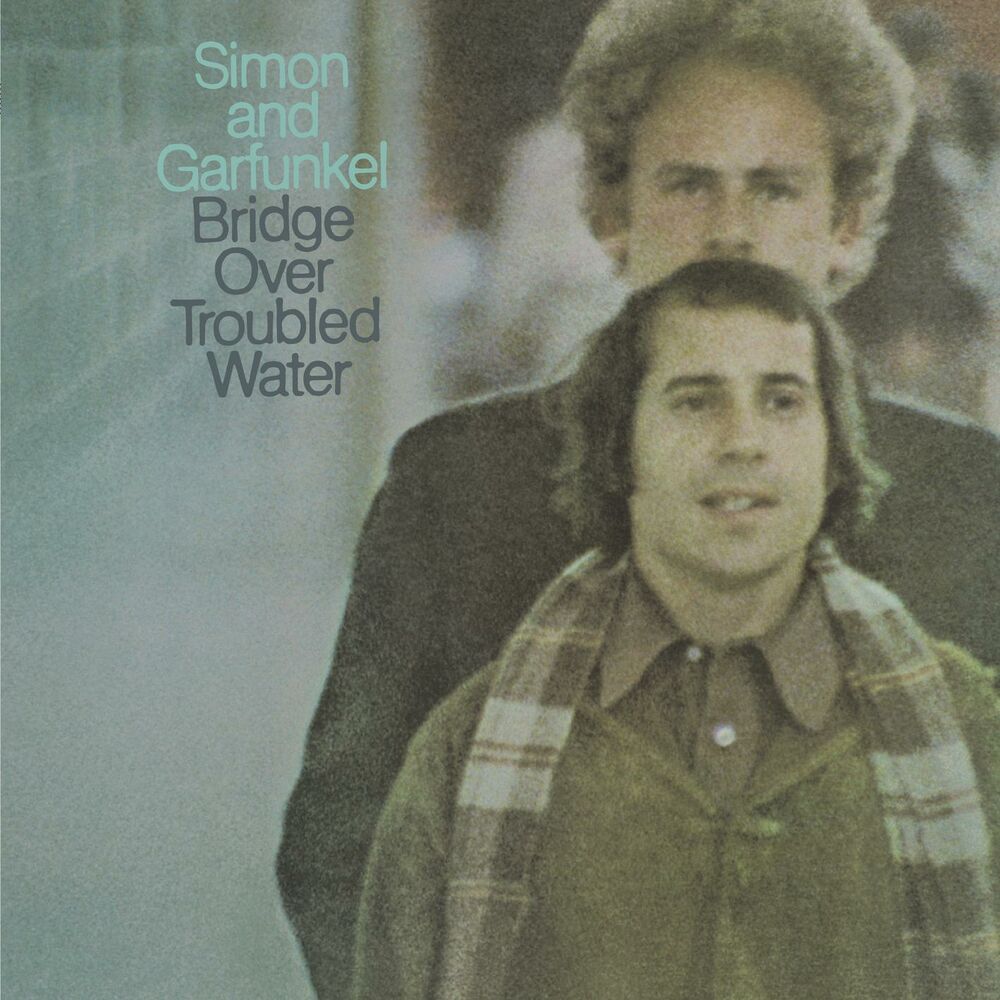
Bridge over Troubled Water
← Back to the lists

Bridge over Troubled Water

Simon and Garfunkel
January 26, 1970
Columbia
11 tracks, 36:49
Rating
–
Not heard yet
110
–Archive
98Critics
0Listeners
Average score 98AOTY 98

Tracklist

  1. Bridge Over Troubled Water4:53
  2. El Condor Pasa (If I Could)3:06
  3. Cecilia2:55
  4. Keep the Customer Satisfied2:35
  5. So Long, Frank Lloyd Wright3:41
  6. The Boxer5:07
  7. Baby Driver3:15
  8. The Only Living Boy in New York3:58
  9. Why Don't You Write Me2:46
  10. Bye Bye Love (Live at Memorial Auditorium, Burlington, VT - October 1968)2:44
  11. Song for the Asking1:49
Listen on

Have you heard it?

Sign in to mark it as listened, rate it and keep notes.

About the artist

Simon & Garfunkel were an American folk-rock duo, one of the best-selling acts of the 1960s. Paul Simon's songwriting and Art Garfunkel's distinctive vocals created a sound that made them among the most popular artists of their decade.

About the album

Bridge over Troubled Water, their fifth and final studio album, blended folk-rock with elements of R&B, gospel, jazz, and pop. Paul Simon wrote most of the songs while Art Garfunkel pursued an acting role, contributing to its ambitious, yet effortless sound.

Why it's rated so high

This album is highly acclaimed, winning six Grammy Awards, including Album of the Year, and selling over 25 million copies worldwide. Retrospective reviews laud its unique sound and delicate texture, securing its place on numerous 'greatest albums' lists.

Career and historical context

This album marked the end of Simon & Garfunkel's recording career, released amidst artistic disagreements and their eventual breakup in 1970. It followed a period of immense success, including the soundtrack for The Graduate and their album Bookends.

Fun facts

  • One finished song, "Cuba Si, Nixon No", was recorded for the album but ultimately excluded.
  • It was the best-selling album in 1970, 1971, and 1972, and at the time, the best-selling album ever.
  • The album remained CBS Records' best-seller until Michael Jackson's Thriller was released in 1982.
  • Art Garfunkel took an acting role in the film Catch-22 during the album's production.
  • The 40th Anniversary Edition included a controversial 1969 TV special, Songs of America.
Written by AI from the album's and artist's Wikipedia articles and the archive's notes. Double-check anything important.

The full story

Bridge over Troubled Water is the fifth and final studio album by the American folk rock duo Simon & Garfunkel. The album was released on January 26, 1970 through Columbia Records. Following the duo's soundtrack for The Graduate, Art Garfunkel took an acting role in the film Catch-22, while Paul Simon worked on the songs, writing all tracks except Felice and Boudleaux Bryant's "Bye Bye Love" (previously a hit for the Everly Brothers). With the help of producer Roy Halee, the album followed a similar musical pattern as their previous album Bookends (1968), partly abandoning their traditional style to incorporate elements of rock, R&B, gospel, jazz, world music, pop and other genres. It was described as their "most effortless record and their most ambitious." After Bridge over Troubled Water was released, several re-releases followed. The album was mixed and released in both stereo and quadraphonic. Columbia Records released a 40th Anniversary Edition on March 8, 2011, which includes two DVDs, including the politically themed TV special Songs of America (1969), the documentary The Harmony Game, additional liner notes and a booklet. Other reissues contain bonus tracks, such as the 2001 version, which covers the demo tapes of "Feuilles-O" and "Bridge over Troubled Water." Contemporary critical reception to Bridge was initially mixed, but retrospective reviews of the album have been laudatory, and it is considered by many to be the duo's best album. Bridge over Troubled Water topped the charts in over ten countries and received six Grammy Awards at the 1971 Grammy Awards, including Album of the Year. The album has sold over 25 million copies worldwide, making it one of the best-selling albums of all time and at the time of its release, the best-selling album ever. It has been ranked on several "greatest" lists, including number 172 on Rolling Stone's list of the "500 Greatest Albums of All Time" in 2020. Despite the accolades, the duo decided to split up, and parted company later in 1970; Garfunkel continued his film career, while Simon worked intensely with music. Both artists released solo albums in the following years. Bridge includes two of the duo's most critically acclaimed and commercially successful songs, "Bridge over Troubled Water" and "The Boxer", which were listed on Rolling Stone's list of the "500 Greatest Songs of All Time."

Background

Simon & Garfunkel were already successful in the music industry. Their Parsley, Sage, Rosemary and Thyme, the soundtrack album for Mike Nichols' film The Graduate and Bookends peaked at number four, one, and one in the US Billboard 200, respectively, with the former selling 3 million copies and the latter two selling 2 million copies each in the United States. Art Garfunkel took the role of Captain Nately in another Nichols film, Catch-22, based on the novel of the same name. Initially Paul Simon was to play the character of Dunbar, but screenwriter Buck Henry felt the film was already crowded with characters and subsequently wrote Simon's part out. The unexpectedly long film production endangered the relationship between the duo; Garfunkel later stated in a 1990 interview with Paul Zollo in SongTalk magazine: "Our way of working was for Paul to write while we recorded. So we'd be in the studio for the better part of two months working on the three or four songs that Paul had written, recording them, and when they were done, we'd knock off for a couple of months while Paul was working on the next group of three or four songs. Then we'd book time and be in the studio again for three or four months, recording those . . . . Rather than wait for Paul to write the next bunch of songs, I went off and did this movie."

Releases

After breaking for Christmas, the duo continued working on the album in early 1970 and finished it in late January. Eleven tracks were featured on this album; one finished song, "Cuba Si, Nixon No", as well as other additional tracks were excluded. Garfunkel did not like this song and proposed instead a chorale, entitled "Feuilles-O", with which Simon disagreed. After a discussion, they decided to not include more tracks. Bridge over Troubled Water charted in over 11 countries, topping the charts in 10 countries, including the US Billboard 200 and the UK Albums Chart. It was the best-selling album in 1970, 1971 and 1972 and was at that time the best-selling album of all time. It remained CBS Records' best-selling album until the release of Michael Jackson's Thriller in 1982. The album topped the Billboard 200 charts for 10 weeks and stayed on the charts for 85 weeks. According to Columbia Records, 1.7 million copies were sold in the first three weeks in the United States. In the United Kingdom, the album topped the charts for 33 weeks, and spent 285 weeks in the top 100, from 1970 to 1975. Furthermore, it received 8× Platinum by the Recording Industry Association of America (RIAA), and 4× Platinum in Canada. Bridge over Troubled Water has since sold 3,163,789 copies in the UK, and over 25 million copies worldwide. The songs "Cuba Si, Nixon No", "Groundhog", and the demo "Feuilles-O" were recorded during sessions but not released on the album. "Cuba Si, Nixon No" was later released on a bootleg recording of a concert of November 11, 1969, by Simon and Garfunkel at Miami University in Oxford, Ohio, while the demo recording of "Feuilles-O" was later released on the Old Friends and The Columbia Studio Recordings (1964–1970) box sets. A remastered and expanded version of the album was released on compact disc in 2001, containing the demo versions of "Feuilles-O" and "Bridge over Troubled Water." It was remastered by Vic Anesini. Garfunkel later recorded "Feuilles-Oh/Do Space Men Pass Dead Souls on Their Way to the Moon?" on his debut solo album Angel Clare, and as the flip-side to his single, "I Shall Sing", from the same album. Columbia Records released a 40th Anniversary Edition on March 8, 2011, comprising three discs. The first disc features the original album and the second disc contains the entirety of Live 1969, which had been released three years earlier as an exclusive at Starbucks. The third disc, a DVD, consisted of the television special Songs of America, which originally aired in 1969 on CBS and unavailable since its original broadcast, and a new documentary The Harmony Game about the making of the album. Songs of America comprised footage of the 1969 tour, intimate backstage conversations, and historic news clips; it had elicited controversy owing to the duo's political comments regarding the Vietnam War and the direction of American society at the time. The Harmony Game featured new 2010 interviews with Simon, Garfunkel, producer Roy Halee, and more principals involved with the making of the album. The 1969 special runs for approximately 52 minutes 37 seconds, while the 2010 documentary runs for approximately 70 minutes 54 seconds. A booklet of liner notes, photos, and essays by critics Michael Hill and Anthony DeCurtis was also included. The album is also included in its entirety as part of the Simon & Garfunkel box sets Collected Works, The Columbia Studio Recordings (1964–1970) and Simon & Garfunkel: The Complete Albums Collection.
Reception and legacy

Bridge over Troubled Water was originally released to a mixed critical response. Writing in Melody Maker in February 1970, Richard Williams identified "a few dull moments" on the album, while adding that "they're worth enduring for the jewels they surround". Williams concluded: "Not, perhaps, another classic like Bookends, but still worth hearing for Simon's constantly surprising timing, and for the way he can make his guitar sound like a small orchestra and the orchestra sound like a big guitar ..." Village Voice critic Robert Christgau was lukewarm about the album in 1970, giving it a "B" grade in his "Consumer Guide" column and notoriously reviewing it with one word: "Melodic". He later expounded on the problematic nature of the record's "smooth, well made" music, writing in Newsday that the album is "often funny and honest. It breathes life. Yet I suspect that its flawless, rather languid loveliness is ultimately soporific". According to Steve Horowitz of PopMatters, contemporary critics compared the album to the Beatles' White Album "in that one can hear the incipient break up of the band in the way they separately perform the material". Among retrospective reviews, Bruce Eder of AllMusic said that Bridge over Troubled Water was "perhaps the most delicately textured album to close out the 1960s from any major rock act", especially in a time of troubles in the United States. Parke Puterbaugh of Rolling Stone assessed the album as "a casually ambitious look back" at both the decade and the duo's musical partnership, which concluded the latter "on an exhilarating note". Author and critic David Browne noted the album's "sonic warmth and richness". Stephen M. Deusner of Pitchfork praised its unique sound, writing that "Bridge sounds like a unified statement enlivened by styles and rhythms not often heard on pop radio at the juncture of [the 1960s and 1970s]." In a 2001 review for Uncut, Ian MacDonald found the album "overproduced and underwritten", adding: "Where Bookends is succinct, dry, and disciplined, Bridge ... is self-satisfied, sentimental, mediocre, and overblown. Even its best song, 'The Boxer', is needlessly inflated and protracted." Writing for MusicHound, Leland Rucker acknowledged that Bridge over Troubled Water "is considered their masterpiece", while noting that he found that "it sounds top-heavy, overproduced, and too precious for its own good." Conversely, Q magazine deemed the album to be Simon & Garfunkel's best and most consistent work, "notable for the strength of its melodies, the force of its lyrics and the Abbey Road-style sophistication of its production". In his book The Encyclopedia of Popular Music, Colin Larkin admires the album as a "celebrated" work that includes a "classic single" ("The Boxer") and a title song that "became a standard with Garfunkel's angelic vocal set perfectly matched to the lush, orchestral arrangement and contrasting tempo". Joe Nolan of American Songwriter notes that "the pair were never more popular or commercially successful than they were with the release of Bridge over Troubled Water". Bridge over Troubled Water won the Grammy Award for Album of the Year, as well as for Best Engineered Recording, while its title track won the Grammys for Record of the Year, Song of the Year, Best Contemporary Song and Best Arrangement Accompanying Vocalist(s) in 1971. Bridge over Troubled Water was nominated at the first Brit Awards for Best International Album and its title track for Best International Single in 1977. In 2000 it was voted number 66 in Colin Larkin's All Time Top 1000 Albums. In 2003, it was ranked at No. 51 on Rolling Stone's 500 Greatest Albums of All Time, maintaining the rating in a 2012 revised list; in a 2020 revision, the album was ranked at No. 172. In December 1993, The Times ranked the album at number 20 on its "The Vultures 100 Best Albums of all Time". The album was also included in the book 1001 Albums You Must Hear Before You Die. Chris Charlesworth, …

From the Wikipedia article Bridge over Troubled Water, available under CC BY-SA 4.0.

Tracklist

  1. Bridge Over Troubled Water4:53
  2. El Condor Pasa (If I Could)3:06
  3. Cecilia2:55
  4. Keep the Customer Satisfied2:35
  5. So Long, Frank Lloyd Wright3:41
  6. The Boxer5:07
  7. Baby Driver3:15
  8. The Only Living Boy in New York3:58
  9. Why Don't You Write Me2:46
  10. Bye Bye Love (Live at Memorial Auditorium, Burlington, VT - October 1968)2:44
  11. Song for the Asking1:49

Listeners 0

Nobody has logged it yet. Be the first.

Log a listen