João's Music Archive
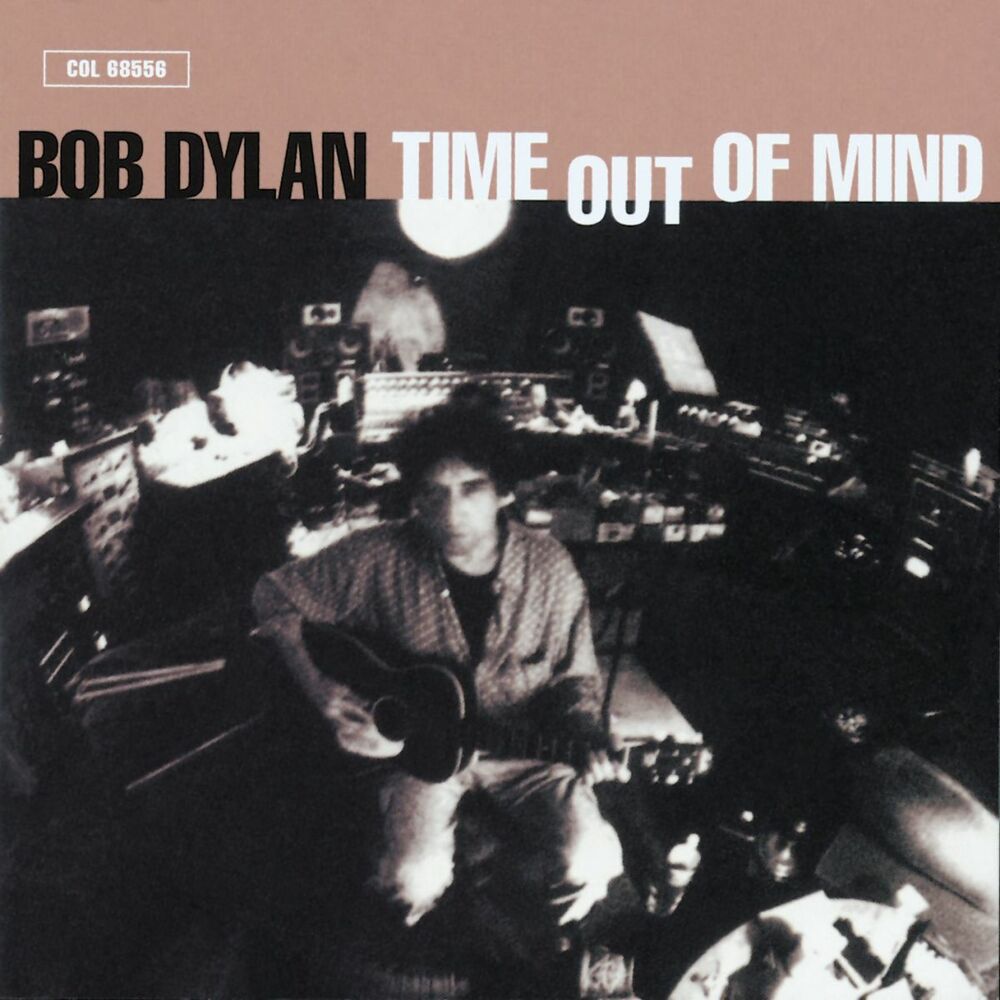
Time Out of Mind
← Back to the lists

Time Out of Mind

Bob Dylan
1997-09-30
Columbia
11 tracks, 1 h 12 min
Rating
–
Not heard yet
110
–Archive
88Critics
0Listeners
Average score 88AOTY 88Pitchfork 9.410 reviews

Tracklist

  1. Love Sick5:20
  2. Dirt Road Blues3:35
  3. Standing in the Doorway7:42
  4. Million Miles5:52
  5. Tryin' to Get to Heaven5:21
  6. 'Til I Fell in Love with You5:15
  7. Not Dark Yet6:28
  8. Cold Irons Bound7:14
  9. Make You Feel My Love3:31
  10. Can't Wait5:46
  11. Highlands16:32
Listen on

Have you heard it?

Sign in to mark it as listened, rate it and keep notes.

About the artist

Bob Dylan is an iconic American singer-songwriter, celebrated as one of the greatest of all time. Hailing from Minnesota, he transformed folk music in the 1960s by infusing it with sophisticated lyrical techniques and intellectual depth, influencing popular culture for decades.

About the album

Time Out of Mind is Bob Dylan's thirtieth studio album, released in 1997, featuring an atmospheric and often dark sound. Produced by Daniel Lanois, it was crafted with innovative microphone techniques, though Dylan later expressed dissatisfaction with the final mix.

Meanings

The album delves into themes of mortality and aging, described by some as a "nearness-of-death" record, yet it also contains moments of wicked glee. Its lyrics evoke an archaic, dreamlike mood, seemingly bypassing the twentieth century with its imagery.

Why it's rated so high

Time Out of Mind is highly acclaimed, winning three Grammy Awards, including Album of the Year, and is considered a major artistic comeback for Dylan. Critics praised its superb songs and transformative quality, with Elvis Costello calling it "fantastic". It is consistently ranked among the greatest albums of all time.

Career and historical context

This album marked a significant artistic comeback for Dylan after a period where he struggled with his musical identity in the 1980s, having not released original material since 1990. It revitalised his career and positioned him as a wise, wizened visionary.

Fun facts

  • It was Dylan's first double studio album on vinyl since The Basement Tapes in 1975.
  • Dylan recommended producer Daniel Lanois listen to early blues musicians like Charley Patton for inspiration.
  • During recording, Dylan and Lanois would discuss ideas in a Miami parking lot, sometimes sitting on a truck fender.
  • Dylan became seriously ill with histoplasmosis shortly after completing the album, leading to tour cancellations.
  • At the 1998 Grammys, a performance artist with "Soy Bomb" painted on his chest danced next to Dylan onstage.
Written by AI from the album's and artist's Wikipedia articles and the archive's notes. Double-check anything important.

The full story

Time Out of Mind is the thirtieth studio album by American singer-songwriter Bob Dylan, released on September 30, 1997, through Columbia Records. It was released as a single CD as well as a double studio album on vinyl, his first since The Basement Tapes in 1975. For many fans and critics, the album marked Dylan's artistic comeback after he appeared to struggle with his musical identity throughout the 1980s; he had not released any original material since the poorly received Under the Red Sky in 1990. Time Out of Mind is one of Dylan's most acclaimed albums, and it went on to win three Grammy Awards, including Album of the Year in 1998. It was also ranked number 410 on Rolling Stone's 500 Greatest Albums of All Time in 2012. The album has an atmospheric sound, the work of producer (and past Dylan collaborator) Daniel Lanois, whose innovative work with carefully placed microphones and strategic mixing was detailed by Dylan in his memoir, Chronicles: Volume One. Although Dylan has spoken positively of Lanois' production style, he expressed dissatisfaction with the sound of Time Out of Mind. Dylan has self-produced his subsequent albums.

Background and writing

In April 1991, Dylan told interviewer Paul Zollo that "there was a time when the songs would come three or four at the same time, but those days are long gone...Once in a while, the odd song will come to me like a bulldog at the garden gate and demand to be written. But most of them are rejected out of my mind right away. You get caught up in wondering if anyone really needs to hear it. Maybe a person gets to the point where they have written enough songs. Let someone else write them". Dylan's last album of original material had been 1990's Under the Red Sky, a critical and commercial disappointment. Since then, he had released two albums of folk covers, Good as I Been to You and World Gone Wrong, and MTV Unplugged, a live album of older compositions; there had been no signs of any fresh compositions until 1996. Dylan began to write a fresh string of songs during the winter of 1996 at his farm in Minnesota, which would later make up Time Out of Mind. Criteria Studio in Miami, Florida was booked for recording. In a televised interview with Charlie Rose, Lanois recalled Dylan talking about spending many late nights working on the lyrics. Once the words were completed, according to Lanois, Dylan considered the record to be finished saying, "You know, whatever we decide to do with it, that's that." Lanois replied: "What's important is that it's written".

Recording sessions

Dylan demoed some of the songs in the studio, something he rarely did. Members of Dylan's touring band were involved in these sessions. Dylan also used these loose, informal sessions to experiment with new ideas and arrangements. Dylan continued rewriting lyrics until January 1997, when the official album sessions began. It was the second collaboration between Dylan and Lanois, who had previously produced Dylan's 1989 release Oh Mercy and was known for his work with artists such as Emmylou Harris (on Wrecking Ball) and U2 (on The Joshua Tree and Achtung Baby). Dylan wanted the sound of Time Out of Mind to be influenced by early blues musicians, such as Charley Patton, Little Walter, and Little Willie John, and he recommended that Lanois listen to their recordings to prepare for the sessions. New personnel hired for the album included slide guitarist Cindy Cashdollar and drummer Brian Blade, both hired by Lanois. Dylan brought in Jim Keltner, who was Dylan's tour drummer from 1979 to 1981. Dylan also hired Nashville guitarist Bob Britt, Duke Robillard, Tex-Mex organist Augie Meyers, and Memphis pianist Jim Dickinson to play at the sessions. According to Lanois, Dylan likes old 1950s records since "they had a natural depth of field which was not the result of a mixing technique". He used a Sony C37A microphone, which was also used to record Dylan's album Oh Mercy. Various other devices were used to produce the album's distinctive sound. Lanois also devised a method to accommodate new or revised lyrics later in an original take, since this was often the case with Dylan. With two different sets of players competing in performance and two producers with conflicting views on how to approach each song, the sessions were far from disciplined. Years later, when asked about Time Out of Mind, Dickinson replied, "I haven't been able to tell what's actually happening. I know they were listening to playbacks, I don't know whether they were trying to mix it or not! Twelve musicians playing live—three sets of drums,... it was unbelievable—two pedal steels, I've never even heard two pedal steels played at the same time before! ... I don't know man, I thought that much was overdoing it, quite frankly". Lanois admitted some difficulty in producing Dylan. "Well, you just never know what you're going to get. He's an eccentric man..." In a later interview, Lanois said Dylan and he used to go to the parking lot to discuss the recording in absence of the band. Lanois elaborated their discussion on the song "Standing in the Doorway". "I said 'listen, I love "Sad Eyed Lady of the Lowlands". Can we steal that feel for this song?' And he'd say 'you think that'd work?' Then we'd sit on the fender of a truck, in this parking lot in Miami, and I'd often think, if people see this they won't believe it!" With Time Out of Mind, Lanois "produced perhaps the most artificial-sounding album in [Dylan]'s canon," says author Clinton Heylin, who described the album as sounding "like a Lanois CV".

Dylan talked about his difficulty at the recording sessions in an interview with Guitar World magazine. "I lose my inspiration in the studio real easy, and it's very difficult for me to think that I'm going to eclipse anything I've ever done before. I get bored easily, and my mission, which starts out wide, becomes very dim after a few failed takes and this and that." In the same interview Dylan cited Buddy Holly as an influence during the recording sessions. In relation to past works like Highway 61 Revisited, Blood on the Tracks, and Infidels, Dylan said:

Those records were made a long time ago, and you know, truthfully, records that were made in that day and age all were good. They all had some magic to them because the technology didn't go beyond what the artist was doing. It was a lot easier to get excellence back in those days on a record than it is now.....The high priority is technology now. It's not the artist or the art. It's the technology that is coming …

Reception

Commercial reception

Time Out of Mind was a commercial success for Dylan. It was widely hailed as Dylan's comeback album and U.S. sales soon passed platinum and stayed on best-selling charts for 29 weeks. In UK the sales passed gold. The album, in other countries also, managed to secure positions on best-selling charts and remained there for several weeks. Again the album's highest chart position worldwide was in Norway, where it peaked at No. 2.

Critical reception

Time Out of Mind received mostly positive reviews and began a renaissance of Dylan's career. In a 2018 retrospective for Pitchfork, Grayson Haver Currin wrote that the album "would transform Dylan from seemingly obsolete icon to wise, wizened visionary almost overnight". In his review for The Village Voice, Robert Christgau said, "The hooks are Dylan's spectral vocals—just his latest ventriloquist's trick, a new take on ancient, yet so real, so ordained—and a band whose quietude evokes the sleepy postjunk funk of Clapton's 461 Ocean Boulevard without the nearness of sex". He later regarded it as "one of those nearness-of-death albums", along with Mississippi John Hurt's Last Sessions (1972), Warren Zevon's The Wind (2003), Neil Young's Prairie Wind (2005), and Johnny Cash's American VI: Ain't No Grave (2010). On the NY Rock website, Cook Young called the songs "superb". He described Time Out of Mind as "a curious album. It's sort of two records mixed together. Half the songs compare to the introspective plaintive compositions that we witnessed on Blood on the Tracks. The other half are 12-bar blues ditties that often sound as if Bob is making 'em up as he goes". "Time Out of Mind is fantastic", said Elvis Costello. "I think it might be the best record he's made". Some critics criticized Lanois's production for, as Currin wrote, "warping Dylan’s voice too much, for burying it in a cloud of effects". AllMusic senior editor Stephen Thomas Erlewine wrote, "Time Out of Mind has a grittier foundation—by and large, the songs are bitter and resigned, and Dylan gives them appropriately anguished performances. Lanois bathes them in hazy, ominous sounds, which may suit the spirit of the lyrics, but are often in opposition to Dylan's performances". Michael Gray writes, "The sound is elsewhere unhelpful too on Time Out of Mind. Some tracks have Dylan so buried in echo that there is no hope of hearing the detailing in his voice that was once so central and diamondlike a part of his genius".

Alex Ross wrote:Everything on Time Out of Mind goes under one dreamy, archaic mood. The album manages to skip the twentieth century: trains discourage gambling, people ride in buggies, there's no air-conditioning ("It's too hot to sleep"), church bells ring, "gay" means happy, the time of day is measured by the sun, lamps apparently run on gas (and are turned "down low") and, most of the time, the singer is walking. He is almost ready to stray into the rustic wasteland of Schubert's Winterreise, which opens with the Dylanesque lines "I came here a stranger/ A stranger I depart." The wistfulness is intense....The melancholy could become crushing, but Dylan doesn't let it. The best songs on Time Out of Mind are inexplicably funny; there's a wicked glee in the performance as Dylan manipulates the tatters of his voice, the scatterdness of his inspiration, the paralysis that might arise from his obsession with history, the prevailing image of himself as a mumbling curmudgeon.

Aftermath and legacy

Shortly after completing the album, Dylan became seriously ill with near-fatal histoplasmosis. His forthcoming tour was canceled, and he spent most of June 1997 in excruciating pain. A potentially serious condition (caused by the fungal infection Histoplasma capsulatum), it makes breathing very difficult. "It was something called histoplasmosis that came from just accidentally inhaling a bunch of stuff that was out on one of the rivers by where I live", said Dylan. "Maybe one month, or two to three days out of the year, the banks around the river get all mucky, and then the wind blows and a bunch of swirling mess is in the air. I happened to inhale a bunch of that. That's what made me sick. It went into my heart area, but it wasn't anything really attacking my heart", Dylan told Guitar World magazine. In light of Dylan's May 1997 health scare, a number of columnists, including Dylanologist A. J. Weberman, speculated that the songs on Time Out of Mind were inspired by an increased awareness of his own mortality. This was despite the fact that all of the songs were completed, recorded, and even mixed before he was hospitalized. In interviews following its release, Dylan dismissed these speculations.

Beside being ranked as number 410 on Rolling Stone magazine's list of the 500 greatest albums of all time, in both Pazz & Jop's critics poll and Uncut magazine, Time Out of Mind was voted as album of the year. The album was also included in the book 1001 Albums You Must Hear Before You Die. It was voted number 652 in the third edition of Colin Larkin's All Time Top 1000 Albums (2000). At least two artists have covered Time Out of Mind in its entirety: guitarist Stephen Michael (recording under the name "Georgia Sam") and Arve-Gunnar Heløy, who not only recorded every track but translated all of the lyrics into Norwegian. Hip hop group Public Enemy referenced the album's title in their 2007 Dylan tribute song "Long and Whining Road": "From basement tapes, beyond them dollars and cents / Changing of the guards spent, now where the hell the majors went? / Most of their time out of mind, hating my mess-age rhymes". A 2021 Irish Times article ranking all 39 of Dylan's studio albums placed Time Out of Mind first. The National's Aaron Dessner has cited it as his favorite Dylan album.

40th Grammy Awards

At the 1998 Grammy Awards, Time Out of Mind won in the categories of Album of the Year, Best Contemporary Folk Album and, for "Cold Irons Bound", Best Male Rock Vocal Performance. At the awards ceremony, Dylan performed the song "Love Sick". During the performance, Michael Portnoy, an American multimedia artist and choreographer, ripped off his shirt, ran up next to Dylan, and started dancing and contorting with the words "Soy Bomb" painted in black across his chest. Dylan shot an alarmed glance at Portnoy, but carried on playing. Portnoy continued to dance for about 40 seconds, until another of the background dancers escorted him off stage.

From the Wikipedia article Time Out of Mind (Bob Dylan album), available under CC BY-SA 4.0.

Tracklist

  1. Love Sick5:20
  2. Dirt Road Blues3:35
  3. Standing in the Doorway7:42
  4. Million Miles5:52
  5. Tryin' to Get to Heaven5:21
  6. 'Til I Fell in Love with You5:15
  7. Not Dark Yet6:28
  8. Cold Irons Bound7:14
  9. Make You Feel My Love3:31
  10. Can't Wait5:46
  11. Highlands16:32

Listeners 0

Nobody has logged it yet. Be the first.

Log a listen