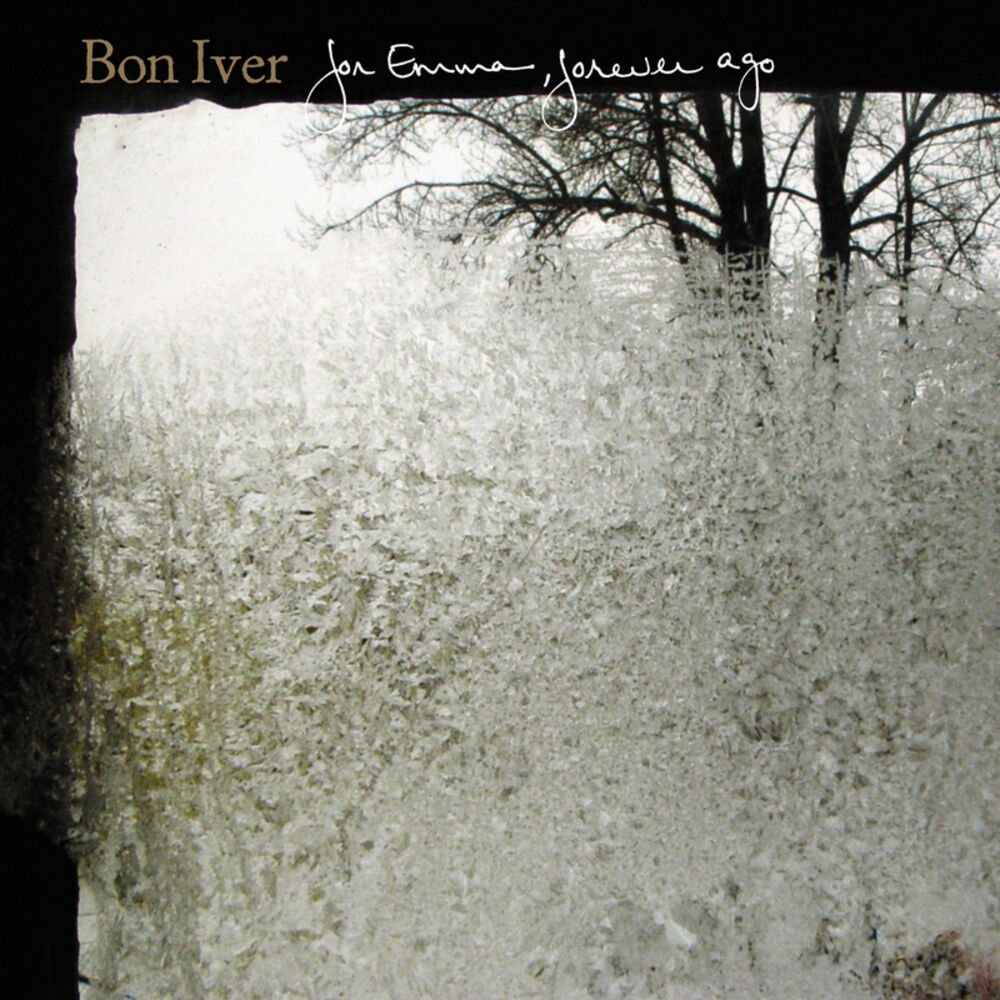
Vernon drove to his father's hunting cabin, roughly an hour's drive northwest of his hometown. He and his father had often spent weekends at the 80-acre rural property—an area they dubbed "the land"—when he was growing up. In an interview, he described it as "a little Alpine style, timber-frame cabin." The cabin was not necessarily ramshackle; his father had replaced its dirt floor and installed plumbing years before. For roughly three weeks, Vernon sat alone in the shack, drinking beer and watching television. He mulled over thoughts about his relationship with Jensen, a break-up he had struggled to get over. He hunted his food, a practice that he had learned from his father. He killed two deer in his period at the property, which lasted the entire three months "and then some," according to Vernon. At one point, he faced a wild bear that entered the cabin late one night, enticed by his stew. His father would drop by "every 10 days or so," supplying his son with beer, eggs, and cheese. Vernon completed tasks for him, such as stripping wood, clearing brush, and stacking lumber. He did not intend to stay for long, viewing the excursion as "an opportunity to escape the trap of society, to not pay bills, to play music and live really cheaply." Instead, he stayed for three months in the harsh Wisconsin winter.
After three weeks, Vernon grew tired of his "self-indulgent, lazy behavior" and began forming song ideas. He had an idea for a song and brought inside his musical equipment, which consisted of several guitars, microphones, and a Power Mac G4 with Pro Tools LE. Shortly before exiting Raleigh, he had developed song ideas but ceased working on them in his depression. He began recording songs and layering his vocals atop more vocals, imitating a choir. He sang in falsetto, which he had first tried with his previous band. He gained freedom in singing in a higher register, feeling he accessed "painful melodies" unattainable in his previous work. He further manipulated his recorded vocals using the software Auto-Tune. Soon, he began developing more songs, which were worked on in 12-hour "bursts" of productivity. "I would work for 14 hours a day and start to feel a little insane," he later commented. The work was "labor-intensive," as he often merged eight or more tracks of vocals on each song. He likened the singularity of the process to his teenage years, where he worked alone with an eight-track. According to Vernon, days were hazy and began to run together for him. He would wake each morning at sunrise, due to the light reflecting from the snow. To help repair his 1964 Sears Silvertone guitar, he traded venison in the nearby town. By February, with winter drawing to a close, Vernon emerged from the cabin with nine songs. He left still feeling physically sick from the infection, and did not feel "renewed" from his creative catharsis. Before heading back to Raleigh, he broke out some whiskey with a couple friends and put the finishing touches on the record, recording brass on "For Emma."
While stories of the "cabin" would become oft-repeated and mythologized, Vernon never viewed it that way: "It's sort of odd to look back and see it as magical, because it felt like a lonely few months at the cabin, where I plugged in the laptop and fucked around." Rolling Stone's Josh Eells later summarized its romanticized story as "part Into the Wild, part Basement Tapes, part Walden, part Unabomber." Vernon later viewed the album as a victory for his mental health, a metaphor for taking "personal steps" to improve his life. He characterized his growth as a "small internal dialogue between me and the microphone." The album's title comes from Jensen's middle name, though he refrained from confirming that she was the central inspiration behind the album. He felt the titular "Emma" was evocative of "a statement, a sentiment and a closing of my own history." He went more in-depth in a later remark: "Emma isn't a person. Emma is a place that you …