Sign in to mark it as listened, rate it and keep notes.
About the artist
Crosby, Stills & Nash was a folk rock supergroup formed in 1968, featuring David Crosby, Stephen Stills, and Graham Nash from prominent bands. They are known for their intricate vocal harmonies, political activism, and lasting influence on American music. The trio was inducted into the Rock and Roll Hall of Fame in 1997.
About the album
This 1969 debut album blended folk, country, and rock, defining a "California sound" with poetic lyrics and intricate harmonies. Stephen Stills largely shaped its sound, playing most instruments, while David Crosby and Graham Nash contributed their distinct songwriting. It produced hit singles like "Suite: Judy Blue Eyes" and "Marrakesh Express."
Meanings
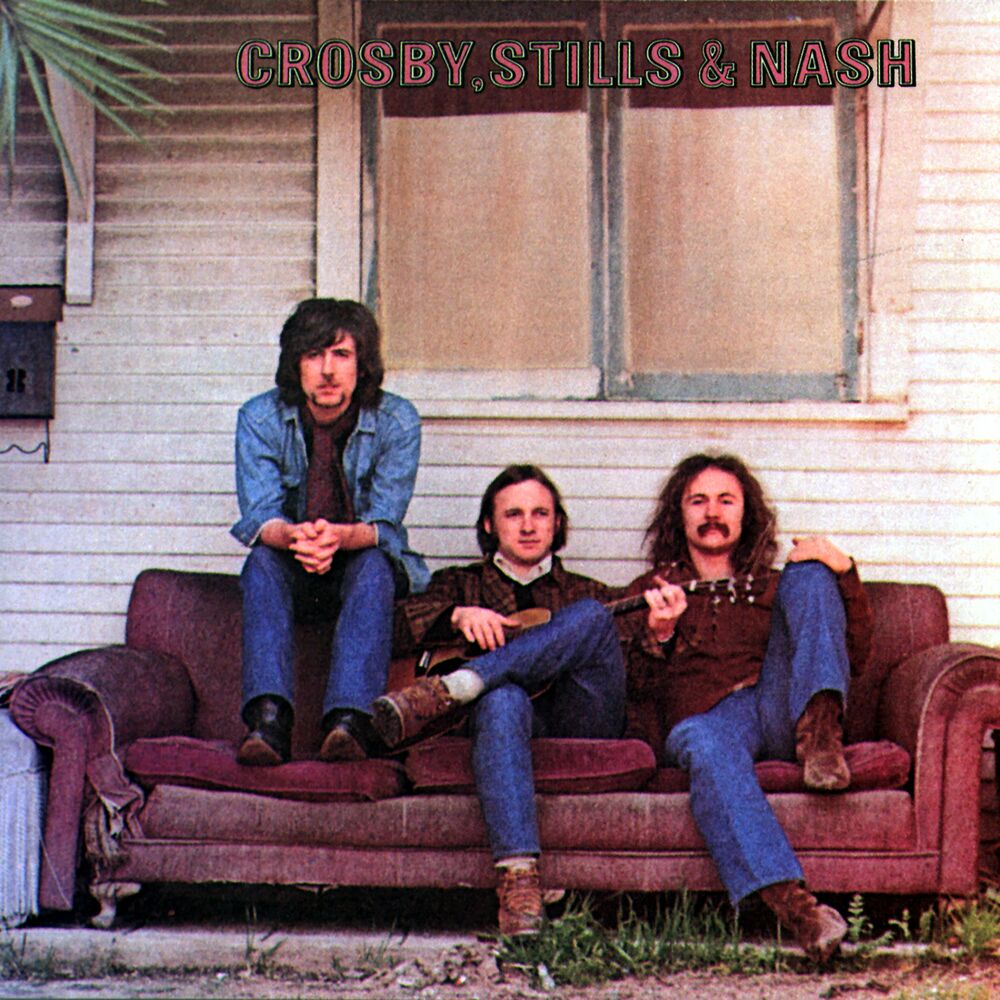
The album's poetic lyrics explore relationships and contemporary social and political issues, pioneering a style of personal confession in songwriting. Its iconic cover features the band members in reverse order of their name, taken at an abandoned house before the group was officially named. They couldn't reshoot as the house was later demolished.
Why it's rated so high
Critics praised its exceptional songwriting and vocal harmonies, with Rolling Stone calling it "an eminently playable record." It achieved four-times platinum status and was inducted into the Grammy Hall of Fame in 1999. The album's success significantly influenced the singer-songwriter movement and the "California sound" of the 1970s.
Career and historical context
This album was released in 1969, shortly after the trio formed from the ashes of their previous successful bands. It was their only release before Neil Young joined, and they performed songs from it at the legendary Woodstock festival that August. Its success led to the signing of similar acts by their management team.
Fun facts
Stephen Stills played all the bass, organ, and lead guitar parts on most tracks.
The album cover photo was taken before the band decided on their name.
Drummer Dallas Taylor appears looking through a window on the original rear sleeve.
The album was voted number 83 in Colin Larkin's All Time Top 1000 Albums.
Jefferson Airplane's Paul Kantner was later credited as co-composer for "Wooden Ships."
Written by AI from the album's and artist's Wikipedia articles and the archive's notes. Double-check anything important.
The full story
Crosby, Stills & Nash is the debut studio album by the folk rock supergroup Crosby, Stills & Nash (CSN), released on May 29, 1969, by Atlantic Records. It is the only release by the band prior to adding Neil Young to their lineup. The album spawned two Top 40 singles, "Marrakesh Express" and "Suite: Judy Blue Eyes", which peaked respectively at No. 28 during the week of August 23, 1969, and at No. 21 during the week of December 6, 1969, on the US Billboard Hot 100. The album itself peaked at No. 6 on the US Billboard Top Pop Albums chart. It has been certified four times platinum by the RIAA for sales of 4 million.
The album has been issued on compact disc three times, mastered first by Barry Diament at Atlantic Studios in the mid-1980s; and remastered by Joe Gastwirt at Ocean View Digital and reissued on August 16, 1994. The album was reissued again by Rhino Records in an expanded edition using the HDCD process on January 24, 2006. On December 6, 2011, a Gold Compact Disc edition of the album was released on the Audio Fidelity label.
Background and recording
Stills dominated the recording of the album. Crosby and Nash played guitar on their own songs, while drummer Dallas Taylor played on most tracks (session drummer Jim Gordon performed in his stead on "Marrakesh Express"). Stills played all the bass, organ, and lead guitar parts, as well as acoustic guitar on his own songs. "The other guys won't be offended when I say that one was my baby, and I kind of had the tracks in my head," Stills said. Even with this dominance, Stills does not appear on the tracks "Guinnevere" and "Lady of the Island", both featuring Crosby and Nash only and a precursor to their partnership on record and stage during the 1970s.
David Crosby bristled over the plan for "Long Time Gone" as he thought he should at least play rhythm guitar on his own song. Stills persuaded him to go home for a while and when he returned Crosby was won over by the music track that Stills and Taylor had recorded. In a more recent interview, Crosby contradicted his earlier statement, stating that he had played guitar on the track. He is so credited in the liner notes to the 1991 box set.
The group performed songs from the album at the Woodstock festival in August 1969. In late 1969 the group appeared with Neil Young on the Tom Jones' TV show and performed "Long Time Gone" with Tom Jones sharing vocals.
Composition and music
"In many ways, the album helped define the California sound," Matt Friedlander wrote. "The songs blended folk, country and rock influences and featured poetic lyrics about relationships and then-current social and political issues." Crosby, Stills & Nash combined the musicians' voices and other strengths; David Crosby's social commentary and atmospheric mood pieces, Stephen Stills' diverse musical skills and capacity to fold folk and country elements subtly into complex rock structures, and Graham Nash's radio-friendly pop melodies. The album features some of their best known songs, including "Helplessly Hoping", "Long Time Gone", "Suite: Judy Blue Eyes", and "Wooden Ships", a collaboration between Crosby and Stills as well as Paul Kantner of Jefferson Airplane.
Artwork
On the album cover the members appear from left to right as Nash, Stills, and Crosby, the inverse of the roll call in the album's title. The photo was taken by their friend and photographer Henry Diltz before they came up with a name for the group. They found an abandoned house with an old battered sofa outside, located at 815 Palm Avenue, West Hollywood, that they thought would be a perfect fit for their image. A few days later the band decided on the name "Crosby, Stills, and Nash". To prevent confusion, they went back to the house a day or so later to re-shoot the cover in the correct order, but when they got there they found the house had been demolished.
Dallas Taylor appears looking through the window of the door on the rear of the sleeve. In the expanded edition, however, he is absent. The original vinyl LP was released in a gatefold sleeve that depicted the band members in large fur parkas with a sunset in the background on the gatefold (shot in Big Bear, California). A long folded page inside displayed the album credits, lyrics, track listing, and a quasi-psychedelic pencil drawing.
Critical reception
In a contemporary review, Rolling Stone critic Barry Franklin called Crosby, Stills & Nash "an eminently playable record" and "especially satisfying work", finding the songwriting and vocal harmonies particularly exceptional. Robert Christgau was less enthusiastic in The New York Times, writing that "[Crosby, Stills & Nash] is as perfect as has been expected. But it also demonstrates the dangers of perfection: the wildness that should liberate great rock is so well-controlled that when it appears (as on Nash's excellent 'Pre-Road Downs') it seems to have been inserted just to prove the music is rock: the only exception is Crosby's wailing vocal on 'Long Time Gone.'" In his capsule-review column for The Village Voice, he jokingly said the vocal saves the album from "a special castrati award".
In a retrospective review, Jason Ankeny of AllMusic believed some of the songs' themes "haven't dated well" but "the harmonies are absolutely timeless, and the best material remains rock-solid". In 2003, Rolling Stone ranked Crosby, Stills & Nash number 259 on their list of The 500 Greatest Albums of All Time, then was re-ranked 262nd in 2012. It was voted number 83 in Colin Larkin's All Time Top 1000 Albums 3rd Edition (2000).
Jefferson Airplane guitarist Paul Kantner was finally credited as co-composer of "Wooden Ships" on the expanded edition reissue, something long acknowledged on his group's version of the song from their Volunteers album, released the same year. David Crosby singing an excerpt of "Come On in My Kitchen" between "Long Time Gone" and "49 Bye-Byes" was left off the 2006 expanded reissue at the request of the late Robert Johnson's estate.
Legacy
The album proved very influential on many levels to the dominant popular music scene in America for much of the 1970s. The success of the album generated respect for the group within the industry and galvanized interest in signing similar acts, many of whom came under management and representation by the CSN team of Elliot Roberts and David Geffen. Strong sales, combined with the group's emphasis on personal confession in its writing, paved the way for the success of the singer-songwriter movement of the early 1970s. Their use of personal events in their material without resorting to subterfuge, their talents in vocal harmony, their cultivation of painstaking studio craft, as well as the Laurel Canyon ethos that surrounded the group and their associates, established an aesthetic for a number of acts that came to define the "California sound" of the ensuing decade, including Eagles, Jackson Browne, post-1974 Fleetwood Mac, and others.
In the album's liner notes, Crosby is quoted by music critic David Wild, saying: "For whatever reasons, I think you get very few records like that [in] life, which you can put on 20 years later and they still hold up. To this day, that first album comes on, and you don't want to take it off or skip a tune. That's the ultimate test. You just want to let it run. You might even want to turn it up."
In 1999, the album Crosby, Stills & Nash was inducted into the Grammy Hall of Fame.