João's Music Archive
Urban Hymns
← Back to the lists

Urban Hymns

The Verve
September 29, 1997
Umc
25 tracks, 2 h 25 min
Special pressing
Green, 180g
Rating
–
Not heard yet
110
–Archive
83Critics
0Listeners
Average score 83AOTY 85Pitchfork 8.910 reviews

Tracklist

  1. Bitter Sweet Symphony (Remastered 2016)5:57
  2. Sonnet4:22
  3. The Rolling People7:02
  4. The Drugs Don't Work5:05
  5. Catching The Butterfly6:26
  6. Neon Wilderness2:38
  7. Space And Time5:37
  8. Weeping Willow4:50
  9. Lucky Man4:53
  10. One Day5:03
  11. This Time3:51
  12. Velvet Morning4:57
  13. Come On / Deep Freeze (Hidden Track)15:15
  14. This Is Music (Live)3:59
  15. Space And Time (Live)6:00
  16. Catching The Butterfly (Live)6:28
  17. Sonnet (Live)4:33
  18. The Rolling People (Live)6:04
  19. Weeping Willow (Live)4:37
  20. The Drugs Don't Work (Live)6:00
  21. Lucky Man (Live)5:30
  22. Life's An Ocean (Live)6:49
  23. Velvet Morning (Live)6:00
  24. Bitter Sweet Symphony (Live)10:07
  25. A New Decade (Live)3:45
Listen on

Have you heard it?

Sign in to mark it as listened, rate it and keep notes.

About the artist

The Verve were an English rock band formed in Wigan in 1990, known for their psychedelic and shoegaze beginnings before achieving commercial breakthrough with Urban Hymns. They endured numerous internal conflicts, break-ups, and legal issues, but became celebrated for hits like "Bitter Sweet Symphony" and "The Drugs Don't Work". The band won two Brit Awards and a Grammy nomination during their peak.

About the album

Urban Hymns is The Verve's third studio album, released in 1997, blending Britpop, neo-psychedelia, and orchestral rock. It was crafted after a band break-up, with frontman Richard Ashcroft developing demos and later inviting guitarist Nick McCabe back to re-record tracks. The album is noted for its mature sound, merging classic pop sensibilities with contemporary rock.

Meanings

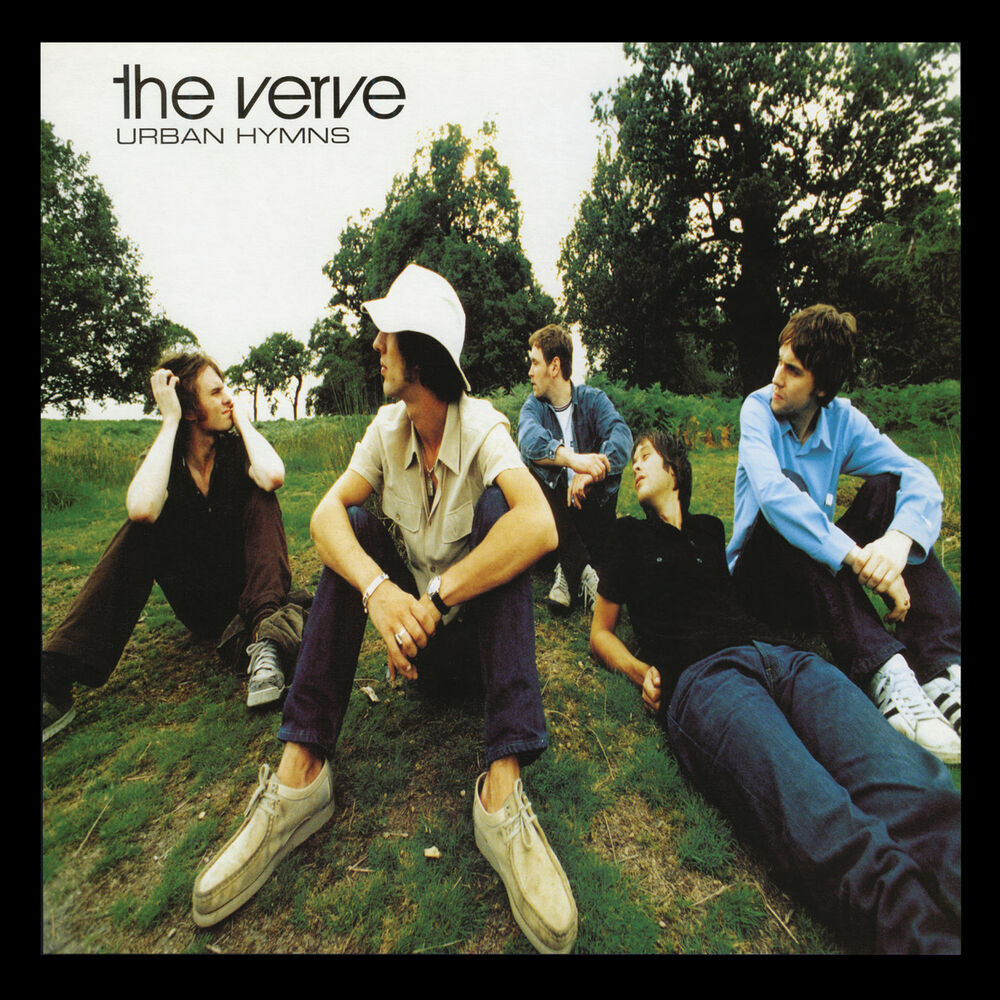
The album's title, Urban Hymns, was chosen early by Richard Ashcroft, reflecting its grand scope. Lyrically, Ashcroft became more open, moving away from abstract imagery to tackle themes of depression and finding positivity in dark times. The cover, a spontaneous group shot in Richmond Park, features the band relaxing, with Ashcroft's dog appearing in the inner sleeve.

Why it's rated so high

Urban Hymns received widespread critical praise, with many highlighting Richard Ashcroft's role and the album's overall quality and maturity. It became one of the best-selling albums in UK history, peaking at number one in several countries and selling 250,000 copies in its first week. Its influence is evident in its high ranking on "The Highest Rated Albums of All Time".

Career and historical context

This album marked The Verve's commercial peak, following a turbulent period of break-ups and line-up changes, including the temporary departure of guitarist Nick McCabe. It arrived as Britpop's popularity began to wane, with electronica gaining prominence, yet the album's success defied these trends. It cemented their place in music history, leading to Brit Awards and a Grammy nomination.

Fun facts

  • Richard Ashcroft initially planned to release the album as a solo effort or under a different band name.
  • Former Suede guitarist Bernard Butler jammed with the band for a week but departed due to creative differences.
  • The recording tapes were initially labelled "Richard Ashcroft" by the frontman.
  • The string arrangement for "Bitter Sweet Symphony" was created with two separate versions.
  • Ashcroft's black Labrador Retriever, Charlie, is featured in the album's inner sleeve artwork.
Written by AI from the album's and artist's Wikipedia articles and the archive's notes. Double-check anything important.

The full story

Urban Hymns is the third studio album by English rock band the Verve, released on 29 September 1997 on Hut Records. The group had broken up while promoting A Northern Soul in August 1995, though they reformed two weeks later without guitarist Nick McCabe. Frontman Richard Ashcroft moved to Bath, Somerset, where he made demos; Simon Tong joined the group soon afterwards. Following aborted recording sessions with producers John Leckie and Owen Morris, the band sought a new guitarist, contacting former Suede guitarist Bernard Butler, who played with them for a week before departing amidst creative differences. In 1996, the Verve started recording at Olympic Studios in London, first with producer Martin "Youth" Glover, followed by engineer Chris Potter. Ashcroft contacted McCabe in early 1997, inviting him back into the band, which McCabe accepted. Several songs were re-recorded to allow for the inclusion of McCabe's guitar parts, with sessions continuing into May 1997. "Bitter Sweet Symphony" was released as the lead single from Urban Hymns in June 1997; the track suffered from a debate over its writing credits due to its use of a sample of the Rolling Stones. "The Drugs Don't Work" followed as the second single from the album in September 1997, which was promoted with three supporting dates for Oasis in London. "Lucky Man" appeared as the third single from the album in November 1997. Nike, Inc. used "Bitter Sweet Symphony" in an advertisement for three months, which in turn helped promote Urban Hymns. "Sonnet" was released as the fourth single from the album in March 1998. The Verve played a hometown show at the Haigh Hall in Wigan to an audience of 40,000 in May 1998. The following month, "The Rolling People" was issued as the fifth and final single from the album as a US radio-only release. Citing stress, McCabe sat out of further touring commitments and was replaced by B. J. Cole. They went on a US tour in July and August 1998, leading up to a show at Slane Castle in Co. Meath, near Dublin, Ireland, before breaking up. Urban Hymns received widespread praise from music critics, many of whom praised Ashcroft's role in making the album; several saw it in the context of Britpop; and others touched on the overall quality of the writing. Retrospective reviews focused on how the Verve mixed their new sound with their old sound and on McCabe's role in the album. It peaked at number one in Ireland, New Zealand, Sweden, and the UK and reached the top 10 in Australia, Austria, Finland, France, Italy, Norway, and Portugal. Initially selling 250,000 copies in its first week of release, Urban Hymns went on to become the fifth fastest-selling album in the UK and has been certified 11-times platinum in the UK by the British Phonographic Industry (BPI). The album's first three singles peaked within the top ten of the UK Singles Chart, with "The Drugs Don't Work" peaking the highest at number one. The BPI have subsequently certified the album's songs: "Bitter …

Background

The Verve released their second studio album, A Northern Soul, in July 1995 through Hut Records, peaking at number 13 in the UK Albums Chart. Its three singles – "This Is Music", "On Your Own", and "History" – all charted within the top 40 of the UK Singles Chart, with "History" reaching the highest at number 24. In the lead-up to the album, the culture of the 1990s had shifted with the emergence of new lad and Loaded magazine, as well as the continual evolution of football culture and Britpop becoming a mainstream movement. Initial promotion consisted of a one-off show in Newcastle, a supporting slot for Oasis in Scotland, a performance at Phoenix Festival, and a US tour. The strained relationships between the band members came to a head when they performed at T in the Park in August 1995; at its conclusion, frontman Richard Ashcroft announced his departure from the band. Bassist Simon Jones saw the situation as an argument rather than a breakup, though the event was reported in press outlets as the latter. When the departure was made public, the press could not reach Ashcroft as he was on a camping trip in Cornwall. Unlike the other members of the Verve, Ashcroft was not concerned about his future career path. Being known as the main songwriter in the band, he was seen as a viable option by Hut. Ashcroft's reputation for offering soundbites to publications appealed to even people who had no interest in the Verve, giving the label an ideal starting point for a solo career. Following the breakup, Ashcroft spent time in hotels, at friends' residences, and at his mother's home. Co-manager Jane Savage said Ashcroft showed up at the offices of their PR company, Savage & Best, saying that he was going to work with different people and at one point planned to form a six-person band. Within two weeks of the split, Ashcroft started collaborating with Jones and drummer Peter Salisbury again. Author Trevor Baker, in his book Richard Ashcroft – The Verve, Burning Money & The Human Condition (2008), said this made the public think that the reported breakup was nothing more than a method to get guitarist Nick McCabe out of the band.

Development and aborted sessions

Ashcroft and his wife Kate Radley relocated to Bath, Somerset, renting a flat not far from the residence of Radley's parents, where Ashcroft began to get creative. Jones, Salisbury, and Tong moved to London, where they waited for Ashcroft to say he was ready to start recording. In the meantime, Ashcroft made nine demos, which included versions of "Bitter Sweet Symphony", "The Drugs Don't Work", "Sonnet", and "Space and Time". Ashcroft asserted that they were not the Verve without McCabe, deciding that the studio time would be for his debut solo album or they would name themselves something else. They drafted Simon Tong, a friend they met at Winstanley College, who was expected to play a keyboard and to accompany Ashcroft's guitar parts. Tong had taught Ashcroft and Jones their first chords on guitar some years prior. Co-manager John Best said Ashcroft had accumulated enough songs, that by September 1995, recording was already underway. Sessions were held at Real World Studios in Bath, Somerset, with producer John Leckie, where they made 32 demo recordings, albeit in unfinished states. Leckie explained that nothing was completed because they were too familiar with one another. Ashcroft did not give Hut permission to release the songs, as he was unhappy with them. Due to the absence of McCabe, who was previously the foundation of the band's sound, Ashcroft had to learn how music worked. One such idea saw him coming up with tempos with hand clapping or using a piano and going from there. He struck the instrument, from which he built rhythms. Throughout 1996, Ashcroft hung out with Oasis, becoming interested in how the members worked together. He solely supported Oasis at the Madison Square Garden in New York City; the reception from the crowd convinced him that he could not handle being a solo musician and that he needed a band backing him. MTV reported that the Verve were recording in February 1996. In May 1996, the band started working with producer Owen Morris, who produced A Northern Soul, at Rockfield Studios in Wales, though they were unable to remake the chemistry that fuelled the A Northern Soul sessions. It was expected to last a week, but they only made it to two days. As Best noted, they lacked a guitarist. When he later asked who they were going to get, the four of them responded, "'It's got to be an amazing guitarist!' And I'm like, 'Who are the best guitarists? It's [former Stone Roses member] John Squire, [former Suede member] Bernard Butler, these sort of people.'" Both of these had left their previous acts, giving the Verve the opportunity to ask either of them. Ashcroft and Best were later at a party with Squire in attendance, though Ashcroft did not wish to approach him. Ashcroft then met with Butler, at Best's suggestion; Butler had previously collaborated with David McAlmont until that partnership dissolved. Best knew him through his prior work with Suede and asked Geoff Travis of Rough Trade Records about getting him for the quartet. Travis did not think Butler would be interested in the endeavour, but to Best's surprise, he agreed. Ashcroft was unsure about the situation, as he had only previously played with childhood friends and saw Butler, despite his reputation, as a stranger. After a week, Butler contacted Best about what was happening, prompting him to get a taxi for Ashcroft in order to meet Butler. The band and Butler jammed for a week, working on "The Drugs Don't Work" and "Sonnet", though Ashcroft brushed aside these sessions, saying that it was only two days in a practice room and that there was no chemistry between them and Butler. Despite him considering Butler a perfect guitarist, the arrangement was deemed a disappointment as Butler wished to contribute his songs in addition to working on Ashcroft's own. Best, putting the lack of a guitarist situation aside, set about finding another producer for them. He thought that Ashcroft's bohemian, devotional personality could work well with Martin …

Recording

Youth sessions and Big Life management

By mid-1996, the quartet were recording at Olympic Studios in London. Youth set a condition that they would all arrive at the studio by 10 a.m., and work through until the evening; by then, they would go home. Youth convinced Ashcroft to abandon the Stone Roses influences in their sound and aim for a traditional, classic rock direction. In addition to this, he wanted Ashcroft to continue working on a track known as "Stones Song", which was later renamed "Bitter Sweet Symphony". Ashcroft liked Youth's restrictions and was relieved that his hedonistic tendencies were reined in when they were working, though he eventually started showing up later to the studio. Throughout the sessions, the recording tapes were designated as "Richard Ashcroft", while Youth wrote "The Verve" on boards, and Ashcroft had to correct him. Ashcroft did not plan to reuse the Verve's name, though he knew that it would sell more if it was labelled as such. He saw it as an act of fraud to use the Verve moniker, similar to the Doors without Jim Morrison or the Clash without Mick Jones. Youth said that Ashcroft wished to preserve the memory of the band prior to their breakup. He was aware that McCabe had served as a foil for Ashcroft, acting akin to an alter ego. While there was not a name for the band, Ashcroft planned to title the album Urban Hymns. "Space and Time" was the first song they attempted to record; the initial run-through ended up too fast, while a subsequent iteration the next day produced a version too slow.

During this time, Oasis performed at Knebworth, which was viewed as the zenith of Britpop. Ashcroft was frustrated with the Verve's success beyond the UK, debating if Best could give them a Knebworth-like moment. Best was occupied managing three separate companies and was unable to fulfil Ashcroft's desire to be his main priority as he was busy working with vocalists Brett Anderson from Suede and Jarvis Cocker from Pulp. Best had unintentionally put Ashcroft in contact with his future management team when the band were working with Youth. The latter was being managed by Big Life, which was operated by Jazz Summers. Upon hearing the new material, Summers told Ashcroft that he could make them the most popular act on the planet. Ashcroft appreciated Summers' enthusiasm for his songs, and he liked him on a personal level, referring to him as a maverick like himself. By this point, Summers was known for helping to break British acts in the US, such as Lisa Stansfield and Wham!. This became the catalyst for Ashcroft wanting to work with Big Life. Baker said that though Savage & Best had success with Britpop acts Pulp and Suede, Summers' company gave Ashcroft the opportunity to move beyond the indie credibility they had ascertained. While the material was taking shape, Ashcroft was concerned that there was something missing. Youth's orders gave them focused recording sessions, which at times were creatively stifling, in contrast to the free-form jam sessions they used to have. Over several months, Ashcroft had been thinking of McCabe. Youth recounted that Ashcroft often mentioned how good of a musician McCabe was during the sessions. Simon Clarke of the Kick Horns, who had previously worked with the Verve on A Storm in Heaven, said that the sessions had a different atmosphere. Kick Horns went into the studio, recorded their parts, and left, feeling like they had less of a rapport with the Verve. Saxophonist Tim Sanders, also acknowledging the tonal shift, said it was an Ashcroft-led environment and was unsure if anything they made ended up on the finished album. He was aware they were repeating parts they employed on A Storm in Heaven, contemplating if they were needed as they were "just fattening things out." In the run-up to Christmas 1996, strings were recorded for "Bitter Sweet Symphony". Ashcroft and string arranger Wil Malone came up with two separate arrangements for it, both centred around the …

Composition

Music

The music of Urban Hymns has been described as Britpop, indie rock, orchestral rock, psychedelic, and post-Britpop, in the vein of Big Star and Oasis. Author Velimir Ilic noted in his book The Verve: Mad Urban Soul (1997) that mid-tempo compositions that owed their debts to Roxy Music, alongside giving it references, points to the likes of Astral Weeks (1968) by Van Morrison, The Wall (1979) by Pink Floyd, and Exile on Main St. (1972) by the Rolling Stones. Max Pilley of Drowned in Sound commented that with McCabe and Potter working on the album, the work of Amon Düül II and Spacemen 3 acted as influences in its creation. Ashcroft's vocals have been compared to those of U2 frontman Bono during the October (1981) era. A Northern Soul's string-laden ballad "History" acted as a prototype for the material on Urban Hymns. On the latter album, the songs did not feature the typical publishing credit attributed to all of the band members. Indicative of the album's phases of recording, some of the tracks were credited solely to Ashcroft, the Verve collectively, or in one case, to McCabe and the Verve. McCabe said in 2017 that these credits were a form of revisionism as every member of the band contributed ideas to the songs, adding that their manager pushed to have Ashcroft as the writer. Baker said a difference was noticeable in the material Ashcroft wrote before, like "The Drugs Don't Work", and after marrying Radley, with "Sonnet" and "Lucky Man" touching on contentment in the music. Author Martin Clarke wrote in his book The Verve: Crazed Highs + Horrible Lows (1998) that Urban Hymns' strength lies in the material Ashcroft wrote on his own without McCabe, such as "Bitter Sweet Symphony", "Sonnet", "The Drugs Don't Work", and "Lucky Man". Upon McCabe's reappearance, Clarke noted a shift towards the improvisation style of the Verve's older material. He saw a stark contrast with the common factor being Ashcroft, as he wrote: "To put it bluntly, The Verve's balladry is currently unparalleled, but their rockier songs are more ordinary." Baker wrote that the album was accessible to people who had little regard for popular music, while at the same time, it came across as their most mature work. He gave the string section in "Bitter Sweet Symphony" as an example, stating that if the prior releases from the band "had worn jeans and a t-shirt, this one was dressed up like James Bond." Author Philip Wilding, in his book The Verve: Bitter Sweet (1998), remarked that the album sounded as if it were from a different decade than it was released in, highlighting the elements of psychedelia, the loud–quiet dynamic, and Ashcroft's boisterous taunting. Baker saw it as the Verve trying to merge two separate sides of themselves, mentioning the classic pop writing of "The Drugs Don't Work" and the urge to create contemporary rock music. He added that the Verve were proud that they did not need to make songs that harkened to music from the past, in contrast to Britpop acts like Oasis. Clarke wrote that Ashcroft shone as a vocalist on the album, conveying his emotions on the acoustic songs while also being able to be aggressive when needed.

Lyrics and themes

Journalist Neil Strauss, writing for The New York Times, summarised Urban Hymns as tackling depression while smiling; appreciating the dark days in life as a positive day was probably to follow it. With the album's lyrics, Ashcroft became more open, as he reached a point where he no longer felt that he had to hide behind unnecessary imagery in his words. He intentionally altered his lyrical style for Urban Hymns. Egan said the lyrical transformation of leaving behind such allusions that had started with A Northern Soul was completed by Urban Hymns. Ashcroft commented that the most difficult thing for him to comprehend lately was that it was difficult to fully know a person and for a person to fully know him: "When you grow up you learn to belong by covering yourself up. We're not …

Artwork and packaging

To usher in this new period for the Verve, designer Brian Cannon set about to make a template for the band's releases. Egan said the previous way of making elaborate set pieces was ditched. For the album, Ashcroft told Cannon that he did not want anything too complex for the artwork, wanting the music to speak for itself. The cover photo was a group shot that Egan said was peculiar, as the members did not want to intentionally pose for it. To compromise, the band, Cannon, and photographer Michael Spencer Jones visited Richmond Park in London solely to see what a photography session might result in. Another photographer was present to also take some images, which made Jones feel awkward. The Verve was sitting on the grass as they were waiting for a lighting set-up to be finished when they witnessed a deer herd roaming around the park. When Jones observed that the members of the Verve had relaxed, he decided to take an image, though none of the band were aware at the session. The subsequent photograph shows nearly all of the members, bar McCabe, facing left. Rumours, which were dismissed by Baker, Cannon, and Egan, were posted on the Internet where the word "love" was allegedly hidden in the front cover while looking at the sky, trees, and Ashcroft's hat. Cannon retrospectively told Baker that it was his least favourite cover design he helped create. In the album's inner sleeve, a black Labrador Retriever can be seen playing with the band, who are laughing at it; the dog, which was named Charlie, belonged to Ashcroft. Wilding saw this as a big contrast to how the band are seen in the artwork for A Storm in Heaven, which, to him, seemed like a dissimilar band of people.

Release

"Bitter Sweet Symphony" single and sample dispute

The Verve's return was not formally announced until May 1997, the reveal of which was met with scepticism; critics had diverted their prospects to the likes of Radiohead and Stereophonics. During the time the Verve were absent, Britpop started to decline in popularity as electronica and its associated acts, such as the Chemical Brothers, the Prodigy, and Underworld, grew in prominence. Prior to "Bitter Sweet Symphony" being issued, the Oldham sample had to be cleared. The band were hopeful about it, having learnt that Rolling Stones members Mick Jagger and Keith Richards enjoyed the song. The copyright for the sample was owned by businessman Allen Klein and his company, ABKCO Records. Before the single's planned release date, ABCKO declined clearance for it. Klein said he did not like sampling as a concept and would not allow it for a Rolling Stones song. Summers set about to persuade Klein, as he felt the track had the chance to make a lot of money for both parties. Annoyed by it, Summers contacted the US offices of Virgin Records, asking for assistance in the situation. Virgin's vice chairman Nancy Berry contacted Rolling Stones members Mick Jagger and Keith Richards, who wrote "The Last Time", and played "Bitter Sweet Symphony" for them. Though the pair liked the song, they did not want to be involved with the dispute as it meant crossing Klein. Summers sought EMI president Ken Berry; EMI controlled Virgin, and by extension, albums by the Rolling Stones and the Verve. Berry, who liked the song, promptly went to Klein's office and played it for him. Upon hearing the track, Klein enjoyed the song and gave permission for the sample. His terms of agreement were for 50% of all royalties, the standard percentage for samples, which the Verve agreed to. ABKCO contacted them again shortly before the song's release, demanding 100%, though this bid was too late to have an effect. "Bitter Sweet Symphony" was eventually released as a single on 16 June 1997, while a version remixed by James Lavelle was released on 28 July 1997. Egan said the song listed "farcically complicated credits", denoting a performance by the Andrew Oldham Orchestra, production credit to Oldham, with vocals from Ashcroft. The writing credits were changed to Jagger–Richards and lyrics from Ashcroft, with publishing going to ABCKO. The song became an unanticipated success, with a significant portion of the money going towards Klein's company. As the song was longer than three-and-a-half minutes, the typical length of a pop song, several American radio stations did not play the song. Ashcroft was told that he should edit the track's length, being warned that if they did not, radio stations would and it would not be registered as a "play" in their systems. Baker said the music video propelled the song's success, becoming one of the most-watched and parodied videos of the 1990s. The video, which was shot on Hoxton Street in North London over several days due to inclement weather as the recording sessions for the album were concluding, has Ashcroft walking down a pavement as he mimes the song's lyrics. Ashcroft came into contact with other pedestrians along the way, appearing oblivious as he bumped into them or knocked them to the floor. It was directed by Walter Stern, who previously directed the videos for "Breathe" (1996) and "Firestarter" (1996), both by the Prodigy. The video served as a tribute to the video for "Unfinished Sympathy" (1991) by Massive Attack; their vocalist Shara Nelson is seen in a street in Los Angeles, California, also disregarding people that were close by. Baker remarked that while Nelson appeared to be lost in her thoughts, Ashcroft had "more belligerence and aggression", accurately depicting his "single-mindedness, not to mention his ability to brush aside people who got in his way or who couldn't keep up." Ashcroft loathed that his stare was becoming a defining aspect of his personality …

Reception

Urban Hymns received widespread critical praise upon its release. Many critics latched on to Ashcroft's role, in particular his voice. Tom Lanham of Entertainment Weekly wrote that Ashcroft conveys his voice "like churchworthy gospel. Or at least a tidy sermon for jaded MTVers." Los Angeles Times writer Sara Scribner found Ashcroft to be oddly "detached yet brimming over with pathos all at once." McCormick mentioned that Ashcroft had a knack for detailing his "despair without self-pity, and the Verve beautifully shrouds his musings in shimmering guitars." Serge Truffant of Le Devoir highlighted "Sonnet" as a prime example of how Ashcroft's lyrics can stand apart even without the use of an orchestra. The staff at Select said Ashcroft triumphally managed to subvert the loathsome topics of music and love, "and gets away with a track called 'Neon Wilderness'. Some feat." Mojo writer John McCready did not like the band beforehand but was won over by Urban Hymns, largely in part to Ashcroft's earnestness as a lyricist, supplying listeners with their demand for music to "express some universal humanity". The staff at Music Week shared a similar sentiment, adding that his participation helped make for an "overwhelming and intense listening experience." Melody Maker's Martin James said Ashcroft's vocals evolved past basic "melody and flies with the greats. The ethereal passion and almost spiritual loneliness in his voice underlining the enormous sense of emotional breakdown that runs throughout these songs." Brent Dicrescenzo of Pitchfork echoed this, saying he "even looks and sounds like a ghost." Pete Chakerian of Cleveland Scene, like with Wener, said the album's strength came from Ashcroft reuniting with McCabe; Wener added that aside from Ashcroft's frontman position, "this sounds like the work of a focused unit, not one or two people." Several reviewers touched on the album against the context of Oasis and the Britpop scene as a whole. Boca Raton News writer Ben Wener wrote that the Verve understood the urge to take inspiration from the past instead of outright copying an artist's work, unlike Oasis. He said the Verve, with Urban Hymns, managed to become a bastion of British rock music, despite taking attributes from Oasis, "But where the Gallagher boys are busy sloganeering and recapitulating dead ideologies, The Verve's Richard Ashcroft pens thoughtful mini-epics that are as pointed and intuitive about human nature as they are flowery and sweeping." DJ Bee of The Nation felt that from his first listen of Urban Hymns, it deserved considerably more appraisal than Oasis were receiving, going as far as to inform readers to "imagine what Oasis would sound like if they were as good as they proclaimed. The Verve's Hymn is certainly worth lighting a candle to." Journalist Neil McCormick said Urban Hymns was "deliciously downbeat" in contrast to the upbeat nature of Oasis' Be Here Now, though he struggled to pretend that its stark soul-searching could beat the populist sales of Oasis. NME's Ted Kessler remarked that the album pushes the Verve next to Oasis in "history's grand ledger. It insists, however, that they'll be the ones writing the next chapter." The staff at Gavin Report wrote that if a listener trusted the British music outlets, they would be led to believe the Verve had a spot next to Oasis and Blur as a flagship act for Britpop, "And if, like me, you let your own ears do the judging, you'll still hear song after song of something truly special going down." Tracey Bleile, writing for Consumable Online, said the Verve carved their own spin on Britpop with the second portion of the album, as it leaves the listener "stunned with their ability to do so much with so little." Pittsburgh Post-Gazette writer Ed Masley, meanwhile, said the Verve were the main motivation in ushering a new music scene to displace Britpop, alongside Radiohead, via evoking the sound of U2. Other commentators talked about the overall quality of the …

Retrospective reviews

Retrospective reviews focused on the Verve melding their older sound with their new sound. AllMusic reviewer Stephen Thomas Erlewine noted that the band had softened their psychedelic edge without leaving it beyond, making themselves "sound more muscular than before," highlighting "Catching the Butterfly" and Come On" as examples. He added that the tracks like those put the ballads here into context, "which give Urban Hymns its hurt." musicOMH contributor Graeme Marsh complimented the album for meshing McCabe's psychedelic, electric guitar work with acoustic instrumentation. He mentioned that psychedelic music was the album's foundation, with "The Drugs Don't Work" and "Sonnet" seemingly misplaced. Baker said Urban Hymns was widely misunderstood, explaining that a significant portion of it was "every bit out-there" as the material on their first two albums. He commented that it takes a bitter mindset to disregard the quality of the singles. Baker wrote that their decision to make classic-sounding tracks and contemporary rock music was an issue that was not "entirely solve[d] on Urban Hymns." To him, on many of the tracks, these two sides are placed next to each other rather than being fused together, though the band proved themselves that they were able to make wonderful music in either side. Clarke said Urban Hymns was easily superior to their earlier albums, saying that where A Northern Soul was distinctly pretentious and exaggerated, Urban Hymns "aimed high and, in the case, made it." Record Collector's Jamie Atkins felt that the non-single songs offered the album "an edge that the arena-filling anthems (Lucky Man, Sonnet) may have made you forget." Some critics discussed McCabe's role, while others mentioned Ashcroft's writing directly. While McCabe was the driving force for their first two albums, Pitchfork contributor Stuart Berman said the band expertly widened their sonic palette with Urban Hymns. He explained that "Neon Wilderness" would have been made much longer if it had originated from their early period and instead ended up as an interlude on the album, and jams such as "The Rolling People" were rare exceptions. Berman remarked that in lieu of McCabe's guitar parts, string sections and ambient music rounded out pieces such as "Sonnet" and "Lucky Man". Paul Moody of Classic Rock wrote that the album could still throw a punch, mostly because of McCabe's parts on the songs, highlighting his playing as enhancing "Catching the Butterfly", "Lucky Man", and "Neon Wilderness". McCabe's role was most prominent on "The Rolling People", "Neon Wilderness", and "Come On", which The Line of Best Fit writer Joe Goggins dubbed epics in the vein of A Storm in Heaven. The staff at The Observer praised the Verve's decision to mix their out-there material with Ashcroft's open lyrics, as it "showed up most of their alleged peers as the Britpop chancers they were." Erlewine said that despite the material earmarked for an Ashcroft solo act, the album "unmistakably sounds like the work of a full band, with its sweeping, grandiose soundscapes and sense of purpose." Pilley said that regardless of the writing credit to Ashcroft, it was evident that the songs were the work of more than just him, saying that if he was to receive praise, it should be for burying the hatchet with McCabe. Pilley commented that the lyrics Ashcroft came with up were confessional in a frequently embarrassing sense, yet were a perfect compliment to the album's production. A few critics and music fans have felt that the album is somewhat overrated. FasterLouder ranked Urban Hymns at number 32 in its all-time overrated albums list, where writer Jody Macgregor claimed people bought it on the basis of "Bitter Sweet Symphony" and realised the rest of the material was not as strong as that song. Likewise, Emily Tartanella of Magnet wrote that the release was "one of the most bloated, boring and overpraised albums of the '90s." Pilley said the boisterous tracks, such as …

Commercial performance

Album performance

Fuelled by the success of "Bitter Sweet Symphony", Urban Hymns shifted 250,000 copies in its first week of release. It topped the UK Albums Chart, becoming the fifth fastest-selling album in the UK behind Be Here Now, The Fat of the Land (1997) by the Prodigy, Bad (1987) by Michael Jackson, and Rattle and Hum (1988) by U2. It remained for 12 weeks at the top, with a total of 162 weeks on the chart. It knocked Be Here Now off the top position and was in turn knocked off by Marchin' Already (1997) by Ocean Colour Scene for a single week before returning and staying at number one for five further weeks. Urban Hymns was then knocked off by the soundtrack to Titanic (1997). It ended up as the second best-selling album of the year, being 200,000 copies behind Be Here Now. The album was certified platinum by the British Phonographic Industry (BPI) two days after its release. As of 2016, it has been certified 11-times platinum. In 2009, it was the 15th best-selling album in UK chart history, which was moved down to 18th by 2019. In 2013, Music Week reported that Urban Hymns was the only album issued by Virgin Records to have sold at least three million copies in the UK. As of September 2017, it has sold 3,315,950 copies in the UK, and as of September 2019, 10 million copies worldwide. It initially peaked at number 63 on the Billboard 200 in the US, selling 21,000 copies, giving the band their first commercial success in the country. Figures stood at 470,000 by January 1998; after the Nike advert, the album moved up to number 36, and sales doubled, crossing over one million copies. It ultimately peaked at number 23. Though the Verve did not have as much success in the US compared to British contemporaries the Prodigy and Oasis, it remained within the top 75 of the Billboard 200 because of their prior tours in the US. The Recording Industry Association of America (RIAA) certified it platinum in 1998. As of January 2009, sales in the US stood at 1,358,000 copies. In other countries, Urban Hymns achieved similar chart positions: number 1 in Ireland, New Zealand, and Sweden; number 2 in Italy; number 4 in Finland, Norway, and Portugal; number 9 in Australia, Austria, and France; number 11 in the Flanders region of Belgium and Germany; number 12 in Denmark; number 13 in Switzerland; number 15 in Canada; number 16 in the Netherlands; and number 23 in the Wallonia region of Belgium. The album appeared on various year-end charts for 1997: number 2 in the UK behind Be Here Now; number 28 in Sweden; number 31 in New Zealand; number 70 in Australia; number 86 in the Flanders region of Belgium; number 97 in Germany; and number 99 in the Wallonia region of Belgium. The album appeared on various year-end charts for 1998: number 8 in New Zealand; number 31 in Canada; number 32 in Australia; number 36 in France; number 44 in the Flanders region of Belgium; number 48 in the Netherlands; number 49 in Denmark; and number 51 in Germany. In the follow years, the album appeared on the year-end chart only in the UK: number 129 in 1999; number 172 in 2001; number 138 in 2002; and number 186 in 2006. It was ranked number eight on the decade-end chart in the UK for the 1990s. In other countries, Urban Hymns received similar certifications: gold in Argentina, Italy, and Japan; platinum in Belgium, France, Germany, the Netherlands, New Zealand, Spain, Sweden, and Switzerland; double platinum in Canada; triple platinum in Australia; and ten times platinum in Ireland.

Singles performance

"Bitter Sweet Symphony" peaked at number two on the UK Singles Chart, held off the top position by "I'll Be Missing You" (1997) by Puffy Daddy. It won Single of the Year at the NME Awards. The band were reluctant to appear at the ceremony as they thought they were being overexposed through the media. It was first certified platinum by the BPI in 2013 and has been certified quadruple platinum as of 2024; the RIAA certified the track gold in 2005. It also …

Accolades and legacy

Urban Hymns was nominated for the 1998 Mercury Prize, ultimately losing to Bring It On by Gomez. It did win Best Album at the Rock Bear Awards in Sweden. Morning Star ranked it at number six on their list of the year's best releases. Melody Maker named Urban Hymns as the number one album of 1997 in its year-end list, and the album ranked at number three on NME's year-end critics' poll. Q also included it in their own list of the best albums of 1997, while The Village Voice ranked it at number 18 on their year-end Pazz & Jop critics' poll. At the 1998 Brit Awards, the Verve had nominations for Best Album, Best Producer, Best Single, and Best Video. They won Best Album, beating OK Computer, and Best Producer alongside Youth and Potter. "Bitter Sweet Symphony" lost the Best Rock Song award at the 1999 Grammy Awards to "Uninvited" (1998) by Alanis Morissette. The song's video lost Video of the Year to Madonna, Best Group Video to Backstreet Boys, and Best Alternative Video to Green Day at the 1998 MTV Video Music Awards. In the years following its release, Urban Hymns has received much acclaim. In 2000, it was voted number 213 in Colin Larkin's All Time Top 1000 Albums. Q included it in their 1999 list of the 90 best albums of the 1990s, while the magazine's readers voted it the 18th best album of all time in 1998. It later moved up to 16th place in a similar list compiled in 2006. The Verve were awarded with the first ever Q Classic Album award for Urban Hymns at the 2007 Q Awards, and the following year, Urban Hymns was ranked as the 10th best British album of all time in a poll jointly conducted by Q and HMV. It was also nominated for Best British Album of the Last 30 Years at the 2010 Brit Awards, losing to Oasis' (What's the Story) Morning Glory? (1995). Retrospectively, Consequence of Sound included the album at number 39 on their list of the top 50 albums of 1997, while No Ripchord ranked it at 93 on their top 100 albums of the 1990s list. The Village Voice ranked the album at number eight on their list of the 10 best Britpop albums, followed by Musikexpress and Pitchfork, both of whom put it in the top 10 of their best Britpop album lists. NME ranked it at number 128 in its list of the 500 Greatest Albums of All Time. The album was also included in the 2006 edition of the 2005 book 1001 Albums You Must Hear Before You Die. Urban Hymns became the Verve's breakthrough album. Journalist Mark Beaumont wrote that as it nearly surpassed Oasis, the album changed culture in a way that acted as a countermeasure to the late-stage moments of Britpop, while in turn influencing minor acts who attempted big-sounding indie ballads, such as Travis. Stephen Hill of Louder said Urban Hymns, alongside OK Computer, as leading to the end of Britpop, explaining that it had "phenomenal dexterity, depth, honesty and complexity that Stella-swigging, bucket hat wearing, chirpy Brit-Pop couldn't stand a chance next to it." Goggins said the profound songs, namely "Space and Time", "One Day", and "Velvet Morning", showcased Urban Hymns as an indicator that the Britpop movement was ending. He explained that the Verve combined the anthemic qualities of Oasis and the ambitious musical nature of Blur with a heavy amount of empathy and character. Berman said the album was now seen as "swan song" for the cultural relevance of Britpop, despite it proposing a progression for the genre when it was released. "Bitter Sweet Symphony" was viewed by Leas and David Saavedra of El País as Britpop's last anthem. Leas grouped Urban Hymns alongside Be Here Now and This Is Hardcore (1998) by Pulp as Britpop's "comedown". Baker said "The Drugs Don't Work" was a cross-generational song, considerably more than "Bitter Sweet Symphony", that spoke to children, teenagers, people in their 20s, and people who were much older. He went on to say that it became a staple of buskers in the manner that "Wonderwall" did, which was an indicator of any song's impact. Egan attributed …

From the Wikipedia article Urban Hymns, available under CC BY-SA 4.0.

Tracklist

  1. Bitter Sweet Symphony (Remastered 2016)5:57
  2. Sonnet4:22
  3. The Rolling People7:02
  4. The Drugs Don't Work5:05
  5. Catching The Butterfly6:26
  6. Neon Wilderness2:38
  7. Space And Time5:37
  8. Weeping Willow4:50
  9. Lucky Man4:53
  10. One Day5:03
  11. This Time3:51
  12. Velvet Morning4:57
  13. Come On / Deep Freeze (Hidden Track)15:15
  14. This Is Music (Live)3:59
  15. Space And Time (Live)6:00
  16. Catching The Butterfly (Live)6:28
  17. Sonnet (Live)4:33
  18. The Rolling People (Live)6:04
  19. Weeping Willow (Live)4:37
  20. The Drugs Don't Work (Live)6:00
  21. Lucky Man (Live)5:30
  22. Life's An Ocean (Live)6:49
  23. Velvet Morning (Live)6:00
  24. Bitter Sweet Symphony (Live)10:07
  25. A New Decade (Live)3:45

Listeners 0

Nobody has logged it yet. Be the first.

Log a listen