Tracklist
- The Painter4:34
- No Wonder5:45
- Falling off of the Face of the Earth3:32
- Far from Home3:45
- It's a Dream6:29
- Prairie Wind7:32
- Here for You4:29
- This Old Guitar5:30
- He Was the King6:07
- When God Made Me4:05
Have you heard it?
Sign in to mark it as listened, rate it and keep notes.
The full story
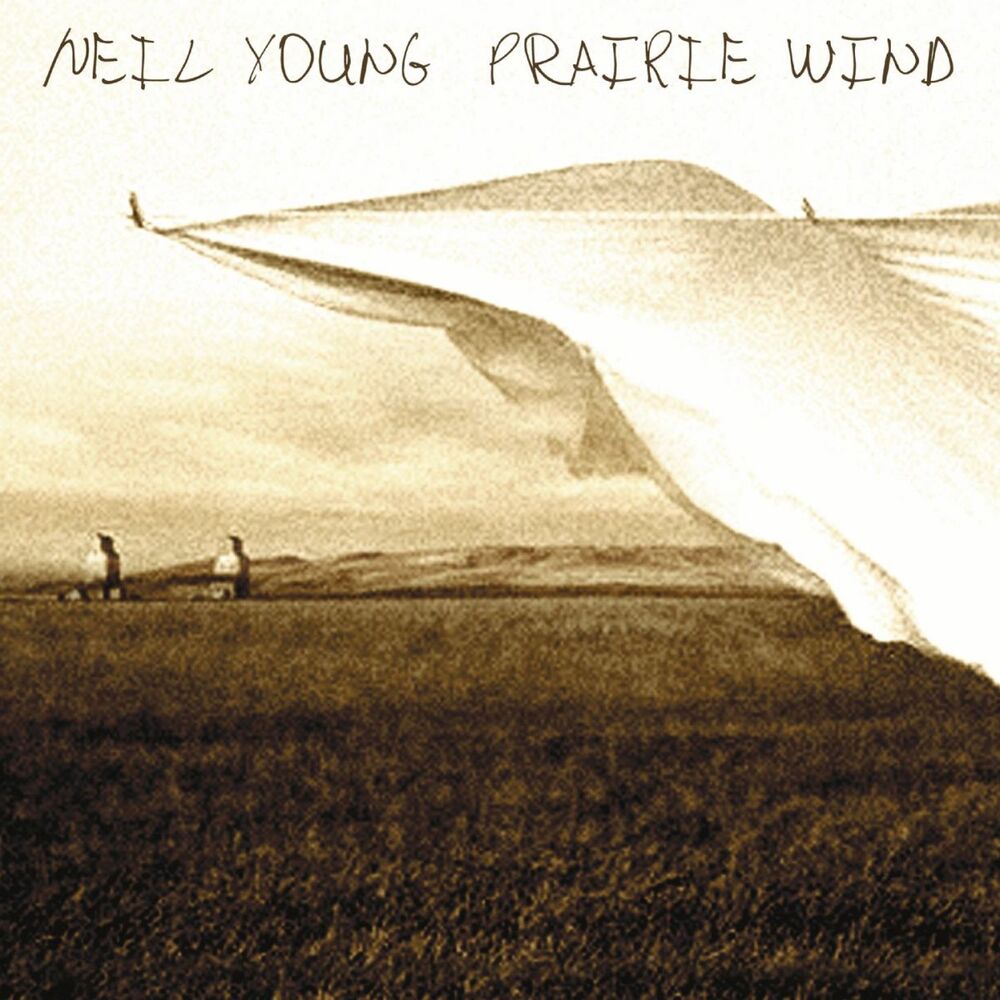
Prairie Wind is the twenty-eighth studio album by Canadian / American musician Neil Young, released on September 27, 2005. After an album rooted in 1960s soul music, Are You Passionate?, and the musical novel Greendale, Prairie Wind features an acoustic-based sound reminiscent of his earlier commercially successful albums Harvest and Harvest Moon. The album's songs find Young pondering his own mortality, as he was undergoing treatment for an aneurysm during the album's production. Songs were also inspired by the extended illness of his father, Canadian sportswriter and novelist Scott Young, who passed a few weeks after the album was completed. The album is dedicated in part to the elder Young.
Writing
The songs find Young reminiscing about his youth, reflecting on the passing of time, and considering his own mortality in light of his father's illness and his own health scare. The album was written and recorded after diagnosis but before undergoing minimally invasive surgery for an aneurysm in the spring of 2005. Young recorded the album's songs on a guitar owned by Hank Williams. In a January 2006 interview for Rolling Stone, Young explained his song writing process: In writing, you have to try to be as unaffected as you can by what's going on around you, while also writing about what's going on around you. I like to remove myself from me to be able to write about the thing I want to write about, I like to think about myself as another soul on the planet. In the morning maybe I'll come out to the studio and start a fire, pick up a guitar. Different guitars make you write differently. Each day's different, though. Could be writing while I'm walking. If it's not happening, I continue living my life. I look at writing songs as like hunting for a wild animal, but you're not trying to kill it. You're trying to communicate with it, to coax it out of its lair. You don't go over and set a fire and try to force it from its lair, or try to scare it out. When it comes out, you don't want it to be scared of you. You have to be pan of what it sees as it's looking around, what it takes as natural, so that it doesn't regard you as a threat. To me, songs are a living thing. It's not hunting to capture. I just want to get a glimpse of it, so I can record it. "Falling Off the Face of the Earth," was inspired by a voicemail left for Young wishing him well as he went into surgery. "Most things just came pouring out, but that song's unique because a lot of it came from a voice-mail message. A friend of mine called, knowing I was going through this, and left me a voice mail that was, 'Thinking about you; just want to tell you that you mean a lot to me,' that kind of stuff. So I wrote it all down and made up this kind of bass-ackwards melody. With songwriting, the key thing is not to have any preconceptions, to be wide open and never worry about whether it's cool or not. Use whatever you can, and worry about cool after you finish the record." Young elaborates to NPR's Terry Gross: I had a melody that I was writing, that'd just come up with that night. And then I was going to bed and I couldn't come up with the lyrics. But I had a melody and chord changes. So I thought, well, you know, I'll just go to sleep, and I'll wake up in the morning and start playing the changes and the words will be there. So, I checked my voicemail and I had a message from Jim Jarmusch...he was just thinking about me and so he left me a message. And some of the phrases that are in the message. I played it again and I wrote down some of the phrases that he used. And in the morning I had the song all done because some of the phrases that he used in the voice-mail were in the... I just used them out of context in this song and kind of opened up the door for everything else. So, the chorus and everything all just fell out. "Far From Home" finds Young remembering his father buying him his first musical instrument, an Arthur Godfrey ukulele, and learning to perform songs from his family members: "When I was just a kid, about eight years old or something, I was a chicken farmer. I had some chickens - I had about thirty-five of them I think. My daddy used to take me out on the weekends and we'd deliver the eggs. And I'd also deliver a newspaper that my dad wrote for because it was some weekend edition kind of thing that I could deliver without getting in the way of going to school. Anyway, one morning Daddy came home. He had this plastic Arthur Godfrey ukulele and he showed it to me. I looked at it and I didn't know much about that. I'd seen it in the store where I bought my 45 RPMs. But I must have said something about it because he bought it for me. And then he played a song …
Recording
Young recorded the album at Masterlink Studios in Nashville, where Roy Orbison had also previously recorded when it was Monument Recording Studios. The recording sessions were video recorded, and a deluxe edition of the album contains a bonus DVD with footage of each song being recorded.
The songs were recorded as they were written, and the track order reflects the order in which the songs were recorded. Young explains in an October 2005 interview for Time magazine: I went into the studio on Thursday and recorded three songs. I wrote one on the way there and two more right away after I recorded the first one. The whole album's chronological; I wrote and recorded in the order it appears on the record. Then I went back up to New York on Monday for a pre-surgery thing, flew back to Nashville, wrote and recorded four, five, six, seven, eight and most of nine and ten. And then I got admitted, and they put me under. The album features the rhythm section of Rick Rosas and Chad Cromwell, with whom he had previously recorded on 1989's Freedom. The album sees Young reunited with many of the Nashville musicians that had appeared on Young's previous albums Comes a Time, Harvest Moon and Silver & Gold. Emmylou Harris and his wife Pegi Young provide backing vocals. Director Jonathan Demme recalls Young raving about working with many of the musicians: "One of the things that Neil talked constantly about in our early conversations on the telephone was just his tremendous regard and love for the other musicians, Pegi and Emmylou and Ben Keith and everybody. He spoke individually about every single person, and he would pepper our conversations with--you know, Anthony Crawford comes up on that song and, you know, that's the song that Grant Boatwright plays the electric guitar on." Several songs also feature ensemble accompaniment. The song "No Wonder" features the Fisk University Jubilee Choir. "Far from Home" and "Prairie Wind" feature a horn section arranged by Wayne Jackson of The Memphis Horns. "It's a Dream" features a string section arranged by Chuck Cochran, who also arranged the string sections on Comes a Time.
Promotion
A premiere live performance of Prairie Wind was held on 18–19 August 2005 at the Ryman Auditorium in Nashville. Here, Young held a two-night concert where songs from the album were performed. These concerts became the subject of a film directed by Jonathan Demme entitled Heart of Gold. Young debuted the album's closing track, "When God Made Me", at the Live 8 concert in Barrie, Ontario, Canada.
Critical reception
The record was regarded by Robert Christgau as "one of those nearness-of-death albums", along with Mississippi John Hurt's Last Sessions (1972), Bob Dylan's Time Out of Mind (1997), Warren Zevon's The Wind (2003), and Johnny Cash's American VI: Ain't No Grave (2010).
Commercial performance
The album debuted on the Billboard 200 album chart at number 11, on October 15, 2005, with sales of approximately 72,000 copies. It remained on the chart for 26 weeks. It was awarded a certified gold record by the RIAA on January 23, 2006. Prairie Wind received two Grammy Award nominations at the 2006 Grammy Awards - "Best Rock Album of the Year" and "Best Rock Solo Performance" for "The Painter".
Tracklist
- The Painter4:34
- No Wonder5:45
- Falling off of the Face of the Earth3:32
- Far from Home3:45
- It's a Dream6:29
- Prairie Wind7:32
- Here for You4:29
- This Old Guitar5:30
- He Was the King6:07
- When God Made Me4:05
Listeners 0
Nobody has logged it yet. Be the first.