Tracklist
- Star Sail (Remastered 2016)4:00
- Slide Away (Remastered 2016)4:03
- Already There (Remastered 2016)5:38
- Beautiful Mind (Remastered 2016)5:28
- The Sun The Sea (Remastered 2016)5:16
- Virtual World (Remastered 2016)6:17
- Make It ‘Til Monday (Remastered 2016)3:12
- Blue (Remastered 2016)3:18
- Butterfly (Remastered 2016)6:39
- See You In The Next One (Have A Good Time) (Remastered 2016)3:08
Have you heard it?
Sign in to mark it as listened, rate it and keep notes.
The full story
A Storm in Heaven is the debut studio album by the English rock band Verve, later the Verve, released on 21 June 1993 on Hut Records. The band had formed between school friends vocalist Richard Ashcroft, bassist Simon Jones, and drummer Peter Salisbury, with guitarist Nick McCabe joining shortly after. After a show in London, they signed to the Virgin Records imprint Hut Records in 1991, which released their first three singles in 1992. Following the appointment of the company Savage and Best as their management, the band recorded their debut album at Sawmills Studios in Cornwall with producer John Leckie. Referred to mainly as a psychedelic album, A Storm in Heaven was largely written in the studio. "Blue" was released as the lead single from A Storm in Heaven in May 1993; initially, promotion saw them go on a UK tour, perform at Glastonbury Festival, and appear on a European tour with the Smashing Pumpkins. Following the release of the second single "Slide Away" in September 1993, Verve embarked on a headlining US tour and closed out the year on a UK tour with Oasis. They went on a headlining European tour in early 1992, prior to their stint on Lollapalooza, on which Salisbury got arrested and Ashcroft had to be hospitalized. They concluded promotion with a round of festivals in Europe, including the Reading Festival. A Storm in Heaven received mixed reviews from music critics; though many largely praised the music, others were not content with its lyrical theme of death and its dark sound. Retrospective reviews and biographies of the Verve were more positive, also focusing on the music. The album peaked at number 27 on the UK Albums Chart, going on to be certified gold by the British Phonographic Industry (BPI) in 2014. "Blue" reached number 69 on the UK Singles Chart. In the following years, most of the album's listeners came to it after the release of the band's third studio album, Urban Hymns (1997); the band returned to the sound of the album through various songs on Urban Hymns and their second studio album, A Northern Soul (1995). It has appeared on best-of lists for the shoegaze genre by NME and Pitchfork.
Background
While at school, Richard Ashcroft had the desire to make music but was unable to play any instrument. When he and his school friends Peter Salisbury and Simon Jones attended higher education, they had the idea of starting a band. Sometime later, Ashcroft heard Nick McCabe playing in a practice room at Winstanley College. After Ashcroft's mother bought him a guitar, he started a band with McCabe and a friend as the bassist. They went by the name the Butterfly Effect before it was changed to Raingarden. As Ashcroft was living in Wigan with Jones, and as their exams loomed, he asked Jones and Salisbury if they wanted to join his band. With their addition, the band re-christened themselves as Verve. Practice sessions followed, with them wanting to find their own sound and not bandwagon on the emerging Madchester movement, spearheaded by the Stone Roses and Happy Mondays. For almost a year, McCabe and Salisbury were unable to play another show, much to the chagrin of Ashcroft. He eventually persuaded the rest of the members to quit their jobs and accompany him on the dole in an effort to make the band work. They subsequently spent most of their time jamming in Wigan, securing frequent shows in the town, and recording a demo while in the house of Jones' parents. At this stage, the Madchester movement had reached an endpoint. Ashcroft said A&R representatives were no longer looking for bands in the North. Coinciding with this, Dave Boyd started working at Virgin Records, accompanied by Miles Leonard, who left his job at Chrysalis Records. Leonard had told the head of A&R at that label about checking out Verve, whom he heard through their demo. After being told no, he shifted to Virgin, who let him travel to see the band in Manchester. Leonard arranged for the band to play a show for the whole A&R department of Virgin in London in July 1991; after this, they signed a publishing deal with Virgin Music. Boyd was moved by the performance that he signed them for, which happened in September 1991. They joined the roster of Hut Records, a subsidiary of Virgin, which consisted of bands from the Madchester scene and other acts that had little support. Their next show in London saw them support Whirlpool; despite not sounding similar to them, Verve were tagged as part of the shoegaze scene. Between April and October 1992, Verve issued their first three singles, "All in the Mind", "She's a Superstar", and "Gravity Grave". During this time, Boyd, now having become the boss at Hut, was concerned for the band's direction and contacted Jane Savage of the PR company Savage and Best, asking if they would like to manage the band. The pair subsequently saw them at a show in London and were impressed, ultimately agreeing to take on the band, serving as both their managers and publicists.
Recording
After shows supporting the Black Crowes, Verve set about to record their debut album. With a DAT machine and a mixing desk in tow, the band went to Wales, where they re-worked all the material they had, only keeping a fraction of it, such as "Slide Away" and "The Sun, the Sea". John Leckie approached Verve about producing them; he was known for his work with the Stone Roses, who were one of Ashcroft's influences. McCabe fixated on Leckie's work with the Fall instead, liking how he refined their sound. Leckie previously saw Verve in London when he initially went to see Whirlpool. Leckie was impressed to the point where he was actively searching gig listings for when they would perform again. Up to that point, he was known for achieving the best sound for newer bands, though he thought that there would be some difficulty in translating their sound onto a recording. Leckie was amazed by their "dynamics, how devastatingly loud they could be, and how quiet and sensitive they would be. At points you could hear a pin drop — and then it would just explode." Despite only having three songs – "Slide Away", "Already There", and "The Sun, the Sea" – newly written at this point, they went to Cornwall with the intent of making an album. The band recorded at Sawmills Studios, a converted mill situated next to the River Fowey, in December 1992 and January 1993. The sessions lasted seven weeks in total, with a break for Christmas 1992. As it was in an isolated area, they could only reach it by boat or by walking down a railway track when the tide was out. If their gear had not arrived by the same boat, they would be forced to wait for 12 hours for the tide to rescind. Its location meant that the band members would not be distracted.
Making an album, as opposed to a one-off recording, made the members relax and not force themselves to make something special from the offset. Eight of the album's final songs came about through improvisational jamming. This working method was hit-and-miss productivity-wise, as five days could pass without anything substantial, while two songs might evolve in a brief period of time. Ashcroft compared it to looking at an empty canvas: "... you don't know what you're going to paint, but you know it's going to be great." He was absent for the majority of this writing, though when he was there, he thought of lyrics on the fly. Leckie focused on getting the right atmosphere instead of working with discipline, a method that McCabe preferred, having previously disliked their prior sessions for taking too much time setting up the drums and getting a particular bass sound. Leckie aimed to capture the band's live spirit when he saw them live. John Cornfield did engineering and programming throughout the sessions. Members of Verve did not like contemporary albums for being overproduced and too clean, wanting a "dirty" sound instead for their debut. Ashcroft's working method was to "record as if it's the last thing we're ever going to do, purely because you get the most out of yourselves." Sometimes, Leckie would alter McCabe's amplifier, only for him to change it back when the former left the room. Leckie had a Shure SM58 microphone facing the speaker cab, and Neumann U 67 directly against the cab. McCabe focused on the sound he got from his amp rather than his guitars, having recently acquired a Mesa/Boogie Mark III. During this time, other musicians were working with digital equipment and disregarding their guitar pedals; McCabe recalled that he found various delay pedals and samplers cheaply and experimented with them, going as far as to say A Storm in Heaven was "essentially me discovering all this equipment. Get a few pedals, see what sounds I could make, wait for a tune to come out of it." Verve had struggled to record a satisfactory version of "Star Sail", finding prior attempts too clean-sounding. A version, recorded at 4 a.m. while the band was stoned, proved to be a turning point, as McCabe said Leckie helped show …
Composition and lyrics
Title and themes
Phill Best proposed the album's name be Storming Heaven, taken from the 1989 book of the same name by Jay Stevens, which discusses American culture handling the effects of LSD. Best added, "how [the drug] was a shortcut to Nirvana ... so I said [to Ashcroft] you should call it 'storming heaven' because that's what your music does. I thought this was a good euphemism for what their music did," before Ashcroft altered it to A Storm in Heaven. Discussing the name, Ashcroft said he preferred music that can immerse the listener, making them "feel calm and soothing, and then hurt you a little bit more." Baker thought that the title was appropriate since the songs were made and recorded in a small timeframe. The album featured a "coherence that, for all the brilliance of their later albums, they would never achieve again. Every member of the band knew what a Verve song sounded like and they were all pulling in the same direction." Ashcroft sought influence in anything he could, with the mundanity of life, such as having meaningful conversations or getting drunk, and the less grounded topics, like looking at a dead body on a street. In addition to those, allusions to galaxies and suns were another obvious theme. Egan said the lyrics were distinctly metaphoric, with Ashcroft choosing to keep a reclusive "ambiguity in his work. He disdained the video culture which now tended to do pop consumers' thinking for them: rather than force feeding people images, he wanted their imaginations to run wild." Radhika Takru of Drowned in Sound said the band did not lament a breakup; more so, they contemplated the "inevitability of its demise." He said a listener can witness "someone struggling to stay nonchalantly afloat when in reality, they're far out of their depth (standard youthful stupidity)."
Music
Ryan Dombal of Pitchfork explains that A Storm in Heaven "lives in that liminal state between jam and song, spontaneity and structure. It’s not calculating, but it never veers into sheer indulgence, either." As the band did not wish their debut to be a collection of hits, their first three singles were left off the track listing. Ashcroft retrospectively said it would have been a rip-off if it had their previous singles on it, preferring it to be "totally different, it's an actual event." He wanted to "make it special", an approach that Egan said "included textures created by additional instruments, including the flute, horns, accordion, and piano. Ashcroft would later assert that he was a believer in natural sounds and that Verve's attempt to be the future wasn't undermined by using classical instruments." The band wrote songs through jamming, prior to Ashcroft adding vocals to what they came up with. Best said they would practice without a vocal melody, resulting in drawn-out instrumental portions, which Ashcroft would scat over. Leckie saw this as a negative, as Ashcroft "would never know what he was singing and he'd never know when the chorus would come. They would have all these different sections and they'd make the changes by the nod." The Kick Horns' contributions, which Ilic referred to as "stunningly ambient brass sections", can be heard on "Already There" and "The Sun, the Sea", which took their cues from the parts on Fun House (1968) by the Stooges. Nick McCabe's guitar work is characterized as "offer[ing] color and clarity to Ashcroft’s grand pronouncements, his tone—gentle as a butterfly one minute, squalling like the sea the next—providing the sort of nuance his singer could never quite pull off." According to Dombal, "McCabe gave Ashcroft’s ambitions a soul to search for." An issue Ashcroft had with contemporary bands was them trying too hard to emulate one particular influence, whereas for Verve, they took in varied inspirations that they were not fanatics of one specific band; they soaked up many acts; "then in turn you don't rip [one of] them off, because you've got so much going on there in your head." …
Artwork and packaging
Front cover
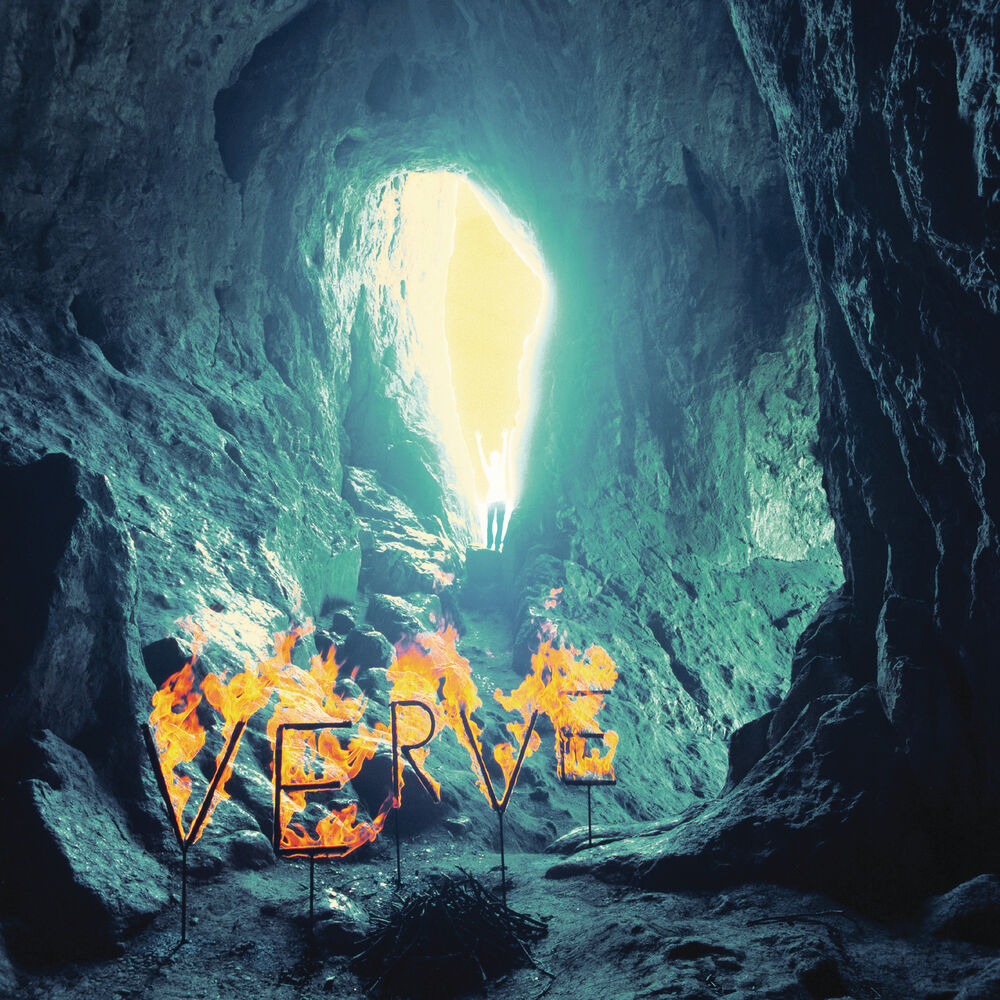
Boyd wanted to use the photograph that ultimately went to the "She's a Superstar" single for their album. Brian Cannon of the design company Microdot and photographer Michael Spencer Jones assured him that they could create something better. Ashcroft previously met Brian Cannon while at a party in Wigan during the former's college period. Ashcroft was interested in Cannon's work at the time; two years later, when Verve got signed, the pair reconnected. Baker said Cannon was influenced by the "magnificently overblown, psychedelic music," featured on the album and set out to idealise a concept that could accompany it. Baker said the artwork shows a "ghostly figure at the mouth of a cave in front of the letters VERVE in flames and then inside [the sleeve] was a whole series of different vignettes of the band and their friends." The image was taken at Thor's Cave, situated at the peak of a hill in Staffordshire; the entranceway was scaled to a height of 10 metres and a width of seven and a half metres. The band was fascinated with the cave's history of mythology, including Paleolithic grave sites and it being the resting place of the wife of an 8th-century martyr. Like with their artwork previously, the band's name was included in the image itself as opposed to being written later on. Spencer Jones hired a friend of his to weld big metal letters, which were then dragged to the cave. Spencer Jones had expressed interest in taking photographs of a band in a cave and found Thor's Cave while on a walk with his girlfriend. It dawned on him that the best angle was not from outside the cave but rather from the interior facing outwards. Cannon thought that the metal letters should be alight, which, when combined with the blue illumination of the cave itself, worked well on a colour level. Spencer Jones said it appeared "obvious that it looked like a womb", so they had a shadowy figure coming through at the end. He thought it was an acceptable method of bringing in an element of humanity without involving someone inside the cave. It was only after this that they thought about the concept of the cycle of life. On each occasion they tried to light the wicks atop each metal letter, the V would go out before they were able to light the E.
Gatefold and back cover images
Cannon said he had been a fan of bands that used gatefold sleeves for their albums and wanted to employ that for Verve. The artwork collectively took circa three or four months to create and details the cycle of life. He explained that the front cover acted as "birth — the cave's like a vaginal opening in the mountain in the background." The gatefold photos show the "recklessness of youth" as a burning car is seen while members of the band sit nearby and play chess, taken in Billinge, Wigan. This was followed by the "hopelessness of middle-life", depicted with a man sitting and watching a TV, concluding with "death with the guy in the graveyard." The former was taken in a cellar in Up Holland, Lancashire, while the latter, used for the back cover, was shot in Birkdale Cemetery in Southport with a man wearing Ashcroft's clothing. One of the gatefold sleeve images shows the members either reading a newspaper or having a game of chess next to a farmhouse as a car is burning in the background. Cannon said the vehicle was a Citroën found in a Wigan scrapyard that they purchased for £50. It lacked an MOT and was illegal to drive on a road. They got it to the residence of Paul Frodsham, a friend of Ashcroft. The former manager of the band, Dave Halliwell, poured the petrol on it and almost immolated himself. The idea for a burning car came from Ashcroft, who wanted it set in an urban environment, but Spencer Jones thought it would send the wrong type of statement. "It was too much of an aggressive image — an urban setting with a car on fire. What's that saying? It was good to juxtapose that against very peaceful setting. You're getting this ultra violence if the …
Release and name change
In May 1993, Billboard reported that Verve's debut studio album was planned for release the following month. Record companies PolyGram and Deutsche Grammophon filed a suit against Verve on 7 May 1993 at the US District Court in Los Angeles, California, claiming trademark infringement. It was in regards to Verve Records; PolyGram issued releases through this jazz imprint, while Deutsche Grammophon owned the rights to the label's name. All members of the band and Caroline Distribution, Hut and Virgin Records were listed as defendants in the suit, which alleged that their "activities were likely to cause confusion, mistake or deception as to the source of origin" of the band's releases. It sought an injunction to halt sales of any release bearing Verve's name, with damages to be determined. According to Savage, the label said that if someone were to go to a record store and exclaim, "'I want a new Verve record' and they'd be given a record by this British pop group when they obviously want a jazz record." The band relegated the suit to lawyers while they focused on promoting their upcoming album. Discussions for a name continued for a month, with suggestions of renaming to Verv so that they could call their album Dropping an 'E' for America. Verve had the idea of having market research done in the US to see if product confusion would have occurred. This would have been a costly move, in addition to the legal fees from defending against the suit. A Storm in Heaven appeared in the US as intended through Vernon Yard Recordings, a subsidiary of Virgin Records, on 15 June 1993, where it was distributed by CEMA, owned by Virgin Records' parent company, EMI. It was released in the UK on 21 June 1993 through Hut Records. Clarke described the album's context: "Surrounded by Suede's rejuvenated London-centric Bowie-isms, Blur's defining Modern Life Is Rubbish tirade, and the mainstream successes of grunge, the album sat uncomfortably among its contemporaries." During the final date of their late 1993 UK tour, it was reported that the band had settled out-of-court with Verve Records, which saw the band amend their name to the Verve. While amending the name avoided legal fees, the Verve still had to pay £25,000 to Verve Records for requiring the band to tack on the definite article instead of changing it entirely. On 4 January 1994, it was announced that Hut Records was to be distributed by EMI, following the expiration of a deal with distribution companies RTM and Pinnace. Ray Cooper, the deputy managing director at Virgin Records, said that Virgin felt that Hut had now "achieved a degree of maturity which makes it appropriate to bring its distribution in-house." Egan said this meant that Hut could no longer be considered an independent label, making their releases ineligible to chart on the Independent Charts, which the Verve's prior releases had appeared on. Boyd was unfazed by the situation, though he criticized Virgin, he thought that it would help Hut "move up a gear." A Storm in Heaven was re-pressed on vinyl in 2016; that same year, an expanded version of the album was issued, including B-sides, EP tracks, BBC Radio 1 session material, and a DVD of a 1992 live performance. Alongside this, two outtakes from the recording sessions, "Shoeshine Girl" and "South Pacific", were also featured in the set. "Slide Away" and "Blue" were included on the band's second compilation album, This Is Music: The Singles 92–98 (2004), while music videos for both were featured on the video album of the same name.
Singles
"Blue" was released as the album's lead single on 10 May 1993. "Twilight", "Where the Geese Go", and "No Come Down" were included as its B-sides. "Blue" was issued to modern rock radio stations in the US in July 1994. Two music videos were made for "Blue": one aimed for the US market, shot in Dublin, Ireland; and the other, aimed for the British market, filmed in Islington, London. The latter version starts with the members going to …
Retrospective reviews and accolades
Retrospective reviews focused on the music of A Storm in Heaven. Journalist Rob Sheffield in The New Rolling Stone Album Guide called A Storm in Heaven a "top-notch debut, full of long, druggy jams, shoegazing guitar excursions, and Mad Richard's shambolic, shamanic vocals." AllMusic reviewer Greg Prato wrote that when revisiting it nowadays, he saw it as an "interesting and original musical direction, since at the time, angst-ridden Seattle bands ... were all the rage." He noted that while some of the tracks tease at the band's latter-day "penchant for composing pop gems", several of the "longer tracks are just as strong," such as "Already There". Hogwood said the album "confirms them to be far more than your average guitar-led quartet from the North of England." Record Collector writer Tim Peacock said the album was largely "dominated by otherworldly, echo-laden delights such as Star Sail and the deceptively bucolic Virtual World and its headily elusive, psychedelia-streaked beauty has remained gloriously intact" in the years that followed. Ian King of PopMatters said the album's most fascinating tracks are the ones that were able to "naturally ebb and flow in a zone somewhere between pop editing and the looser jamming of the material that turned up on their singles and EPs." For Rolling Stone Germany, journalist Sassan Niasseri said the album was for shoegaze fans that "didn't stand on the dance floor, but saw themselves on rowing boats in stalactite caves, like the sighing role models Echo & The Bunnymen." The Line of Best Fit's Ed Nash noted that Ashcroft was "disdainful of the indie scene and wanted mainstream success for the band. The majority of the songs in A Storm in Heaven weren't going to give him that ..." Abdallah wrote that there was a battle between Ashcroft's "self-doubt and the band's panoramic soundscapes provides us with opportunities for self-examination." Journalist Mark Beaumont, in a review for Classic Rock, commented that apart from "Star Sail" and "Blue", the album had not "aged well, essentially 47 minutes of 'Mad' Richard Ashcroft formlessly wailing to be let out of guitarist Nick McCabe's psychedelic wind tunnel." Biographers of the band highly praised the album. Baker called the album an "incredible achievement. Some groups take years to find their own distinct sound, many never do at all but Verve had managed it first time." Ilic said it was a "league away from Suede, Blur and the emerging Britpop fracas. It may not have been the album that set the commercial glove alight, but it was still good enough to leave the fading baggy and shoegazing scenes trailing in its wake, collectively gasping for breath and unable to focus on through the ensuing dust." He added that if the listener "looked hard enough, you could just make out Verve's wiry vocalist in the distance, clicking his heels together before turning into a dot and swaggering over the horizon." Clarke thought that the album was an "impressive, albeit patchy debut" that continued the "formless sings swathed in cloaks of noise" of their early singles "with only a smattering of traditional tracks," highlighting "Blue" and "Slide Away". For the rest of the album, he thought it was "shapeless without being aimless, with the band's spacey backdrop proving at least a worthy sound for Richard's impressive and at times other-worldly, yet still melodic vocals." He compliments Leckie for drawing a "new level out of Richard's vocals, giving him an abrasive touch that was often desperately needed amongst Verve's more self-indulgent ramblings." Wilding said it displayed a grandiose "sweep of psychedelia, but promised something approaching a point of focus with songs like the aforementioned Blue and Star Sail." The Ridgefield Press included "Butterfly" on their list of the best tracks from 1993. A Storm in Heaven was ranked by NME at number 473 on their 2013 list of the 500 best albums of all time. The publication went on to rank it at number nine on their …
Commercial performance and legacy
A Storm in Heaven initially peaked at number 27 in the UK Albums Chart, and topped the UK Independent Albums chart. The album's 2016 reissue re-entered the main UK chart at number 84. It was certified silver and gold in the UK by the British Phonographic Industry (BPI) in 2013 and 2014, respectively. "Blue" reached number 69 on the UK Singles Chart. Writer Alex Niven, in his 2014 33⅓ book on Oasis' Definitely Maybe, suggested that in addition to the visual influence of the album, its music was inspired by A Storm in Heaven. He went on to call the Verve's album as "very much like a darker, weirder cousin" to Definitely Maybe, and highlighted the echo-enhanced guitar work from McCabe as a factor. Jenell Kesler of It's Psychedelic Baby! Magazine said the majority of the album's listeners came to it following the release of the Verve's third studio album, Urban Hymns (1997), "then walked the cat backwards, discovering this highly intoxicating bit of wanderlust." Mark Lager of Under the Radar said the album "stood apart from other albums that decade [of the 1990s] (and subsequent albums in the band's discography) because of Nick McCabe's guitar soundscapes." The Verve returned to the sound of A Storm in Heaven on "So It Goes" from their next album, A Northern Soul (1995), and "This Time" from Urban Hymns. Walker said the opening moments of "The Sun, the Sea" reappeared in the former album's "This Is Music" and the latter album's "The Rolling People". Leckie said they "came close [to perfecting A Storm in Heaven] but neither they nor I thought they managed it. It lacked the overwhelming effect of the Verve experience, maybe as there was no audience to feed off." He added that the performances in the recordings were better than their previous, early release, but thought that the songs overall were lacking in quality. McCabe referred to the finished album as a recording of works-in-progress; Leonard said McCabe thought it could be improved, unable to be completely happy "with the result, whether it was a recording or a live show." McCabe found it difficult to work with Leckie, who had different ideas in his head from what McCabe wanted. He went as far as to say, "I don't really think he knows how to record guitars."
Tracklist
- Star Sail (Remastered 2016)4:00
- Slide Away (Remastered 2016)4:03
- Already There (Remastered 2016)5:38
- Beautiful Mind (Remastered 2016)5:28
- The Sun The Sea (Remastered 2016)5:16
- Virtual World (Remastered 2016)6:17
- Make It ‘Til Monday (Remastered 2016)3:12
- Blue (Remastered 2016)3:18
- Butterfly (Remastered 2016)6:39
- See You In The Next One (Have A Good Time) (Remastered 2016)3:08
Listeners 0
Nobody has logged it yet. Be the first.