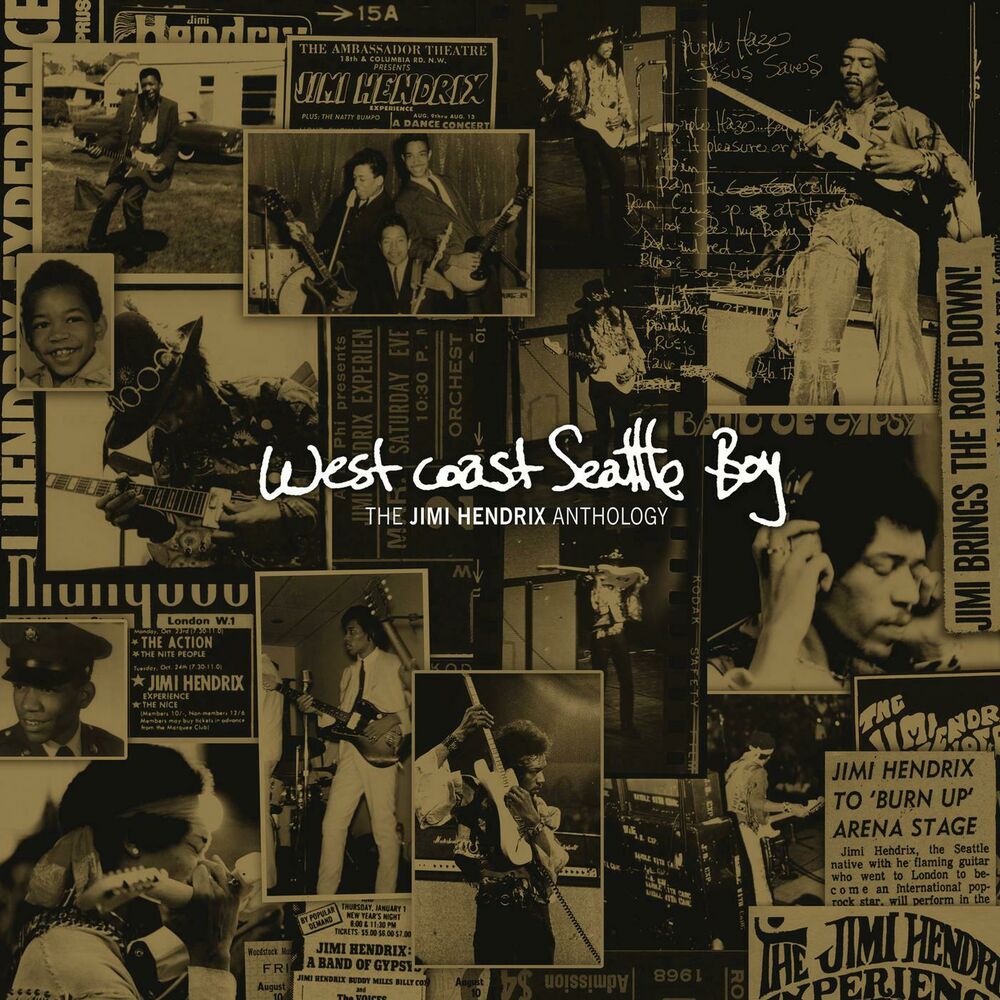
West Coast Seattle Boy: The Jimi Hendrix Anthology
2010-11-16Legacy Recordings
25 tracks, 1 h 19 min
Tracklist
- Testify (Parts 1 & 2)4:07
- Mercy, Mercy (Single/LP Version)2:25
- Can't Stay Away (LP Version)2:50
- My Diary (with Rosa Lee Brooks)2:29
- Utee (with Rosa Lee Brooks)2:00
- I Don't Know What You Got But It's Got Me4:01
- Dancing All Around the World2:58
- I'm so Glad2:39
- Move Over and Let Me Dance2:40
- Have You Ever Been Disappointed (2007 Remastered Single Version)6:20
- Help Me (Get That Feeling) Part One (Single Version)2:33
- (My Girl) She's a Fox2:44
- That Little Old Groove Maker2:15
- Sweet Thang2:32
- Instant Groove2:22
- Fire (Anthology Version)2:51
- Are You Experienced (Anthology Version)6:03
- May This Be Love (Anthology Version)3:17
- Can You See Me (Anthology Version)2:33
- The Wind Cries Mary (Anthology Version)4:00
- Love Or Confusion (Anthology Version)3:16
- Little One (Anthology Version)4:07
- Mr. Bad Luck (Anthology Version)2:55
- Cat Talking to Me (Anthology Version)2:52
- Castles Made of Sand (Anthology Version)3:10
Have you heard it?
Sign in to mark it as listened, rate it and keep notes.
The full story
James Marshall "Jimi" Hendrix (born Johnny Allen Hendrix; November 27, 1942 – September 18, 1970) was an American guitarist and singer-songwriter. He is widely regarded as one of the greatest and most influential guitarists of all time. He was inducted into the Rock and Roll Hall of Fame in 1992 as a part of his band, the Jimi Hendrix Experience; the institution describes him as "arguably the greatest instrumentalist in the history of rock music". Hendrix began playing guitar at age 15. In 1961, he enlisted in the US Army, but was discharged the following year. Soon afterward, he moved to Clarksville, then Nashville, Tennessee, and began playing gigs on the Chitlin' Circuit, earning a place in the Isley Brothers' backing band and later with Little Richard, with whom he continued to work through mid-1965. He then played with Curtis Knight and the Squires. Hendrix moved to England in late 1966, after bassist Chas Chandler of the Animals became his manager. Within months, he formed the Jimi Hendrix Experience (with its rhythm section consisting of bassist Noel Redding and drummer Mitch Mitchell) and achieved three UK top-ten hits: "Hey Joe", "Purple Haze", and "The Wind Cries Mary". He achieved fame in the US after his performance at the Monterey Pop Festival in 1967. His third and final studio album, Electric Ladyland (1968), became his most successful release and his only number-one album on the US Billboard 200 chart. The world's highest-paid rock musician, Hendrix headlined the Woodstock Festival in 1969 and the Isle of Wight Festival in 1970. He died in London from barbiturate-related asphyxia in September 1970, at the age of 27. Hendrix was inspired by American rock and roll and electric blues. He favored overdriven amplifiers with high volume and gain, and was instrumental in popularizing the previously undesirable sounds caused by guitar amplifier feedback. He was also one of the first guitarists to make extensive use of tone-altering effects units in mainstream rock, such as fuzz distortion, Octavia, wah-wah, and Uni-Vibe. He was the first musician to use stereophonic phasing effects in recordings. Rolling Stone wrote: "Hendrix pioneered the use of the instrument as an electronic sound source. Players before him had experimented with feedback and distortion, but Hendrix turned those effects and others into a controlled, fluid vocabulary every bit as personal as the blues with which he began."
Unauthorized and posthumous releases
By 1967, as Hendrix was gaining in popularity, many of his pre-Experience recordings were marketed to an unsuspecting public as Jimi Hendrix albums, sometimes with misleading later images of Hendrix. The recordings, which came under the control of producer Ed Chalpin of PPX, with whom Hendrix had signed a recording contract in 1965, were often re-mixed between their repeated reissues, and licensed to record companies such as Decca and Capitol. Hendrix publicly denounced the releases, describing them as "malicious" and "greatly inferior", stating: "At PPX, we spent on average about one hour recording a song. Today I spend at least twelve hours on each song." These unauthorized releases have long constituted a substantial part of his recording catalogue, amounting to hundreds of albums. Some of Hendrix's unfinished fourth studio album was released as the 1971 title The Cry of Love. Although the album reached number three in the US and number two in the UK, producers Mitchell and Kramer later complained that they were unable to make use of all the available songs because some tracks were used for 1971's Rainbow Bridge; still others were issued on 1972's War Heroes. Material from The Cry of Love was re-released in 1997 as First Rays of the New Rising Sun, along with the other tracks that Mitchell and Kramer had wanted to include. Four years after Hendrix's death, producer Alan Douglas acquired the rights to produce unreleased music by Hendrix; he attracted criticism for using studio musicians to replace or add tracks. In 1993, MCA Records delayed a multimillion-dollar sale of Hendrix's publishing copyrights because Al Hendrix was unhappy about the arrangement. He acknowledged that he had sold distribution rights to a foreign corporation in 1974, but stated that it did not include copyrights and argued that he had retained veto power of the sale of the catalogue. Under a settlement reached in July 1995, Al Hendrix regained control of his son's song and image rights. He subsequently licensed the recordings to MCA through the family-run company Experience Hendrix, L.L.C., formed in 1995. In August 2009, Experience Hendrix announced that it had entered a new licensing agreement with Sony Music Entertainment's Legacy Recordings division, to take effect in 2010. Legacy and Experience Hendrix launched the 2010 Jimi Hendrix Catalog Project starting with the release of Valleys of Neptune in March of that year. In the months before his death, Hendrix recorded demos for a concept album tentatively titled Black Gold, now in the possession of Experience Hendrix LLC, but it has not been released.
Influences
As an adolescent in the 1950s, Hendrix became interested in rock and roll artists such as Elvis Presley, Little Richard, and Chuck Berry. In 1968, he told Guitar Player magazine that electric blues artists Muddy Waters, Elmore James, and B. B. King inspired him during the beginning of his career; he also cited Eddie Cochran as an early influence. Of Muddy Waters, the first electric guitarist of which Hendrix became aware, he said: "I heard one of his records when I was a little boy and it scared me to death because I heard all of these sounds." In 1970, he told Rolling Stone that he was a fan of western swing artist Bob Wills and while he lived in Nashville, the television show the Grand Ole Opry.
Cox stated that during their time serving in the US military, he and Hendrix primarily listened to southern blues artists such as Jimmy Reed and Albert King. According to Cox, "King was a very, very powerful influence". Howlin' Wolf also inspired Hendrix, who performed Wolf's "Killing Floor" as the opening song of his US debut at the Monterey Pop Festival. The influence of soul artist Curtis Mayfield can be heard in Hendrix's guitar playing, and the influence of Bob Dylan can be heard in Hendrix's songwriting; he was known to play Dylan's records repeatedly, particularly Highway 61 Revisited and Blonde on Blonde.
Legacy
The Rock and Roll Hall of Fame biography for the Experience states: "Jimi Hendrix was arguably the greatest instrumentalist in the history of rock music. Hendrix expanded the range and vocabulary of the electric guitar into areas no musician had ever ventured before. His boundless drive, technical ability and creative application of such effects as wah-wah and distortion forever transformed the sound of rock and roll." Musicologist Andy Aledort described Hendrix as "one of the most creative" and "influential musicians that has ever lived". Music journalist Chuck Philips wrote: "In a field almost exclusively populated by white musicians, Hendrix has served as a role model for a cadre of young black rockers. His achievement was to reclaim title to a musical form pioneered by black innovators like Little Richard and Chuck Berry in the 1950s." Hendrix favored overdriven amplifiers with high volume and gain. He was instrumental in developing the previously undesirable technique of guitar amplifier feedback and helped to popularize use of the wah-wah pedal in mainstream rock. He rejected the standard barre chord fretting technique used by most guitarists in favor of fretting the low 6th string root notes with his thumb. He applied this technique during the beginning bars of "Little Wing", which allowed him to sustain the root note of chords while also playing melody. This method has been described as piano style, with the thumb playing what a pianist's left hand would play and the other fingers playing melody as a right hand. Having spent several years fronting a trio, he developed an ability to play rhythm chords and lead lines together, giving the audio impression that more than one guitarist was performing. He was the first artist to incorporate stereophonic phasing effects in rock music recordings. Holly George-Warren of Rolling Stone wrote: "Hendrix pioneered the use of the instrument as an electronic sound source. Players before him had experimented with feedback and distortion, but Hendrix turned those effects and others into a controlled, fluid vocabulary every bit as personal as the blues with which he began."
While creating his unique musical voice and guitar style, Hendrix synthesized diverse genres, including blues, R&B, soul, British rock, American folk music, 1950s rock and roll, and jazz. Musicologist David Moskowitz emphasized the importance of blues music in Hendrix's playing style, and according to authors Steven Roby and Brad Schreiber, "[He] explored the outer reaches of psychedelic rock". His influence is evident in a variety of popular music formats, and he has contributed significantly to the development of hard rock, heavy metal, funk, post-punk, grunge, and hip-hop. His lasting influence on modern guitar players is difficult to overstate; his techniques and delivery have been abundantly imitated by others. Despite his hectic touring schedule and notorious perfectionism, he was a prolific recording artist who left behind numerous unreleased recordings. More than 40 years after his death, Hendrix remains as popular as ever, with annual album sales exceeding that of any year during his lifetime. As with his contemporary Sly Stone, Hendrix embraced the experimentalism of white musicians in progressive rock in the late 1960s and inspired a wave of progressive soul musicians that emerged by the next decade. He has directly influenced numerous funk and funk rock artists, including Prince, George Clinton, John Frusciante of Red Hot Chili Peppers, Eddie Hazel of Funkadelic, and Ernie Isley of the Isley Brothers. Hendrix influenced post-punk guitarists such as John McGeoch of Siouxsie and the Banshees and Robert Smith of The Cure. Grunge guitarists such as Jerry Cantrell of Alice in Chains, Kurt Cobain of Nirvana, and Mike McCready and Stone Gossard of Pearl Jam have cited Hendrix as an influence. Hendrix's influence also extends to many hip-hop artists, including De La Soul, A Tribe Called Quest, Digital …
Tracklist
- Testify (Parts 1 & 2)4:07
- Mercy, Mercy (Single/LP Version)2:25
- Can't Stay Away (LP Version)2:50
- My Diary (with Rosa Lee Brooks)2:29
- Utee (with Rosa Lee Brooks)2:00
- I Don't Know What You Got But It's Got Me4:01
- Dancing All Around the World2:58
- I'm so Glad2:39
- Move Over and Let Me Dance2:40
- Have You Ever Been Disappointed (2007 Remastered Single Version)6:20
- Help Me (Get That Feeling) Part One (Single Version)2:33
- (My Girl) She's a Fox2:44
- That Little Old Groove Maker2:15
- Sweet Thang2:32
- Instant Groove2:22
- Fire (Anthology Version)2:51
- Are You Experienced (Anthology Version)6:03
- May This Be Love (Anthology Version)3:17
- Can You See Me (Anthology Version)2:33
- The Wind Cries Mary (Anthology Version)4:00
- Love Or Confusion (Anthology Version)3:16
- Little One (Anthology Version)4:07
- Mr. Bad Luck (Anthology Version)2:55
- Cat Talking to Me (Anthology Version)2:52
- Castles Made of Sand (Anthology Version)3:10
Listeners 0
Nobody has logged it yet. Be the first.