Tracklist
- Sivad15:13
- Little Church (Live at the Cellar Door, Washington, DC - December 1970)3:15
- Medley: Gemini / Double Image (Live at the Cellar Door, Washington, DC - December 1970)5:54
- What I Say (Live at the Cellar Door, Washington, DC - December 1970)21:09
- Nem um Talvez4:03
- Selim2:13
- Funky Tonk (Live at the Cellar Door, Washington, DC - December 1970)23:26
- Inamorata and Narration By Conrad Roberts (Live at the Cellar Door, Washington, DC - December 1970)26:29
Have you heard it?
Sign in to mark it as listened, rate it and keep notes.
The full story
Live-Evil is an album of both live and studio recordings by the American jazz musician Miles Davis. Parts of the album featured music from Davis' concert at the Cellar Door in 1970, which producer Teo Macero subsequently edited and pieced together in the studio. They were performed as lengthy, dense jams in the jazz-rock style, while the studio recordings consisted mostly of renditions of Hermeto Pascoal compositions. The album was originally released on November 17, 1971.
Background
A number of famous jazz musicians feature on the album, including Gary Bartz, Ron Carter, Dave Holland, Keith Jarrett and Jack DeJohnette. One of the key musicians on the album, John McLaughlin, was not a regular member of Miles Davis's band during the time of recording. Davis said he called McLaughlin at the last minute to join the band for the last of four nights they recorded live at the Cellar Door, as Davis was "looking for an element he hadn't quite nailed down" on the previous nights, though most of the other band members contradicted this, with Bartz saying "We did know that the weekend was going to be for a possible recording, and that ["Mahavishnu" John McLaughlin] would come for the weekend. Miles had in the back of his mind that this would be for a possible album."
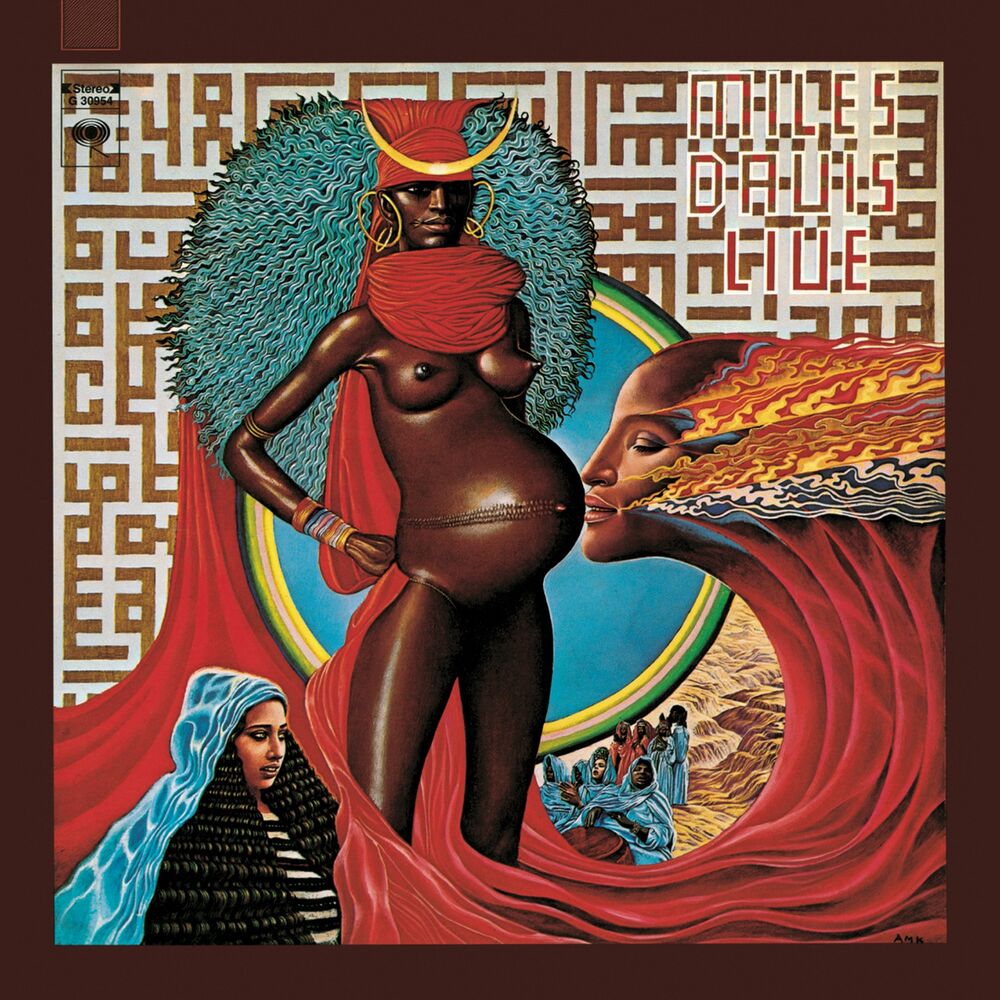
Cover artwork
The album cover was illustrated by artist Mati Klarwein. Klarwein had painted the front cover independently of Davis, but the back cover was painted with a suggestion from Davis:
"I was doing the picture of the pregnant woman for the cover and the day I finished, Miles called me up and said, 'I want a picture of life on one side and evil on the other.' And all he mentioned was a toad. Then next to me was a copy of Time Magazine which had J. Edgar Hoover on the cover, and he just looked like a toad. I told Miles I found the toad." Record club pressings of the album simply had the album title printed on a black cover.
Critical reception
Live-Evil was released by Columbia Records in 1971 to critical acclaim. In a contemporary review for Rolling Stone, Robert Palmer said "this sounds like what Miles had in mind when he first got into electric music and freer structures and rock rhythms". He called the shorter, ballad-like recordings "things of great beauty", devoid of solos but full of "stunning, bittersweet lines", while also praising each band member's soloing on the live jams: "Everybody is just playing away, there aren't any weak links, and there isn't any congestion to speak of. Miles reacts to this happy situation by playing his ass off, too". Black World critic Red Scott remarked that all of Live-Evil's songs "fuse into a perfect complement of musicians passing moods to each other". Pete Welding from DownBeat was less enthusiastic in a two-and-a-half star review, finding the live recordings characterized by "long dull stretches of water-treading alternating with moments of strength and inspiration". The magazine's John Corbett later called Live-Evil "an outstandingly creative electric collage", while Erik Davis from Spin found the music "kinetic" and described McLaughlin's playing as "Hindu heavy-metal fretwork". Pitchfork's Ryan Schreiber believed it was "easily the most accessible of Miles Davis' late-'70s [sic] electric releases", describing its music as "at once both sexually steamy and unsettling". He said the live recordings "run the gamut from barroom brawl action-funk to sensual bedroom jazz magic, creating two hours of charged eccentricity you'll never forget". Robert Christgau said that apart from the meandering "Inamorata", the "long pieces are usually fascinating and often exciting", including "Funky Tonk", which he called Davis's "most compelling rhythmic exploration to date". He believed the shorter pieces sounded like "impressionistic experiments", while "Selim" and "Nem Um Talvez" appropriately "hark back to the late '50s". Edwin C. Faust from Stylus Magazine called Live-Evil "one of the funkiest albums ever recorded" while deeming the "somber" short pieces to be "haunting examples of musical purity—Miles enriching our ears with evocative melodies (his work on Sketches of Spain comes to mind) while the bass creeps cautiously, an organ hums tensly, and human whistles/vocals float about forebodingly like wistful phantoms".
Tracklist
- Sivad15:13
- Little Church (Live at the Cellar Door, Washington, DC - December 1970)3:15
- Medley: Gemini / Double Image (Live at the Cellar Door, Washington, DC - December 1970)5:54
- What I Say (Live at the Cellar Door, Washington, DC - December 1970)21:09
- Nem um Talvez4:03
- Selim2:13
- Funky Tonk (Live at the Cellar Door, Washington, DC - December 1970)23:26
- Inamorata and Narration By Conrad Roberts (Live at the Cellar Door, Washington, DC - December 1970)26:29
Listeners 0
Nobody has logged it yet. Be the first.