Tracklist
- All In2:58
- Getting There (feat. Niki Randa)1:49
- Until The Colours Come1:07
- Heave(n)2:22
- Tiny Tortures3:03
- All The Secrets1:56
- Sultan’s Request1:41
- Putty Boy Strut2:53
- See Thru To U (feat. Erykah Badu)2:24
- Until The Quiet Comes2:40
- DMT Song (feat. Thundercat)1:19
- The Nightcaller3:28
- Only If You Wanna1:42
- Electric Candyman (feat. Thom Yorke)3:32
- Hunger (feat. Niki Randa)3:39
- Phantasm (feat. Laura Darlington)3:51
- me Yesterday//Corded4:39
- Dream To Me1:36
Have you heard it?
Sign in to mark it as listened, rate it and keep notes.
The full story
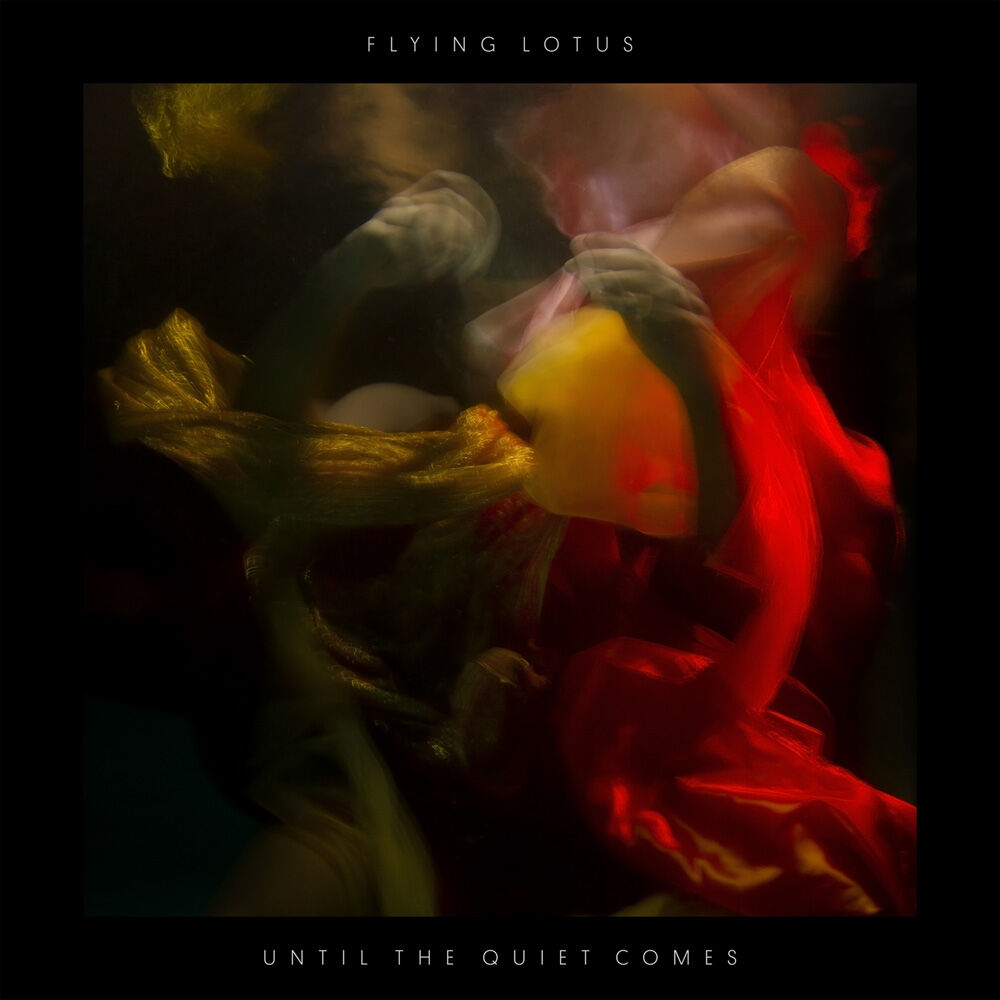
Until the Quiet Comes is the fourth studio album by American electronic music producer Flying Lotus, released on September 26, 2012 by Warp Records. Flying Lotus was inspired to create the album by psychedelic music, African percussion, and concepts of the human subconscious and dream world. He recorded for two years at his home in Los Angeles, experimenting with different mixing techniques and dynamics while primarily using an Ableton Live sequencer along with other instruments and software. The producer was accompanied on certain songs by guest vocalists, including Erykah Badu, Thom Yorke, and Laura Darlington. The album also continued his creative partnership with bassist Thundercat, who had appeared on Flying Lotus' 2010 record Cosmogramma. An electronic jazz album, Until the Quiet Comes features free jazz elements, varying musical tones, contrasting scales, and shifts in rhythmic feel. Its songs are sequenced together and characterized by what music journalists noted to be ghostly vocal production, irregular drum beats, pulsating percussive textures, trembling basslines, trilled synthesizers, and fluctuating samples. The album has a journey-like concept and dreamy musical narrative, which Flying Lotus conceived while imagining himself in the process of astral projection. He later said the album could be interpreted uniquely by listeners; it has been interpreted by writers as a musical accompaniment to dreams and a process of emotional introspection by the producer. Until the Quiet Comes was marketed with two singles and a short film featuring music from the album. Flying Lotus also promoted the album with an international concert tour from October to November 2012, performing at venues in North America and abroad. The album debuted at number 34 on the Billboard 200 and sold 13,000 copies in its first week of release. It was a widespread critical success, receiving praise for its complex music and Flying Lotus' sound engineering.
Background
In 2010, Flying Lotus released his third album Cosmogramma to critical acclaim and mainstream exposure. He recorded the album while grieving his mother's death, and titled it as a reference to his late great-aunt Alice Coltrane. The album showcased his dense, loose mix of electronic and live instrumentation with avant-garde jazz, dance, and hip-hop influences. During its recording, he developed a creative relationship with contributing bassist Thundercat, a member of his Brainfeeder record label. They continued working together on Flying Lotus' 2010 EP Pattern+Grid World, which continued the dense electronic style of Cosmogramma. They developed more musical ideas together, from which Flying Lotus culled and produced for Thundercat's debut album The Golden Age of Apocalypse in 2011. For Until the Quiet Comes, Flying Lotus was inspired by African percussion music and psychedelic bands such as Silver Apples, Can, Stereolab, Portishead, and Gentle Giant. He also returned to listening to the music of his relatives Alice and John Coltrane after listening excessively to austere electronica while recording Cosmogramma. Musically, he wanted to avoid repeating himself and chose a more minimal direction for the album, seeking to eschew the "strange sense of urgency" of Cosmogramma's music for "tension and release". He elaborated on his direction for the album in an interview for The National, saying that "I think I'd have been in a bad position if I tried to recreate the same energy as I did on Cosmogramma – like, go in further. How about we pull back, try to do something that gets to the core of the emotional sentiment. Not so grand, more intimate. But still have the core of what it is." Conceptually, Flying Lotus pursued human-subconscious and dream world themes. He sought to tone down Cosmogramma's grandiose, universal concept and create a timeless, journey-like work with Until the Quiet Comes, from which he felt listeners could interpret their own stories. He imagined himself astral projecting when conceiving the album and tried to translate ideas from fiction he had read into music, including holographic universes, metaphysics, New Age philosophy, and astrodynamics. In conceiving a narrative for the album, he drew on Joseph Campbell's hero's journey literary theory to introduce a world, characters, and situations musically. He characterized the album as both "a collage of mystical states, dreams, sleep and lullabies", and "a children's record, a record for kids to dream to". He clarified the idea in an interview for Spin as "that whole experience of being innocent in this new world that you don't really understand. I imagined Little Nemo on a flying bed floating over the city, and this is the soundtrack to it." Flying Lotus felt more confident in his ideas and as a recording artist after striving to distinguish himself from his contemporaries on previous albums.
Recording and production
Flying Lotus started working on Until the Quiet Comes at his home in Mount Washington, Los Angeles, which featured more acoustic space than his previous residence in Echo Park. He recorded the album for two years, using a spacious room there as a recording studio. He revisited scrapped ideas from the sessions for Thundercat's debut album and revised their direction for Until the Quiet Comes. The song "Hunger" developed from a demo he had recorded for the soundtrack to one of the Twilight films, and "Sultan's Request" was performed live by Flying Lotus for three years before the album. For "Electric Candyman", he used a beat he had prepared for sessions that ultimately fell through with Burial, and he used a five-year-old recording with Samiyam for the second half of "The Nightcaller". Flying Lotus recorded Until the Quiet Comes in a three-part process—first composing rough drafts for songs, then refining them for several months with additional instrumentation to make them substantial, and finally mixing the songs for a cohesive album. Unlike with his previous work, he concentrated on his music's dynamics rather than just its production when working on the album. Interested in music theory and arrangements, he started taking piano lessons at the beginning of the album's recording to learn more chords and progressions. Rather than emphasize conventional song structure elements such as hooks and choruses, Flying Lotus composed instrumentals that he found to be more intellectual and less danceable than Cosmogramma and treated them as the basis of tracks when recording the album. He also recorded melodic refrains to evoke feelings of childlike innocence on songs.
Flying Lotus worked primarily with an Ableton Live music sequencer through his MacBook Pro laptop. At his home studio, he had upgraded monitors acquired from after his move there, and various digital and analog instruments, including a drum kit, a Fender Rhodes piano, Wurlitzer electric pianos, Access Virus and Minimoog Voyager synthesizers, a drum machine, three Mac Powerbooks, and a DSP unit. He played drums without quantizing them and referred to the personal library of samples he had amassed over his career while producing the album. He recorded the song "Dream to Me" the day after purchasing a microKORG synthesizer. He ultimately recorded over 60 songs for the album before editing them down. To attain certain dynamics on songs, Flying Lotus studied different mixing techniques and switched software midway through the album's recording. He later cited the switch as the reason for the album's completion being overdue, although he felt that it was productive to challenge himself as a student of music. Flying Lotus employed a trial and error approach to mixing and applied his new knowledge of compression to attain a more satisfactory result before the album's master. He also sought to limit distracting frequencies and segues in favor of more important sounds throughout the album. To make certain sounds more affecting, he used the side-chain compression technique to trigger compression of different organ, strings, and bass sounds upon a drum kick on a song. He said of his production and the music's dynamic range in an interview for Electronic Musician, "I've been learning to bring things down before I even start. I'll start composing a track at like −8dB, then I have all this headroom to play with afterward. I've learned how to tuck and limit things, learned to EQ before you limit." As with his previous releases, Until the Quiet Comes was mastered by engineer Daddy Kev at his Echo Chamber Studio in Eagle Rock. He used a Pro Tools 9 workstation and various EQ plug-ins on his Mac Pro, while working at a 24-bit, 96 kHz audio quality to comply with iTunes' "Mastered for iTunes" regulations. To preserve the tracks' original dynamics, Daddy Kev used a signal chain that processed both digital and analog signals. He found the mastering process to be "very intimate" and likened it …
Music
Until the Quiet Comes is characterized by varying musical tones, contrasting scales, both consonant and dissonant sounds, counterpoint, and shifts in feel. Its complex, diverse soundscapes deviate from popular music song forms and employ contrast and improvisational adjustments in mood, structure, and time signature. Darryl Kirchner of The Huffington Post notes an emphasis on timbre throughout the album. Mark Richardson of Pitchfork observes Flying Lotus "putting a smaller frame around each individual part" throughout the album's shifts and finds the "energy" to be "just as strong" as on his previous albums, but "concentrated into a smaller space." Although he finds it less "imposing" than its predecessor, Thomas May of musicOMH comments that "Until the Quiet Comes is like a chamber concerto to Cosmogramma's symphony", noting "an increased sense of space and separation" on the former. Songs on the album incorporate ghostly vocal production, winding basslines, uptempo drum-and-bass fills, broad orchestral elements, pulsating percussive textures, bright keyboards, trilled synthesizers, and fluctuating samples. They are sequenced together and exhibit a diminishing pace from the end of one track to the start of another. Joe Tacopino of Rolling Stone views that the album's guest vocalists "float into [Flying Lotus's] realm like visitors, just as fragile and malleable as the other elements he employs. This reiterates the album's feel as one complete story, instead of disparate songs." Fellow music journalist Vincent Pollard comments that most of the vocals are "used as subtle textures" and observes Flying Lotus "employing more organic tropes in his digital mix". He incorporates horn arrangements and live drum patterns, while his programmed beats evoke the "in the pocket" drumming of percussionists such as Rashied Ali. The songs also exhibits Flying Lotus' characteristic mix of skittering, muffled percussion atop slightly irregular drum beats, accompanied by Thundercat's trembling basslines. Stylistically, the album eschews Flying Lotus' hip-hop roots for jazz influences, including free form jazz tonality and undertones, and jazz-based time signatures and patterns. Gabrielle Ahern of CMJ calls it "a moody, electronic version of experimental jazz." Jonny Ensall of Time Out views the album as "a digital jazz record which pushes hip hop beats and R&B melodies into bold, new syncopated and atonal territory." Tony Ware of Electronic Musician attributes "certain chord choices and the interest in astral mystical states that permeates Until the Quiet Comes" to Flying Lotus' "family lineage" of jazz musicians. Uncut finds it "often reminiscent of his auntie's work", while Consequence of Sound's Derek Staples perceives a "free jazz aesthetic" similar to "his great-uncle John Coltrane's Ascension", viewing both albums as "exercise[s] in dense rhythmic layers and melodic dissonance." The album also repurposes elements of pop, soul, fusion, and psychedelia in a modern classical fashion. Q describes the album as "a lush, almost psychedelic mood piece." Lucy Jones of NME attributes the album's "meander[ing] and experiment[ing]" to a progressive rock influence.
Concept and interpretations
Until the Quiet Comes has been described by Uncut and Mojo as having a dreamy musical narrative; the latter magazine said it is, "quite literally, a dream album". Andy Beta from Spin likened it to the "dreams within dreams within dreams" concept from the 2010 film Inception. Karen Lawler of State said "if the limbo between awake and sleeping, dreams and nightmares could be expressed through music, this album might well be it." Jeff Weiss, writing in LA Weekly, felt the record had a loose concept that "surrounds the nocturnal visions of a child lost in spacedust dreams" and likens it to a narcotic film in the vein of Little Nemo and Michel Gondry, writing that "swirling voices seem like clouds communing. Snare crashes mimic obscene villains. Hard beats propel …
Marketing and sales
Two singles were released to promote Until the Quiet Comes, beginning with "See Thru to U" on August 16, 2012, as a digital download on iTunes. It was accompanied by the release of an abstract music video online. On September 17, Flying Lotus released a teaser video called Small Moments, in which previews of the album's songs were accompanied by mysterious, botanical imagery. "Putty Boy Strut" was released on September 19 with an accompanying animated, robot-themed video by Cyriak. A music video for "Tiny Tortures" was released on November 29 and featured Elijah Wood playing a depressed man without a right arm who envisions objects in his room recreating his arm, but is revealed to be torturing himself. A short film promoting the album was released on September 6, 2012. It was titled after the album and directed by Kahlil Joseph, who shot it in 35 mm film at the Nickerson Gardens housing project in Watts, Los Angeles and incorporated three songs from the album—"See Thru to U", "Hunger", and "Getting There". The film was intended to be a tragic depiction of urban life featuring Joseph's interpretations of innocence, violence, and death. It begins with an African-American youth's death, segues into a scene of affection shared among other African-American males, and concludes with the shooting of another, whose death is reversed to the effect of a dance. A scene in the film also features an inner city youth wearing a shirt bearing the words "J Dilla Changed My Life", an allusion to the influence of J Dilla on Flying Lotus. The film received praise from critics, and its viral success led to Warp Records' decision to pitch it to a music video network; it was ultimately accepted and aired by MTV2. Hilton Als of The New Yorker called the film "an amalgamation of horrifying beauty" and wrote of Joseph's use of rewind, "the character's fall becomes a kind of dance—for life." Until the Quiet Comes was first released in Japan on September 26, 2012, as a CD, before a wider release on all formats—CD, vinyl, and digital—by Warp Records on October 2. It was also made available for streaming online from September 26 to October 2, the date of its release in North America. Until the Quiet Comes was sent as a single 47-minute digital track to music critics who would be reviewing it. Flying Lotus intended for the album to be listened as a whole instead of skimmed through by listeners. During October, he appeared at several release events, including in-store appearances, signings, DJ sets, and interview sessions at music venues and retailers. In the first week of release, the album debuted at number 34 on the Billboard 200, selling 13,000 copies. By October 7, 2012, it had sold 14,000 copies, according to Nielsen SoundScan. The album also debuted at number 34 on the UK Albums Chart, becoming Flying Lotus' highest-charting record there. In Belgium, it charted for four weeks, peaking at number 26.
Critical reception
Until the Quiet Comes was met with widespread critical acclaim. At Metacritic, which assigns a normalized rating out of 100 to reviews from mainstream publications, the album received an average score of 83, based on 36 reviews. The album was hailed by NME magazine's Lucy Jones as "the sound of the future" and by Scott Kara of The New Zealand Herald as a "masterpiece of sound engineering". Reviewing for AllMusic, Andy Kellman said Flying Lotus "not only peels away layers from his sound but organizes his tracks into a gracefully flowing sequence" on what is "his most accessible and creative release yet." Filter magazine's Kyle Lemmon found his musicianship deft and the songs invariably "vaporous and angelic or menacing and silhouetted", and Thomas May from musicOMH praised both the difficult concept and its execution. "With an unprecedented melodic disposition and busy yet rarely cluttered arrangements", May wrote, "this album possesses remarkable poise and balance in the face of its fearsome complexity." Drowned in Sound's Jazz Monroe believed it may prove to be the producer's best album because of his ability to "close the schism between the true avant-garde and the leftfield mainstream". Arnold Pan of PopMatters said that his amalgamated music was achieved with admirable ease and lucidity, as Flying Lotus "conducts a master class on both how to create flow as well as how to maintain it through an entire album." While finding the record's "complicated brilliance" less "boisterous" than Cosmogramma, Jonah Bromwich of The A.V. Club claimed the album "does a better job than its predecessor of weaving together the tangled strands of" disparate styles and concluded, "after multiple listens, the album reveals itself to be as nuanced, as subtle, and a lot more digestible". Also in comparison to Cosmogramma, Vincent Pollard wrote in Exclaim! that it accomplishes a more spiritual yet unpretentious depth, resulting in "one of the most rewarding and beautiful albums of the year". Some reviewers were less impressed. State magazine's Karen Lawler said the songs are "too short for any single musical concept to fully develop", and Alex Macpherson from The Guardian found the record to be "packed full of ideas" on tracks that "feel less like fully fleshed-out compositions than lightly drawn sketches started, but not always finished". In Rolling Stone, Will Hermes applauded Flying Lotus' "taste for 21st-century soul jazz with swarming high-end displays", but said "it all adds up to something so captivating that vocal guests ... can get a little lost. Although maybe that's the point". Robert Christgau named the title track and "Sultan's Request" as highlights but was lukewarm about the jazz-inspired musical concept, saying that it "achieves the sopranos-and-tinkle phase of sophisticated aural pansensuality". Jazz critic Tom Hull called it a "dreamy series of blips and voices" that is "mostly pleasant enough but a couple trigger my classical gag reflex."
Tracklist
- All In2:58
- Getting There (feat. Niki Randa)1:49
- Until The Colours Come1:07
- Heave(n)2:22
- Tiny Tortures3:03
- All The Secrets1:56
- Sultan’s Request1:41
- Putty Boy Strut2:53
- See Thru To U (feat. Erykah Badu)2:24
- Until The Quiet Comes2:40
- DMT Song (feat. Thundercat)1:19
- The Nightcaller3:28
- Only If You Wanna1:42
- Electric Candyman (feat. Thom Yorke)3:32
- Hunger (feat. Niki Randa)3:39
- Phantasm (feat. Laura Darlington)3:51
- me Yesterday//Corded4:39
- Dream To Me1:36
Listeners 0
Nobody has logged it yet. Be the first.