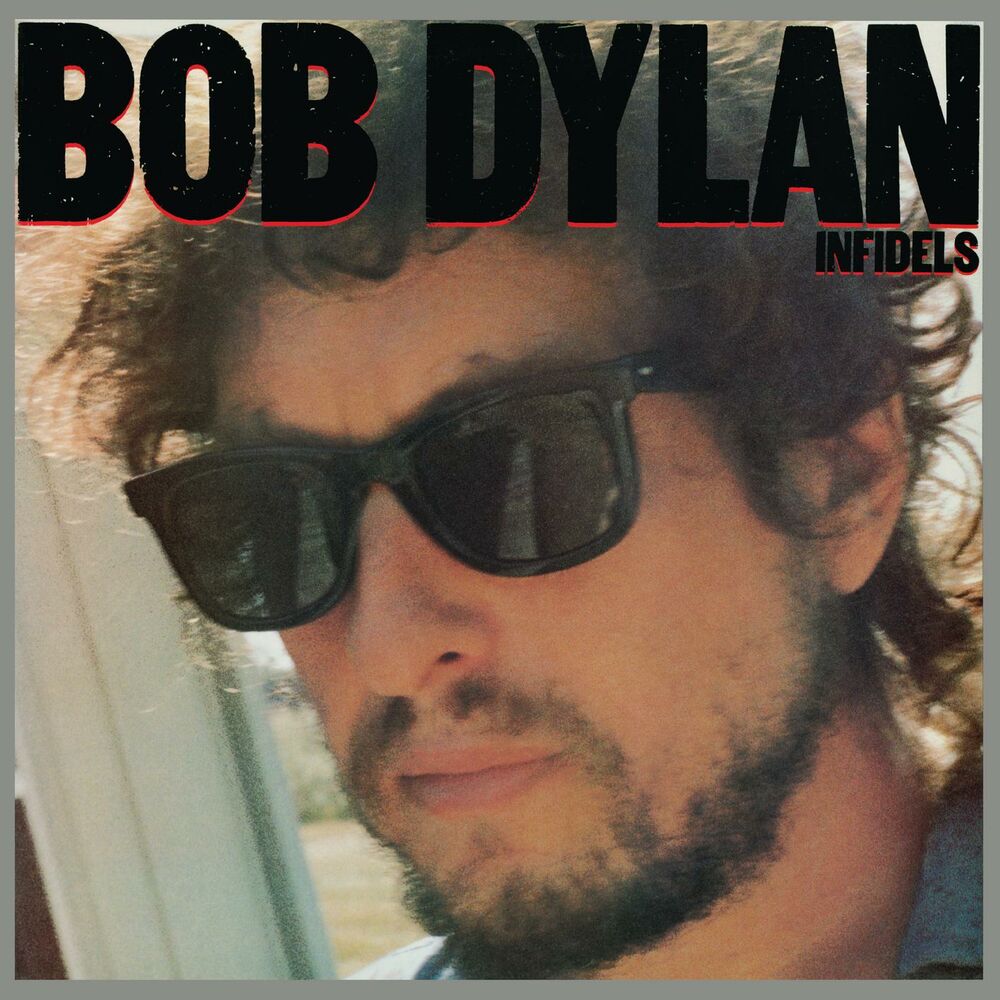
Tracklist
- Jokerman6:15
- Sweetheart Like You4:33
- Neighborhood Bully4:35
- License to Kill3:33
- Man of Peace6:30
- Union Sundown5:22
- I and I5:12
- Don't Fall Apart on Me Tonight5:54
Have you heard it?
Sign in to mark it as listened, rate it and keep notes.
The full story
Infidels is the twenty-second studio album by American singer-songwriter Bob Dylan, released on October 27, 1983, by Columbia Records. Produced by Mark Knopfler and Dylan himself, Infidels is seen as his return to secular music, following a conversion to Christianity, three evangelical records and a subsequent return to a less religious lifestyle. Though he has never entirely abandoned religious imagery, Infidels gained much attention for its focus on more personal themes of love and loss, in addition to commentary on the environment and geopolitics. Christopher Connelly of Rolling Stone called those gospel albums just prior to Infidels "lifeless", and considered Infidels to be Dylan's best poetic and melodic work since Blood on the Tracks. The critical reaction was the strongest for Dylan in years, almost universally hailed for its songwriting and performances. The album also fared well commercially, reaching No. 20 in the US and going gold, and No. 9 in the UK. The album's highest chart position worldwide was in Norway, where it peaked at No. 1. Fans and critics were disappointed that several songs were inexplicably cut from the album just prior to mastering—primarily "Blind Willie McTell", considered a career highlight by many critics, and not officially released until it appeared on The Bootleg Series Volume III eight years later. The album was recorded and mixed entirely on digital recording equipment.
Recording sessions
Infidels was produced by Dire Straits frontman Mark Knopfler, who had previously played guitar on Dylan's Slow Train Coming. Dylan initially wanted to produce the album himself, but feeling that technology had passed him by, he approached a number of contemporary artists who were more at home in a modern recording studio. David Bowie, Frank Zappa and Elvis Costello were all approached before Dylan hired Knopfler.
Knopfler said it was difficult to produce Dylan: You see people working in different ways, and it's good for you. You have to learn to adapt to the way different people work. Yes, it was strange at times with Bob. One of the great parts about production is that it demonstrates to you that you have to be flexible. Each song has its own secret that's different from another song, and each has its own life. Sometimes it has to be teased out, whereas other times it might come fast. There are no laws about songwriting or producing. It depends on what you're doing, not just who you're doing. You have to be sensitive and flexible, and it's fun. I'd say I was more disciplined. But I think Bob is much more disciplined as a writer of lyrics, as a poet. He's an absolute genius. As a singer—absolute genius. But musically, I think it’s a lot more basic. The music just tends to be a vehicle for that poetry. Once Knopfler was aboard, the two quickly assembled a team of accomplished musicians. Knopfler's own guitar playing was paired with that of Mick Taylor, a former lead guitarist of the Rolling Stones. Having been introduced to Taylor the previous summer, Dylan had developed a friendship with him that resulted in the guitarist hearing the Infidels material first during the months leading up to the April sessions. In addition, the sessions benefited from Taylor's ability as a slide guitarist. Knopfler said about the instrument he plays on Infidels: "I still haven't got a flat-top wooden acoustic, because I've never found one that was as good as the two best flat tops I ever played. One ... was a hand-built Greco that Rudy Pensa of Rudy's Music Stop lent me. I used ... the Greco on Infidels." Knopfler suggested Alan Clark for keyboards as well as engineer Neil Dorfsman, both of whom were hired. According to Knopfler, it was Dylan's idea to recruit Robbie Shakespeare and Sly Dunbar as the rhythm section. Best known as Sly & Robbie, Shakespeare and Dunbar were famed reggae producers as well as recording artists signed to Island Records. "Bob's musical ability is limited, in terms of being able to play a guitar or a piano," said Knopfler. "It's rudimentary, but it doesn't affect his variety, his sense of melody, his singing. It's all there. In fact, some of the things he plays on piano while he's singing are lovely, even though they're rudimentary. That all demonstrates the fact that you don't have to be a great technician. It's the same old story: If something is played with soul, that's what's important."
Reception
While Infidels was better received than its predecessor, Shot of Love, Graham Lock of New Musical Express still referred to Dylan as "culturally a spent force ... a confused man trying to rekindle old fires." Rolling Stone and The Village Voice critic Robert Christgau was not impressed either, writing that Dylan had "turned into a hateful crackpot". Greil Marcus dismissed it many years later as another "bad [album] that made no sense, didn't hang together, had no point, and did not need to exist". But even some of the skeptics found some merit in Infidels. In the same review, Christgau wrote, "All the wonted care Dylan has put into this album shows." Indeed, critics were unanimous in praising the overall sound, "one case where the streamlined production doesn't seem to work against the rugged authority he can still command as a singer," wrote Tim Riley. Music critic Bill Wyman conceded that "the songs are mature and complex" even though "melodically they are similar sounding and the affair as a whole still has echoes of his crackpot Christian days." Infidels would place tenth on The Village Voice's Pazz & Jop Critics Poll for 1983, Dylan's highest placement since 1975 when The Basement Tapes placed #1 and Blood on the Tracks placed #4. Years later, when outtakes like "Someone's Got a Hold of My Heart", "Blind Willie McTell" and "Foot of Pride" began to circulate, the album's stature would in some ways grow, becoming a missed opportunity at a potential masterpiece to some critics like Rob Bowman and Clinton Heylin. Without a tour in 1983, Infidels still generated modest sales, selling consistently through the Christmas shopping season. CBS even produced a music video for "Sweetheart Like You", Dylan's first in the MTV era. Steve Ripley from Dylan's Shot of Love band was one of the guitarists in the video. The female guitar player featured who mimed Mick Taylor's guitar solo is Carla Olson. This appearance led to her recording a live album with Taylor as well as numerous studio sessions with him. And Dylan gave her the unreleased song "Clean Cut Kid" for her debut album Midnight Mission (A&M Records). "Sweetheart Like You" was followed by a second video for "Jokerman", which CBS issued as a single in February 1984.
Aftermath and legacy
Dylan spent the autumn of 1983 recording demos and various songs at his home in Malibu, California. Rather than work alone, Dylan brought in a number of young musicians, including Charlie Sexton, drummer Charlie Quintana and guitarist JJ Holiday. As Heylin notes, "this was Dylan's first real dalliance with third-generation American rock & rollers." These informal sessions set the stage for Dylan's first public performances since 1982. Dylan appeared on Late Night with David Letterman on March 22, 1984. He performed with Quintana, Holiday (introduced by Letterman as "Justin Jesting"), and bassist Tony Marsico. Performing three songs with his band of post-punk musicians, the Plugz, Dylan delivered what many consider to be his most entertaining television performance ever. The combo first performed an unrehearsed version of Sonny Boy Williamson's "Don't Start Me to Talking", then a radically different arrangement of "License To Kill". The final song was a peppy, somewhat new-wave version of "Jokerman" that ended with a harmonica solo. At the end of the performance, Letterman walked onstage and congratulated Dylan, asking him if he could come back and play every Thursday. Dylan smiled and jokingly agreed.
Tracklist
- Jokerman6:15
- Sweetheart Like You4:33
- Neighborhood Bully4:35
- License to Kill3:33
- Man of Peace6:30
- Union Sundown5:22
- I and I5:12
- Don't Fall Apart on Me Tonight5:54
Listeners 0
Nobody has logged it yet. Be the first.