Tracklist
- Heroes And Villains (Remastered 2001)3:38
- Vegetables (Remastered 2001)2:06
- Fall Breaks And Back To Winter (Woody Woodpecker Symphony/Remastered 2001)2:15
- She's Goin' Bald (Remastered 2001)2:14
- Little Pad (Remastered 2001)2:29
- Good Vibrations (Remastered 2001)3:35
- With Me Tonight (Remastered 2001)2:17
- Wind Chimes (Remastered 2001)2:35
- Gettin' Hungry (Remastered 2001)2:27
- Wonderful (Remastered 2001)2:20
- Whistle In (Remastered 2001)1:04
Have you heard it?
Sign in to mark it as listened, rate it and keep notes.
The full story
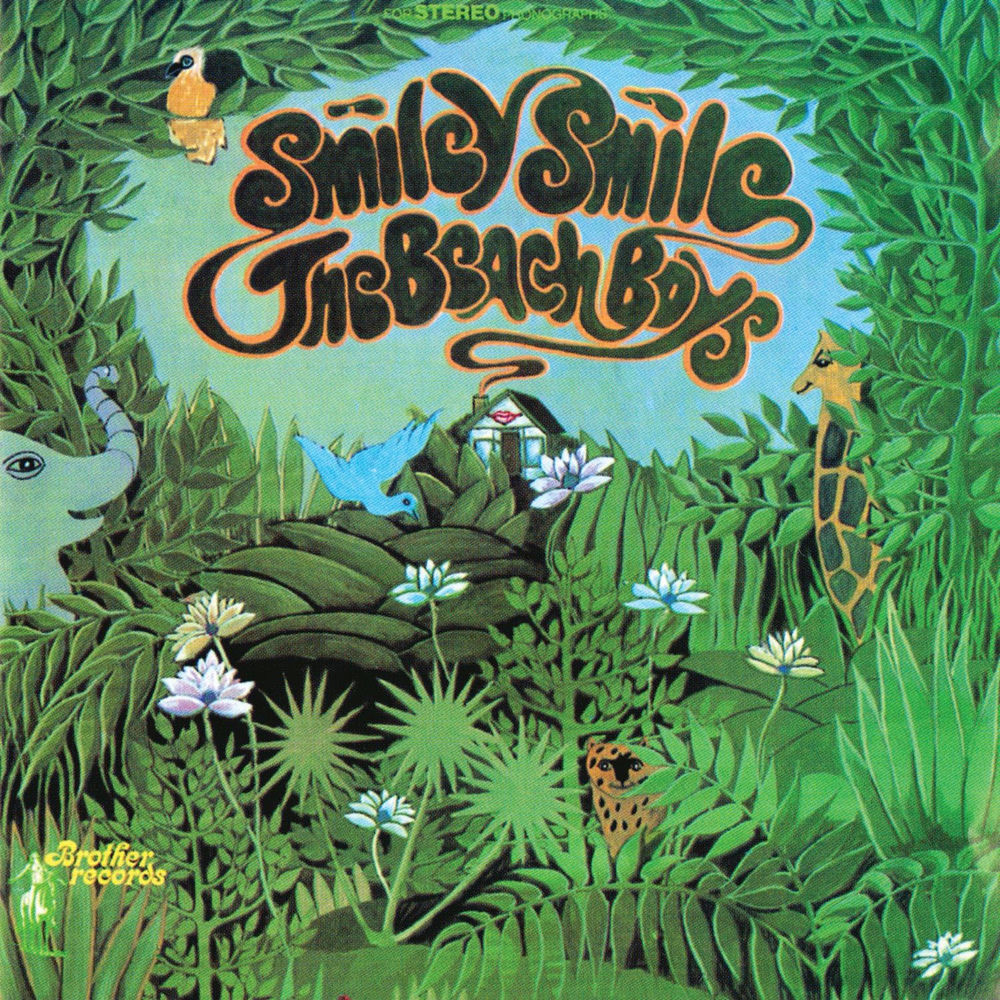
Smiley Smile is the twelfth studio album by the American rock band the Beach Boys, released on September 18, 1967. Conceived as a simpler and more relaxed version of their unfinished Smile album, Smiley Smile is distinguished for its homespun arrangements, "stoned" aesthetic, and lo-fi production. It was largely recorded in June and July 1967 at principal songwriter Brian Wilson's makeshift home studio using radio broadcasting equipment, a detuned piano, electronic bass, melodica, found objects for percussion, and a Baldwin theater organ. The unconventional recording process juxtaposed an experimental party-like atmosphere with disjointed music sequences, combining the engineering methods of "Good Vibrations" (1966) with the loose feeling of Beach Boys' Party! (1965). Despite leading these sessions, Wilson deliberately credited the album's production to the group collectively for the first time. After settling payment disputes with Capitol Records, Smiley Smile was distributed in collaboration with Brother Records, the band's new self-owned record company. Critics and fans generally received the album and its lead single, "Heroes and Villains", with confusion and disappointment. The album reached number 9 on UK record charts, but sold poorly in the U.S., peaking at number 41—the band's lowest chart placement to that point. A second single, "Gettin' Hungry", was credited to Wilson and Mike Love and failed to chart. Smile was left incomplete as the band immediately moved onto the recording of Lei'd in Hawaii, an unfinished live album with performances in the style of Smiley Smile. Smiley Smile has since become a critical and cult favorite, influencing the development of the lo-fi, ambient, and bedroom pop genres. It is often regarded as one of the finest chill-out albums for its positive effects on listeners experiencing an LSD comedown, a usage adopted by at least one drug clinic. In 1974, it was ranked number 64 in NME's list of the greatest albums of all time. Outtakes and session highlights from the album were included on the compilations The Smile Sessions (2011) and 1967 – Sunshine Tomorrow (2017).
Background
The Beach Boys' album Pet Sounds, issued on May 16, 1966, was massively influential upon its release, containing lush and sophisticated orchestral arrangements that raised the band's prestige to the top level of rock innovators. Early reviews for the album in the US ranged from negative to tentatively positive, but the reception from music journalists in the UK was very favorable. The group had recently employed the Beatles' former press officer Derek Taylor as their publicist. Bothered by the Beach Boys' popular association with surf culture, leader and songwriter Brian Wilson requested that Taylor rebrand the group, resulting in Taylor spearheading a media campaign that proclaimed Wilson to be a musical genius. In October 1966, the group followed up Pet Sounds with "Good Vibrations", a laboriously produced single that achieved major international success. By then, an album titled Smile had been conceived as an extension of that song's recording approach, with Wilson composing music in collaboration with lyricist Van Dyke Parks. Wilson envisioned Smile as an outlet for all of his intellectual occupations, such as his fascination with spirituality and its relationship to humor and laughter. He told Melody Maker: "Our new album will be better than Pet Sounds. It will be as much an improvement over Sounds as that was over [our 1965 album] Summer Days." By the end of the year, NME conducted an annual reader's poll that placed the Beach Boys as the world's top vocal group, ahead of the Beatles and the Rolling Stones.
Wilson enlisted talent manager David Anderle in the formation of Brother Records, an independent label, with the intention of giving "entirely new concepts to the recording industry, and to give the Beach Boys total creative and promotional control over their product", according to Anderle. A February 1967 lawsuit seeking $255,000 (equivalent to $2.46 million in 2025) was launched against Capitol Records over neglected royalty payments. Within the lawsuit, there was also an attempt to terminate the band's contract with Capitol before its November 1969 expiration. In April 1967, Wilson and his wife put their Beverly Hills home up for sale and took residence at a newly purchased mansion in Bel Air. Wilson also set to work on constructing a personal home studio. Parks permanently withdrew from the project in April, with Anderle following suit weeks later. Between mid-April and early May, Wilson took a four-week break from studio recording. On April 26, Carl Wilson was arrested for refusing his draft into the US Army and later released on bail. On April 28, in an effort to promote the group's upcoming UK tour, EMI issued the single "Then I Kissed Her" to the chagrin of the band, who did not approve the release. On May 6, a week after stating that Smile was to be released "any moment", Taylor announced in Disc & Music Echo that the album had been "scrapped" by Wilson. However, Taylor's assertion of the album's cancellation at that point was likely to be spurious. The Beach Boys were still under pressure and a contractual obligation to deliver an album to Capitol. For most of May, the touring group embarked on a run of shows in Europe while Brian resumed scheduling recording sessions at professional studios, some of which were cancelled on short notice.
Throughout 1967, Wilson's public image was reduced to that of an "eccentric" figure as a multitude of revolutionary rock albums were released to an anxious and maturing youth market. For a time, the Beach Boys had been the Beatles' chief rivals, and Wilson was concerned that if Smile followed in the wake of another critically successful release by the Beatles, then his album would be received with unjust comparisons. His race was effectively lost when the Beatles released Sgt. Pepper's Lonely Hearts Club Band (May 1967). By June, Wilson declared to his bandmates that most of the material recorded for Smile would be abandoned. In an interview conducted in January 1968, he …
Modular approach and recording atmosphere
Since the recording of "Good Vibrations" in 1966, Wilson had established a new method of operation. Instead of working on whole songs with clear large-scale syntactical structures, Wilson limited himself to recording short interchangeable fragments (or "modules"). Through the method of tape splicing, each fragment could then be assembled into a linear sequence, allowing any number of larger structures and divergent moods to be produced at a later time. Smiley Smile continued this approach. The album also continued Brian's exploration of "party tracks"—a form of music which includes the sounds of people shouting and making noises, as if at a party. Brian had enacted this approach with Beach Boys' Party! in 1965, thereby mixing that record's style with the modular composition method he devised for "Good Vibrations".
Most of Smiley Smile was recorded at Brian's improvised home studio from June 3 to July 14, 1967. The group had held a few of the early sessions at Hollywood Sound Recorders and Western Studios. All sessions after June 11 were conducted at the home studio. The core instrumentation at these sessions consisted of organ, honky-tonk piano, and electronic bass played by the Beach Boys themselves, rather than the session musicians employed in much of their previous work. Brian became obsessed with his electric theatre organ during the album's recording, specifically, the Baldwin HT-2 model, usually with minimum use of the instrument's stops, resulting in a more minimalist approach to the new arrangements. Most of the piano was played by Brian, and most of the bass was played by Carl. It was the first album for which production was credited to the entire group, instead of Brian alone. Dennis Wilson explained: "He wanted it that way. He said 'It's produced by the Beach Boys.'" When asked if Brian was "still the producer of Smiley Smile", Carl answered, "Most definitely." He described Smiley Smile as an improvised, low-effort affair that was "more like a 'jam' album." Brian acknowledged: "We had done about six months work on another thing, but we jumped and ended up doing the entire thing here at the house with an entirely different mood and approach than what we originally started out with." When questioned on why the band took the approach they did, he stated, "We just had a particular atmosphere that we were working in that inspired the particular kind of things that were on the album." He said that he did not "have any paranoia feelings" recording the album: "[W]e had so much fun. The Smiley Smile era was so great, it was unbelievable. Personally, spiritually, everything, it was great."
According to music theorist Daniel Harrison, Smiley Smile is not a work of rock music as the term was understood in 1967, and that portions of the album "can be thought of as a kind of protominimal rock music". In his book about psychedelic music, author Jim DeRogatis referred to Smiley Smile as a work of the "ultimate psychedelic rock library". Conversely, Stylus Magazine's Edwin Faust wrote in 2003 that the album "embraces the listener with a drugged out sincerity; a feat never accomplished by the more pretentious and heavy-handed psychedelia of that era. It is for this reason Smiley Smile flows so well with the more experimental pop of today". Mike Love, recalling how "She's Goin' Bald" had been written about fellatio, commented: "We were stoned out of our heads. We were laughing our asses off when we recorded that stuff." Dennis remembered the album as "the most fun thing we ever did." Bruce Johnston did not participate in most of these sessions and later called the work "very spacy" and "weird", but "so subtle and so damn innovative."
Release
The Beach Boys were initially involved in the conception of the Monterey Pop Festival, which was held in June 1967. At the last minute, the band announced that they could not appear at the festival for reasons pertaining to Carl's military draft and their commitments to finish "Heroes and Villains" for Capitol. Derek Taylor, who had terminated his employment with the group to focus on the festival's organization, remembered that dropping out of the program "undoubtedly set the band in a very bad light. They were certainly heavily criticized at the time for it. It seemed rather like an admission of defeat." Biographer David Leaf explained: "Monterey was a gathering place for the 'far out' sounds of the 'new' rock ... and it is thought that this non-appearance was what really turned the 'underground' tide against them." Detractors referred to the band as the "Bleach Boys" and "the California Hypes" as the media focus shifted from Los Angeles to the happenings in San Francisco.
The Capitol lawsuit was eventually settled out of court, with the Beach Boys receiving the royalties owed in exchange for Brother Records to distribute through Capitol Records, along with a guarantee that the band produce at least one million dollars profit. An official announcement of the resolution was made on July 18. Capitol A&R director Karl Engemann began circulating a memo, dated July 25, in which Smiley Smile was referred to as a stopgap for Smile. The memo also discussed conversations between him and Wilson pertaining to the release of a 10-track Smile album, which would not have included the songs "Heroes and Villains" or "Vegetables". In July, two singles were issued on the Brother imprint: "Heroes and Villains" and "Gettin' Hungry". The former peaked at number 12 on the Billboard Hot 100. The latter was not credited to the Beach Boys, but instead to Brian Wilson and Mike Love. Smile was never delivered; instead, the group played two shows at an auditorium in Honolulu, which were filmed and recorded with the intention of releasing a live album, Lei'd in Hawaii. On stage, the band performed "Heroes and Villains" and "Gettin' Hungry", and rearranged their past hits in the style of Smiley Smile. Bruce Johnston, who was absent for most of the Smiley Smile recording sessions, did not accompany the group, although Brian did. In early August, Johnston told the British press that he had heard Smiley Smile, and when asked about Smile, said that the album would be released "within the next two months." On September 18, 1967, Smiley Smile was released in the US. The LP peaked at number 41 on the Billboard charts, making it their worst-selling album to that date. It spent most of its 21-week chart time bubbling under 100 and 197. When released in the UK in November, it performed better, reaching number 9 on the Record Retailer LPs Chart. During their annual Thanksgiving tour of the US, the band did not perform any of the tracks on Smiley Smile except "Good Vibrations". In a December interview, Mike Love acknowledged that Smiley Smile had "baffled and mystified" the public and that the band "had this feeling that we were going too far, losing touch I guess." He promised that their next album, then slated to be Wild Honey, would bring the group "back more into reality".
Aftermath and archival releases
Smiley Smile became the first in a trilogy of lo-fi Beach Boys albums (preceding Wild Honey and Friends) and the first in a seven-year string of under-performing Beach Boys albums (ending with the 1974 compilation Endless Summer). The Smile era is generally viewed as the ending of the Beach Boys' most artistically creative period, and the point after which Brian began gradually relinquishing his hold as the group's creative leader. Commenting on Smiley Smile in retrospect, Bruce Johnston said it was "a thousand times better than the [original Smile] ... It's just the most underrated album in the whole catalog for me." Dennis Wilson said, "It was not as ambitious as Pet Sounds was. But ... I listened to it in a jungle in Africa and it sounded great." Conversely, Al Jardine felt that "there are some pretty cool songs on that album but I didn't like rehashing some of the Smile songs. That didn't work for me." Mike Love wrote, "Some of the songs we recorded could barely be called songs. They were chants, spacey fragments, weird sound effects. Every group produces at least one bad album ... I don't think Brian wanted to be associated with it either." Much of the group's subsequent recordings from 1967 to 1970 followed similar experimental traditions as Smiley Smile – namely, through sparse instrumentation, a more relaxed ensemble, and a seeming inattention to production quality. Numerous session musicians have reported that the Beach Boys had not been a distraction to Brian's workflow when recording at established studios, but once the group made the home studio their primary base of operations, his bandmates became more integrated in the band's creative decisions. Carl took Brian's place as the most musically dominant member, and Brian would not be credited as producer for another Beach Boys album until 1976's 15 Big Ones. Smile material continued to trickle out in later releases, often as filler songs to offset Brian's unwillingness to contribute. "Cool, Cool Water", an outtake from Smiley Smile and Wild Honey sessions, was partially rerecorded and issued as the closing track for Sunflower (1970). When The Smile Sessions box set was released in 2011, co-producer Mark Linett acknowledged that "there's things that some people think – should Smiley Smile sessions be there – [with tracks such as] 'Can't Wait Too Long', we get into a very fuzzy area". In 2017, additional session highlights from the album were released on the rarities compilation 1967 – Sunshine Tomorrow. The compilation was followed several months later with two more digital-exclusive releases: 1967 – Sunshine Tomorrow 2: The Studio Sessions and 1967 – Live Sunshine.
Impact and legacy
In later years, Smiley Smile became celebrated as one of the finest chill-out albums, and one that is suited for listening during an LSD comedown. At least one drug treatment center adopted the LP as a tool for comforting patients. Carl Wilson mentioned this clinic, located in Fort Worth, Texas, to the NME in 1970, saying, "They don't use any traditional medical treatment whatsoever. All they do is play the patient our Smiley Smile album and apparently this acts as a soothing remedy which relaxes them and helps them to recover completely from their trip."
Music theorist Daniel Harrison writes that Smiley Smile may be regarded as a piece akin to art music within the Western classical tradition, highlighting its pioneering contributions to the rock genre as comparable to the introduction of unconventional techniques, such as atonality, in classical music. Writing in 1971, Richard Williams felt that the album's disjointed and fragmentary approach had "all the epigrammatic, enigmatic power of Japanese haiku", containing 'passages written in the conditional tense (i.e. the songs move easily between reality and fantasy), a technique evolved by Godard in the cinema and which only Wilson, as far as I know, has picked up in pop."
Smiley Smile was one of 100 albums featured in the 2000 book The Ambient Century as a chapter in the development of ambient music. Pitchfork contributor Mark Richardson wrote that the record "basically invented the kind of lo-fi bedroom pop that would later propel Sebadoh, Animal Collective, and other characters." The New York Observer's Ron Hart wrote that Smiley Smile had effectively presaged the work of Harry Nilsson, Elvis Costello, Stereolab, the High Llamas, the Olivia Tremor Control, and Father John Misty. Dedicated tribute albums include Smiling Pets (1998) and Portland Sings The Beach Boys "Smiley Smile" (2013). Other admirers of the album have included Pete Townshend of the Who and Robbie Robertson of the Band. XTC's Andy Partridge considered it one of "the most influential records for me" and it was a direct inspiration for his song "Season Cycle" (Skylarking, 1986). In an interview with Time, Steven Tyler of Aerosmith stated that his "island" music picks include Smiley Smile, "Just for the melodic fuck all." Keiichi Suzuki and Hirokazu Tanaka, composers for the Japanese role-playing video game series Mother, cited Smiley Smile among influences on the games' soundtracks. Comedian Trevor Moore stated that the theme song for his troupe's television show, The Whitest Kids U' Know, was based on "Little Pad", which itself had been used as the opening theme for their live shows.
Tracklist
- Heroes And Villains (Remastered 2001)3:38
- Vegetables (Remastered 2001)2:06
- Fall Breaks And Back To Winter (Woody Woodpecker Symphony/Remastered 2001)2:15
- She's Goin' Bald (Remastered 2001)2:14
- Little Pad (Remastered 2001)2:29
- Good Vibrations (Remastered 2001)3:35
- With Me Tonight (Remastered 2001)2:17
- Wind Chimes (Remastered 2001)2:35
- Gettin' Hungry (Remastered 2001)2:27
- Wonderful (Remastered 2001)2:20
- Whistle In (Remastered 2001)1:04
Listeners 0
Nobody has logged it yet. Be the first.