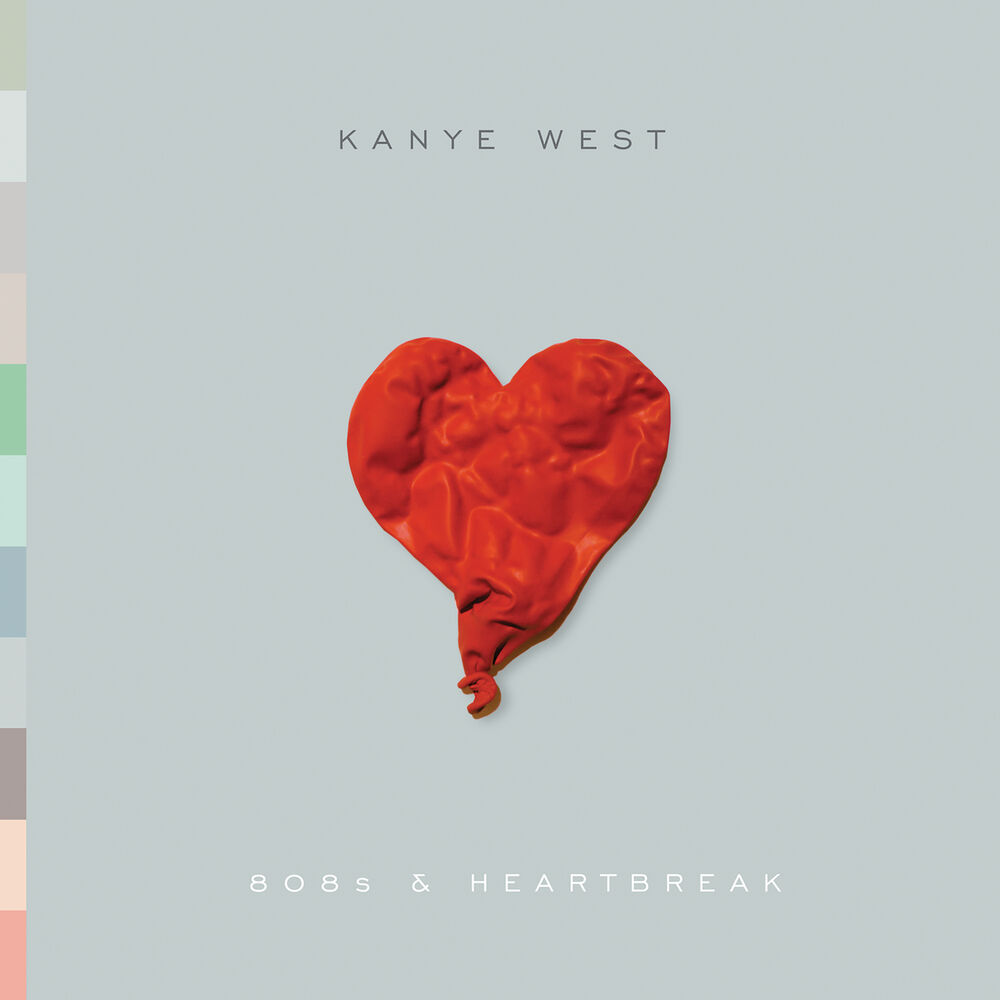
The album was recorded over a span of approximately three weeks from September to October 2008. Recording sessions took place at Glenwood Studios in Burbank, California and at Avex Recording Studio in Honolulu, Hawaii. The 808 of the title is a reference to the Roland TR-808 drum machine, used heavily in the album. Drawing inspiration from 1980s synth-pop and electropop performers such as Phil Collins, Gary Numan, TJ Swan, and Boy George, West felt that the 808 was a resourceful instrument that could be used to evoke emotion; the concept was introduced to him by Jon Brion. West utilized the sounds created by the 808 and manipulated its pitch to produce a distorted, electronic sound, an effect he referred to as "heartbreak". He felt the characteristic of the sound was representative of his state of mind. According to West, the fact that Hawaii's area code was "808" was coincidental, as he had already developed the album's title before being informed. The realization inspired him to pursue his direction with the album, however. In terms of musical direction, West's intentions, according to Mike Dean, were to defy the typical sound of hip-hop beats, instead evoking the presence of tribal drums. Overall, West maintained a "minimal but functional" approach to producing the album.
West credits rapper Kid Cudi, who had signed to his GOOD Music record label, with helping create the album's stark, brooding sound. After receiving a copy of his 2008 mixtape A Kid Named Cudi, West became an avid fan, especially of the hit single "Day 'n' Nite". West surprised Kid Cudi with a phone call and asked him to fly to Hawaii to work on 808s & Heartbreak. The pair worked together in the studio while having films such as Close Encounters of the Third Kind play silently in the background. Ultimately, Kid Cudi co-wrote four songs on 808s & Heartbreak, the first being the chorus for "Heartless". West told Rolling Stone, "His writing is just so pure and natural and important. [That's] more important than where things chart." No I.D., West's collaborator and former mentor, added that tracks for the album also originated from their concurrent recording for Jay-Z's The Blueprint 3 (2009). "Matter of fact, when we did 'Heartless,' [West] just stopped and said, 'No.' I was like, 'No what?' He was like, 'No way! This is my record!'", as No I.D. recalled. "I was like, 'Come on, man. Can we just finish the guy's album?' He was like, 'Nope. I'm doing an album.'"
For his vocals on 808s & Heartbreak, West employed the voice-audio processor technology of Auto-Tune. He had experimented with it on his 2004 debut album The College Dropout, specifically the background vocals of "Jesus Walks" and "Never Let Me Down", but he had not used the technology for lead vocals until 2008. "We were working on the remixes for Lil Wayne's 'Lollipop' and Young Jeezy's 'Put On' and he fell in love with the Auto-Tune", producer Mike Dean recalled. Towards the end, West enlisted T-Pain for coaching on how to utilize the technology. In an interview with Billboard, T-Pain said that West told him he had listened to his debut album Rappa Ternt Sanga (2005) before making 808s & Heartbreak. T-Pain also claimed that West brought him in to make 808s sound more like his debut album. West stated that he loved using Auto-Tune and dismissed notions from those who did not like the technology. At a listening event, he considered it "the funnest thing to use". West went on to state that he appreciates how Auto-Tune makes it clear when he sings off-key, enabling him to "sing more perfect".
Young Jeezy contributed a rap verse on the track "Amazing" while "See You in My Nightmares" is a duet with Lil Wayne. Singer-songwriter Esthero provided the few female vocals found on the album; credited under birth name Jenny-Bea Englishman, she co-wrote three tracks. When "RoboCop" appeared on the Internet, West disclaimed responsibility and was upset that the leak had occurred as the track was an unfinished …