João's Music Archive
Both Directions at Once: The Lost Album
← Back to the lists

Both Directions at Once: The Lost Album

John Coltrane
June 29, 2018
Impulse Records
14 tracks, 1 h 28 min
Rating
–
Not heard yet
110
–Archive
88Critics
0Listeners
Average score 88Metacritic 90AOTY 87Pitchfork 8.68 reviews

Tracklist

  1. Untitled Original 11383 (Take 1)5:41
  2. Nature Boy3:23
  3. Untitled Original 113868:43
  4. Vilia (Take 3)5:32
  5. Impressions (Take 3)4:36
  6. Slow Blues11:28
  7. One Up, One Down (Take 1)8:01
  8. Vilia (Take 5)4:37
  9. Impressions (Take 1)4:06
  10. Impressions (Take 2)4:37
  11. Impressions (Take 4)3:40
  12. Untitled Original 11386 (Take 2)8:41
  13. Untitled Original 11386 (Take 5)8:23
  14. One Up, One Down (Take 6)7:17
Listen on

Have you heard it?

Sign in to mark it as listened, rate it and keep notes.

About the artist

John Coltrane was an American jazz saxophonist, bandleader, and composer, considered one of the most influential figures in jazz history. He pioneered the use of modes and was at the forefront of free jazz, with his music often taking on a spiritual dimension.

About the album

Both Directions at Once is a studio album recorded in 1963 by John Coltrane's Classic Quartet, featuring Jimmy Garrison, Elvin Jones, and McCoy Tyner. Lost for decades, these recordings offer an unvarnished portrait of the iconic band at work, finally released in 2018.

Meanings

The album's title comes from Wayne Shorter's recollection of Coltrane describing his musical aim as "starting a sentence in the middle, and then going to the beginning and the end of it at the same time." This phrase, "both directions at once," encapsulates Coltrane's ambitious and complex approach to music-making.

Why it's rated so high

Critics hailed the album as a "missing link" and a "key transitional document," offering significant insights into the John Coltrane Quartet's highly charged sound. It provides a fresh look at Coltrane's evolution, enhancing understanding of how the group progressed towards later masterpieces like A Love Supreme.

Career and historical context

This album captures Coltrane and his Classic Quartet in March 1963, during a prolific period and just before their famous recording with Johnny Hartman. It offers a rare glimpse into the band's working process, reflecting the breadth of what they were delivering onstage at that time.

Fun facts

  • The recordings were made on the last day of a two-week stint at Birdland.
  • Impulse! Records destroyed the master tape to save on storage space.
  • The album survived as a copy Coltrane gave to his first wife, Juanita Naima.
  • Coltrane's son Ravi helped assemble the final album for release.
  • The record company acquired the tapes after an auction house announced their sale.
Written by AI from the album's and artist's Wikipedia articles and the archive's notes. Double-check anything important.

The full story

Both Directions at Once: The Lost Album is a studio album recorded by American jazz saxophonist John Coltrane for Impulse! Records and released in 2018. The recordings were made in 1963 during Coltrane's Classic Quartet period but lost for decades.

Background and recording

Both Directions at Once was recorded at Van Gelder Studio in New Jersey on March 6, 1963, by saxophonist John Coltrane and his Quartet: double bassist Jimmy Garrison, drummer Elvin Jones and pianist McCoy Tyner. The session took place on the last day of a two-week stint at Birdland. The next day, the group would join singer Johnny Hartman for the recording of John Coltrane and Johnny Hartman. To cut down on storage space, Impulse! Records destroyed the master tape, and the recording was lost for decades. The seven tracks on Both Directions survived as a copy Coltrane gave to his first wife, Juanita Naima. Van Gelder made a separate copy for Coltrane to listen to at home. In 2005, after the Guernsey's auction house announced plans to sell Coltrane-related artifacts, the record company intervened to acquire the tapes. Coltrane's son Ravi and studio executive Ken Druker assembled the final album with liner notes written by Ashley Kahn. Ravi recalled that he and the others involved in the preparation of the album were "over the moon," and commented: "We spend our lives following these players, recording, studying them, transcribing them – you go at the new material like it's sustenance." The album's title came from a recollection by Wayne Shorter, who stated that at one point, Coltrane told him that what he was attempting to achieve musically was "starting a sentence in the middle, and then going to the beginning and the end of it at the same time... both directions at once."

Critical reception

Giovanni Russonello of The New York Times noted that, on the album, "we hear something close to the breadth of what Coltrane and his associates were delivering onstage," and commented: "the band was working in its own lingua franca, basically playing a version of its live set. Even more than on the album Coltrane from a year before, we can feel how closely connected these musicians... had become, and how combustive those live moments must have been." Marc Myers, in an article for The Wall Street Journal, stated that the release "provides significant insights into the highly charged sound of the John Coltrane Quartet," and concluded that "it's impossible not to hear the feeling of Both Directions in Coltrane's solos on his Johnny Hartman album. The two are now forever linked." Writing for Spin, Winston Cook-Wilson remarked: "Both Directions at Once... speaks to Coltrane's humility as a stylist, and the reason why he is revered by jazz fans of all persuasions, including anyone who only knows the bare minimum number of albums. If it's not Giant Steps, the album that type of casual Coltrane fan knows is A Love Supreme. Both Directions at Once definitely isn't Supreme, but it enhances our understanding of how that group of musicians came to make it." In a review for Rolling Stone, Hank Shteamer wrote: "Don't expect a readymade masterpiece... better to view The Lost Album as a key transitional document. For the die-hards... it's another small but crucial puzzle piece in the group's still-stunning evolution during its roughly three-year lifespan. For everyone else, it's an unvarnished, day-in-the-life portrait of an icon – and the three musical giants that helped him achieve that status – at work." Richard Brody, writing for The New Yorker, found the album "moving and illuminating, as it fills in some of the background and middle range of Coltrane's career," but stated: "it doesn't hold a place in the foreground of his career or his discography. The very fact of its rediscovery and release is wondrous, and I wouldn't want to be without it. For those who listen to much Coltrane, it's a significant and valuable supplement. For those who don't, I suspect that it's likelier to inspire admiration rather than excitement, interest rather than love." In an article for The Guardian, Geoff Dyer stated: "Coltrane's quartet... come powering out of the blocks. So completely were they living within the process of music-making that they could pick things up at a moment's notice... The result is not likely to be high on any list of jazz essentials but it illustrates how the forward momentum of creative expression was harnessed, at this point, by a constant desire to maintain and extend the commercial success achieved a couple of years earlier by My Favorite Things." Writing for Variety, Chris Morris commented: "At its heart, Both Directions at Once is a portrait of an artist and a band on the brink of a historic explosion. The bracing, probing, self-questioning and keenly played music on this collection is the missing link between the provisional work heard on 1962's Coltrane and the quartet's epochal studio albums... that would follow in 1964-65. Is its belated arrival a godsend? Absolutely." Coltrane biographer Ben Ratliff noted: "The music does not seem, in its context, to be a full step forward. It's a little caught between shoring up and surging forth... It can give you new respect for the rigor, compression, and balance of some of his other albums from the period... It is possible to take in Both Directions at Once, some of it middling by Coltrane's standards and some of it extraordinary by anyone's, without much thought about sellability or progress. In an ideal case, both qualities are overrated anyway. This is an ideal case." In a review for JazzTimes, Michael J. West remarked: "the music is remarkable and revelatory. It offers a fresh new look at how Coltrane was evolving at a previously underdocumented moment in his artistry, and adds …
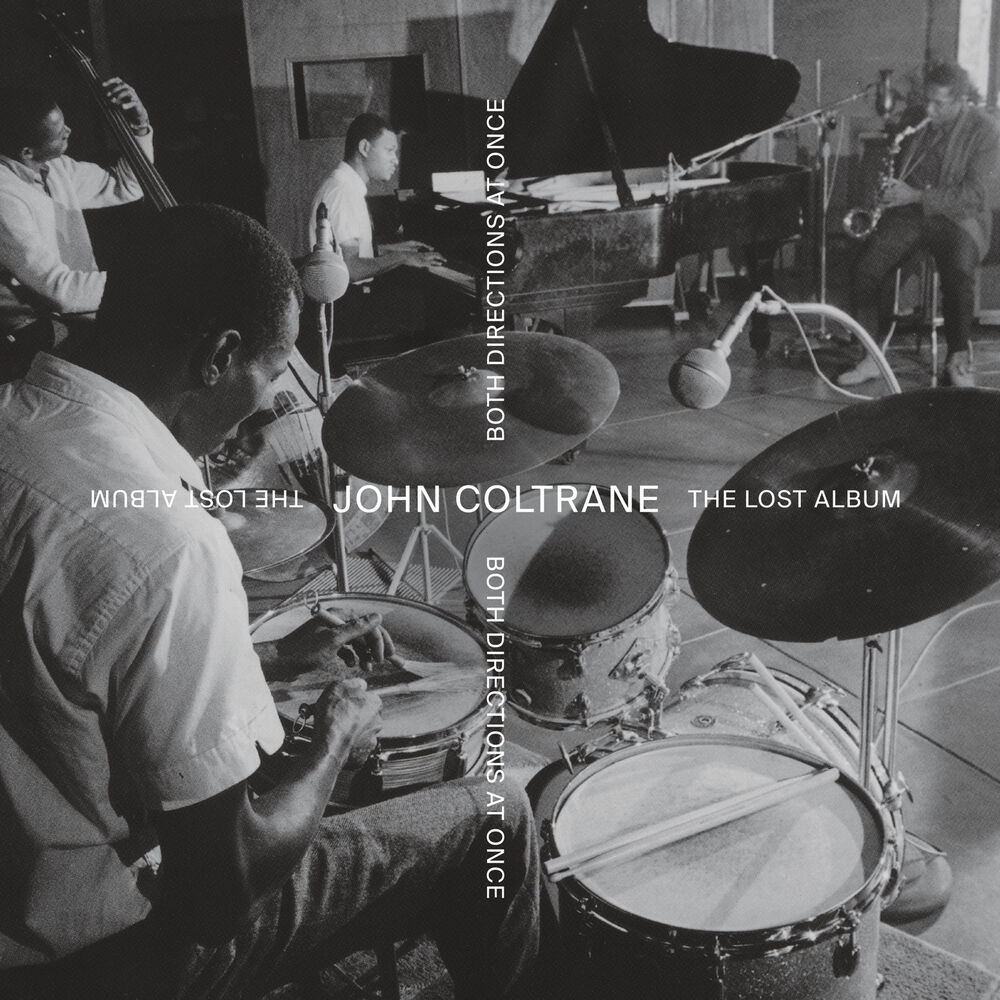
From the Wikipedia article Both Directions at Once: The Lost Album, available under CC BY-SA 4.0.

Tracklist

  1. Untitled Original 11383 (Take 1)5:41
  2. Nature Boy3:23
  3. Untitled Original 113868:43
  4. Vilia (Take 3)5:32
  5. Impressions (Take 3)4:36
  6. Slow Blues11:28
  7. One Up, One Down (Take 1)8:01
  8. Vilia (Take 5)4:37
  9. Impressions (Take 1)4:06
  10. Impressions (Take 2)4:37
  11. Impressions (Take 4)3:40
  12. Untitled Original 11386 (Take 2)8:41
  13. Untitled Original 11386 (Take 5)8:23
  14. One Up, One Down (Take 6)7:17

Listeners 0

Nobody has logged it yet. Be the first.

Log a listen