Sign in to mark it as listened, rate it and keep notes.
About the artist
The Velvet Underground was an American rock band formed in New York City in 1964. They became known for their integration of rock and roll and the avant-garde, which earned them little commercial success during their initial nine-year run but made them one of the most influential bands of their era, particularly in underground, experimental, and alternative music scenes.
About the album
White Light/White Heat is the second studio album by the American rock band the Velvet Underground. Released on January 30, 1968, by Verve Records, it was the band's last studio album with multi-instrumentalist and founding member John Cale.
Meanings
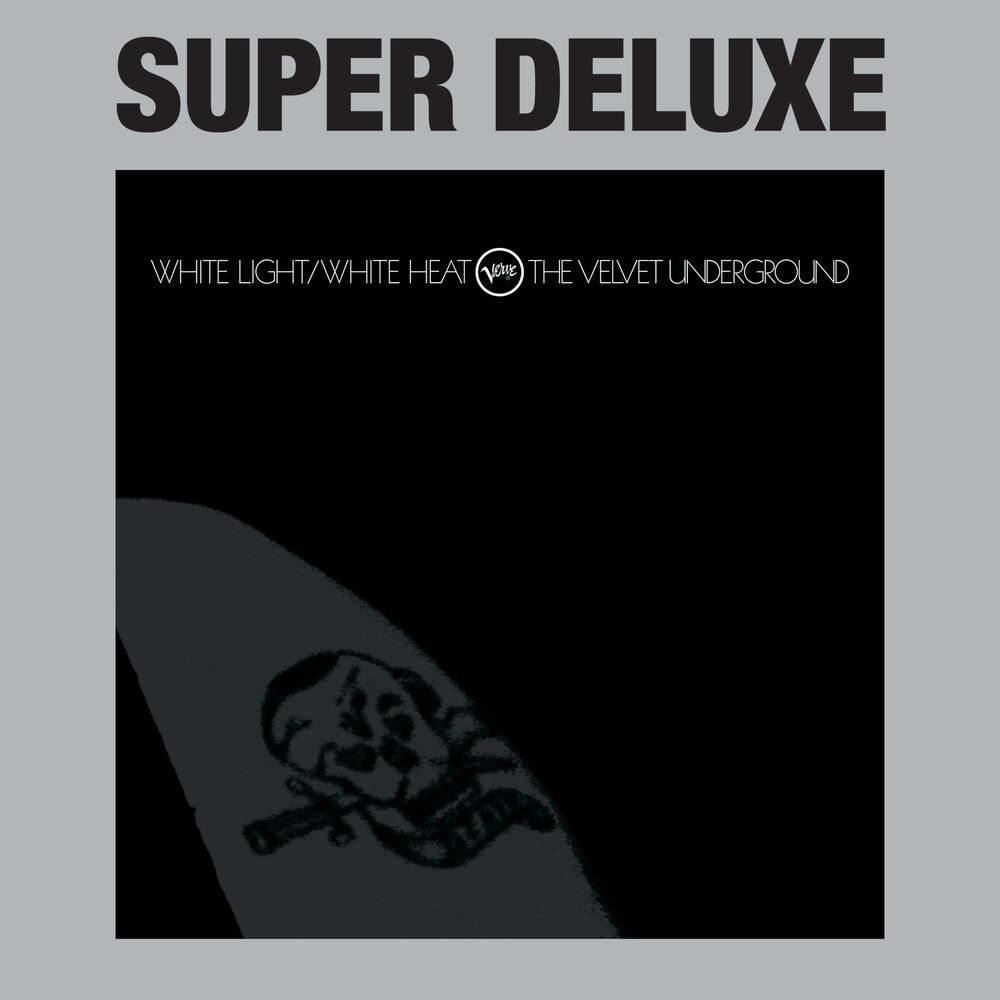
The original album cover for White Light/White Heat is a faint image of a tattoo of a skull. The tattoo was that of Joe Spencer, who played the lead role in Warhol's 1967 film Bike Boy. Spencer starred as a hustler in a motorcycle gang and is seen taking a shower in the movie.
Why it's rated so high
Like other releases by the group, the lyrical themes and avant-garde instrumentation of White Light/White Heat did not resonate with mainstream audiences at the time. For example, Rolling Stone refused to review the record. Though Billboard predicted that the album would become a hot-seller for record stores catering to underground acts, it only briefly appeared on the Billboard Top LPs chart.
Career and historical context
After the disappointing sales of the Velvet Underground's first album, The Velvet Underground & Nico (1967), their relationship with Andy Warhol deteriorated. They toured throughout most of 1967, and many of their live performances featured noisy improvisations that would form a model for White Light/White Heat. The band fired Warhol, parted ways with Nico (which she would describe as being fired), and recorded their second album with Tom Wilson credited as producer.
Taken from Wikipedia (CC BY-SA 4.0).
The full story
White Light/White Heat is the second studio album by the American rock band the Velvet Underground. Released on January 30, 1968, by Verve Records, it was the band's last studio album with multi-instrumentalist and founding member John Cale. Recorded after band leader Lou Reed fired Andy Warhol, who had produced their debut album The Velvet Underground & Nico, they hired Steve Sesnick as their new manager and Tom Wilson, who had worked on the band's debut, to produce the album. White Light/White Heat was engineered by Gary Kellgren.
Like The Velvet Underground & Nico, the album includes lyrically transgressive themes, exploring topics such as sex, amphetamines, and drag queens. Reed was inspired by a variety of authors, including William S. Burroughs and Alice Bailey, and the lyrics create a cast of characters, such as in "The Gift" and "Sister Ray". Musically, he took influence from avant-garde jazz musicians such as Ornette Coleman. Warhol conceived the album's cover art, although he is officially uncredited.
White Light/White Heat was recorded quickly and modeled after the band's live sound and techniques of improvisation, since they often played loud with new equipment from an endorsement deal with Vox. The final product was compressed and distorted as a result; most of the band was dissatisfied with this, and the album was followed with the less experimental The Velvet Underground the following year. Reed had Cale fired later in 1968. The album's extensive use of distortion became a prototype for later punk rock, shoegaze, and noise rock. The 17-minute "Sister Ray" is widely considered the standout track by critics and fans.
White Light/White Heat sold fewer copies than The Velvet Underground & Nico, and peaked at 199 on the Billboard Top LPs chart. The album's only single, "White Light/White Heat", failed to chart, which the band blamed on airplay bans and lack of promotion from Verve. The album was dismissed by many contemporary mainstream music critics, although underground newspapers took notice; ultimately, White Light/White Heat had a significant impact on the development of punk rock and no wave and has appeared on several lists of the greatest albums of all time, including being placed at number 272 on Rolling Stone's list of the "500 Greatest Albums of all Time" in 2020.
Background
After the disappointing sales of the Velvet Underground's first album, The Velvet Underground & Nico (1967), their relationship with Andy Warhol deteriorated. They toured throughout most of 1967, and many of their live performances featured noisy improvisations that would form a model for White Light/White Heat. The band fired Warhol, parted ways with Nico (which she would describe as being fired), and recorded their second album with Tom Wilson credited as producer. Jack Donohue, writing for The Tech (the student newspaper of MIT), would be one of the first to announce that the band were working on a follow-up. The band had access to new equipment through an endorsement deal with Vox. The sound of the album was designed to be a conscious antithesis to the psychedelic Summer of Love in San Francisco and also to capture their live sound.
Steve Sesnick was chosen as the replacement manager for the band, and he was accepted by all band members except John Cale; drummer Moe Tucker even considered him a fifth member of the group. The album was influenced by Lou Reed's obsession with astrology, especially his interest in the Virgo-Pisces astrological opposition. Rehearsal was similar to the band's debut, with the band's best pieces being reworked mostly in the studio. However, Cale would state that no one in the band "had the patience to rehearse" the album, even after numerous attempts to do so.
Recording
The album was recorded in a short time frame, and with a noticeably different style from that of The Velvet Underground & Nico. Decades after its release, John Cale (in the liner notes of Peel Slowly and See) described White Light/White Heat as "a very rabid record ... The first one had some gentility, some beauty. The second one was consciously anti-beauty." Sterling Morrison recalled: "We were all pulling in the same direction. We may have been dragging each other off a cliff, but we were all definitely going in the same direction." Tucker estimated that the album took two weeks to record across about seven sessions. It was "almost" recorded in one day—the band would not "accommodate what [they] were trying to do due to the limitations of the studio", according to Morrison. They were well prepared, and the tension between Cale and Reed was not apparent in the studio.
White Light/White Heat was recorded in September 1967 at Mayfair Sound Studios on Seventh Avenue in Manhattan, with work to form its songs being done in the previous summer. The band specifically passed on songs that sounded gentler—though Cale also said that the band simply did not have enough songs prepared for recording, which led to a reduced track list. White Light/White Heat would have far more involvement from Wilson, who originally only produced "Sunday Morning" on The Velvet Underground & Nico; however, he would not participate heavily, as he would talk to his girlfriends for most of the studio time.
Reed wanted to go "as high and as hard as we could". At the time, Reed played a 12-string guitar, Gibson, and Epiphone guitars; he also used Vox amplifiers. The band also used Vox distortion pedals to the fullest extent; recording engineer Gary Kellgren reportedly said "you can't do it – all the needles are on red" during the recording sessions. To get the sound of a character receiving a blade through their skull in "The Gift", Reed stabbed or smashed a cantaloupe at the request of Frank Zappa, who was recording in the same studio. For "Sister Ray", the band worked individually instead of coordinating together, and Tucker's drums were drowned out due to the level of noise. The song was recorded in one take to prevent the disjunct sound that the band felt had characterized "Heroin" on the previous record. Tucker was disappointed with the final product, as Wilson forgot to turn on some of her drum microphones while recording. According to Reed, Kellgren walked out during the recording of "Sister Ray" and waited for the band to call him back in after they were done playing.
"I Heard Her Call My Name" was remixed by Reed after the recording process to boost his vocals, which Tucker said ruined the sound of the song. Morrison considered the album a technical failure, additionally citing "I Heard Her Call My Name"; he would quit the band for several days in response. While mixing the album, Reed discovered extensive distortion since the band played too loudly, which they did not have enough studio time to resolve. Cale said the band had not considered how playing at such a volume would affect the technical quality of the record, and Morrison concluded that it was "doomed" due to its level of distortion and compression. Before its release, Wilson resigned from MGM Records, the owner of the band's label at the time, and would never work with the band again.
Release
The title track "White Light/White Heat" was released as a single in November 1967 but failed commercially. The B-side was "Here She Comes Now"; these tracks are the two shortest tracks on the album. The band claimed that it was banned in San Francisco—Reed said that this was because of the former's references to drugs and the latter's references to sex.
The album was released on January 30, 1968. The original pressing of the record incorrectly listed the track "Here She Comes Now" as "There She Comes Now". Initially, the band had a high ego after its release, but were nevertheless disappointed by its lack of promotion from MGM. Like the band's debut, it was banned on radio and was a commercial disappointment. It spent two weeks on the Billboard Top LPs chart, peaking at number 199, a lower position than the band's debut album.
Although the band was disappointed in Verve and MGM's lack of promotion, Verve nevertheless ran a full-page ad in Rolling Stone and various ads in underground newspapers, including a full-page ad in Hullabaloo, a teen magazine. Verve also ran radio ads advertising "The Gift" and used the band's history with Warhol as a selling point. MGM included songs from the album as a part of a promotional set of interviews and songs—the set includes an interview with the band members. Bockris, another biographer of Reed's, said that the reaction to it was "even harsher ... than the first", with particular criticism directed towards its transgressive lyrics. The band had difficulties distributing the single "White Light/White Heat" and received the most revenue through touring. They also had difficulties attracting larger audiences, even after appearing at Warhol's Exploding Plastic Inevitable events. Ultimately, growing tension between Reed and Cale led to Cale being fired from the band at Reed's behest.
Cover artwork
The original album cover for White Light/White Heat is a faint image of a tattoo of a skull. The tattoo was that of Joe Spencer, who played the lead role in Warhol's 1967 film Bike Boy. Spencer starred as a hustler in a motorcycle gang and is seen taking a shower in the movie. Although he was not credited for the cover design as with their debut, it was Warhol's idea to use a black-on-black picture of the tattoo. Reed selected the image from the negatives from the film, and it was enlarged and distorted by Billy Name of the Factory. Morrison, however, states that the cover was picked by him. On the physical version of the album, this can only be seen when viewing the cover from a certain angle. On the back of the album is a photo of the band members at the Boston Tea Party, a concert venue in Boston. Morrison chose the photo and liked it, while Tucker thought that both she and Reed looked terrible on it.
There also exists a unique MGM Records UK cover, made in 1971, featuring a white background and abstract toy soldiers. The UK cover was not authorized by the band members. In 1974, the album was reissued by MGM under the title Archetypes. The cover of this version features two men wearing helmets standing in front of a Woolworth's.
Reception
Like other releases by the group, the lyrical themes and avant-garde instrumentation of White Light/White Heat did not resonate with mainstream audiences at the time. For example, Rolling Stone refused to review the record. Though Billboard predicted that the album would become a hot-seller for record stores catering to underground acts, it only briefly appeared on the Billboard Top LPs chart. For Record Mirror, Peter Jones and Norman Jopling called it "a hippy must", with repetitive, "growling" blues-style instrumentation and deadpan vocals. The reviewers singled out "Sister Ray" as "behemoth" while comparing "The Gift" to Dylan Thomas' radio drama Under Milk Wood. A reviewer for Billboard called the lyrics "interesting" and the narrative-heavy songs such as "The Gift" joyful, albeit drowned out by the "pulsating instrumentation". Melody Maker, on the other hand, wrote off the album as "utterly pretentious, unbelievably monotonous". Peter Reilly of HiFi/Stereo Review, while erroneously describing the album's release as headed by Warhol, assigned the album ratings of "fair" for recording, "distinct" for stereo quality, and "not so good" for performance.
Wayne McGuire, writing for The Boston Sound, praised Cale's bass playing, particularly on "White Light/White Heat", calling him one of the best contemporary bass players. McGuire also considered the album a symbol of progression for the band. Sandy Pearlman, writing for Crawdaddy, noted its technological and "mechanical" sound while questioning why Warhol wasn't credited for contributing to its cover. The Listener's Tim Souster praised "Sister Ray", saying the track shows "pop is at last making decisive steps in a direction with far-reaching implications for the creative development not only of pop itself but of 'serious' music too". Internationally, Dutch magazine HitWeek gave the album a positive review, while noting its poor sound quality. British magazine NME noted its short track list and called it "weirdo stuff". Disc found it to be "staggering". A detailed review by Gene Youngblood in the underground newspaper Los Angeles Free Press praised the album, declaring it unique and ahead of its time like the band's debut. Lenny Kaye of New Times said the cover artwork could be juxtaposed with that of The Velvet Underground & Nico.
Legacy
Retrospective reviews have been much more positive, and White Light/White Heat eventually sold over half a million copies internationally before Reed's death in 2013.
David Fricke of Rolling Stone, in a 1985 review of the first three records of the band, said it stood out even compared with contemporary songs, stating that no wave and hardcore songs didn't meet its "sheer industrial discord and locomotive propulsion". Reviewing the deluxe edition of the record, Douglas Wolk of Pitchfork labeled it a "best new reissue". Walk called the album "mysterious" and "a relentless, screeching, thudding, scoffing assault on the pop sensibilities of its time". Thomas Hobbs, in a review for Crack, praised its production but was divided on its lyrics, saying they "make it a record that's a lot harder to love; perhaps that was the aim all along".
Other reviews praised the album's abrasive production. Mark Deming of AllMusic considered it "easily the least accessible" of the band's albums, saying: "anyone wanting to hear their guitar-mauling tribal frenzy straight with no chaser will love it, and those benighted souls who think of the Velvets as some sort of folk-rock band are advised to crank their stereo up to ten and give side two a spin." Greg Kot of Chicago Tribune described the album as "Loud, abrasive, chilling-the perfect antidote for the Age of Aquarius." The Guardian singled out the track "Sister Ray," saying the only appropriate sound to follow the "brutal improvisational workout ... is silence". Record Collector contended that it "was as near as the VU ever got to sounding trippily à la mode in 1967–68, even if it remains as streaked with street dirt as a discarded pie." Unterberger said the album was perhaps the "loudest ... of all time."
White Light/White Heat contains a distorted, feedback-driven, and roughly recorded sound, which is regarded as influential; it foreshadowed the start of punk rock and the no wave genre. The Social Distortion album White Light, White Heat, White Trash (1996) would be named after White Light/White Heat. Oregano Rathbone of uDiscoverMusic said the record signalled a significant turn in rock music and for the band; similarly, Mike Boehm of the Los Angeles Times considered it a "raw, brutal milestone in the development of what would become punk rock". Joe Viglione of AllMusic cited it as an influence on grunge.
Tracks from the record were covered by underground and contemporary artists. English punk band Buzzcocks were formed by Pete Shelley and Howard Devoto out of their shared interest in "Sister Ray". A live cover of "Sister Ray" by English post-punk band Joy Division, recorded at the Moonlight Club in London on April 2, 1980, was included on the band's 1981 compilation album Still. "Roadrunner" by the Modern Lovers, from their Cale-produced 1976 self-titled album, is heavily indebted to "Sister Ray"; influential in its own right, the song was ranked on Rolling Stone's 500 Greatest Songs of All Time. David Bowie performed the album's title track routinely after May 1973, and Nirvana covered "Here She Comes Now" in 1990. Reed later boasted that "no group in the world can touch what we did" on the album.
Rankings
White Light/White Heat has been included in several lists by music publications as one of the greatest albums of the 1960s decade and of all time. It was listed at number 292 on Rolling Stone magazine's 2003 list of The 500 Greatest Albums of All Time, with the ranking slipping to number 293 in the 2012 revision and climbing to number 272 in the 2020 edition. It was voted number 309 in the third edition of Colin Larkin's All Time Top 1000 Albums (2000). Pitchfork ranked it at number 26 on its 2017 list of the 200 best albums of the 1960s. NME ranked it number 89 in its inaugural 1974 list of the top 100 albums of all time, and as number 352 on its 2013 list of the 500 Greatest Albums of All Time. The album has been listed in unranked "best of" lists, such as Ultimate Classic Rock's …
Reissues
The album was reissued as Archetypes by MGM in 1974, though the reason for the change in title is unknown. It was out of print in the United States until 1985, when it received a reissue, along with the group's first three albums. These reissues were unexpectedly successful, which led to further releases under PolyGram, such as the outtake compilation Another View. The album was included in the band's 1995 retrospective box set Peel Slowly and See, and was later reissued as a "Super Deluxe" edition for its 45th anniversary in 2013, including mono versions of tracks, demos, and live performances.