João's Music Archive
Rust in Peace
← Back to the lists

Rust in Peace

Megadeth
September 24, 1990
Capitol Records
13 tracks, 56:59
Rating
–
Not heard yet
110
–Archive
87Critics
0Listeners
Average score 87AOTY 869 reviews

Tracklist

  1. Holy Wars...The Punishment Due (2004 Remix)6:30
  2. Hangar 18 (2004 Remix)5:11
  3. Take No Prisoners (2004 Remix)3:26
  4. Five Magics (2004 Remix)5:40
  5. Poison Was The Cure (2004 Remix)2:56
  6. Lucretia (2004 Remix)3:56
  7. Tornado Of Souls (2004 Remix)5:16
  8. Dawn Patrol (2004 Remix)1:48
  9. Rust In Peace...Polaris (2004 Remix)5:36
  10. My Creation (2004 Remix)1:36
  11. Rust In Peace...Polaris (Demo)5:25
  12. Holy Wars...The Punishment Due (Demo)6:16
  13. Take No Prisoners (Demo)3:23
Listen on

Have you heard it?

Sign in to mark it as listened, rate it and keep notes.

About the artist

Megadeth is an American heavy metal band, formed in 1983 by Dave Mustaine, known for their technically complex guitar work and intricate arrangements. As one of the "big four" of American thrash metal, they helped develop and popularise the genre, exploring themes like war, politics, and religion. Mustaine has been the sole consistent member throughout their career.

About the album

Rust in Peace is Megadeth's fourth studio album, released in 1990, and marked the debut of guitarist Marty Friedman and drummer Nick Menza, forming the band's classic lineup. Recorded at Rumbo Recorders, it's known for its mature, complex sound, featuring razor-sharp guitars and intricate arrangements. Dave Mustaine was in rehab for part of the recording, with producer Mike Clink overseeing initial sessions.

Meanings

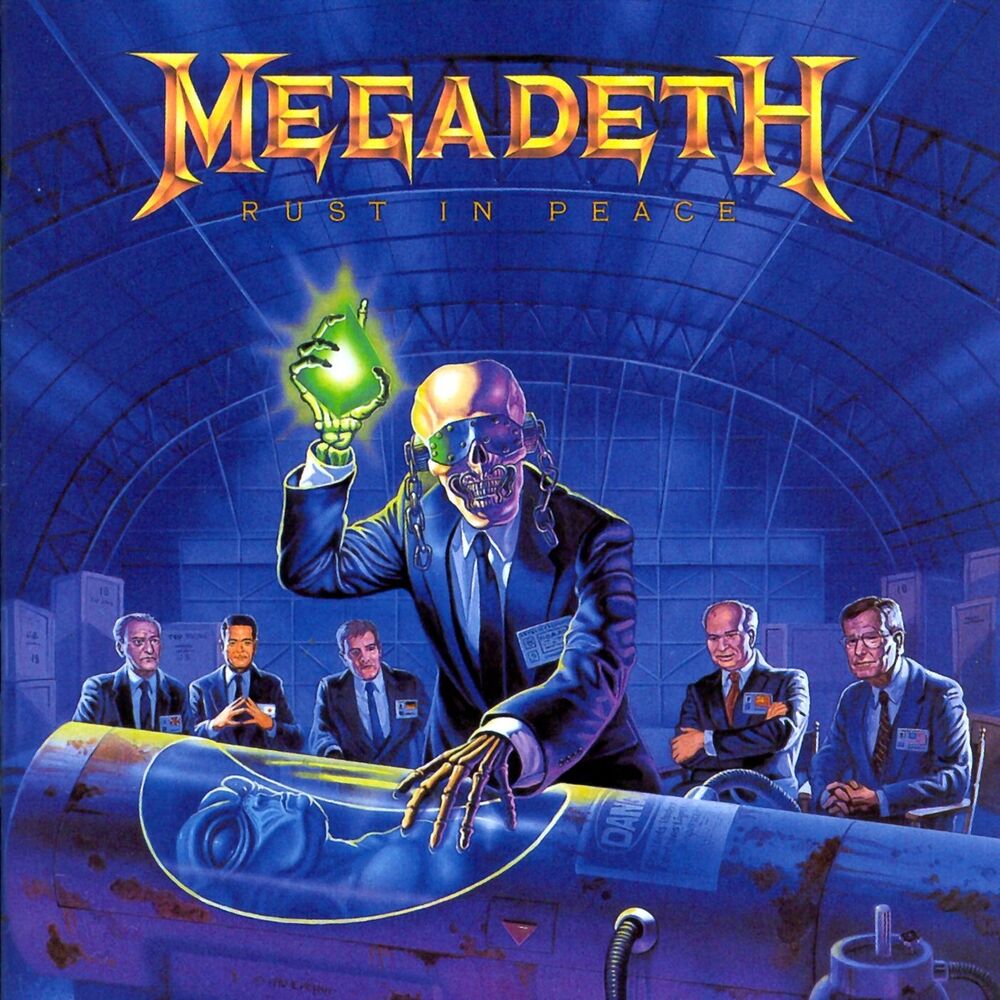
The album's title, "Rust in Peace," was inspired by a bumper sticker Mustaine saw, wishing nuclear weapons would "rust in peace." Lyrical themes span religion, politics, warfare, and Mustaine's personal struggles, alongside UFO conspiracy theories and the Marvel character Punisher. The cover art depicts band mascot Vic Rattlehead and world leaders viewing an alien, referencing the song "Hangar 18."

Why it's rated so high

Upon its 1990 release, "Rust in Peace" received widespread critical acclaim for its instrumental virtuosity, thoughtful lyricism, and punkish rage. Critics praised its maturity and complexity, noting how it transcended the hard rock genre and set a new standard for heavy metal in the 90s. It has since been cited as a genre-defining work and one of the best thrash metal records of all time.

Career and historical context

This album followed a period of negative publicity for Megadeth due to substance abuse and internal disputes, leading to lineup changes before its recording. It introduced the "classic" lineup with Marty Friedman and Nick Menza, marking a period of stability. "Rust in Peace" became one of several platinum-selling albums that brought the band public recognition and cemented their place among the thrash metal elite.

Fun facts

  • Dave Mustaine was in rehab for drug addiction during the first half of the album's recording.
  • Original Megadeth guitarist Chris Poland tracked demo parts for seven songs on the album.
  • The album cover features world leaders of the era, including Mikhail Gorbachev and George H. W. Bush.
  • The object held by Vic Rattlehead on the cover was confirmed by Mustaine to resemble Kryptonite.
  • Dave Mustaine posted the correct transcription of the "Holy Wars" main riff online in 2017.
Written by AI from the album's and artist's Wikipedia articles and the archive's notes. Double-check anything important.

The full story

Rust in Peace is the fourth studio album by American thrash metal band Megadeth, released on September 24, 1990, by Capitol Records. It was the first Megadeth album to feature guitarist Marty Friedman and drummer Nick Menza. The songs "Hangar 18" and "Holy Wars... The Punishment Due" were released as singles. A remixed and remastered version of the album featuring four bonus tracks was released in 2004. Since its release, Rust in Peace has often been named as one of the best thrash metal records of all time, by publications such as Decibel and Kerrang!, and listed in the reference book 1001 Albums You Must Hear Before You Die. The album was nominated for a Grammy Award for Best Metal Performance at the 33rd Grammy Awards. At the 1991 Foundations Forum, the album received a Concrete Foundations Award for "Top Radio Album" and the single "Hangar 18" won "Top Radio Cut" award.

Background and production

In 1988, Megadeth appeared at the Monsters of Rock festival at Donington Park in the UK, alongside Iron Maiden, Kiss, Helloween, Guns N' Roses, and David Lee Roth. The band performed to an audience of more than 100,000 people and was soon added to the "Monsters of Rock" European tour, but dropped out after the first show due to bassist David Ellefson's drug problems. Further issues within the band caused frontman and guitarist Dave Mustaine to fire drummer Chuck Behler and guitarist Jeff Young, and cancel their scheduled 1988 Australian tour. Nick Menza, previously Behler's drum tech, was hired as the band's new drummer. The search for a new guitarist was a drawn out process; Mustaine examined a number of guitarists for the job, including Dimebag Darrell of Pantera, who was initially offered the job before declining, as he requested that his brother, Pantera drummer Vinnie Paul, also be hired. Jeff Waters of Annihilator was also considered. Mustaine had asked original Megadeth guitarist Chris Poland to rejoin the band, with Poland tracking lead guitar parts on demo versions of Rust in Peace ... Polaris, Lucretia, Five Magics, Tornado of Souls, Take No Prisoners, Holy Wars ... The Punishment Due and Poison Was the Cure. According to Poland, he was "99 percent going to join" the band but was talked out of it by his manager. According to Mustaine, one of the last guitarists he had heard about, Marty Friedman, had sent him a copy of Dragon's Kiss, Friedman's debut album. Upon listening to the record, Mustaine had him come in to audition and hired him. This would become the band's first stable line-up and, as recognized by fans, the 'classic' Megadeth lineup. The album title Rust in Peace was inspired by a bumper sticker that Mustaine saw on the back of a vehicle while driving home from Lake Elsinore, California. The sticker read: "May all your nuclear weapons rust in peace". Mustaine liked the concept and decided to use it as a title for Megadeth's upcoming album. Rust in Peace was recorded at Rumbo Recorders with producer Mike Clink, while the mixing was handled by Max Norman. Clink was brought in for his work on both Guns N' Roses' Appetite for Destruction and UFO's Strangers in the Night. Mustaine, however, was not present for the first half of recording due to being in rehab for his drug addiction, so recording proceeded with Clink at the helm. The producer's work dealt mostly with the bass, drums and Friedman's guitar. Clink later had commitments to produce Guns N' Roses' Use Your Illusion I and II, so he left the project to engineer Micajah Ryan to finish recording the guitars and vocals, primarily with Mustaine. In a 2002 interview, Mustaine declared that they "really didn't make the record with [Clink]" as at the time he was focused on Guns N' Roses and stated most of the work in the album was done by himself, Norman, and engineer Micajah Ryan.

Artwork

The album artwork was created by artist Ed Repka, who previously had done the cover for Peace Sells... but Who's Buying? in 1986. It references "Hangar 18", and depicts band mascot Vic Rattlehead and world leaders of the era viewing an alien body. In addition to creating the album's cover, Repka also supplied artwork for the album's two singles. The object Rattlehead is holding was confirmed by Mustaine to be a material resembling Kryptonite. The men featured on the cover are, from left to right: an unidentified British representative, Japanese Prime Minister Toshiki Kaifu, West German President Richard von Weizsäcker, Soviet President Mikhail Gorbachev, and United States President George H. W. Bush.

Composition

The album features multiple lyrical themes: religion, politics and warfare, as well as Mustaine's personal issues, such as his fight against drug and alcohol addiction, UFO conspiracy theories and the Marvel Comics character Punisher. The opening song, "Holy Wars... The Punishment Due" finds its thematic inspiration derived from the Northern Ireland conflict, in which the largely Catholic nationalist community were in conflict with the mainly Protestant loyalist community over the sovereignty of the six counties of Northern Ireland. Mustaine has said that at a show in Antrim, Northern Ireland, he discovered bootlegged Megadeth T-shirts were on sale. He was dissuaded from taking action to have them removed on the basis that they were part of fund raising activities for "The Cause", explained as something to bring equality to Catholics and Protestants in the region. Liking how "The Cause" sounded as was explained to him, Mustaine dedicated a performance of "Anarchy in the U.K." to it, causing the audience to riot. The band were escorted in a bulletproof bus back to their hotel in Dublin after the show. This incident, along with Marvel's Punisher, inspired Mustaine to write the song. "Rust in Peace... Polaris", addresses the topic of nuclear warfare, with "Polaris" referring to the Cold War-era Lockheed UGM-27 Polaris intercontinental ballistic missile. Mustaine has revealed that the song, originally titled "Child Saint", was one of his earlier compositions, having been written before his tenure with Metallica (1981–83). Menza proposed the concept for "Hangar 18", a song about UFO conspiracies and Area 51. Musically, the song features twin guitar solos after the verse. "Poison Was the Cure" was worked on around the Peace Sells... but Who's Buying? era, and was developed further during the So Far, So Good... So What! years, but the band "demoed" it in 1990 and refined it to the point where it was included on Rust in Peace. In 2017, more than 25 years after the album was released, Dave Mustaine revealed the majority of "Holy Wars" tabs on the web did not transcribe the main riff correctly, and posted the correct transcription himself.

Release and reception

Rust in Peace was released on September 24, 1990, by Capitol Records. In 1994, the album was certified platinum by the Recording Industry Association of America (RIAA) for shipping one million copies in the United States. Rust in Peace, along with the rest of Megadeth's Capitol-released studio albums, was remixed and remastered in 2004. Upon release, the album received widespread critical acclaim. Greg Kot of the Chicago Tribune called it Megadeth's most accomplished album, praising its "instrumental virtuosity, thoughtful lyricism and punkish rage". Robert Palmer of Rolling Stone wrote that the album is demonstration of how far the "nasty speed thrash" concept can go without being "formulaic and boring". Reviewing the album for Entertainment Weekly, Jim Farber described the music as "sheer velocity, combined with dexterity" and Mustaine's lyrics as "nihilistic whimsy". Spin reviewer Tom Nordlie praised the album, deeming it a "mature, complex, surprisingly consonant and sparely produced album", and concluded that Rust in Peace "never sleeps". Music journalist Kim Cooper also noted the album's maturity and wrote that Rust in Peace "transcended the hard rock genre and raised the bar to a whole new level". Another positive reaction came from Rock Hard, whose writer Holger Stratmann stated that the record was "pure Megadeth", filled with "razor sharp guitars" and "snotty vocals".

Legacy and influence

In retrospective analysis, Rust in Peace has been cited as having a large impact on its genre. Heavy metal magazine Decibel labeled the album as a "genre-defining work", while Kerrang! wrote that the record "set a new standard for heavy metal in the 90s". IGN named Rust in Peace the fourth most influential heavy metal album of all time, commenting that the album "displays Dave Mustaine's finest writing ever". Additionally, Martin Popoff ranked it eleventh among the best heavy metal albums of all time. In a reader poll organized by MusicRadar in 2010, Rust in Peace was voted as the sixth best metal album ever. The MusicRadar staff explained that the record saw Megadeth moving "into the big league", while staying true to their intricate sound and lyricism. In a list compiled by Chad Bowar of About.com, Rust in Peace was placed as the best heavy metal album of the 1990s and named a "thrash masterpiece". The album was nominated for Best Metal Performance at the 33rd Grammy Awards. The album was also included in the book 1001 Albums You Must Hear Before You Die. In 2015, the album was inducted into the Decibel Hall of Fame.

The tracks "Holy Wars... The Punishment Due" and "Hangar 18" have become staples of Megadeth's live set, and are fan favorites. The guitar solo on "Tornado of Souls" is considered to be one of the greatest solos in heavy metal music. In 2010, the band announced a 22-show North American tour to celebrate the 20th anniversary of Rust in Peace. The band performed the entire album at every show. Dates in South and Central America were later added to the tour, due to positive response from fans. In 2010, Shout! Factory released a live recording filmed on the Hollywood Palladium stop of the tour, entitled Rust in Peace Live. It was released on September 7, 2010, in Blu-ray, CD and DVD formats, and debuted at number 161 on the Billboard 200 and number two on the Billboard DVD charts. Rust in Peace in its entirety was released as purchasable downloadable content in the rhythm game Rock Band, a part of their "Rust in Peace Download Package". It was released a little more than a year after the release of Peace Sells...But Who's Buying? on the game's download store. A cover version of "Holy Wars" by Steve Ouimette was featured in Rock Revolution. "Holy Wars" was also featured in Guitar Hero: Warriors of Rock, while "Hangar 18" was featured in Guitar Hero II and as downloadable content for Guitar Hero 5. Both songs have been described as amongst the most difficult songs in the series' history. "Holy Wars", "Hangar 18" and "Tornado of Souls" were also released as downloadable content for Rocksmith 2014. A sequel to "Hangar 18" titled "Return to Hangar" later featured on Megadeth's ninth studio album, The World Needs a Hero. In 2015, satire website The Onion published an article titled "Humanity Still Producing New Art As Though Megadeth's Rust In Peace Doesn't Already Exist".

From the Wikipedia article Rust in Peace, available under CC BY-SA 4.0.

Tracklist

  1. Holy Wars...The Punishment Due (2004 Remix)6:30
  2. Hangar 18 (2004 Remix)5:11
  3. Take No Prisoners (2004 Remix)3:26
  4. Five Magics (2004 Remix)5:40
  5. Poison Was The Cure (2004 Remix)2:56
  6. Lucretia (2004 Remix)3:56
  7. Tornado Of Souls (2004 Remix)5:16
  8. Dawn Patrol (2004 Remix)1:48
  9. Rust In Peace...Polaris (2004 Remix)5:36
  10. My Creation (2004 Remix)1:36
  11. Rust In Peace...Polaris (Demo)5:25
  12. Holy Wars...The Punishment Due (Demo)6:16
  13. Take No Prisoners (Demo)3:23

Listeners 0

Nobody has logged it yet. Be the first.

Log a listen