Tracklist
- A New Decade (Remastered 2016)4:13
- This Is Music (Remastered 2016)3:39
- On Your Own (Remastered 2016)3:36
- So It Goes (Remastered 2016)6:14
- A Northern Soul (Remastered 2016)6:35
- Brainstorm Interlude (Remastered 2016)5:15
- Drive You Home (Remastered 2016)6:46
- History (Remastered 2016)5:29
- No Knock On My Door (Remastered 2016)5:11
- Life's An Ocean (Remastered 2016)5:41
- Stormy Clouds (Remastered 2016)5:39
- (Reprise) (Remastered 2016)6:14
Have you heard it?
Sign in to mark it as listened, rate it and keep notes.
The full story
A Northern Soul is the second studio album by English rock band the Verve, released on 3 July 1995 through Hut Records. With the tumultuous promotion for their debut studio album, A Storm in Heaven (1993), combined with their friends in Oasis becoming exceptionally popular, relationships between members of the Verve became strained. After connecting with Oasis producer Owen Morris, the Verve went to a rehearsal space in Wigan to write material for the next album, which they recorded at Loco Studios in Wales. The sessions gained notoriety for the stories that emerged from the time, including vocalist Richard Ashcroft going missing for five days and him allegedly totalling a car on the studio's lawn. In the first three weeks, they had finished 15 tracks; after this point, the situation soured as guitarist Nick McCabe grew exhausted from dealing with the other members frequently partying and taking ecstasy, in addition to Ashcroft and Morris shouting and destroying objects. At one point, McCabe began to have a different working schedule from the others, starting at 10–11 a.m. while the rest of the band started at 6 p.m. Variously described as alternative rock, psychedelic rock, and psychedelic soul, Ashcroft said A Northern Soul revolved around one person experiencing various emotions. He wrote material for it after the end of a six-year relationship, using a portastudio at co-manager John Best's house over several weeks. The Verve started promotion with a UK gig supporting Oasis in April 1995, followed by one in France two days later. After McCabe was injured in an altercation with a bouncer, a month's worth of shows were cancelled. "This Is Music" was released as the lead single from the album in May 1995, followed by the second single, "On Your Own", a month later. The Verve embarked on a UK tour in June 1995, which was followed by appearances at the Glastonbury and Phoenix Festivals. They went on a US tour, which lasted until August 1995, when they returned to the UK to play at T in the Park. At its conclusion, Ashcroft announced his departure from the band, which the press reported as if they were breaking up. "History" was the third and final single from the album, released in September 1995. A Northern Soul received positive reviews from music critics, many of whom praised the album's musical depth, while others commented on the personal nature of the lyrics. Retrospective reviews and biographies of the Verve were also focused on the music. The album peaked at number 13 on the UK Albums Chart, going on to be certified gold by the British Phonographic Industry (BPI) in 1998. All three of its singles peaked within the top 40 of the UK Singles Chart, with "History" peaking the highest at number 24. Melody Maker, NME, and Select included the album on their lists of the year's best releases; NME also included it on their list of the 500 best albums of all time, while author Colin Larkin featured it in his book All Time Top 1000 Albums (2000). It …
Background
The Verve released their debut studio album, A Storm in Heaven, in June 1993 through the Virgin imprint Hut Records. Reaching number 27 in the UK Albums Chart, it entered a music scene dominated by grunge, sitting against the emergence of British bands Blur and Suede. Shortly afterwards, frontman Richard Ashcroft said he wanted to record the follow-up as soon as possible. In 1993, the band promoted the album with a UK tour, a European tour with the Smashing Pumpkins – by which point they were writing songs for their next album – a US tour with Acetone, and ending with a UK tour with Acetone and up-and-comers Oasis. The Verve's notoriety as troublemakers was exacerbated by connecting themselves with Oasis. In 1994, the Verve went on a Europe tour, trekked across the US as part of Lollapalooza, and played a series of European festivals, including Reading Festival. In the lead-up to Lollapalooza, the compilation No Come Down (1994) was issued as a stop-gap release. Keith Wood of the Verve's US label, Vernon Yard Recordings, said the band initially planned to record their second album around this time, until they decided to do Lollapalooza instead. Issues plagued the members during the stint, including drummer Peter Salisbury getting arrested and Ashcroft being taken to the hospital for not drinking enough fluids. The grind of touring the US eventually took its toll on Ashcroft and guitarist Nick McCabe, with the pair not being on friendly terms. Throughout that year, interpersonal relationships between members of the Verve grew apart, spurred on by the ballooning popularity of their friends in Oasis. That band's debut, Definitely Maybe (1994), had performed better on the charts than A Storm in Heaven, which was a commercial failure. Author Trevor Baker, in his book Richard Ashcroft – The Verve, Burning Money & The Human Condition (2008), wrote that following the popularity of Definitely Maybe, sales predictions for indie acts shifted considerably, and the band were seen by some commentators as lucky for not being removed from the Virgin Records roster. Brian Cannon of the design company Microdot, who created art for both Oasis and the Verve, attributed the frequent support of Hut Records boss Dave Boyd as a factor.
Writing and Morris' involvement
Since the recording of their debut album, Ashcroft had some life-changing experiences that would fuel his songwriting. Towards the end of 1994, Ashcroft and his girlfriend Sarah Carpenter ended their six-year relationship when the latter became infatuated with one of the band's roadies, Andy Burke, who was also one of Ashcroft's best friends. As Ashcroft was dealing with this, Jones was also going through mental struggles. The latter found it difficult to acclimatise at home in Wigan after Lollapalooza and the US in general. McCabe was also breaking up with his pregnant girlfriend Monica; he was growing weary of others around him. Ashcroft fled to London and, subsequently, the countryside without informing anyone. Ashcroft attempted to reconcile with her in London over a period of three months. For two of those three, he was mentally and physically exhausted. When he reconvened with the rest of the band, they were performing the music that he felt conveyed the emotions he was experiencing, allowing the two aspects to go together with relative ease. Ashcroft stayed with Best, who was dating Lush frontwoman Miki Berenyi, for a period of six-to-eight weeks. Best had a portastudio in his frontroom that Berenyi used for making songs, which Ashcroft used when borrowing her acoustic guitar to write for himself. When the band wanted a different producer for their second album, Noel Gallagher of Oasis proposed Owen Morris, who had co-produced Definitely Maybe. Morris himself shared a similar perspective on the rock and roll lifestyle as the Verve. Ashcroft said they went with him as he was around their age and equally as intense as the rest of the band in "everything we do, lifestyle, music, everything ..." As the members wanted to avoid repeating mistakes that they had made on A Storm in Heaven, they set about writing prior to entering a studio. The band holed up in their former rehearsal space in Wigan, which Ashcroft dubbed a "black hole, a claustrophobic pit." The space was located in a dark industrial warehouse, which they felt was inspirational to the point that Ashcroft and McCabe put aside their personal issues. The members drove around during the night on occasion, seeking further inspiration. Ashcroft learned of a tale from Keith Richards where he talked about the Rolling Stones being mocked by Dean Martin, which he connected to and used as an influence: "That's what happened to us ... we just thought, 'Fuck you all, we're gonna delve into our black hole in Wigan and make the greatest music you've heard in your life.'" Morris, whose visibility as a producer increased after Definitely Maybe, visited the band during one of their rehearsals, feeling enthusiastic about what he was hearing. It was a fruitful period, with them having two albums' worth of songs in time for recording, contrasting with creating the bulk of A Storm in Heaven as they were recording it.
Recording
The initial idea for the recording sessions was to take recording gear to their rehearsal room, as they were the most productive there, and it had the right atmosphere. When they realised that it was impractical to use it for recording, they decided on Loco Studios in Wales. Philip Wilding, author of The Verve: Bitter Sweet (1998), wrote that the sessions for their second album became mythologised as a combination of "lurid stories and gruesome hearsay echoing in stories of drug-fuelled jam sessions that became extensive recording sessions and bouts of reckless violence." Baker conveyed a similar situation, while singling out co-manager John Best for describing the situation as lunatics running an asylum. Author Sean Egan, in his book The Verve: Star Sail (1998), said various tales have since come out about the sessions, including: Ashcroft allegedly totalling a hired car by driving it on the studio's lawn; the band often playing a single song for hours at a time; Ashcroft disappearing for five days; and the band debating whether to destroy a tape machine, which was valued at £100,000, so that they could get a sound to end the album on. Morris, who co-produced the sessions with them, said his job was to contain the audio of the band performing and not make it sound bland. The band and Morris were assisted in the studio by engineer Mark Lee. To aid the recording sessions, the band gave the studio a club atmosphere by playing music the entire time, taking ecstasy, and working on material when they felt inspired to. By the first three weeks, they had completed 15 songs; by contrast, for A Storm in Heaven, they only did one song a week in the same length of time. As the band as a unit strived for perfection, it meant that the individual members had strained relationships with one another. After this point, the situation soured as McCabe, bagged by the issues with Monica, became tired of the frequent partying that the other members were doing. He said Ashcroft and Morris were yelling and breaking objects. Jones said they did not need any encouragement from Morris, who was "as mad as you like", adding that it was "all ... too much." While Jones did not explain what happened during the sessions, Boyd said it was a group of people growing up, combined with ecstasy consumption. There was one instance where the band was locked out from entering the studio because an employee was concerned about what they could do to the facilities. Boyd said Morris was also consuming ecstasy; there was one three-week period where Morris and the band ingested the drug every day. On one occasion, Best visited the studio only to find Morris, who was high on ecstasy, standing on the recording console with a glass of alcohol. He promptly threw the drink at the room's glass wall, leaving a hole the size of a large bullet. Best compared the encounter to entering a turbulent celebration with a "lunatic edge to it." He noticed that the members were operating on different schedules. As McCabe had a child, he wanted to start working at 10–11 a.m. and finish at 10–11 p.m. The rest of the band, meanwhile, woke up at 2 p.m., recorded at 6 p.m., and finished at 6 a.m. the following morning. McCabe said he was emotionally distraught, reaching a point where the only common trait between them was creating music, while his life at home was equally a "disaster and I didn't feel comfortable anywhere." He was forced to contribute more during the sessions than other guitarists would, owing to him having to track both the rhythm and lead guitar parts. Egan said these parts were "already more complex than most bands' because of the atmospheric nature of The Verve's music." McCabe found the partying boring and an annoying distraction.
Ashcroft came close to being a casualty of drugs akin to Roky Erickson or Arthur Lee of Love; he was still emotionally damaged from his split with Carpenter, which did not help. When Ashcroft came to this realisation, he was distraught, only to …
Composition and lyrics
Title and music
Discussing the album, Ashcroft said the "doors have opened for me personally with my writing. We've been liberated. Touring, you get lost on a rock and roll adventure. You're on the Stardust trip. You're in the mansion in your head with the white robes on doing rock operas called 'Woman'. But then you come home and it's time to get twenty Regal and a pastie and assess who you are. That's why the new album's got more soul to it. It's modern Northern blues." Egan said a possibility for the album's title was how the Verve viewed their sound as the "result of a fundamental sincerity." musicOMH's Ben Hogwood suggested that the title was a confident declaration of their Wigan lineage, which he said was a noble proclamation, though "ultimately a doomed one." He added that it was taken from the 1960s Northern soul movement, where it focuses its "impact on the whole body and mind rather than just the feet, shaking it from the very core." Ashcroft said the album revolved around one person experiencing various emotions: "pretty painted, then elated, then arrogant. All facets of that personality are a northern soul." Egan said this character was Ashcroft incognito, writing that a few critics were sceptical about how an individual "'soul' could have gone through such torment as to inspire such desolate songwords ..." Gigwise writer AP Childs considered A Northern Soul an alternative rock album that surpasses the "stargazer dreaminess of the previous offering with its tortured glamour of industrial-sized proportions." He said that, beside "Brainstorm Interlude", there was little psychedelic music to be found on it. Nick Southall of Stylus Magazine dubbed it "[m]odern, urban, tortured psychedelic soul", while Spin's Alex Pappademas saw it as psychedelic rock and Britpop. Clarke was dismissive of the Britpop tag, adamant that the Verve had nothing to do with that genre musically or visually. Kayley Kravitz of Vanyaland reaffirmed Britpop, saying the Verve did what Blur and Lush had done before them, moving away from shoegaze and into Britpop. Best said the album had two different sides at odds with one another: "You've got songs that are traditional Verve psychedelic work-outs and then you've got songs like 'History' that I heard and thought, Wow! This is a very interesting new development." McCabe felt that his playing ability had also improved, owing to the two years promoting A Storm in Heaven. Jones explained that it was not literal soul music but rather soul music in the manner that they were "expressing ourselves and playing from our heart. A lot of the songs on this album are first takes, just us going in and playing from a feeling." PopMatters writer Ian King wrote that McCabe's guitar playing informed the sound of A Northern Soul and noted that it was an important point in their history where Ashcroft's skill as a songwriter began to take hold of the band, highlighting "On Your Own" and "History" as prime examples. He remarked that both are stylistically different – "On Your Own" being a slow-tempo acoustic ballad and "History" serving as a symphonic track – and both feature less guitarwork. King said that McCabe's guitar playing originally helped them stand out from their contemporaries more than Ashcroft did. A Northern Soul marked the point where Ashcroft became the leader of the Verve. In addition to their usual roles in the band, the members provided extra instrumentations to the songs: Ashcroft with percussion on "This Is Music", "So It Goes", "History", and "Life's an Ocean", acoustic guitar on "On Your Own", "So It Goes", "History", and "Stormy Clouds", and electric piano on "No Knock on My Door"; Jones with percussion on "A New Decade", keyboards on "A Northern Soul", twelve-string acoustic guitar on "History"; McCabe with piano on "On Your Own" and "Stormy Clouds", twelve-string guitar on "On Your Own", acoustic guitar on "So It Goes" and "Stormy Clouds", Hammond organ on "So It Goes", and a Moog …
Artwork
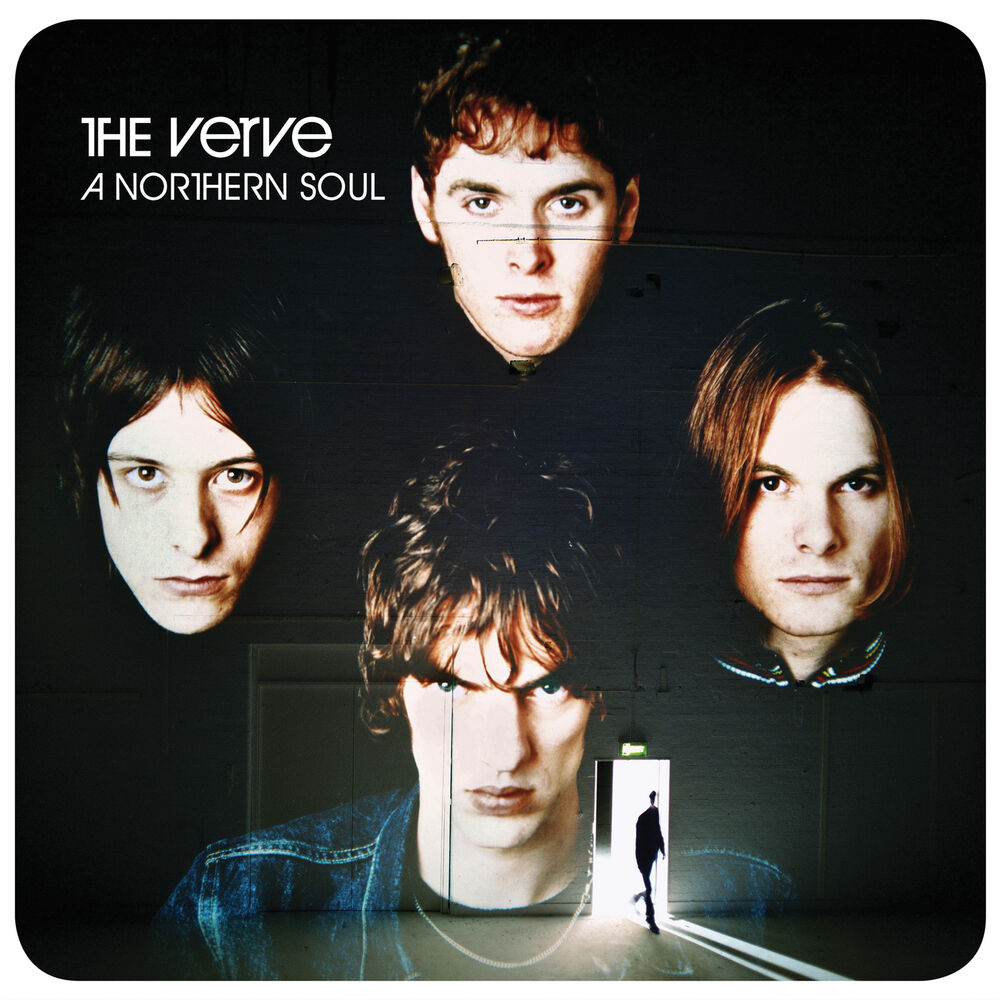
Cannon handled the sleeve concept, design, and art direction of the album, while Michael Spencer Jones did the photography. In addition to this, two additional photographs were taken by Scarlet Page and Mary Scanlon, who took images dubbed "The Verve on the bus" and "The Verve in the café", respectively. Baker thought the front cover image was indicative of the Verve's new direction, with the four heads placed in front of a black background serving as a reference to the cover for With the Beatles (1963) by the Beatles. A small door can be seen in the corner, which Baker said "perhaps represent[ed] the door into their minds." Cannon said he was a huge fan of the Beatles, despite others thinking it was a homage to the video for "Bohemian Rhapsody" (1975) by Queen, such as Egan. They took the image inside of a warehouse, located near the Tower Bridge in London, and projected the photograph of the band, blown up to sixteen metres in height, on a wall. They had Salisbury come in through the doorway. Cannon explained that they had the members wrapped up in black velvet, leaving only their heads visible. Egan said they wanted to depict the vastness and "three-dimensional qualities" that Cannon could hear in the music. The image of the members was shot on their previous US tour, which Clarke said showed "how ravaged they had become, with all of them looking exhausted and mad-eyed." Journalist Mark Beaumont, in a review for NME, wrote that the shot of a person walking through a door with the image of the band on top "emphasised the hugeness of the more traditional rock music they were making within." Wilding said the back cover of the album sees Jones' face being mirrored in the "chrome facade of the Feelings Machine," a reference to the vending machine lyric found in "Life's an Ocean". Jones is in the process of putting 50 cents into the machine; red levers can be seen below various black-and-white images of faces giving a range of emotions from anger to sorrow. Wilding thought this recalled the artwork of the Who during their concept album phase. The machine was repurposed for the music video for the Verve's "The Drugs Don't Work" (1997).
Release
When recording concluded, McCabe stayed at his mother's house in Wigan while suffering from depression. His mother inquired about his state of mind, and when she would leave the house, he threw and broke items around the place. At the same time, Ashcroft was dealing with the aftereffects of drugs and suffering from psychosis. Spencer Jones said during this period, Ashcroft had a fear of phones, as no one could get in contact with him. Best was concerned for the members as he saw that there was a "problem and I could see that they weren't talking about it", while other co-manager Jane Savage said Ashcroft seemed "more insular", being singled out from the rest of the band because of the music press. In the period following A Storm in Heaven, 1990s culture shifted with the emergence of new lad and Loaded magazine, as well as the continual evolution of football culture. In addition, Britpop became a mainstream movement; Ashcroft said he abstained from watching or listening to music on the TV and radio.
The Verve played their first show in eight months in Southend-on-Sea on 17 April 1995, supporting Oasis, followed by another show with them in Paris, France, two days later. For the former gig, hype was building around the Verve as critics forecasted that they could become hugely popular. This was intended to be the launch pad for a UK tour, but was cancelled due to McCabe getting into an accident. McCabe was in an altercation with a bouncer at Paris' Bataclan, who would not let him into the backstage area as he did not have a security pass. The bouncer manhandled McCabe, pushed him against a foot, hit him in the face, and kicked him down some stairs. The incident resulted in a broken finger, with it needing to be in a plaster for six weeks; it left him unable to play his guitar. The band had to cancel a month's worth of shows because of this, including four headlining shows and a support slot for Oasis in Sheffield. By this point, comparisons were being increasingly made to Oasis by publications, which frustrated Ashcroft. In June 1995, the Verve restarted their UK tour in Manchester, with support from Pusherman; it included a headlining spot at the Heineken Music Festival. Over the next few months, friendships deteriorated further, partially due to McCabe being unhappy. Despite having successful shows, he tried to find faults in every one; when they appeared at the Glastonbury Festival, his amp blew up. Ashcroft played maracas to compensate before it was in working order. A Northern Soul was released on 3 July 1995 through Hut Records and in the US through Vernon Yard Recordings. After a one-off show in Newcastle, the Verve supported Oasis in Scotland and then performed at the Phoenix Festival. Following this, they embarked on a US tour, dubbed Conquering America, through early August 1995. Here, they were represented by Ted Gardner of Larrikin Management. In the press, Ashcroft remained positive about the stint, despite the issues during the previous one. The trek was supported by Hum and included a performance at the Cincinnati Riverfest. McCabe was not happy with how the band was doing in the US, wishing that their label was making more effort to help them when compared to the UK, where they were gaining traction. The situation between the members came to a head when they performed at T in the Park in August 1995, where Ashcroft reportedly seemed ill, blundering across the stage, hitting Salisbury, and throwing parts of his drum kit around. Best said that when they got into the tour bus, Ashcroft remarked that it would be the last show they played, announcing his departure from the band. Aside from the mental strain, Ashcroft was also having physical issues, such as a glandular virus, admitting that "maybe I wasn't in a fit state of mind to be making massive decisions, but that's the way it was and everyone agreed." Best recounted that there was silence upon hearing this; Jones said that everyone involved was unhappy with the …
Retrospective reviews
Retrospective reviews commented on the music of A Northern Soul. Journalist Rob Sheffield in The New Rolling Stone Album Guide said it "kicked home with the gorgeous breakup ballad 'On Your Own' and the epic 'History,' [...] It was their breakthrough, and the Verve celebrated by splitting up almost immediately." Radhika Takru of Drowned in Sound was unable to deny the maturity the album had, sporting a wider range of emotions compared to the Verve's debut. She noted their expertise and authority of the music; she said A Northern Soul was "not as personal, and far more guarded and reflective than its predecessor which sits young, loud and reckless." Hogwood saw it as "far from comfortable music, made at the peak of the band’s overindulgence and prodigious drug taking." The Line of Best Fit's Ed Nash said Ashcroft was setting himself up as a notable songwriter, however, Nash took issue with Ashcroft's ballads, as they gave minimal space for McCabe's cavernous guitar sounds, "Something had to give and it was the guitarist." Record Collector writer Tim Peacock said the album was a traditional, focused rock album that got bogged "down by Ashcroft’s plaintive existential angst." Childs said the album was a "testament to giving up and restarting just to discover you then want to give up again. [...] The album’s content could be a paean reflecting the band’s doubt [...] the cold chorus of perhaps dark days ahead." Beaumont, in a review for Classic Rock, commented that despite its troubled production, the album was remarkably cohesive and, aside from the infrequent extended psychedelic passage, A Northern Soul was a turbulent progression "from the band least likely to stay together long enough to own the 90s." For Rolling Stone Germany, journalist Sassan Niasseri said that with the album, the band displayed their "rather strenuous Led Zeppelin homage, tank driver rock." Biographers were impressed by the quality of the music on A Northern Soul, despite its troubled production. Baker thought it was not as cohesive as its predecessor, though its "best moments would be among the best moments of 1995. They’d flown far away from their roots in obscure space rock and now they had songs that they could proudly put alongside the classic tunes of their youth." He felt that it had a "very uneven feel" steaming from the mixing of emotional ballads such as "On Your Own" and the A Storm in Heaven-esque "So It Goes". "It’s not an album that flows smoothly." Ilic said the album was "flowing with warm, dense and powerful overtones. McCabe's flamboyant electrics were stamped all over it, but sounded especially blissful on 'Brainstorm Interlude' and 'Drive You Home'. It marked a distinct change from the freeform sculpture of their first album, and lyrically the fantasy-based songs had also veered towards the richer realms of Ashcroft's personal experiences." Clarke noted that it was "full of their trademark swirling guitars, huge rock themes and meandering, sprawling songs", and to him, it was substantially superior to the band's older work, being "richer in lyrical thought and musical texture, and easily their most accomplished project to date." He added that with the addition of sweeping string sections and "ethereal guitar work, it was also a much classier record", going on to highlight Ashcroft's direction in both his vocal parts and lyrics. Wilding wrote that the album was more plaintive in its approach when compared to their debut album, finding it "nothing short of heroic. Twelve heady, soulful tracks that wouldn't have looked amiss on some Led Zeppelin compilation." Wilding added that if you match that with Ashcroft putting the "lyrical spotlight on himself and you had an album that, due to the fact that the band imploded before they could show the world just his lustrous their record might be, would fall through the net."
Commercial performance and accolades
A Northern Soul peaked at number 13 in the UK Albums Chart, selling more in its first month of release than A Storm in Heaven had done in the two years since its release. Despite this, it fell under the band's expectations. Its 2016 reissue re-entered the chart at number 80. The album was certified silver and gold in the UK by the British Phonographic Industry (BPI) in 1997 and 1998, respectively. "This Is Music" peaked at number 35 in the UK. "On Your Own" peaked at number 28 in the UK. "History" peaked at number 24 in the UK. Melody Maker, NME, and Select all included the album on their 1995 best of the year lists. Noel Gallagher and Robert Plant of Led Zeppelin praised A Northern Soul, with the former calling it the third-best album of the year. It was ranked by author Colin Larkin at number 289 in the All Time Top 1000 Albums (2000) and by NME at number 390 on their 2013 list of the 500 best albums of all time. PopMatters ranked the 2016 expanded edition of the album, with a similar reissue of A Storm in Heaven, at number 10 on their list of the best 25 re-releases from the year, while Rolling Stone included the two sets on their unranked list. Pappademas considered A Northern Soul one of 10 essential Britpop albums, while Musikexpress and Pitchfork included the album in the top 30 of their best Britpop album lists.
Legacy
Baker said for the majority of listeners, the album was remembered for a single track, "History", which was the "moment The Verve took a giant step towards popular acclaim but it was also symbolic – in more ways than one – of a band that were falling apart. Richard was starting to discover himself as a songwriter and the rest of the band could have been forgiven for thinking they were now almost surplus to requirements as he came up with the initial germ of the idea." Baker found it astonishing how the album was disregarded by music press outlets and BBC Radio One, yet listeners that did not understand the "power and fury of ‘This Is Music’ or ‘A New Decade’ couldn't help but respond to ‘History’. Unfortunately, though, most mainstream music fans never got to hear it or even read about it." Ashcroft also pointed out the lack of radio support and bemoaning promotion from magazines. While McCabe did not get along with Morris, unlike the rest of the band, he praised the final, finished work. Out of everyone they worked with previously, he said Morris was the closest to closing the gap between the band's live and studio sounds. The Verve returned to the sound of A Northern Soul on "Neon Wilderness" from Urban Hymns, which acted as a counterpart to "Brainstorm Interlude". Luke Haines of labelmates the Auteurs said the success of A Northern Soul prompted higher-ups at Virgin to push him to release a commercial-sounding album with hit singles on it, resulting in How I Learned to Love the Bootboys (1999). Members of the Hiss expressed admiration for A Northern Soul; because of Morris' role on that album, they enlisted him for their album Panic Movement (2003).
Tracklist
- A New Decade (Remastered 2016)4:13
- This Is Music (Remastered 2016)3:39
- On Your Own (Remastered 2016)3:36
- So It Goes (Remastered 2016)6:14
- A Northern Soul (Remastered 2016)6:35
- Brainstorm Interlude (Remastered 2016)5:15
- Drive You Home (Remastered 2016)6:46
- History (Remastered 2016)5:29
- No Knock On My Door (Remastered 2016)5:11
- Life's An Ocean (Remastered 2016)5:41
- Stormy Clouds (Remastered 2016)5:39
- (Reprise) (Remastered 2016)6:14
Listeners 0
Nobody has logged it yet. Be the first.