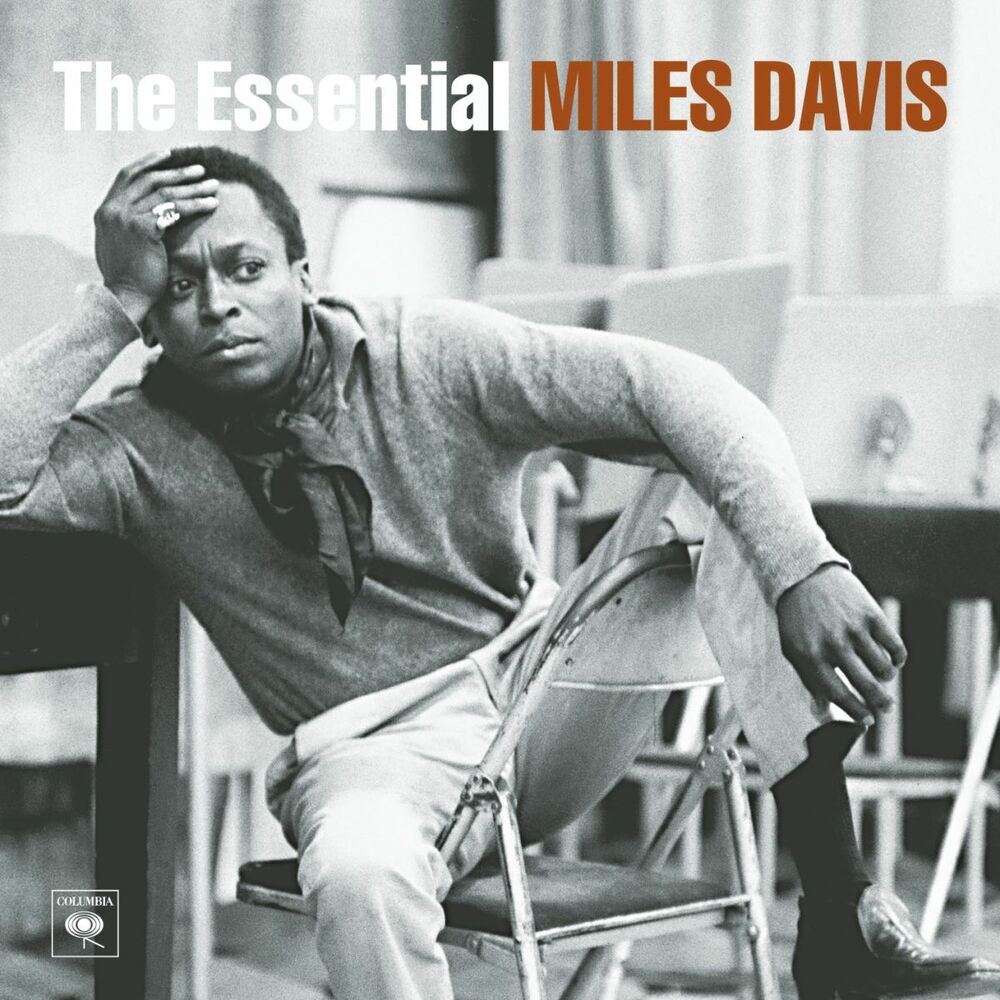
Tracklist
- Now's the Time3:15
- Jeru3:10
- Compulsion5:35
- Tempus Fugit3:50
- Walkin'13:26
- 'Round Midnight5:55
- Bye Bye Blackbird7:55
- New Rhumba4:37
- Generique2:45
- Summertime3:19
- So What (feat. John Coltrane, Cannonball Adderley & Bill Evans)9:22
- The Pan Piper3:52
- Someday My Prince Will Come (feat. John Coltrane, Hank Mobley, Wynton Kelly, Paul Chambers & Jimmy Cobb) (Alternate Take)5:43
- My Funny Valentine (Live)14:55
- E.S.P.5:29
- Nefertiti7:52
- Petits Machins (Little Stuff)8:05
- Miles Runs the Voodoo Down (feat. Wayne Shorter, Bennie Maupin, John McLaughlin, Chick Corea, Joe Zawinul, Dave Holland & Harvey B14:02
- Little Church (Live at the Cellar Door, Washington, DC - December 1970)3:15
- Black Satin5:14
- Jean Pierre (Live at Shinjuku Nishi-Guchi Hiroba, Tokyo, Japan - Oct. 1981 - version 2)4:02
- Time After Time3:38
- Portia6:18
Have you heard it?
Sign in to mark it as listened, rate it and keep notes.
The full story
Miles Dewey Davis III (May 26, 1926 – September 28, 1991) was an American trumpeter, bandleader, composer, and painter. He is among the most influential and acclaimed figures in the history of jazz and 20th-century music. In a career spanning nearly five decades, Davis was at the forefront of several major stylistic developments in jazz, including bebop, cool jazz, hard bop, third stream, modal jazz, avant-garde jazz and jazz fusion. His legacy extends into rock, funk, classical and hip-hop. Born into an affluent family in Alton, Illinois, and raised in East St. Louis, Davis started on the trumpet in his early teens. He left to study at the Juilliard School in New York City, before dropping out and making his professional debut as a member of saxophonist Charlie Parker's bebop quintet from 1944 to 1948. Shortly afterwards, he recorded the Birth of the Cool sessions for Capitol Records, which were instrumental to the development of cool jazz. In the early 1950s, Davis recorded some of the earliest hard bop music under Prestige Records. After a widely acclaimed comeback performance at the Newport Jazz Festival, he signed a long-term contract with Columbia Records, and recorded the album 'Round About Midnight in 1955. It was his first work with saxophonist John Coltrane and bassist Paul Chambers, key members of the sextet he led into the early 1960s. During this period, he alternated between orchestral jazz collaborations with arranger Gil Evans, such as the Spanish music–influenced Sketches of Spain (1960), and band recordings, such as Milestones (1958) and Kind of Blue (1959). The latter recording remains one of the most popular jazz albums of all time, having sold more than five million copies in the U.S. alone and 6.4 million copies worldwide. Davis made several lineup changes while recording Someday My Prince Will Come (1961), his 1961 Blackhawk concerts, and Seven Steps to Heaven (1963), another commercial success that introduced bassist Ron Carter, pianist Herbie Hancock and drummer Tony Williams. After adding saxophonist Wayne Shorter to his new quintet in 1964, Davis led them on a series of more abstract recordings often composed by the band members, helping pioneer the post-bop genre with albums such as E.S.P. (1965) and Miles Smiles (1967), before transitioning into his electric period. During the 1970s, he experimented with rock, funk, African rhythms, emerging electronic music technology, and an ever-changing lineup of musicians, including keyboardist Joe Zawinul, drummer Al Foster, bassist Michael Henderson and guitarist John McLaughlin. This period, beginning with Davis's 1969 studio album In a Silent Way and concluding with the 1975 concert recording Agharta, was the most controversial in his career, alienating and challenging many in jazz. His million-selling 1970 record Bitches Brew helped spark a resurgence in the genre's commercial popularity with jazz fusion as the decade progressed. After a five-year retirement due to poor …
Legacy and influence
Miles Davis is considered one of the most innovative, influential and respected figures in the history of music. The Guardian described him as "a pioneer of 20th-century music, leading many of the key developments in the world of jazz." He has been called "one of the great innovators in jazz", and had the titles Prince of Darkness and the Picasso of Jazz bestowed upon him. The Rolling Stone Encyclopedia of Rock & Roll said, "Miles Davis played a crucial and inevitably controversial role in every major development in jazz since the mid-'40s, and no other jazz musician has had so profound an effect on rock. Miles Davis was the most widely recognized jazz musician of his era, an outspoken social critic and an arbiter of style—in attitude and fashion—as well as music." William Ruhlmann of AllMusic wrote, "To examine his career is to examine the history of jazz from the mid-1940s to the early 1990s, since he was in the thick of almost every important innovation and stylistic development in the music during that period ... It can even be argued that jazz stopped evolving when Davis wasn't there to push it forward." Francis Davis of The Atlantic noted that Davis's career can be seen as "an ongoing critique of bebop: the origins of 'cool' jazz ..., hard bop, or 'funky' ..., modal improvisation ..., and jazz–rock fusion ... can be traced to his efforts to tear bebop down to its essentials." His approach, owing largely to the African-American performance tradition that focused on individual expression, emphatic interaction, and creative response to shifting contents, had a profound impact on generations of jazz musicians. In 2016, the digital publication The Pudding, in an article examining Davis's legacy, found that 2,452 Wikipedia pages mention Davis, with over 286 citing him as an influence.
On November 5, 2009, U.S. Representative John Conyers of Michigan sponsored a measure in the United States House of Representatives to commemorate Kind of Blue on its 50th anniversary. The measure also affirms jazz as a national treasure and "encourages the United States government to preserve and advance the art form of jazz music". It passed with a vote of 409–0 on December 15, 2009. The trumpet Davis used on the recording is displayed on the campus of the University of North Carolina at Greensboro ( UNCG). It was donated to the school by Arthur "Buddy" Gist, who met Davis in 1949 and became a close friend. That gift was the reason why the jazz program at UNCG is named the Miles Davis Jazz Studies Program. In 1986, the New England Conservatory awarded Davis an honorary doctorate for his contributions to music. Since 1960, the National Academy of Recording Arts and Sciences (NARAS) honored him with eight Grammy Awards, a Grammy Lifetime Achievement Award and three Grammy Hall of Fame Awards. In 2001, The Miles Davis Story, a two-hour documentary film by Mike Dibb, won an International Emmy Award for arts documentary of the year. Since 2005, the Miles Davis Jazz Committee has held an annual Miles Davis Jazz Festival. Also in 2005, the Davis biography The Last Miles was published; a London exhibition was held of his paintings; The Last Miles: The Music of Miles Davis, 1980–1991 was released, detailing his final years; and eight of his albums from the 1960s and 1970s were reissued in celebration of the 50th anniversary of his signing to Columbia Records. In 2006, Davis was inducted into the Rock and Roll Hall of Fame. In 2012, the U.S. Postal Service issued commemorative stamps featuring Davis. Miles Ahead was a 2015 American music film directed by Don Cheadle, co-written by Cheadle with Steven Baigelman, Stephen J. Rivele and Christopher Wilkinson, which interprets the life and compositions of Davis. It premiered at the New York Film Festival in October 2015. The film stars Cheadle, Emayatzy Corinealdi as Frances Taylor, Ewan McGregor, Michael Stuhlbarg and LaKeith Stanfield. That same year, a statue of Davis was erected in his home city, Alton, …
Tracklist
- Now's the Time3:15
- Jeru3:10
- Compulsion5:35
- Tempus Fugit3:50
- Walkin'13:26
- 'Round Midnight5:55
- Bye Bye Blackbird7:55
- New Rhumba4:37
- Generique2:45
- Summertime3:19
- So What (feat. John Coltrane, Cannonball Adderley & Bill Evans)9:22
- The Pan Piper3:52
- Someday My Prince Will Come (feat. John Coltrane, Hank Mobley, Wynton Kelly, Paul Chambers & Jimmy Cobb) (Alternate Take)5:43
- My Funny Valentine (Live)14:55
- E.S.P.5:29
- Nefertiti7:52
- Petits Machins (Little Stuff)8:05
- Miles Runs the Voodoo Down (feat. Wayne Shorter, Bennie Maupin, John McLaughlin, Chick Corea, Joe Zawinul, Dave Holland & Harvey B14:02
- Little Church (Live at the Cellar Door, Washington, DC - December 1970)3:15
- Black Satin5:14
- Jean Pierre (Live at Shinjuku Nishi-Guchi Hiroba, Tokyo, Japan - Oct. 1981 - version 2)4:02
- Time After Time3:38
- Portia6:18
Listeners 0
Nobody has logged it yet. Be the first.