Tracklist
- Stephanie Knows Who (LP / Stereo Version)2:32
- Orange Skies2:50
- ¡Que Vida!3:41
- Seven and Seven Is (LP Version)2:19
- The Castle3:00
- She Comes in Colors2:46
- Revelation18:58
Have you heard it?
Sign in to mark it as listened, rate it and keep notes.
The full story
Da Capo is the second studio album by American rock band Love, released in November 1966 by Elektra Records. The album was recorded during September and October 1966 at RCA Studios in Hollywood, California, with the exception of lead single "7 and 7 Is", recorded the previous June. The single was a departure for the band and became their highest charting, reaching No. 33 on the Billboard Hot 100. Despite the success of "7 and 7 Is", a string of well received live performances at the time and contemporary critical acclaim for the album upon its release, it peaked at No. 80 on the Billboard 200. Prior to the album's recording, the band had grown dissatisfied with Elektra and attempted to leave the label but were placated with a cash advance and an increased royalty rate. The album marked several significant changes for the band, including a new studio (RCA), engineer (Dave Hassinger) and producer (Paul A. Rothchild). Additionally, there were several lineup changes in the band, with drummer Alban "Snoopy" Pfisterer moving to keyboards and Michael Stuart recruited to take his place on drums, as well as the addition of jazz saxophonist and flautist Tjay Cantrelli. The songs were composed by frontman Arthur Lee but "rewritten and rearranged in the studio", with the band members developing their own parts. In contrast to the band's first album, Love (1966), which had been dominated by garage rock and folk rock, Da Capo features a wide range of musical styles, including psychedelia, baroque pop, jazz, Latin music and proto-punk. The album is also regarded as one of the first examples of "jazz rock", and Lee and guitarist Johnny Echols credited jazz musicians Miles Davis and John Coltrane as having influenced the sound. Some critics have considered Da Capo to be a stylistic bridge between Love and their acclaimed third studio album, Forever Changes (1967), regarding Lee's smoother vocal tone and more autobiographical lyrics on Da Capo to be a harbinger of his work on Forever Changes and later Love albums. The album's title derives from the Italian musical term "da capo", meaning "from the beginning". Da Capo has been included in several critics' record guides and all-time lists, including John Tobler's 100 Great Albums of the Sixties (1994), Colin Larkin's All Time Top 1000 Albums (2000), Tom Moon's 1,000 Recordings to Hear Before You Die (2008) and Robert Dimery's 1001 Albums You Must Hear Before You Die (2005).
Background
Conflict with Elektra
In March 1966, Love's self-titled debut album, along with the single "My Little Red Book", was released to moderate commercial success, reaching number 57 on the Billboard Top LPs. According to author Barney Hoskyns, the album "trumpeted the presence of a major new musical force on the LA scene". It was also a pivotal release for Elektra Records, giving them their first rock album as well as their first hit single; however, the band quickly grew dissatisfied with the label's production and promotional efforts. In an attempt to get off the label, bandleader Arthur Lee revealed that when he had signed the recording contract on January 4, 1966, he was not yet 21 years old, making the agreement void. This infuriated Elektra president Jac Holzman, who later said: "That was the point in my relationship with Arthur where he moved from being a scoundrel to being totally dishonest ... He said he wasn't making a second album, which meant [if he'd carried out this threat] that Da Capo wouldn't have happened". An addendum to the contract was made, dated April 25, which gave the band $2,500 in cash and an increase in their royalty rate from 5 to 7 percent; however, it also required them to produce 20 more recordings for Elektra to be released on future albums. Lee later claimed that he also demanded 100% of the publishing rights, but Holzman said this was never agreed on. The contract was then notarized on May 6 to prevent further issues regarding the members' ages; Holzman also ensured that a photocopy of Lee's driver's license was stapled to the document.
"7 and 7 Is" and lineup changes
On June 17 and 20, Love recorded their second single, "7 and 7 Is". The song was a radical departure from the band's original folk rock sound; biographer John Einarson writes that it was "like nothing anyone had either conceived or heard before ... a loud, aggressive, no-holds-barred, garage-style punk song, a decade before that musical term was current." Despite being a creative success, however, the song's recording sessions, held at Sunset Sound Recorders with Holzman producing and Bruce Botnick engineering, were the last to feature the five-piece lineup of the debut album. Due to drummer Alban "Snoopy" Pfisterer's limited abilities, he and Lee took turns attempting the song's intense drum part. Pfisterer later said: "The session was a nightmare ... I had blisters on my fingers. I don't know how many times I tried to play that damn thing and it just wasn't coming out. Arthur would try it; then I'd try it. Finally I got it. He couldn't do it." Released in July, "7 and 7 Is" spent ten weeks climbing the Billboard Hot 100, peaking at number 33 and becoming the highest-charting single of the band's career. During that same time, the band decided to make some changes to their lineup for their second album. Reluctant to fire Pfisterer, Lee instead elected to move him over to keyboards – organ, piano, and harpsichord – as he had been classically trained as a child. To replace him on drums, Lee hired Michael Stuart – formerly of the Sons of Adam, who had occasionally opened for Love and had a local hit with one of Lee's songs, "Feathered Fish". Lee then recruited Tjay Cantrelli (born John Barberis), a jazz saxophonist and flautist whom he had crossed paths with in the early 1960s, bringing the band to a seven-piece.
On Stuart's first day with the group, Lee and lead guitarist Johnny Echols brought him to Elektra's offices where, unbeknownst to him, they had planned another attempt to end their commitment with the label. Stuart recalls the encounter in his 2003 autobiography Behind the Scenes on the Pegasus Carousel with the Legendary Rock Group LOVE:Arthur said [to the executive], "I want to talk to you about releasing us from our commitment to Elektra. You really don't have the capacity to be able to handle our group. What do we have to do to get off the label?" And Johnny said, "Yeah, and your records are made cheaply. Look, …
Recording and production
The sessions for Da Capo began at RCA Victor's studio at 6363 Sunset Boulevard in Hollywood. Echols suggested that the change in studio was due to Sunset Sound being occupied by label-mates the Doors. Andrew Sandoval writes that the new environment provided Love "the right atmosphere" for their new material. Botnick was unable to engineer the sessions due to the change, so the job was instead done by Dave Hassinger, whose "sonic mastery", Sandoval continues, "gave the group further confidence in their work." Echols reported positive recollections of the setting: "Everything was relaxed in there ... It wasn't uptight at RCA as it was at Sunset Sounds. Several times we had fistfights at Sunset Sound, 'cause it was a small kind of claustrophobic type of place. The atmosphere and the people – Bruce and all of that – just was not conductive in the way RCA was with Dave Hassinger." Paul A. Rothchild, who had just finished the sessions for the Doors' first album in August 1966, was brought in produce Da Capo. The group had been impressed with his previous work and that he had spent time in prison for cannabis possession shortly beforehand. Echols and Botnick both acknowledged that his "no-nonsense" style of producing helped control Lee's often commanding studio presence. Echols said that Lee "could be like a kid, trying to get away with whatever he could. Jac let Arthur get away with that and let him run around. Rothchild wasn't like that. He expected us to pay attention to him, and we did." Holzman praised Rothchild's work, saying that "Da Capo was an artistic stretch, and I think a lot of the reach on that album was provided by Paul." "There's a fair amount of Paul Rothchild on that album", remarked Botnick. According to Echols, most of the songs on Da Capo "were rewritten and rearranged in the studio", which resulted in them "eating up time in that place". Lee, the band's principal songwriter, presented his new songs by playing the basic chord progressions on his black Gibson acoustic guitar and singing the lyrics. Each member then wrote their own parts, with Lee making suggestions along the way; however, Pfisterer, who was unable to improvise, said that his parts were either written down or "explained to me exactly" by Lee. Despite Lee's new songs, the first track attempted, on September 27, was rhythm guitarist and secondary songwriter Bryan MacLean's song "Orange Skies". Echols recalled tensions flaring during the session over Cantrelli's flute part: "they kept threatening to call Herbie Mann in because Tjay could not get this part right simply because we were out of tune ... we tuned up to this harpsichord and the harpsichord was off ... They thought it was his fault". The next three days were dedicated to Lee's songs "¡Que Vida!", "She Comes in Colors", and "The Castle", respectively. On October 2, the band recorded "Stephanie Knows Who" before returning to Sunset Sound to finish the album with the side-long track "Revelation". The album was then mixed by Botnick, who felt that Hassinger "made Love sound different than I did" and wanted to ensure that "there would be no differentiation between [his] work and my work."
Title and packaging
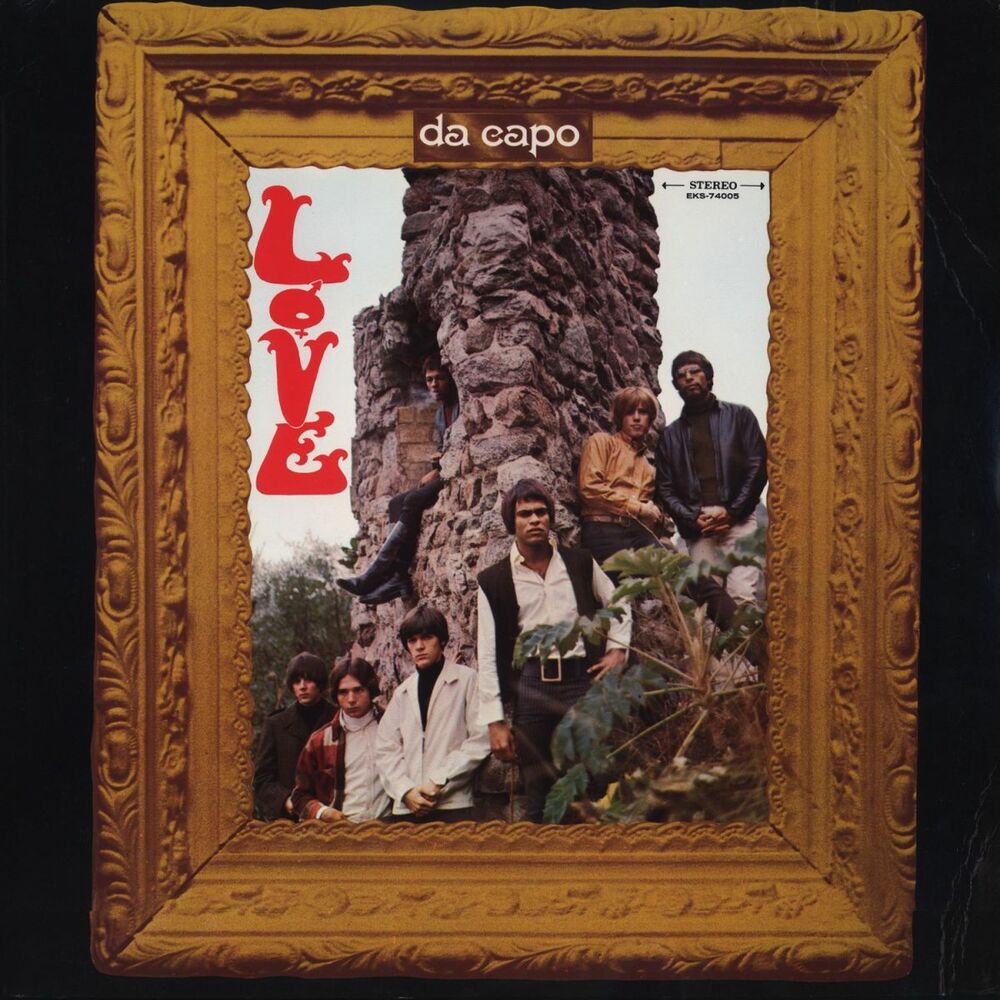
Keeping with the theme of Love "restarting" their sound, Lee asked Pfisterer, the only member of the band who could read music, the musical term for going back to the beginning, to which he replied with "Da capo". The album's front cover, designed by William S. Harvey, illustrates this theme by showing a framed photo of the band at the same burnt-out house in Laurel Canyon featured on the cover of their first album. According to Stuart, the cover photo captures Lee exhaling from a joint. The album's back cover photo was taken by Guy Webster in the upstairs office of the Whisky a Go Go. Echols said that it was the only photo shoot the band did where they posed in a studio, because "for every other thing we went outside."
Release and reception
Love unveiled their new lineup and sound to the public with a residency at the Whisky during October 19–30, 1966. According to a contemporary review from the Los Angeles Times, the band attracted "a cream crop of Sunset Strip celebrities who came to judge the change." The shows were, in Spevack's words, "remarkably successful by all accounts", and received rave reviews from the local press. Digby Diehl of the Times referred to the band's sound as "a hypnotic mélange" and further wrote that: "The flute and harpsichord jazz improvisations on numbers such as 'Stephanie Knows Who' and 'Orange Skies' lend a fresh lift to what might be an ordinary rock piece." A later review from the paper placed the band's "clean" presentation and "balance of instruments and roles" with those of the Beatles and Buffalo Springfield. Echols remembered the band's performances with the expanded lineup as "probably the most fun we had playing." Da Capo was first announced as an album on November 12, 1966, with an advertisement placed by Elektra on page 1 of Billboard magazine. By late January 1967 when Da Capo was listed by Billboard as a "New Action Album", "7 and 7 Is" had already received commercial and critical success, helping to boost the album's sales. It entered the Billboard Top LPs chart on February 11, 1967, and peaked at number 80 on April 8, failing to achieve the commercial success the band had hoped it would. Lee blamed the album's disappointing performance on Elektra, but Botnick disagreed, saying, "Arthur wouldn't go out and promote it!" Stuart later reflected that the band "should have toured behind it"; however, he recognized that Lee "prided himself on being different. If bands toured after releasing an album, he would do it differently." Regarding the album as "an undeniably groundbreaking release for 1966" with a style that had "no other context or reference in [rock] up to that point", Einarson asks if Lee had "overestimated his own audience with a body of music perhaps too complex and esoteric for their tastes". In the observation of writer Jim Bickhart, "by that point, Arthur had shown he was kind of oblivious to who his audience was and how to appeal to them ... he was not thinking, 'I'm going to bring my audience along with me,' he was just thinking, 'I'm going to do what I'm going to do.'" Da Capo received favorable recognition from contemporary reviewers. David Harris of Mojo-Navigator called it "a great advance" over Love's debut album and recognized their "integration of jazz and [rock] into a new form of music." In a more critical review for Esquire magazine, Robert Christgau felt that, although "7 and 7 Is" was a "perfect rocker", the rest of side one "sounds cluttered and lacks sock", directing the latter criticism to Lee's voice being "more often too sweet for his material." Of "Revelation", Christgau wrote: "It includes excellent guitar and harmonica work and great screaming ... It also includes some mediocre alto sax and (I shudder) a protracted drum solo. A brave stab at a target somewhere between rock and jazz, I think it fails, but it may prove prophetic."
Legacy
Da Capo has been largely overshadowed by Love's third album Forever Changes, widely regarded as one of the greatest albums of all time. Spevack writes that many fans and critics who have given Forever Changes that title have also declared Da Capo "the perfect album side", and that the decision to devote the entire other side to "Revelation" instead of a potential six further songs from Lee or MacLean has resulted in Love "only having one universally beloved masterpiece LP and not two." Writing for AllMusic, Richie Unterberger said that although side one stands as "a truly classic body of work", side two keeps the album as a whole from attaining that status. Mike Segretto called the album "frustrating" due to it not "follow[ing] through on its tremendous promise." He said that the first side "may be the best run of Love songs the band ever recorded", and that the album may have ended up being their best if the second side "had some songs on it." Despite this, Segretto said that the strength of side one still set the album "well above the majority of its contemporaries." The album has been featured in several record guides, such as: John Tobler's 100 Great Albums of the Sixties (1994); Colin Larkin's All Time Top 1000 Albums (2000), where it was voted number 331; Tom Moon's 1,000 Recordings to Hear Before You Die (2008), albeit as a "Catalog Choice" after Forever Changes; and Robert Dimery's 1001 Albums You Must Hear Before You Die (2005). Alice Cooper, who recorded a cover of "7 and 7 Is" for his 1981 album Special Forces, has named Da Capo as one of his favorite albums of all time. Jack White, an avowed Love fan, was inspired to name The White Stripes' second album De Stijl (2000) "because Love called their second album Da Capo."
Tracklist
- Stephanie Knows Who (LP / Stereo Version)2:32
- Orange Skies2:50
- ¡Que Vida!3:41
- Seven and Seven Is (LP Version)2:19
- The Castle3:00
- She Comes in Colors2:46
- Revelation18:58
Listeners 0
Nobody has logged it yet. Be the first.