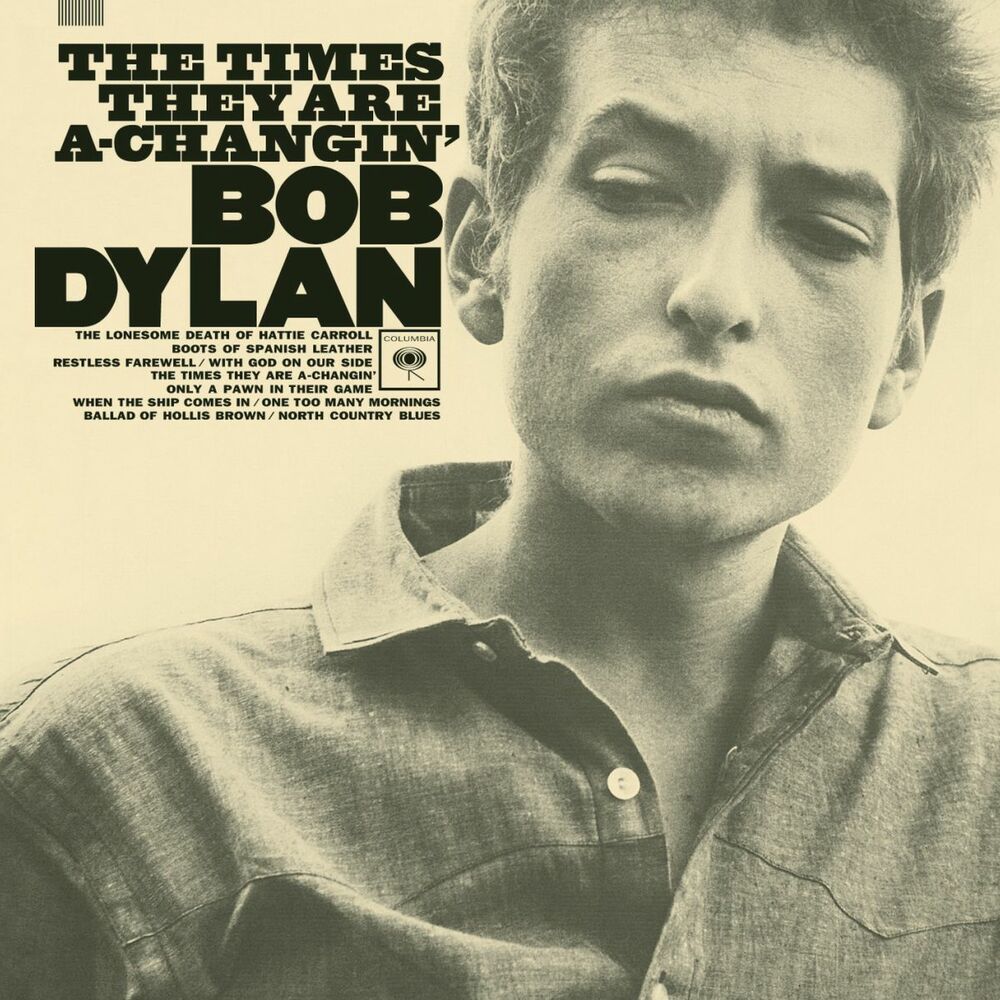
Tracklist
- The Times They Are A-Changin'3:11
- Ballad of Hollis Brown5:03
- With God on Our Side7:05
- One Too Many Mornings2:37
- North Country Blues4:31
- Only a Pawn in Their Game3:30
- Boots of Spanish Leather4:37
- When the Ship Comes In3:15
- The Lonesome Death of Hattie Carroll5:44
- Restless Farewell5:33
Have you heard it?
Sign in to mark it as listened, rate it and keep notes.
The full story
The Times They Are a-Changin' is the third studio album by the American singer-songwriter Bob Dylan. It was released on February 10, 1964, through Columbia Records. Whereas his previous albums, Bob Dylan (1962) and The Freewheelin' Bob Dylan (1963), combined original material and cover songs, this was the first to feature only original compositions. The album consists mostly of stark, sparsely arranged ballads concerning issues such as racism, poverty, and social change. The title track is one of Dylan's most famous; many feel that it captures the spirit of social and political upheaval that characterized the 1960s. While it was still acclaimed, some critics and fans were not quite as taken with the album as a whole, relative to his previous work, for its lack of humor or musical diversity. Still, The Times They Are a-Changin' peaked at No. 20 on the US chart, eventually going gold, and belatedly reaching No. 4 in the UK in 1965.
Recording sessions
Dylan began work on his third album on August 6, 1963, at Columbia's Studio A, located at 799 Seventh Avenue in New York City. Once again, Tom Wilson was the producer for the entire album. Dylan had, by the time of recording, become a popular, influential cultural figure. Eight songs were recorded during that first session, but only one recording of "North Country Blues" was ultimately deemed usable and set aside as the master take. A master take of "Seven Curses" was also recorded, but it was left out of the final album sequence. Another session at Studio A was held the following day, this time yielding master takes for four songs: "Ballad of Hollis Brown", "With God on Our Side", "Only a Pawn in Their Game", and "Boots of Spanish Leather", all of which were later included on the final album sequence. A third session was held in Studio A on August 12, but nothing from this session was deemed usable. However, three recordings taken from the third session eventually saw official release: "master" takes of "Paths of Victory," "Moonshine Blues," and "Only a Hobo" were all included on The Bootleg Series Volumes 1–3 (Rare & Unreleased) 1961–1991 released in 1991. In 2013, "Eternal Circle" (Take 4), "Hero Blues" was included in the 1963 entry of The 50th Anniversary Collection 1963. Sessions did not resume for more than two months. During the interim, Dylan toured briefly with Joan Baez, performing a number of key concerts that raised his profile in the media. When Dylan returned to Studio A on October 23, he had six more original compositions ready for recording. Master takes for "The Lonesome Death of Hattie Carroll" and "When the Ship Comes In" were both culled from the October 23 session. A master take for "Percy's Song" was also recorded, but it was ultimately set aside and was not officially released until Biograph in 1985. An alternate take on "Percy's Song," a "That's All Right" (Arthur Crudup)/"Sally Free and Easy" (Cyril Tawney) medley and "East Laredo Blues" were released in 2013 on the 1963 entry of The 50th Anniversary Collection 1963. Another session was held the following day, October 24. Master takes of "The Times They Are a-Changin'" and "One Too Many Mornings" were recorded and later included in the final album sequence. A master take for "Lay Down Your Weary Tune" was also recorded, but ultimately left out of the final album; it was eventually released on Biograph. Two more outtakes, "Eternal Circle" and "Suze (The Cough Song)", were later issued on The Bootleg Series Volumes 1–3 (Rare & Unreleased) 1961–1991. A final outtake, "New Orleans Rag", was released in 2013 on The 50th Anniversary Collection 1963. The sixth and final session for The Times They Are a-Changin' was held on October 31, 1963. The entire session focused on one song — "Restless Farewell"— whose melody is taken from an Irish-Scots folk song, "The Parting Glass", and it produced a master take that ultimately closed the album.
Legacy
On October 26, 1963, three days after recording the final song for The Times They Are a-Changin', Dylan held a concert at New York's Carnegie Hall. That night, he performed eight songs from his forthcoming third album, as well as several outtakes from the same album sessions (including "Percy's Song", "Seven Curses", and "Lay Down Your Weary Tune"). Columbia recorded the entire concert, however the recording would not see release in its entirety until the Deluxe Edition of The Bootleg Series Vol. 18: Through the Open Window 1956–1963. Nevertheless, the performance was well received by the press and audience alike. A month later, on November 22, 1963, President John F. Kennedy was assassinated in Dallas, Texas. Dylan's friend Bob Fass was sitting with Dylan in Carla Rotolo's apartment the day of the shooting. According to Fass, Dylan was deeply affected by it and said: "What it means is that they are trying to tell you 'Don't even hope to change things'." Three weeks to the day after Kennedy's assassination, the Emergency Civil Liberties Committee gave Dylan their annual Tom Paine Award for his contribution to the civil rights movement. Dylan gave an acceptance speech at the awards ceremony held at Hotel Americana in New York. In his closing remarks, he stated the following:
I want to accept this award, the Tom Paine Award, from the Emergency Civil Liberties Committee. I want to accept it in my name but I'm not really accepting it in my name and I'm not accepting it in any kind of group's name, any Negro group or any other kind of group. There are Negroes—I was on the march on Washington up on the platform and I looked around at all the Negroes there and I didn't see any Negroes that looked like none of my friends. My friends don't wear suits. My friends don't have to wear suits. My friends don't have to wear any kind of thing to prove that they're respectable Negroes. My friends are my friends, and they're kind, gentle people if they're my friends. And I'm not going to try to push nothing over.
So, I accept this reward—not reward, [laughter] award in behalf of Phillip Luce who led the group to Cuba which all people should go down to Cuba. I don't see why anybody can't go to Cuba. I don't see what's going to hurt by going any place. I don't know what's going to hurt anybody's eyes to see anything. On the other hand, Phillip is a friend of mine who went to Cuba.
I'll stand up and to get uncompromisable about it, which I have to be to be honest, I just got to be, as I got to admit that the man who shot President Kennedy, Lee Oswald, I don't know exactly where—what he thought he was doing, but I got to admit honestly that I too—I saw some of myself in him. I don't think it would have gone—I don't think it could go that far. But I got to stand up and say I saw things that he felt, in me—not to go that far and shoot. [Boos and hisses] You can boo but booing's got nothing to do with it. It's a—I just a—I've got to tell you, man, it's Bill of Rights is free speech and I just want to admit that I accept this Tom Paine Award in behalf of James Forman of the Students Non-Violent Coordinating Committee and on behalf of the people who went to Cuba." [Followed by applause and boos]
It was voted number 378 in the third edition of Colin Larkin's All Time Top 1000 Albums (2000). Clinton Heylin wrote: "in less than six months [Dylan] had turned full circle from the protest singer who baited Paul Nelson into someone determined to write only songs that 'speak for me' [...] Dylan's ambitions as a writer for the page [...] may have been further fed at the end of December when he met renowned beat poet Allen Ginsberg, author of Howl and Kaddish." Dylan was already familiar with Ginsberg's work. By now, beat poetry and French symbolists had become an enormous influence on Dylan's work, as Dylan "passed from immediate folk sources to a polychrome of literary styles". In an interview taken in 1985, Dylan said that he did not start writing …
Tracklist
- The Times They Are A-Changin'3:11
- Ballad of Hollis Brown5:03
- With God on Our Side7:05
- One Too Many Mornings2:37
- North Country Blues4:31
- Only a Pawn in Their Game3:30
- Boots of Spanish Leather4:37
- When the Ship Comes In3:15
- The Lonesome Death of Hattie Carroll5:44
- Restless Farewell5:33
Listeners 0
Nobody has logged it yet. Be the first.