Sign in to mark it as listened, rate it and keep notes.
About the artist
Sufjan Stevens is an American singer, songwriter, and multi-instrumentalist, known for his diverse musical styles and intricate, often self-played, arrangements. He co-founded Asthmatic Kitty Records and has received Grammy and Academy Award nominations. His music frequently explores themes of religion and spirituality.
About the album
Illinois is Sufjan Stevens' fifth studio album, a sprawling orchestral-folk record exploring the history, culture, and myths of the US state of Illinois. Stevens recorded and produced it himself in New York City using low-fidelity equipment and a wide array of instruments. It is celebrated for its complex orchestrations and literary lyrics.
Meanings
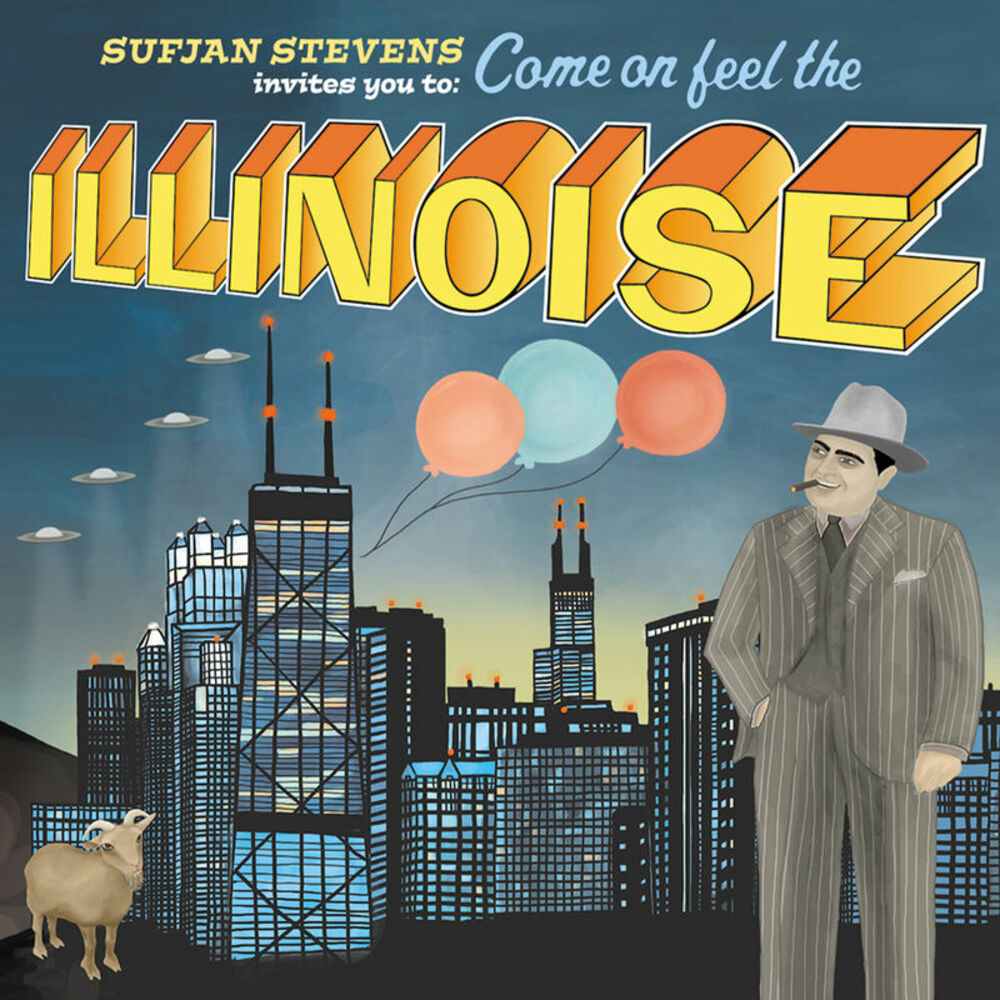
The album delves into the history, culture, art, and geography of Illinois, referencing specific places, events, and people, including a serial killer and a UFO sighting. The title 'Illinoise' is a playful nod to the state's common mispronunciation and a reference to the Slade song 'Cum On Feel the Noize.' The original cover art featured Superman, later covered due to copyright concerns.
Why it's rated so high
Illinois received universal acclaim, named the best-reviewed album of 2005 by Metacritic and appearing on numerous 'best of the decade' lists. Critics praised its well-written lyrics, complex orchestrations, and Stevens' growth as a songwriter. It was his greatest commercial success to date, charting on the Billboard 200 and eventually certified gold.
Career and historical context
Illinois was Stevens' second state-themed album, part of a half-joking '50 states project' that brought him wide recognition. It marked a significant shift in his career, becoming his first album to chart on the Billboard 200 and significantly raising his public profile. The album's success led to a world tour and later inspired a Tony Award-winning musical adaptation.
Fun facts
The original album cover featured Superman, which had to be covered with a balloon sticker for legal reasons.
Sufjan Stevens recorded and produced the entire album himself using low-fidelity studio equipment.
The album's title 'Illinoise' is a pun on a Slade song and the state's pronunciation.
Stevens initially considered the '50 states project' a joke and a promotional gimmick.
Illinois was adapted into a Tony Award-winning Broadway musical in 2024.
Written by AI from the album's and artist's Wikipedia articles and the archive's notes. Double-check anything important.
The full story
Illinois (styled Sufjan Stevens invites you to: Come on feel the Illinoise on the cover; sometimes spelled as Illinoise) is the fifth studio album by the American singer-songwriter Sufjan Stevens. It features songs referencing places, events, and persons related to the U.S. state of Illinois. Illinois is Stevens' second based on a U.S. state—part of a planned series of fifty that began with the 2003 album Michigan and that Stevens has since acknowledged was a joke. It was adapted into a musical, Illinoise, in 2023 and, after playing smaller venues, opened at the St. James Theatre on Broadway and was nominated for four Tony Awards in 2024, winning for Best Choreography.
Stevens recorded and produced the album at multiple venues in New York City using low-fidelity studio equipment and a variety of instruments between late 2004 and early 2005. The artwork and lyrics explore the history, culture, art, and geography of the state—Stevens developed them after analyzing criminal, literary, and historical documents, and weaved them with personal stories. Following its release, Stevens promoted Illinois with a world tour.
The album received widespread critical acclaim from music critics for its well-written lyrics and complex orchestrations. In particular, reviewers noted Stevens' progress as a songwriter since the release of Michigan. Illinois was named the best-reviewed album of 2005 by review aggregator Metacritic, and was included on several reviewers' "best of the decade" lists—including those of Paste, NPR, and Rolling Stone. The album amounted to Stevens' greatest public success to date; it was his first to place on the Billboard 200, and it topped the Billboard list of "Heatseekers Albums". The varied instrumentation and experimental songwriting on the album invoked comparisons to work by Steve Reich, Neil Young, and the Cure. Besides numerous references to Illinois, Stevens continued a theme of his songwriting career by including multiple references to his Christian faith.
Background, recording, and tour
Stevens launched his 50-state project in 2003 with the album Michigan and chose to focus on Illinois with this recording because "it wasn't a great leap" and he liked the state, as he considered it to be the American Midwest's "center of gravity". Before creating the album, Stevens read literature by Illinois authors Saul Bellow and Carl Sandburg, and studied immigration records and history books for the state—he made the deliberate decision to avoid current events and focused on historical themes. He also took trips through several locations in Illinois and asked friends and Internet chat rooms for anecdotes about their experiences in the state. Although he began work in 2004 on Oregon-themed songs and briefly considered releasing a Rhode Island-themed 7-inch, Stevens has since not released another album focused on a state, saying in a November 2009 interview with Paste that "the whole premise was such a joke," and telling Andrew Purcell of The Guardian in October 2009 "I have no qualms about admitting [the fifty states project] was a promotional gimmick." An Arkansas-related song was released through NPR as "The Lord God Bird" and material intended for New Jersey and New York became The BQE.
All of the songs on Illinois were written, recorded, engineered, and produced by Stevens, with most of the material being recorded at The Buddy Project studio in Astoria, Queens, and in Stevens' Brooklyn apartment. As with his previous albums, Stevens recorded in various locations, with additional piano recorded in St. Paul's Church in Brooklyn; strings and vocals performed in collaborators' apartments; electronic organ recorded in the New Jerusalem Recreational Room in Clarksboro, New Jersey; and vibraphone played at Carroll Music Studios in New York City. Stevens mostly created the album without collaboration, focusing on the writing, performance, and technical creation of the album by himself: "I was pretty nearsighted in the construction of Illinois. I spent a lot of time alone, a few months in isolation working on my own and in the studio. I let things germinate and cultivate independently, without thinking about an audience or a live show at all."
Stevens employed low-fidelity recording equipment, which allowed him to retain creative control and keep costs low on recording Illinois. Typically, his process involved recording tracks using two Shure SM57s and an AKG C1000, running through a Roland VS880EX, at a sampling rate of 32 kHz (lower than the rates typically used in recording). He then employed Pro Tools for mixing and other production tasks.
After consulting with Michael Kaufmann and Lowell Brams of Asthmatic Kitty about the amount of material he had recorded, Stevens decided against a double album, saying that would be "arrogant". In 2006, several tracks recorded during these sessions were sent to Seattle-based musician and producer James McAllister for additional instrumentation and production, and were released in 2006 on the follow-up album The Avalanche: Outtakes and Extras from the Illinois Album. Among these outtakes are three separate recordings of the song "Chicago"—including the "Multiple Personality Disorder Version", which was produced during a subsequent tour. The "Adult Contemporary Easy Listening Version" of the song was supposed to appear on the Illinois album, but was changed at the last minute.
Illinois was released on July 4, 2005, through Rough Trade Records in Europe and was distributed domestically by Asthmatic Kitty Records starting July 5, 2005. Although he initially had no plans to perform this material live, less than two weeks after the release of Illinois, Stevens embarked on a North American tour to promote the album, performing with a string section of eight to ten members named the Illinoisemakers. He deliberately chose to avoid television as a promotional tool and focused on the tour performances themselves. He was supported on some dates by opening acts Liz Janes (who is also signed to …
Musical style and themes
Reviewers have noted similarities between this album and those of musicians and composers in several musical genres—from pop to contemporary classical, even show tunes and jazz-based time signatures. The lyrics and their rich thematic elements have been noted for their literary quality, earning comparisons to Ralph Waldo Emerson, Henry David Thoreau, William Carlos Williams, and Walt Whitman. Genre labels that have been applied to the album include indie folk, indie pop, indie rock, folk rock, anti-folk, chamber folk, and lo-fi.
Musical style
Reviewers of Illinois have compared Stevens' style to Steve Reich, Vince Guaraldi, the Danielson Famile, Neil Young, Nick Drake, and Death Cab for Cutie. Stevens' use of large orchestral arrangements in his music—much of it played by himself through the use of multi-track recording—has been noted by several reviewers. Rolling Stone summarized the musical influences of Illinois, saying "the music draws from high school marching bands, show tunes and ambient electronics; we can suspect Steve Reich's Music for 18 Musicians is an oft-played record in the Stevens household, since he loves to echo it in his long instrumental passages." A review in The A.V. Club referred to some of the vocal work as "regressively twee communalism", but found Stevens' music overall to be "highly developed". The song "Come On! Feel the Illinoise!" has a saxophone part resembling "Close to Me" by the Cure.
The creation of Illinois marked a shift in Stevens' emphasis on songwriting and studio work toward live performance and more abstract concepts of motion and sound—subsequent tours and albums emphasized electronic music and modern dance over the indie folk material on Michigan and Illinois. He has ceased writing songs about individual characters with straightforward narratives or concept albums and briefly considered quitting the music business entirely after creating and promoting this album. He also found that the way in which he listened to music had changed after producing Illinois:
I think now I listen more as a technician and a researcher. I'm always hearing music in terms of what I can take out of it, and I think I've always listened like that. I have a hard time just listening for pleasure. I'm much less about instinct, and more of a utilitarian listener. Like, what is the use of this song? What is the usefulness of this melody for this theme or statement? What are they doing that's unusual sounding, and how can I learn from that?
Stevens is a classically trained oboist and his knowledge of classical and baroque music influenced many of his arrangements. Stevens himself has noted the influence of composers Igor Stravinsky, Sergei Rachmaninoff, and Edvard Grieg; along with minimalist composers Terry Riley, Steve Reich, and Philip Glass. The music on this album was written to be grandiose, to match the history of the territory. Stevens used time signature changes in the composition of Illinois for dynamic effect—for instance, "Come On! Feel the Illinoise!" begins with a 5/4 time signature and then changes to a standard 4/4 later in the song.
Personal and Illinois themes
Many of the lyrics in Illinois make references to persons, places, and events related to the state of the same name. "Concerning the UFO Sighting Near Highland, Illinois" is about a UFO sighting by police officers near Highland, Illinois, where several persons reported seeing a large triangular object with three lights flying at night. "Come on! Feel the Illinoise!" makes reference to the World's Columbian Exposition, which took place in Chicago in 1893.
"John Wayne Gacy, Jr." documents the story of the 1970s Chicago-based serial killer of the same name. Several lyrics make explicit references to events in his life: "[w]hen the swingset hit his head" refers to an event in Gacy's childhood, when a swing hit his head and caused a blood clot in his brain; "He dressed up like a clown for them / with his face paint white and red" …
Artwork
Divya Srinivasan created the album artwork, depicting a variety of Illinois-related themes, including Abraham and Mary Todd Lincoln, the Sears Tower, and Black Hawk. The album cover reads, "Sufjan Stevens Invites You To: Come On Feel the Illinoise!" as a wordplay on the common mispronunciation of the state's name as "ill-i-NOYZ" and a reference to the Slade song "Cum On Feel the Noize" made famous in the United States by the metal band Quiet Riot. The text on the cover caused some confusion over the actual title of the album—it is officially titled Illinois, as opposed to Come on Feel the Illinoise or Illinoise. Paste listed Illinois as having the seventh best album art of the decade 2000–2009. The album also won the PLUG Independent Music Award for Album Art/Packaging of the Year in 2006.
Shortly after the release of the album, reports arose that DC Comics had issued a cease and desist letter to Asthmatic Kitty because of the depiction of Superman on the cover. However, on October 4, 2005, Asthmatic Kitty announced that there had been no cease and desist letter; the record company's own lawyers had warned about the copyright infringement. On June 30, 2005, Asthmatic Kitty's distributor Secretly Canadian asked its retailers not to sell the album; however, it was not recalled. On July 5, the distributor told its retailers to go ahead and sell their copies, as DC Comics agreed to allow Asthmatic Kitty to sell the copies of the album that were already manufactured, but the image was removed from subsequent pressings. Soon after it was made public that the cover would be changed, copies of the album featuring Superman were sold for as high as $75 on eBay. On the vinyl edition released on November 22, 2005, Superman's image is covered by a balloon sticker. The image of the balloon sticker was also used on the cover of the compact disc and later printings of the double vinyl release. Stevens himself was surprised by the development and also had to pay a fee for referencing lyrics from Woody Guthrie's folk anthem "This Land Is Your Land" in the track "No Man's Land", which was later released on The Avalanche.
The 10th anniversary vinyl reissue of Illinois features the Marvel Comics character Blue Marvel, who hails from Chicago, in place of Superman. Asthmatic Kitty obtained permission from the publisher to use the character's likeness. The Blue Marvel edition's artwork was created by Divya Srinivasan and has LP 1 on "cape white" vinyl, LP 2 on "antimatter blue" vinyl, and a bonus single of "Chicago (Demo)" (on both sides) on a red vinyl 12" disc shaped like a six-sided star in reference to the municipal flag of Chicago.
Critical reception
Illinois was Sufjan Stevens' greatest commercial and critical success to date. For the first time, his work charted on the Billboard 200 and received several awards from critics. According to the review aggregator Metacritic, Illinois received "universal acclaim" based on a weighted average score of 90 out of 100 from 40 critic scores. The site assesses this as "universal acclaim" and designated it the best-reviewed album of 2005, alongside Z by My Morning Jacket. In 2020, Consequence of Sound ranked several of Stevens' studio albums, with Illinois coming in second behind the 2015 release Carrie & Lowell.
Andy Battaglia of The A.V. Club said that Stevens "has grown into one of the best song-makers in indie rock" with the album. Tim Jonze of NME called Illinois "a brainy little fucker" and described Stevens as "prolific, intelligent and—most importantly—brimming with heart-wrenching melodies." Rob Sheffield of Rolling Stone responded favorably to the album, praising the "over-the-top arrangements" and Stevens' "breathy, gentle voice" as well as the personal nature of songs such as "Chicago" and "Casimir Pulaski Day", but criticized "John Wayne Gacy, Jr.", stating that it "symbolizes nothing about American life except the existence of creative-writing workshops". Michael Metivier of PopMatters described "John Wayne Gacy, Jr." as "horrifying, tragic, and deeply sad without proselytizing." Amanda Petrusich of Pitchfork described Illinois as "strange and lush, as excessive and challenging as its giant, gushing song titles." Dave Simpson of The Guardian echoed this sentiment by saying that the music sounds like "The Polyphonic Spree produced by Brian Eno." The diversity in instrumentation also received a positive review from Entertainment Weekly's Kristina Feliciano.
Jesse Jarnow of Paste praised the playful nature of Illinois, commenting that it had "sing-song" melodies and "jaunty" orchestrations. Jarnow also noted ironic lyrics, citing a line from "The Predatory Wasp of the Palisades is Out to Get Us!": "I can't explain the state I'm in ..." after a section of the song that references many Illinois landmarks. Q called the album a "sizeable step forward" from Michigan, and said Stevens' love for the state of Illinois is infectious. Critic Andy Gill dubbed Illinois "an extraordinary achievement" in Uncut, and in a separate review for The Independent added that it "makes most other albums seem small-minded and, ironically, rather parochial." Catherine Lewis of The Washington Post responded favorably to the album, stating that it has well-written lyrics, comparing Stevens' rhyming to that of Stephin Merritt. Lewis cited "Casimir Pulaski Day" as one of the most memorable songs of the album. In December 2005, American webzine Somewhere Cold voted Illinois CD of the Year on their 2005 Somewhere Cold Awards Hall of Fame list.
Accolades
Illinois achieved recognition with inclusion on numerous reviewers' "best of the year" and "best of the decade" lists. In particular, the album topped the best of the decade list appearing in the November 2009 issue of Paste and NPR named Illinois on their list of "The Decade's 50 Most Important Recordings". Pitchfork called Illinois the sixteenth best album of the decade, with Stevens' previous album—Michigan—placing 70 on that same list. The album also won the 2005 New Pantheon Award—a type of Shortlist Music Prize. The album was also included in the book 1001 Albums You Must Hear Before You Die. Finally, Paste listed Stevens as one of their "100 Best Living Songwriters" in 2006, primarily due to the writing on Michigan and Illinois.
Commercial performance
In its first week of sales, Illinois sold 9,000 copies, 20% coming from online sales. Overall, the album sold more than 100,000 copies by November 2005 and over 300,000 by the end of 2009. It was Stevens' first release to place on the Billboard 200, reaching number 121 within eight weeks on the chart. It also reached number one on Billboard's Heatseekers Albums chart and number four on the Independent Albums chart, remaining on them for 32 and 39 weeks, respectively. In August 2017, the album was certified gold by the Recording Industry Association of America (RIAA), signifying shipments in excess of 500,000 copies in the United States.
In July 2013, it was certified silver by the British Phonographic Industry (BPI) for 60,000 sold units in the United Kingdom and in April 2023, it was certified gold for 100,000 sold units.
Musical adaptation
Illinois was adapted into a dance-based musical, Illinoise, directed and choreographed by Justin Peck with a companion book written by Jackie Sibblies Drury and Peck. It premiered at Bard College on June 23, 2023, and a Chicago production opened at Chicago Shakespeare Theatre on February 3, 2024. The show features new arrangements for a live band and three voices, and aims to "lead [the audience] on a mighty journey through the American heartland, from campfire storytelling to the edges of the cosmos". It debuted in New York on March 2, 2024, at Park Avenue Armory, and opened on Broadway at the St. James Theater from April to August 2024.