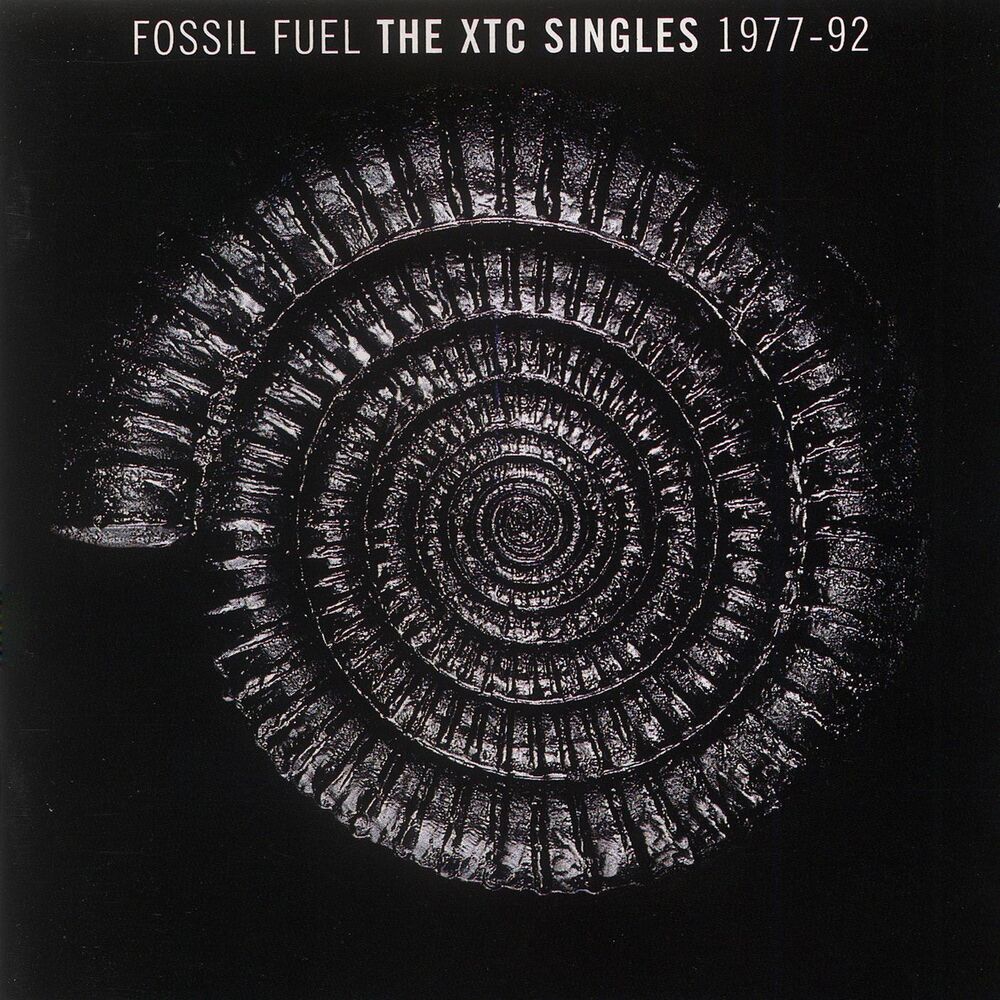
Fossil Fuel: The XTC Singles Collection 1977 - 1992
2009-10-30Virgin Catalogue
25 tracks, 1 h 34 min
Tracklist
- Science Friction3:12
- Statue Of Liberty2:52
- This Is Pop?2:38
- Are You Receiving Me?3:02
- Life Begins At The Hop3:49
- Making Plans For Nigel4:12
- Ten Feet Tall3:12
- Wait Till Your Boat Goes Down4:21
- Generals And Majors (Edit)3:41
- Towers Of London (Edit)4:38
- Sgt. Rock (Is Going To Help Me)3:36
- Love At First Sight3:06
- Respectable Street3:08
- Senses Working Overtime4:34
- Ball And Chain4:30
- No Thugs In Our House5:16
- Great Fire3:51
- Wonderland4:50
- Love On A Farmboy's Wages3:59
- All You Pretty Girls3:50
- This World Over (Edit)4:46
- Wake Up (Edit)3:41
- Grass (Edit)2:43
- The Meeting Place3:14
- Dear God3:38
Have you heard it?
Sign in to mark it as listened, rate it and keep notes.
The full story
XTC were an English rock band formed in Swindon in 1972. Fronted by songwriters Andy Partridge (vocals, guitars) and Colin Moulding (vocals, bass), the band gained popularity during the rise of punk and new wave in the 1970s, later playing in a variety of styles that ranged from angular guitar riffs to elaborately arranged pop. Partly because the group did not fit into contemporary trends, they achieved only sporadic commercial success in the UK and US, but attracted a considerable cult following. They have since been recognised for their influence on Britpop and later power pop acts. Partridge and Moulding first met in the early 1970s and subsequently formed a glam outfit with drummer Terry Chambers. The band's name and line-up changed frequently, and it was not until 1975 that the band was known as XTC. In 1977, the group debuted on Virgin Records and were subsequently noted for their energetic live performances and their refusal to play conventional punk rock, instead synthesizing influences from ska, 1960s pop, dub music and avant-garde. The single "Making Plans for Nigel" (1979) showed them using innovative production techniques and marked their commercial breakthrough. Between 1979 and 1992, XTC had a total of 10 albums and 6 singles that reached the UK top 40, including "Sgt. Rock (Is Going to Help Me)" (1980) and "Senses Working Overtime" (1982). After 1982's English Settlement, the band stopped concert touring and became a studio-based project centred on Partridge, Moulding and guitarist Dave Gregory. A spin-off group, the Dukes of Stratosphear, was invented as a one-off excursion into 1960s-style psychedelia, but as XTC's music evolved, the distinctions between the two bands lessened. XTC continued to produce more progressive records, including the albums Skylarking (1986), Oranges & Lemons (1989) and Nonsuch (1992). In the US, "Mayor of Simpleton" (1989) was their highest-charting single, while "Dear God" (1986) was controversial for its anti-religious message.
Due to poor management, XTC never received a share of profits from record sales (of which there were millions), nor from touring revenue, forcing them into debt throughout the 1980s and 1990s. In 1993, they went on strike against Virgin, citing an unfair recording contract, and soon extricated themselves from the label. Gregory left the band during the making of Apple Venus Volume 1 (1999), after which the XTC name was used by the duo of Partridge and Moulding. In 2006, Partridge announced that his creative partnership with Moulding had disintegrated, leaving XTC "in the past tense". Moulding and Chambers briefly reunited as the duo TC&I in the late 2010s. Partridge and Gregory remain musically active.
Musical style and development
Group dynamic
==== Partridge and Moulding ====
XTC's principal songwriters were guitarist Andy Partridge and bassist Colin Moulding. Partridge, who wrote the majority of XTC's songs, was the group's frontman and de facto leader. He drove the band's image, designed many of their record sleeves, and handled most of their interviews. His involvement with XTC's record sleeves stemmed from his disappointment with the sleeve for the "Statue of Liberty" single, which depicted a poorly cropped photo of the statue and the XTC logo in red. He was less successful in his attempts to involve himself in the band's music videos, as he said, the woman in charge of Virgin's video department rebuked all his ideas, some of which other groups later adopted in award-winning videos. Partridge and Moulding did not write together. Of their partnership, Moulding stated in 1992: "There's a lot of freedom to do what each of us likes with the other's songs, however. ... Each person puts his little prints on them." They did collaborate on arrangements, with "horn lines and harmonies, that sort of thing." He also lent praise to Partridge as "a real ideas man, and I love good ideas. It's not hard contributing bass parts when you have such good songs to contribute to." Discussing Moulding's songs, Partridge said that few were included on XTC albums because Moulding was not a prolific writer. Gregory said that all of Moulding's proposed songs would be recorded to preserve democracy in the band, and "occasionally at the expense of some of Andy's often superior offerings. This didn't always go down well, either with Andy or the band, but Colin did have some killer melodies and a sweeter sound to his voice that made a welcome diversion when listening to an album as a whole." Partridge opined that Moulding's songs initially "came out as weird imitations of what I was doing", but by the time of Drums and Wires, "he really started to take off as a songwriter." He was more effused with Moulding's offerings for Skylarking, which included the highest ratio of Moulding songs for any XTC album. On Moulding's bass-playing, Partridge praised his "old-fashioned" tendency to match notes to the bass drum. In Song Stories, Neville Farmer comments that Partridge "is the boss—erratic but willful [and] runs the band on instinct", while Moulding "is the voice of calm ... a foil to Andy's radical side." Music journalist Peter Paphides felt that the songwriters' personalities "couldn't seem more different," with Moulding "phlegmatic, shy, and heartbreakingly pretty" and Partridge an "art-school dropout ... uptight, dominating and extrovert." In Moulding's view, Partridge also typically acted as an "executive producer" for albums while frequently undermining the authority of the actual credited producer. Their recording approaches differed in that Moulding sometimes preferred spontaneous or imperfect performances, whereas Partridge working method was to refine a song through repeated takes. The band occasionally took to the term "Andy-ness" to describe Partridge's studio indulgences. Despite this, they rarely found themselves encumbered by serious creative differences. In 1997, Moulding called one dispute over a Skylarking bass part the "only real argument" between him and Partridge in the band's history.
==== Andrews, Gregory and drummers ==== Barry Andrews, XTC's keyboard player for their first two albums, emerged as a third solo songwriter on the group's second album Go 2, and left the band shortly thereafter. His replacement, guitarist Dave Gregory, did not contribute songs, but was the only one in the band who could score music, and frequently contributed orchestral arrangements. Moulding said that when Andrews was in the band, Partridge had "no kind of foil" to work with, as both musicians were drawn to dissonant harmonies: "[Andy] used to like the real kind of angular, spiky, upward-thrusting guitar ... if one is angular, the other has to kind of straighten him out …
Lyricism and English culture
XTC are noted for their "Englishness". Partridge denied that this was conscious on his part: "I don't try to be English. I guess because I am English, it comes out English. But I don't sit down and think, "Cor blimey, can I put a union jack and a beefeater's outfit on, Mary?" British music critic John Harris identified Partridge's XTC compositions as within the same "lineage" of small town English songwriting invented by Ray Davies of the Kinks, and followed by the Jam, the Specials, "scores of half-forgotten punk and new wave bands," the Smiths and mid 1990s Britpop. In Partridge's opinion, the band "never got beyond Swindon." He also felt that XTC being described as "pastoral" was a compliment: "'Pastoral' to me means being more in touch with the country than the city, which I think we are. London gives me the willies." Lyrically, he cited Ray Davies, John Lennon, and Paul McCartney as his biggest influences. According to biographer Neville Farmer, Partridge and Moulding tended to write about "more general aspects of their lives and their attitudes". Farmer added that "Colin nor Andy handle political or religious matters with subtlety. If they have an idea about something, they say it straightforwardly. They are no more embarrassed about their view on the world than Andy is about his sex life. That makes them easy targets for criticism." For Partridge, other popular subject matter included financial shortage, factory work, comic book characters, seafaring, war, and ancient rituals. He described himself as an atheist and said he did not become interested in politics until circa 1979, when he voted for Margaret Thatcher "purely because she was a woman. I was that naive. Now I'm very left."
Recognition and influence
Writing for AllMusic, music critic Stephen Thomas Erlewine recognised the group thus:
XTC was one of the smartest – and catchiest – British pop bands to emerge from the punk and new wave explosion of the late '70s. ... While popular success has eluded them in both Britain and America, the group has developed a devoted cult following in both countries that remains loyal over two decades after their first records. ... XTC's lack of commercial success isn't because their music isn't accessible – their bright, occasionally melancholy, melodies flow with more grace than most bands – it has more to do with the group constantly being out of step with the times. However, the band has left behind a remarkably rich and varied series of albums that make a convincing argument that XTC is the great lost pop band.
XTC were one of the progenitors of Britpop, were influential to later power pop acts such as Jellyfish and the Apples in Stereo, and anticipated the indie/art pop bands of the 2000s. They also inspired tribute bands, tribute albums, fan conventions, and fansites. Dave Gregory said that he became aware of XTC's "huge" influence on American acts through his interactions with musicians in the late 1980s. They Might Be Giants paid tribute to them in their song, "XTC vs. Adam Ant". XTC also had a significant influence and cult following in Japan. By the late 1980s, they were supported by three dedicated fanzines in as many countries. Between 1979 and 1992, they had a total of 10 albums and 6 singles that reached the UK top 40.
The band are often compared reverentially to 1960s acts such as the Who, the Kinks, and most frequently, the Beatles. In a 1991 article that focused on a resurgence of power pop groups, members of Jellyfish and the Posies reflected that they were drawn to 1960s artists because of the 1980s music they influenced. As the Posies' Jon Auer said: "our '60s-ish-ness is actually early-'80s-ish-ness, a pop sensibility that came from listening to Squeeze and XTC". According to Chris Ingham, acts such as Kula Shaker, the Shamen and the Stone Roses recruited engineer John Leckie chiefly because of his productions for the retro-psychedelic Dukes of Stratosphear records. Japanese band Seagull Screaming Kiss Her Kiss Her was named after the XTC song of similar title. Peter Gabriel is quoted: "I've always looked to XTC for inventive songwriting, innovative production, and a sense of humor. It's their strong blend of personalities that make them one of the great British bands." Kurt Cobain of Nirvana said in 1991: "There's a lot of good pop music. I've always liked it…bands like the Beatles, XTC, stuff like that." Minor Threat, Dag Nasty, and Bad Religion veteran Brian Baker has also cited XTC as an influence. Discussing the band's relative obscurity and lack of financial success, Schabe said that "it's difficult to justify claims of greatness without trying to understand exactly why they never managed to rise above the status of cult band. Respect and recognition are the real validation of such claims, not financial success". Andy Partridge characterized the band as "quietly influential" and thought that the decision to quit touring "definitely affected our popularity later on". Schabe disagreed that the lack of touring had an effect and wrote that "XTC suffered more from the hands of industry forces than they did from failure to find an audience." Partridge also estimated that XTC's fan demographic had a male/female ratio of about 60–40, which was "reassuring" to him, as he thought the band only appealed to "computer nerds". In the 1981 edition of Rolling Stone's Book of Rock Lists, XTC were ranked number 15 for its list of the "17 Loudest Bands in the World", ahead of Queen and Kiss. XTC were the only group besides the Stranglers to emerge from the punk scene with a keyboardist. Journalist Steven Hyden of The A.V. Club wrote that their style of "post-punk guitar pop" became popular in the early 2000s among bands such as …
Tracklist
- Science Friction3:12
- Statue Of Liberty2:52
- This Is Pop?2:38
- Are You Receiving Me?3:02
- Life Begins At The Hop3:49
- Making Plans For Nigel4:12
- Ten Feet Tall3:12
- Wait Till Your Boat Goes Down4:21
- Generals And Majors (Edit)3:41
- Towers Of London (Edit)4:38
- Sgt. Rock (Is Going To Help Me)3:36
- Love At First Sight3:06
- Respectable Street3:08
- Senses Working Overtime4:34
- Ball And Chain4:30
- No Thugs In Our House5:16
- Great Fire3:51
- Wonderland4:50
- Love On A Farmboy's Wages3:59
- All You Pretty Girls3:50
- This World Over (Edit)4:46
- Wake Up (Edit)3:41
- Grass (Edit)2:43
- The Meeting Place3:14
- Dear God3:38
Listeners 0
Nobody has logged it yet. Be the first.