João's Music Archive
Physical Graffiti
← Back to the lists

Physical Graffiti

Led Zeppelin
February 24, 1975
Atlantic Records
15 tracks, 1 h 22 min
Rating
–
Not heard yet
110
–Archive
92Critics
0Listeners
Average score 92Metacritic 97AOTY 87Pitchfork 10.04 reviews

Tracklist

  1. Custard Pie (1990 Remaster)4:13
  2. The Rover (1993 Remaster)5:36
  3. In My Time of Dying (1990 Remaster)11:05
  4. Houses of the Holy (1990 Remaster)4:02
  5. Trampled Under Foot (1990 Remaster)5:35
  6. Kashmir (1990 Remaster)8:28
  7. In the Light (1990 Remaster)8:46
  8. Bron-Yr-Aur (1993 Remaster)2:06
  9. Down by the Seaside (1993 Remaster)5:16
  10. Ten Years Gone (1990 Remaster)6:31
  11. Night Flight (1993 Remaster)3:37
  12. The Wanton Song (1990 Remaster)4:09
  13. Boogie with Stu (1993 Remaster)3:53
  14. Black Country Woman (1993 Remaster)4:32
  15. Sick Again (1993 Remaster)4:42
Listen on

Have you heard it?

Sign in to mark it as listened, rate it and keep notes.

About the artist

Led Zeppelin, an English rock band formed in 1968, pioneered hard rock and heavy metal by blending heavy electric guitar with blues and folk. They became one of the best-selling music artists globally, known for popularising album-oriented and stadium rock. Rolling Stone called them "the heaviest band of all time" and "the biggest band of the seventies."

About the album

"Physical Graffiti" is Led Zeppelin's sixth studio album, a 1975 double LP featuring eight new songs recorded at Headley Grange. To fill the second disc, seven unreleased tracks from earlier album sessions were included. It showcases a broad stylistic range, from hard rock and progressive rock to rock 'n' roll and folk.

Meanings

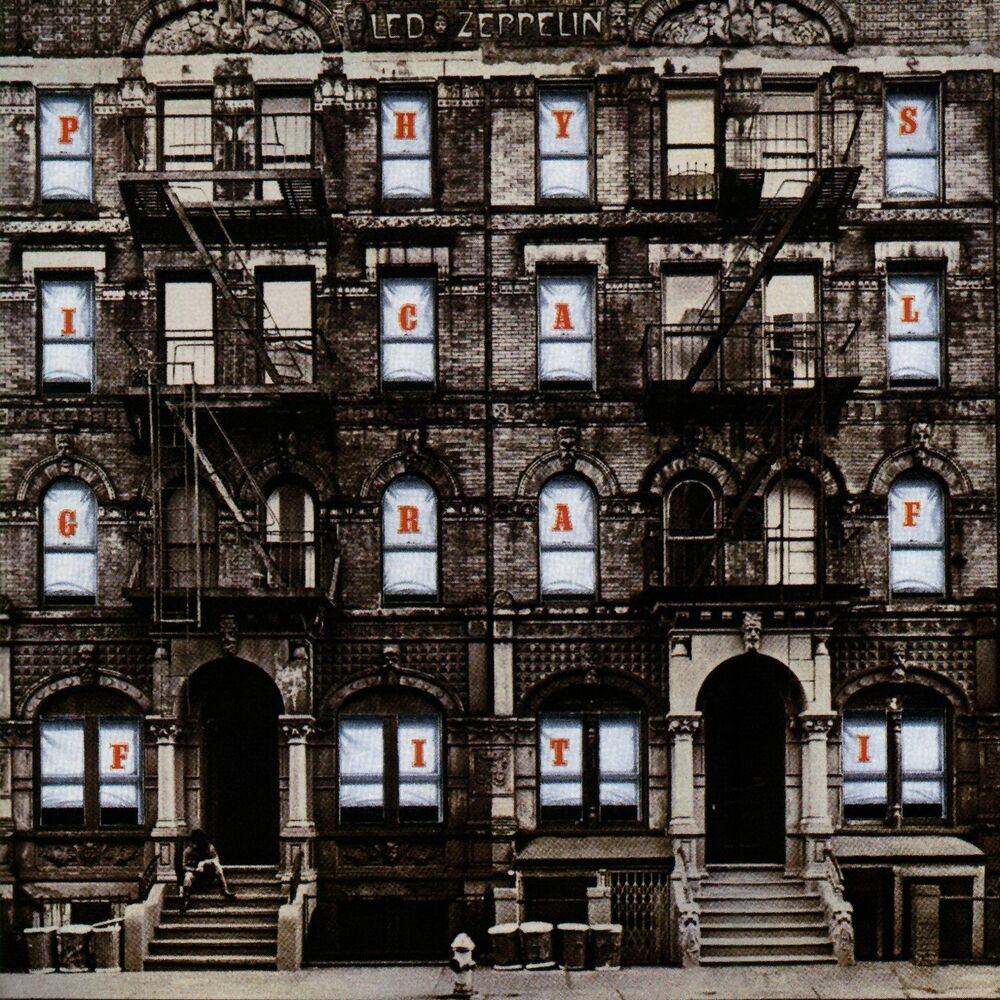
The album's title, "Physical Graffiti," was coined by Jimmy Page to reflect the immense physical and written energy invested in its creation. Its iconic die-cut cover depicts a New York City tenement block, with interchangeable windows revealing various cultural icons, American figures, and Hollywood ephemera.

Why it's rated so high

Upon its 1975 release, the album was a commercial and critical triumph, debuting at number one in the UK and number three in the US. Robert Plant and Jimmy Page both consider it a creative high-water mark for the band. Rolling Stone ranked it among the 500 Greatest Albums of All Time, and it was nominated for a Grammy for best album package.

Career and historical context

This double album marked Led Zeppelin's first release on their own Swan Song Records label, following a period of intense touring. Its delayed release, due to manufacturing difficulties with the intricate cover, built huge anticipation, leading to unprecedented advance orders. It solidified their status as a dominant force in 1970s rock.

Fun facts

  • The album's recording sessions at Headley Grange allowed the band to improvise and experiment freely.
  • John Bonham was a driving force in the sessions, often suggesting ideas and arrangements for tracks.
  • The album's cover features real New York City tenement buildings located at 96 and 98 St. Mark's Place.
  • The original photograph for the cover had to be cropped to fit the square album format.
  • The album was the first to go platinum on advance orders alone in the United States.
Written by AI from the album's and artist's Wikipedia articles and the archive's notes. Double-check anything important.

The full story

Physical Graffiti is the sixth studio album by the English rock band Led Zeppelin. Released as a double album on 24 February 1975 in the United States and on 28 February 1975 in the United Kingdom, it was the group's first album to be released under their new label, Swan Song Records. The band wrote and recorded eight new songs for the album in early 1974 at Headley Grange, a country house in Hampshire, which gave them ample time to improvise arrangements and experiment with recording. The total playing time covered just under three sides of an LP, so they decided to expand it into a double album by including seven previously unreleased tracks from the sessions for the band's earlier albums Led Zeppelin III (1970), Led Zeppelin IV (1971) and Houses of the Holy (1973). The album covered a range of styles including hard rock, progressive rock, rock 'n' roll and folk. The album was then mixed over summer 1974 and planned for an end-of-year release; however, its release was delayed because the Peter Corriston–designed die-cut album cover proved difficult to manufacture. Physical Graffiti was commercially and critically successful upon its release and debuted at number one on album charts in the UK and number three in the United States. It was promoted by a successful US tour and a five-night residency at Earl's Court, London. The album has been reissued on CD several times, including an expansive 40th anniversary edition in 2015. Physical Graffiti was later certified 16× platinum in the United States by the Recording Industry Association of America (RIAA) in 2006, signifying shipments of over eight million copies in the US.

Recording

The first attempt by Led Zeppelin to record songs for Physical Graffiti took place in November 1973 at Headley Grange in Hampshire, England, where they had previously recorded their untitled fourth album. The recording equipment consisted of Ronnie Lane's Mobile Studio. Guitarist and producer Jimmy Page and drummer John Bonham recorded an instrumental which was later reworked as "Kashmir" during this visit. However, these sessions quickly came to a halt, and the studio time was turned over to Bad Company, who used it to record songs for their debut album. The press reported that bassist/keyboardist John Paul Jones was ill and unable to record. However, he had become disillusioned with the group and tired of touring, and told manager Peter Grant he was considering quitting. Grant asked him to reconsider and to take the rest of the year off to recuperate. The group reconvened at Headley Grange in January and February 1974, where they recorded eight tracks engineered by Ron Nevison. Lead singer Robert Plant later referred to these eight tracks as "the belters," including "off-the-wall stuff that turned out really nice." As with previous sessions at Headley Grange, the informal atmosphere allowed the group to improvise and develop material while recording. Sometimes the group would rehearse or record a track several times, discuss what went wrong or what could be improved, and then realise they'd worked out a better alternative arrangement. Bonham was a driving force in the sessions, regularly suggesting ideas and the best ways to play complicated arrangements successfully. This led to him getting a lead songwriting credit on several tracks. The eight songs extended beyond the length of a conventional album, nearly spanning three sides of an LP, so the group decided to create a double album and add material they'd recorded for previous albums but never issued. This included various jam sessions such as "Boogie with Stu," which Page thought would be unsuitable as a track on a single album. Additional overdubs were laid down, and the final mixing of the album was performed in July 1974 by Keith Harwood at Olympic Studios, London. Page coined the title Physical Graffiti to reflect the physical and written energy that went into producing the set. The band was also working on a track titled "Swan Song", with instrumental portions recorded during the Physical Graffiti sessions in 1974, with plans to add lyrics. The song was ultimately left off the album, but Page wanted to revisit it, and his 1980s band The Firm recorded a version of it called "Midnight Moonlight". The original track was never released, but can be heard in various bootlegs.

Artwork and packaging

The album was originally released with a die-cut sleeve design depicting a New York City tenement block, through whose windows various cultural icons could be interchangeably viewed. Art director Mike Doud and album designer Peter Corriston were looking for a symmetrical building with interesting details that wasn't obstructed by other objects and would fit the square album cover. They then developed the rest of the cover around the idea of people moving in and out of the tenement, with various sleeves that could be placed under the main cover and fill the windows with different pieces of information. The two 5-storey buildings photographed for the album cover are located at 96 and 98 St. Mark's Place in New York City. The original photograph underwent a number of tweaks to arrive at the final image. The fourth floor had to be cropped out to fit the square album cover format. (The front doorway and stoop at 96 St. Mark's Place is also the location used by the Rolling Stones for the music video promoting their single "Waiting on a Friend", from their 1981 album Tattoo You). Eschewing the usual gatefold design in favour of a special die-cut cover, the original album jacket included four covers made up of two inners (for each disc), a middle insert cover and an outer cover. The middle insert cover is white and details all the album track listings and recording information. The outer cover has die-cut windows on the building, so when the middle cover is wrapped around the inner covers and slid into the outer cover, the title of the album is shown on the front cover, spelling out the name "Physical Graffiti". Images in the windows touched upon a set of American icons and a range of Hollywood ephemera. Pictures of W. C. Fields and Buzz Aldrin alternated with the snapshots of Led Zeppelin. Photographs of Lee Harvey Oswald, Marcel Duchamp and Pope Leo XIII are also featured. Per the liner notes, AGI/Mike Doud (London) and Peter Corriston (New York) created the package concept and design. Elliott Erwitt, B. P. Fallon, and Roy Harper photographed the album. "Tinting Extraordinaire": Maurice Tate, and window illustration by Dave Heffernan. In 1976, the album was nominated for a Grammy Award in the category of best album package.

Release and critical reception

Physical Graffiti was Led Zeppelin's first release on their own Swan Song Records label, launched in May 1974. Until this point, all of Led Zeppelin's albums had been released on Atlantic Records, which would distribute Swan Song. The album was first announced to the press on 6 November with a planned release date of 29 November and an accompanying US tour (the band's tenth) starting in January. Delays in producing the album's sleeve design prevented its release before the tour began. It was finally released on 24 February 1975.

The album was a commercial and critical success, building a huge advance order after the delayed release date; when it was eventually issued, it reached No. 1 in the UK charts. In the US, it debuted at No. 3 on the Billboard Pop Albums chart, rising to No. 1 the following week and staying there for six weeks. Physical Graffiti has since proven to be one of the most popular releases by the group, shipping 8 million copies in the United States. It was the first album to go platinum on advance orders alone. Shortly after its release, all previous Led Zeppelin albums simultaneously re-entered the top-200 album chart. The group debuted several songs from Physical Graffiti live at a warm-up gig in Rotterdam, Netherlands, on 11 January, a week before the US tour, which lasted until 27 March. The tour was also successful, and was followed up by a series of shows at Earl's Court, London. Tickets sold out within four hours, and promoter Mel Bush described the demand as "unprecedented demand in the history of rock music", so two further dates were added. The shows attracted rave reviews, and critics noted the band enjoyed playing the new material on Physical Graffiti more than the older songs. NME's Nick Kent reviewed the album three months before it was released. He speculated it could be the group's best work to date, saying "the album's tonal density is absolutely the toughest, most downright brutal I've heard all year". In March 1975, Billboard magazine's reviewer wrote: "[Physical Graffiti] is a tour de force through a number of musical styles, from straight rock to blues to folky acoustic to orchestral sounds." Similarly, Jim Miller stated in Rolling Stone that the double album was "the band's Tommy, Beggar's Banquet and Sgt. Pepper rolled into one: Physical Graffiti is Led Zeppelin's bid for artistic respectability". Village Voice critic Robert Christgau maintained his long-held ambivalence regarding Led Zeppelin, writing that except for side two, the material often wanders into "wide tracks, misconceived opi, and so forth", and "after a while Robert Plant begins to grate". In 2003, Rolling Stone ranked it at number 70 on the magazine's list of the "500 Greatest Albums of All Time". It was re-ranked at number 73 in a 2012 revised list, and re-ranked at number 144 in 2020. Plant later felt that Physical Graffiti represented the band at its creative peak, and has since said that it is his favourite Led Zeppelin album. Page has also said the album was a "high-water mark" for the group, and the creative energy from jamming and gradually working out song structures together led to some strong material. Reviewing the album for BBC Music in 2007, Chris Jones described it as "a towering monument to the glory of Zeppelin in their high-flying heyday".

(*) designates unordered lists.

Reissues

Physical Graffiti was first issued on CD as a double-disc set in 1987. However, it was done without input from the band, and the first pressing accidentally edited off the studio banter at the end of "In My Time of Dying" (later fixed on repressings). Page was unhappy with his lack of input over the CDs and decided he would produce new versions himself. He booked a week in May 1990 with engineer George Marino to remaster the entire back catalogue. Eight tracks from Physical Graffiti appeared on the four-disc Boxed Set and three on Remasters, both in 1990; the remainder appeared on Boxed Set 2 in 1993, while the album was properly reissued in 1994. An extended remastered version of Physical Graffiti was reissued on 23 February 2015, almost exactly forty years after the original album was released. The reissue comes in six formats: a standard two-CD edition, a deluxe three-CD edition, a standard two-LP version, a deluxe three-LP version, a super deluxe three-CD plus three-LP version with a hardback book, and as high resolution 24-bit/96k digital downloads. The deluxe and super deluxe editions feature bonus material containing alternative takes and arrangements of songs. The reissue was released with an altered colour version of the original album's artwork as its bonus disc's cover.

From the Wikipedia article Physical Graffiti, available under CC BY-SA 4.0.

Tracklist

  1. Custard Pie (1990 Remaster)4:13
  2. The Rover (1993 Remaster)5:36
  3. In My Time of Dying (1990 Remaster)11:05
  4. Houses of the Holy (1990 Remaster)4:02
  5. Trampled Under Foot (1990 Remaster)5:35
  6. Kashmir (1990 Remaster)8:28
  7. In the Light (1990 Remaster)8:46
  8. Bron-Yr-Aur (1993 Remaster)2:06
  9. Down by the Seaside (1993 Remaster)5:16
  10. Ten Years Gone (1990 Remaster)6:31
  11. Night Flight (1993 Remaster)3:37
  12. The Wanton Song (1990 Remaster)4:09
  13. Boogie with Stu (1993 Remaster)3:53
  14. Black Country Woman (1993 Remaster)4:32
  15. Sick Again (1993 Remaster)4:42

Listeners 0

Nobody has logged it yet. Be the first.

Log a listen