Sign in to mark it as listened, rate it and keep notes.
About the artist
Paul Simon is an acclaimed American singer-songwriter and guitarist, celebrated for his work with Art Garfunkel and a diverse solo career. He has explored genres from folk and rock to gospel, reggae, and soul, earning 16 Grammy Awards and two Rock and Roll Hall of Fame inductions.
About the album
Graceland is Paul Simon's seventh solo album, released in 1986, blending pop, rock, a cappella, zydeco, and South African styles like mbaqanga and isicathamiya. Simon recorded with South African musicians in Johannesburg and later with American artists, creating a unique fusion.
Meanings
The album explores themes of hope and dread, personal relationships, and poverty, with lyrics often improvised from musical patterns. The title "Graceland" symbolises a spiritual journey and a revitalisation of Simon's love for music, referencing Elvis Presley's home.
Why it's rated so high
Graceland received widespread critical acclaim upon release and is frequently cited as one of the best albums in history, winning the 1987 Grammy for Album of the Year. Its unique blend of musical styles set a new standard for musical experimentation and popularised African rock in the West.
Career and historical context
Released after a period of personal and professional setbacks for Simon, including a failed marriage and a commercially unsuccessful album, Graceland revitalised his career. The album sparked controversy due to Simon recording in apartheid-era South Africa, breaking a cultural boycott, though he argued it was a statement of collaboration.
Fun facts
Simon became fascinated by a bootleg cassette of South African mbaqanga music, which inspired the album.
He paid South African musicians $200 an hour, triple the rate for top New York players, to ensure fair compensation.
The album's engineer, Roy Halee, used new digital technology and extensive editing to create the album's sound.
Simon's ex-wife, Carrie Fisher, is referenced in the lyrics of the title track, "Graceland."
Ladysmith Black Mambazo became world famous after appearing on the album and Saturday Night Live.
Written by AI from the album's and artist's Wikipedia articles and the archive's notes. Double-check anything important.
The full story
Graceland is the seventh solo studio album by the American singer-songwriter Paul Simon. It was produced by Simon, engineered by Roy Halee, and released on August 25, 1986, by Warner Bros. Records. It incorporates multiple genres, including pop, rock, a cappella, zydeco, and South African styles such as isicathamiya and mbaqanga.
In the early 1980s, Simon's relationship with his former musical partner Art Garfunkel had deteriorated, his marriage to the actress Carrie Fisher had collapsed, and his previous record, Hearts and Bones (1983), had been a commercial failure. In 1984, after a period of depression, Simon became fascinated by a bootleg cassette of mbaqanga, South African street music. He and Halee spent two weeks in Johannesburg recording with South African musicians. Further recordings were held in the US with American musicians, including Linda Ronstadt, the Everly Brothers, Rockin' Dopsie and the Twisters, and Los Lobos. Simon toured with South African musicians, performing their music and songs from Graceland.
Graceland became Simon's most successful album and his highest-charting album in over a decade, with estimated sales of more than 16 million copies worldwide. It won the 1987 Grammy for Album of the Year and is frequently cited as one of the best albums in history. In 2006, it was added to the US National Recording Registry as "culturally, historically, or aesthetically important".
Organizations such as Artists United Against Apartheid criticized Simon for breaking the cultural boycott on South Africa imposed for its policy of apartheid, while others accused him of appropriating the music of another culture. Simon responded that Graceland was a political statement that showcased collaboration between black and white people and raised international awareness of apartheid. Some praised him for helping popularize African music in the West.
Background
Following a series of hit records released in the 1970s, Simon's career declined. His relationship with his former musical partner Art Garfunkel had again deteriorated; his sixth solo studio album, Hearts and Bones (1983), achieved the lowest sales of his career; and his marriage to the actress Carrie Fisher collapsed. He recalled: "I had a personal blow, a career setback, and the combination of the two put me into a tailspin".
In 1984, Simon agreed to produce an album by the Norwegian multi-instrumentalist Heidi Berg, who had played in the house band for Saturday Night Live and been the bandleader for the short-lived TV series The New Show. Berg was drawn to the cheerful accordion sound in mbaqanga, the Black African street music from Johannesburg's Soweto township, and wanted to fuse Western and African music. Without hearing the music, Simon advised Berg to travel to South Africa and contact local musicians. Berg had been inspired by a bootleg cassette mixtape of obscure South African songs, and lent the cassette to Simon. Berg stipulated that Simon return the tape in a week, as it was a continual source of ideas for her, but Simon kept it. He first listened to it on a drive to Montauk, New York, where he was having a summer home built. He called the tape "very good summer music, happy music" that reminded him of 1950s rhythm and blues. He began improvising melodies over it as he listened in his car, and decided to use it to make his own album.
Simon asked his contacts at his label, Warner, to identify the artists on the tape. Through the South African record producer Hilton Rosenthal, Warner confirmed that the music was South African and played by the Boyoyo Boys. Simon considered buying the rights to his favorite song on the tape, "Gumboots", and using it to write his own song, as he had with the song "El Condor Pasa" in the 1960s. Instead, Rosenthal suggested that Simon record an album of South African music, and sent him dozens of records from South African artists.
In the 1980s, recording in South Africa was dangerous, and the United Nations had imposed a cultural boycott for its policy of apartheid, or forced racial segregation. The boycott forced states to "prevent all cultural, academic, sporting and other exchanges" with South Africa, and ordered writers, artists, musicians and "other personalities" to boycott it. Simon later told The New York Times: "I knew I would be criticized if I went, even though I wasn't going to record for the government ... or to perform for segregated audiences. I was following my musical instincts in wanting to work with people whose music I greatly admired."
Before leaving for Johannesburg, Simon contributed to "We Are the World", a charity single benefiting African famine relief. Simon discussed recording in South Africa with the "We Are the World" producers Quincy Jones and Harry Belafonte, who both encouraged him to go. Belafonte said he should first gain the approval of the African National Congress (ANC) to prevent trouble with apartheid concerns, but Simon said he did not want to make the project a political issue. The South African black musicians' union voted to let Simon come, as the exposure could benefit their music by placing it on an international stage. When Simon told Berg of his plans to record an album inspired by the tape she had lent him, their working relationship ended. She felt that Simon had taken her idea and left her with nothing.
Recording
In February 1985, Simon and his longtime engineer, Roy Halee, flew to Johannesburg, intending their visit to be secret. The Warner executives were uninterested in the project, viewing Simon as a bad investment due to the failure of his previous two solo albums. Simon felt their indifference worked in his favor, as it gave him more freedom. Halee believed the executives viewed him and Simon as "crazy".
Rosenthal used his connections to assemble musicians who had inspired Simon, including Lulu Masilela, Tao Ea Matsekha, General M. D. Shirinda and the Gaza Sisters and the Boyoyo Boys Band. Though musicians in Johannesburg were typically paid $15 an hour, Simon arranged to pay them $200 an hour, around triple the rate for top players in New York City. Simon said he "wanted to be as above board as I could possibly be", as many of the musicians did not know who he was and would not be lured by the promise of royalties alone. He also offered royalties to those he felt had contributed to composing songs.
Recording sessions took place at Ovation Studios. Halee worried the studio would be a "horror show" but was surprised to find it "very comfortable". He likened it to a garage, which Halee feared would be a problem for recording, and none of the musicians wore headphones. Jam sessions ranged from 10 to 30 minutes, and Simon and Halee intended to assemble an album from the recordings on their return home. Though the playing was technically simple, Simon found it difficult to mimic. Outside the studio, the public was hostile toward Simon, but the Musician's Union received him warmly.
Though Simon described the recording sessions as "euphoric", he recalled "tension below the surface" due to the effects of apartheid. The musicians would become anxious when recording continued into the evening, since they were prohibited from using public transportation or being on the streets after curfew. Simon recalled, "In the middle of the euphoric feeling in the studio, you would have reminders that you're living in an incredibly tense racial environment, where the law of the land was apartheid."
At the end of the two-week trip, Simon felt a relief from his personal turmoil and a revitalized passion for music. He and Halee returned to the Hit Factory studio in New York City to edit the material. Simon flew several South African musicians to New York to complete the record three months after the Johannesburg sessions. The sessions resulted in "You Can Call Me Al" and "Under African Skies". Simon began writing lyrics at his home in Montauk, New York, while listening to the recordings. The process was slow, but he determined he had sufficient material to begin rerecording. He played the tracks backward to "enhance their sound", interspersing gibberish to complete the rhythms.
Simon involved guest musicians, including the American singer Linda Ronstadt and his childhood heroes the Everly Brothers. During a trip to Louisiana with Richard "Dickie" Landry, Simon saw a performance by the Lafayette zydeco band Good Rockin' Dopsie and the Twisters, and recorded "That Was Your Mother" with them in a small studio behind a music store. He felt that the accordion, central to zydeco, would make a pleasing transition back to his own culture. Afterward, he contacted the Mexican-American band Los Lobos, with which he recorded "All Around the World or The Myth of Fingerprints" in Los Angeles.
Halee edited the album with new digital technology, transferring analog tape recordings to the digital workspace countless times. He said, "The amount of editing that went into that album was unbelievable ... without the facility to edit digital, I don't think we could have done that project." He used tape echo and delay on every song, and paid particular attention to the bass, saying, "The bassline is what the album is all about. It's the essence of everything that happened." Each song was mixed in about two days at the Hit Factory, where most of the vocal overdubs were recorded.
Music
Graceland incorporates genres including pop, rock, a cappella, zydeco, isicathamiya and mbaqanga. Mbaqanga, or "township jive", originated as the street music of Soweto, South Africa. The album was influenced by the work of the South African musicians Johnny Clegg and Sipho Mchunu, and their band Juluka's Zulu-Western pop crossover music. Juluka was South Africa's first integrated pop band. Simon includes thanks to Clegg, Juluka, and Juluka's producer Hilton Rosenthal in the liner notes. He included American "roots" influences with tracks featuring zydeco musicians such as Rockin' Dopsie and Tex-Mex musicians.
Graceland alternates between playful and more serious songs. Simon thought of it as like a play: "As in a play, the mood should keep changing. A serious song may lead into an abstract song, which may be followed by a humorous song." On many songs, Simon and Halee employ a Synclavier to "enhance" the acoustic instruments, creating an electronic "shadow".
"The Boy in the Bubble" is a collaboration with the Lesotho group Tau Ea Matsekha. "Graceland" features the bassist Bakithi Kumalo and the guitarist Ray Phiri. Simon wrote in the original liner notes that it reminded him of American country music, and wrote: "After the recording session, Ray told me that he'd used a relative minor chord—something not often heard in South African music—because he said he thought it was more like the chord changes he'd heard in my music." The steel guitarist Demola Adepoju contributed to the track some months after its completion. "I Know What I Know" is based on music from an album by General M. D. Shirinda and the Gaza Sisters. Simon was attracted to their work due to the unusual style of guitar playing, as well as the "distinctive sound" of the women's voices. "Gumboots" is a re-recording (with additional saxophone solos) of the song with which Simon first found himself enamored from the cassette tape that spawned Graceland.
Joseph Shabalala also contributed to "Diamonds on the Soles of Her Shoes", with Ladysmith Black Mambazo and the Senegalese singer-percussionist Youssou N'Dour. It was recorded a week following their appearance on Saturday Night Live. The pennywhistle solo featured on "You Can Call Me Al" was performed by Morris Goldberg, a white South African living in New York. "Homeless" was written jointly by Simon and Shabalala, the lead singer of Ladysmith Black Mambazo, to a melody from a traditional Zulu wedding song. In the song "Under African Skies", "the figure of Joseph becomes the dual image of a dispossessed African black man and the New Testament Joseph." For the song, Simon sent Shabalala a cassette demo, and the two later met at Abbey Road Studios in London, where the rest of the song was completed. "Crazy Love" features music from Stimela, Phiri's group that was very successful in South Africa.
Lyrics
To write lyrics, Simon listened to the recordings made during his time in Johannesburg, identifying patterns in the music to fit to verses. He said:
It was very difficult, because patterns that seemed as though they should fit together often didn't. I realized that in African music, the rhythms are always shifting slightly and that the shape of a melody was often dictated by the bassline rather than the guitar. Harmonically, African music consists essentially of three major chords—that's why it sounds so happy—so I could write almost any melody I wanted in a major scale. I improvised in two ways—by making up melodies in falsetto, and by singing any words that came to mind down in my lower and mid range.
Simon told The Village Voice's Robert Christgau in 1986 that he was bad at writing about politics, and felt his strength was writing about relationships and introspection. In contrast to Hearts and Bones, Graceland's subject matter is more upbeat. Simon made an effort to write simply without compromising the language. Composing more personal songs took him significantly longer, as it involved "a lot of avoidance going on". Rewrites were necessary as Simon ended up using overcomplicated words. A perfectionist, Simon rewrote songs only to scrap the newer versions. Songs such as "Graceland" and "The Boy in the Bubble" took three to four months, while others, such as "All Around the World" and "Crazy Love", came together quickly.
"The Boy in the Bubble" discusses starvation and terrorism, but mixes this with wit and optimism. Simon concurred with this assessment: "Hope and dread—that's right. That's the way I see the world, a balance between the two, but coming down on the side of hope." The song retains a variation of the only lyric Simon composed on his South African trip: "The way the camera follows him in slo-mo, the way he smiled at us all." The imagery was inspired by the assassination of John F. Kennedy and the attempted assassination of Ronald Reagan. "Homeless" discusses poverty within the black majority in South Africa. According to Simon's ex-wife Carrie Fisher, the "Graceland" lines "She's come back to tell me she's gone / As if I didn't know that, as if I didn't know my own bed / As if I'd never noticed the way she brushed her hair from her forehead" refer to her. She confirmed she had a habit of brushing her hair from her forehead, and said she felt privileged to be in one of Simon's songs.
Throughout the recording process, Simon remained unsure of the album's thematic connection. He kept dozens of yellow legal pads with random words and phrases he would combine in an attempt to define the album. He derived the album title from the phrase "driving through Wasteland", which he changed to "going to Graceland", a reference to Elvis Presley's Memphis home. Simon believed it represented a spiritual direction: just as he had embarked on a physical journey to collect ideas in Africa, he would spiritually journey to the home of the rock "forefather" to revitalize his love for music.
Release
Graceland was released by Warner Bros. with little promotion in August 1986. Before its release, Simon speculated that he was no longer "a viable commercial force in popular music".
By July 1987, Graceland had sold six million copies worldwide. That year, Rolling Stone's David Fricke said the album had become "a daily soundtrack in urban yuppie condos and suburban living rooms and on radio airwaves from Australia to Zimbabwe". In South Africa, it was the best-selling release since Michael Jackson's Thriller (1982). It sold 150,000 copies in Australia in 1988, and had sold 470,000 copies there by January 1989. As of 2014, Graceland was estimated to have sold more than 16 million copies.
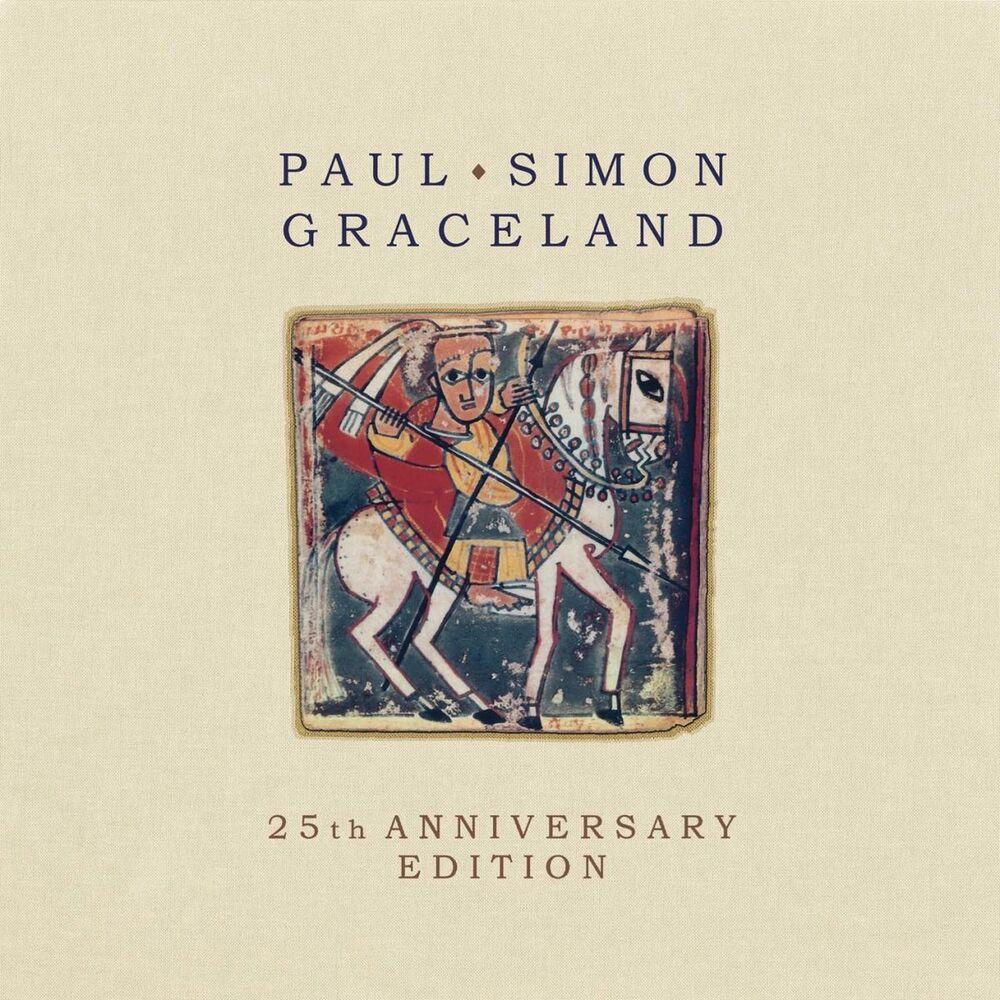
In 2004, Graceland was reissued with three previously unreleased demo tracks. In 2011, it was reissued in a 25th-anniversary edition with further demos, a live concert DVD, and a documentary. In June 2018, Sony Music and Legacy Records issued Graceland: The Remixes, featuring remixes of Graceland songs by artists including Paul Oakenfold, Groove Armada, and Thievery Corporation.
Critical reception
Graceland received widespread acclaim upon release. Rolling Stone's Rob Tannenbaum characterized it as "lovely, daring and accomplished". Stephen Holden of The New York Times wrote: "With his characteristic refinement, Mr. Simon has fashioned that event into the rock album equivalent of a work of literature." In The Village Voice, Robert Christgau deemed it Simon's best record since his 1972 self-titled album, as well as "a tremendously engaging and inspired piece of work". It went on to top The Village Voice's Pazz & Jop critics' poll for that year (1986).
Retrospective reviews have remained favorable. According to AllMusic's William Ruhlmann, "Graceland became the standard against which subsequent musical experiments by major artists were measured." Joe Tangari of Pitchfork wrote that "its songs transcend the context as listening experiences. These songs are astute and exciting, spit-shined with the gloss of production that bears a lot of hallmarks of the era but somehow has refused to age. Taken as a whole, the album offers tremendous insight into how we live in our world and how that changes as we get older." Patrick Humphries of BBC Music wrote that "it may well stand as the pinnacle of his remarkable half-century career ... Simon fashioned a record which was truly, blindingly original, and – listening to it a quarter of a century on – modern and timeless." Andy Gill of The Independent wrote: "The character of the base music here is overwhelming: complex, ebullient and life-affirming, and in yoking this intricate dance music to his sophisticated New Yorker sensibility, Simon created a transatlantic bridge that neither pandered to nor patronised either culture."
Accolades
Graceland earned Simon the Best International Solo Artist award at the 1987 Brit Awards. It was ranked No. 84 in a 2005 survey by British television's Channel 4 to determine the 100 greatest albums of all time.
Graceland was ranked 81st on the 2003 list of Rolling Stone magazine's 500 Greatest Albums of All Time, as "an album about isolation and redemption that transcended 'world music' to become the whole world's soundtrack." The ranking increased to 71st in the 2012 revision and 46th in the 2020 list. In 2000 it was voted number 43 in Colin Larkin's All Time Top 1000 Albums. The song "Graceland" was named #485 in the 2004 list of Rolling Stone's 500 Greatest Songs of All Time. In 2006, Graceland was added to the US National Recording Registry as "culturally, historically, or aesthetically important".
Grammy Awards
Legacy
The New York Times writer Jon Pareles said Graceland popularized African rock in the west, alongside albums such as Peter Gabriel's So (1986) and Talking Heads' Remain in Light (1980). A 2012 documentary film, Under African Skies, was directed by Joe Berlinger for the album's 25th anniversary, and includes archival footage, interviews, discussion of the controversy, and coverage of an anniversary reunion concert.
Advocates for Graceland feel its music transcends the racial and cultural barriers of its production. Andrew Leahey of American Songwriter wrote that "Graceland was never just a collection of songs, after all; it was a bridge between cultures, genres and continents, not to mention a global launching pad for the musicians whose popularity had been suppressed under South Africa's white-run apartheid rule." Presenting the album in a modern context, Tris McCall of the Star-Ledger wrote: "In a sense, Simon was ahead of his time: the curatorial approach he took to assembling full tracks from scraps of songs and pre-existing recordings is closer in execution to that of Kanye West than it is to any of his contemporaries." In 2012, Rolling Stone wrote that it was "hard to even remember the charges of cultural imperialism that greeted Graceland when it was released". Pitchfork wrote that "it was unique in its total, and totally natural, synthesis of musical strains that turned out to be not nearly as different from each other as its listeners might have expected, and the result resonated strongly around the world and across generations".
The album has influenced musicians including Regina Spektor, Bombay Bicycle Club, Gabby Young, Casiokids, the Very Best, Givers, Lorde and Vampire Weekend. Vampire Weekend faced criticism that their 2008 debut album was too similar to Graceland, due to its origins in African music. Simon defended them, saying: "In a way, we were on the same pursuit, but I don't think you're lifting from me, and anyway, you're welcome to it, because everybody's lifting all the time. That's the way music grows and is shaped."
Simon said in 2013:
There was the almost mystical affection and strange familiarity I felt when I first heard South African music. Later, there was the visceral thrill of collaborating with South African musicians onstage. Add to this potent mix the new friendships I made with my band mates, and the experience becomes one of the most vital in my life.
From the Wikipedia article Graceland (album), available under CC BY-SA 4.0.
Tracklist
The Boy In the Bubble4:00
Graceland4:51
I Know What I Know (with General M.D.Shirinda & The Gaza Sisters)3:14
Gumboots (with Boyoyo Boys)2:45
Diamonds on the Soles of Her Shoes5:49
You Can Call Me Al4:41
Under African Skies3:37
Homeless (with Ladysmith Black Mambazo)3:49
Crazy Love, Vol. II4:20
That Was Your Mother (with Good Rockin' Doopsie & The Twisters)2:53
All Around the World or the Myth of Fingerprints (with Los Lobos)3:26
Homeless (Demo)2:32
Diamonds on the Soles of Her Shoes (Alternate Unreleased Version)4:43
All Around the World or the Myth of Fingerprints (Early Version) (Early Version)3:17
You Can Call Me Al (Demo)2:04
Crazy Love (Demo)2:31
The Story of "Graceland" as Told by Paul Simon9:37