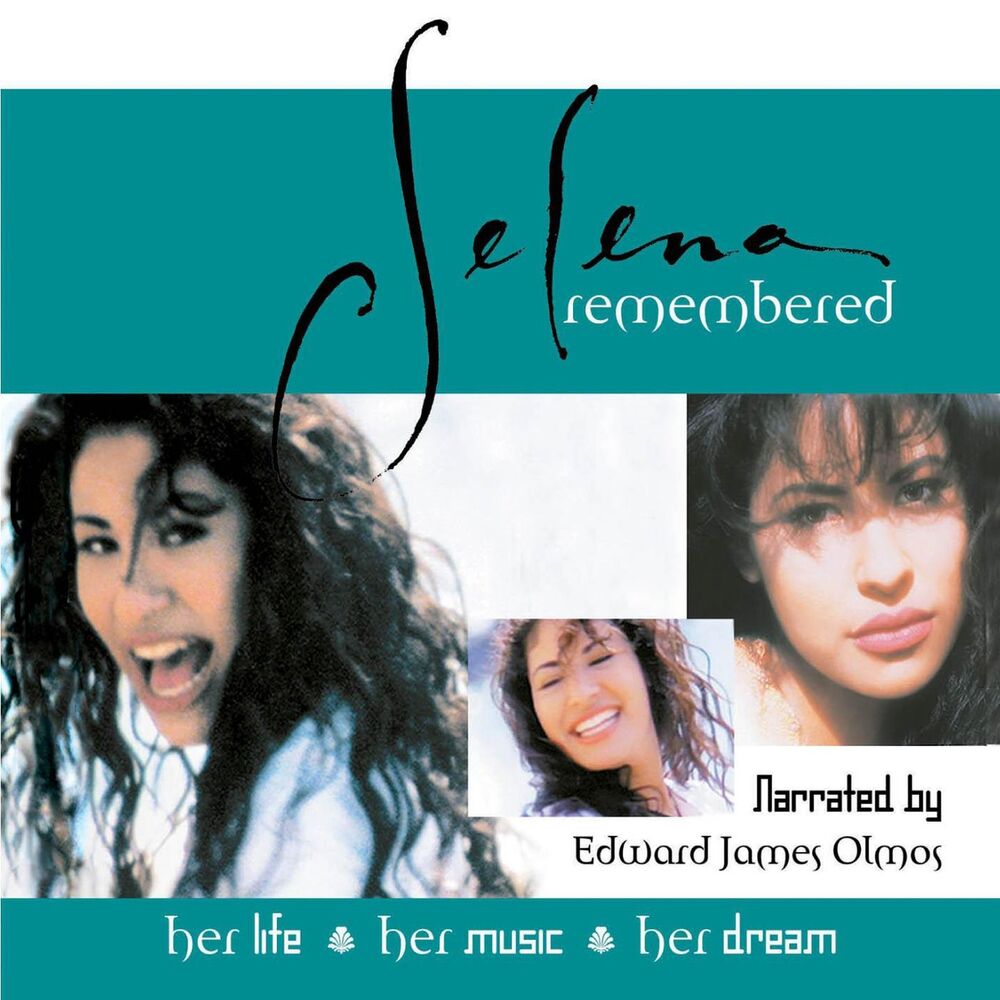
Tracklist
- Techno Cumbia3:45
- Como La Flor3:02
- Baila Esta Cumbia3:00
- Dame Un Beso3:52
- Ven Conmigo2:26
- La Carcacha4:09
- No Debes Jugar (1993 Version)2:48
- La Llamada (1993 Version)3:12
- Amor Prohibido2:50
- Bidi Bidi Bom Bom3:30
- No Me Queda Más3:18
- Fotos Y Recuerdos2:34
- Dreaming Of You5:23
- I Could Fall In Love4:41
Have you heard it?
Sign in to mark it as listened, rate it and keep notes.
The full story
Selena is a 1997 American biographical musical drama film about Tejano music star Selena Quintanilla-Pérez, played by Jennifer Lopez. The film, written and directed by Gregory Nava, chronicles the star's rise to fame and death when she was murdered by Yolanda Saldívar at the age of 23. In addition to Lopez, the film also stars Edward James Olmos, Jon Seda, Constance Marie, Jacob Vargas, Lupe Ontiveros, and Jackie Guerra in her film debut. Selena was released in the United States on March 21, 1997, by Warner Bros. Pictures. The film received positive reviews from critics and grossed $35 million worldwide against a production budget of $20 million. For her performance, Jennifer Lopez received a Best Actress nomination at the 55th Golden Globes. In 2021, it was selected for preservation in the United States National Film Registry by the Library of Congress as being "culturally, historically, or aesthetically significant", and was re-released in select cinemas on April 7, 2022, to coincide with the film's 25th anniversary. In 2024, the Pérez Art Museum Miami organized a screening of Selena as part of the institution's Floating Films with Ballyhoo Media. During this event, the film was screened from the water.
Production
Development
On March 31, 1995, Selena was shot and killed by Yolanda Saldívar, a former friend who had managed the singer's Selena Etc. boutiques. Response by the Hispanic community was comparable to the reaction of the assassinations of John Lennon and John F. Kennedy, or the death of Elvis Presley. Newsstands were swarmed by people looking for items concerning Selena. Shortly thereafter, several media projects were in production, including eight unauthorized biographies, six documentaries and two Quintanilla family-unapproved biographical films. This led Abraham to begin working on an authorized biographical material within weeks of her death, a process he found difficult since the family was still mourning. He believed the film would "put an end to all the false rumors" that were circulating through the media at the time and "silence [the media] from telling the wrong story." He wanted "the whole world to know the [true] story about [Selena]." A.B. spoke out about the family's concern about possible "misinterpretation of [Selena], [their] family, and a culture" by outside sources, and their belief that it was imperative to release their own official film. A.B. claimed the decision was foisted upon them after learning about the unauthorized biographies and films that could have potentially misconstrued Selena's story. At the time of Abraham's decision, there were "gossip and hurtful crazy things that were coming from the press" about the family's plan on a film. Abraham wanted the film to immortalize Selena "in a true positive and beautiful way [and wanted] to celebrate her life [and to] quiet and put to rest all [the] negative ugliness [the media had portrayed]." News of Abraham's desire to release an official authorized film reached Hollywood, and American film producer, Moctesuma Esparza. Esparza immediately approached Abraham at his Corpus Christi office about partnering to produce the film. He educated Abraham about the filmmaking process and the support system he could provide while giving Abraham authoritative control over casting, approval of the script and choosing the director. On August 30, 1995 (a week after he and Abraham agreed to partner), Esparza returned to Corpus Christi from California and brought on Gregory Nava. Abraham disliked Esparza's decision and expressed concern about Nava's potential involvement. Abraham told Esparza he did not want Nava to be the director because of his ego, though Esparza convinced Abraham that he was the perfect candidate. Producer Robert Katz later said Nava was chosen because other films he directed "[have] a very uplifting and positive quality" and believed they deal with "very strong and tragic elements." The Dallas Morning News found Nava's works to give "moviegoers a passionate, powerful look at Hispanic life". On September 8, 1995, Abraham informed the media his decision to partner with Esparza/Katz Productions and announced the film's budget to be in the range of $15 and $20 million. In an Entertainment Weekly interview, Abraham confessed on wanting the duo because they were "in tune with our culture". Other Hispanic filmmakers were considered to direct the film including Luis Valdez and Edward James Olmos (who later joined the cast for the film), but had settled with Nava. Katz said the team had overcome "what most people thought was a fatal contract" by entrusting Abraham's decisions and having a working relationship with him throughout the film's production: "working things out in advance so the studios knew exactly what we were proposing." Nava began writing the script after recording the Quintanilla family on their stories about Selena. Suzette commented on how Nava took "hours and hours of little stories of our lives and what we would do and how we felt." Nava explained how some stories "had came out" during his recording sessions with the family and published the first draft on March 4, 1996. The incident where Selena and Perez eloped was written in the …
Release
Box office
Selena opened March 21, 1997 and earned $11.6 million on its opening weekend. On its second weekend, the film earned $6.2 million. The following weekend, it earned $6.1 million. The film grossed $35.5 million domestically during its theatrical run.
Home media
Selena was released on VHS, Laserdisc, and DVD on September 23, 1997. A 10th Anniversary DVD edition was released on September 18, 2007, by Warner Home Video. The two-disc set contains the original theatrical version (127 minutes) and a director's cut version (134 minutes) of the film, which had been shown on several TV stations before. Extras include Making of Selena: 10 Years Later, Selena, Queen of Tejano, and nine additional scenes. Warner Archive Collection released the Blu-ray format for the first time on May 19, 2020, as a manufacture-on-demand title, and it contained both cuts of the film in addition to all the extras from the 10th Anniversary DVD. Selena was re-released in theaters on April 7, 2022, by Iconic Distribution, to mark twenty five years of the classic film.
Reception
Critical response
Selena received mostly positive reviews from critics. The review aggregator Rotten Tomatoes reported that 66% of critics gave the film a positive review based on 85 reviews, with an average score of 6/10. The critics’ consensus reads, "Selena occasionally struggles to tell its subject's story with depth or perspective, but those flaws are rendered largely irrelevant by Jennifer Lopez in the title role." At Metacritic, which assigns a rating out of 100 to reviews from mainstream critics, the film has received an average score of 67 based on 17 reviews, indicating "generally favorable" reviews. Audiences polled by CinemaScore gave the film an average grade of "A" on an A+ to F scale. Roger Ebert, film critic for the Chicago Sun-Times, was impressed by the acting, and gave Selena three-and-a-half stars out of four and wrote, "Young Selena is played by Becky Lee Meza, who has a big smile and a lot of energy. The teenage and adult Selena is played by Lopez in a star-making performance. After her strong work as the passionate lover of Jack Nicholson in the current Blood and Wine, here she creates a completely different performance, as a loyal Quintanilla who does most of her growing up on a tour bus with her dad at the wheel." Entertainment Weekly believed Lopez perfected Selena's accent while "studying performance footage of the pop sensation" according to Nava. Lopez said "you need to do your homework on this gig" because Selena was "fresh in the public's mind". Film critic Lisa Kropiewnicki liked the film and wrote, "Jennifer Lopez delivers a breakout performance...[and] Nava's engaging script wisely mines his subject's life for humor and conflict, embracing Selena Quintanilla's passion for music." Film critic James Berardinelli also liked the film and the screenplay, writing, "It would have been easy to trivialize Selena's story, turning it into a sudsy, made-for-TV type motion picture." He believed the acting was top-notch and wrote "Jennifer Lopez is radiant as the title character, conveying the boundless energy and enthusiasm that exemplified Selena, while effectively copying not only her look but her mannerisms. I wonder if Selena's family, upon watching this performance, felt an eerie sense of déjà vu." Los Angeles Times film critic Kenneth Turan gave the film a mixed review. He wrote the film is part of a "completely predictable Latino soap opera." However, he added that "there are chunks of Selena that only a stone could resist. This movie turns out to be a celebration not only of the singer but also (as "What's Love" was for Angela Bassett) of the actress who plays her, Jennifer Lopez." Leonard Maltin gave the film two-and-a-half stars out of four; while he praised Lopez and Olmos, he called the film a "glossy, congenially corny biography. "Ironically," Maltin wrote, "the film does more to solidify Selena's celebrity than she was able to accomplish in her short lifetime." Some critics, however, did not like how the film appeared to be a sanitized Selena portrait. Critic Walter Addiego considers Nava's work a worshipful biography of her. Addiego, writing for the San Francisco Examiner, did have a few enjoyable moments viewing the film but wrote, "You can't help cheering for Selena, but the good feeling is diminished by the sense that her story's been simplified and sanitized."
Legacy and recent history
In Latin Sensations (2001), Herón Márquez noted that the film's success "introduced English-speaking America to Selena's music, made Jennifer Lopez a bona fide star, and awakened Corporate America to the enormous and growing presence—and buying power—of Latinos in the United States." On January 1, 2021, all 38 members of the Congressional Hispanic Caucus signed a letter addressed to the Library of Congress "formally nominating" Selena to be added to the National Film Registry. The lobbying effort aimed at Carla Hayden was led by Representative Joaquin Castro (D–TX), chairman of the caucus, and framed the act as a way to, among other things, more broadly recognize Latino contributions to film, increase acclaim of Latino cinema and effect broader cinematic representation. On December 14, 2021, the film was officially selected for preservation in the United States National Film Registry by the Library of Congress for being "culturally, historically, or aesthetically significant." Selena: The Series is a biographical television series about the late singer Selena Quintanilla. The series comes 23 years after its original film and premiered on Netflix on December 4, 2020.
Tracklist
- Techno Cumbia3:45
- Como La Flor3:02
- Baila Esta Cumbia3:00
- Dame Un Beso3:52
- Ven Conmigo2:26
- La Carcacha4:09
- No Debes Jugar (1993 Version)2:48
- La Llamada (1993 Version)3:12
- Amor Prohibido2:50
- Bidi Bidi Bom Bom3:30
- No Me Queda Más3:18
- Fotos Y Recuerdos2:34
- Dreaming Of You5:23
- I Could Fall In Love4:41
Listeners 0
Nobody has logged it yet. Be the first.