Tracklist
- Chinese Democracy4:43
- Shackler's Revenge3:36
- Better4:57
- Street Of Dreams4:46
- If The World4:53
- There Was A Time6:40
- Catcher In The Rye5:52
- Scraped3:30
- Riad N' The Bedouins4:10
- Sorry6:14
- I.R.S.4:27
- Madagascar5:37
- This I Love5:34
- Prostitute6:15
Have you heard it?
Sign in to mark it as listened, rate it and keep notes.
The full story
Chinese Democracy is the sixth studio album by the American hard rock band Guns N' Roses, released on November 23, 2008, through Geffen Records and Black Frog. It was their first album of original material since Use Your Illusion I and II (1991), and the first to feature none of the classic members aside from vocalist Axl Rose. The album's development spanned over a decade, becoming one of the most protracted and expensive recording processes in history, with reported costs exceeding $13 million. Recorded amid lineup upheavals, legal disputes, and leaks, Chinese Democracy saw Rose collaborate with a rotating cast of musicians and producers, including band members Dizzy Reed, Paul Tobias, Robin Finck, Josh Freese, Tommy Stinson, Chris Pitman, Buckethead, Richard Fortus, Ron "Bumblefoot" Thal, Brain and Frank Ferrer, and producers Youth, Sean Beavan, Roy Thomas Baker and Caram Costanzo. Recording began in 1998 with the intention of producing multiple albums; although more than 50 tracks were completed, Rose's inconsistent studio schedule and repeated re‑recordings caused substantial delays in the project's progress. It is the first Guns N' Roses album not produced by Mike Clink; instead, Rose and Costanzo handled production. The album blends hard rock with industrial and electronic influences, a shift from the band's previous blues and punk-based music. Upon release, it debuted at number three on the Billboard 200. It was certified platinum and received generally favorable reviews for its ambition and vocal performances, though its production and lengthy recording process drew mixed reactions. In the United States, the album was released exclusively via Best Buy, and it was banned in China due to lyrics in the lead single, the title track. The album's release was accompanied by a widely publicized Dr Pepper promotion, with the company offering a free soda to all Americans if the album arrived in 2008. Retrospective assessments have acknowledged its complex legacy, with several critics and publications noting that the album has undergone reevaluation, praised by some for its ambition and scope despite the mythology surrounding its creation.
Background
In September 1991, Guns N' Roses released the albums Use Your Illusion I and II, selling a combined 35 million copies. That November, rhythm guitarist Izzy Stradlin left the band, citing exhaustion with the current tour and conflicts with bandmates. He was replaced by Gilby Clarke. In 1993, they released "The Spaghetti Incident?", an album of glam and punk rock cover songs. Though certified platinum in 1994, it sold far less than their previous releases, and the band did not tour to support it. In 1994, the band began writing new material, but bassist Duff McKagan said "nothing got finished" due to drug use. Lead guitarist Slash accused Rose of running the band "like a dictatorship", while Rose claimed collaboration was impossible, leading to the material being scrapped. In 1994, Rose replaced Clarke with his childhood friend Paul "Huge" Tobias, without consulting the band. He became "obsessed" with electronica and industrial rock, particularly Nine Inch Nails, and pushed for a more modern sound. Other members opposed Tobias and the stylistic shift, deepening tensions. In early 1995, Ozzy Osbourne guitarist Zakk Wylde auditioned as second guitarist. That August, Rose legally left the band and formed a new partnership under the Guns N' Roses name, and reportedly purchased the full rights to in 1997. Slash departed in 1996, citing creative differences with Rose and issues with Tobias. McKagan described the sessions as indulgent and chaotic: "Axl brought [Tobias] in and said, 'This is our new guitar player' ... There was no democracy... Slash started going, 'Fuck this. What, this is his band now?'. I'd show up at 10, and Axl would arrive at four or five in the morning." In January 1997, Slash was replaced by ex-Nine Inch Nails guitarist Robin Finck. The following month, electronic musician Moby briefly worked with the band, praising their use of loops but conflicting with Rose over recording vocals. He pulled out to focus on his solo work, later admitting he was not suited to produce a rock band. Mike Clink, who had produced all previous Guns N' Roses albums, was considered as producer, as were Scott Litt (R.E.M., Nirvana), Steve Lillywhite (Dave Matthews Band, U2), and Mark Bell (Björk, Depeche Mode). Producer Tim Palmer (Tears for Fears, Pearl Jam) worked on the album for a few days during its early gestation. In April 1997, drummer Matt Sorum was fired after arguing with Rose over Tobias. Sorum later said, "I'm so glad I left because it was just stagnant. It didn't make any sense to be ... not being able to put any of your creative energy out to the world. All my stuff was on some tapes on a shelf and four years had gone by." That same month NBA player and rapper Shaquille O'Neal briefly jammed with Reed, Tobias and studio drummer Sidd Riggs, though Rose dismissed it as a casual encounter. Nine Inch Nails drummer Chris Vrenna auditioned, joining a tentative lineup of Rose, McKagan, Tobias, Finck, Vrenna and keyboardist Dizzy Reed. Vrenna recalled, "When I was there, Moby was going to produce. Axl didn't come in very often." Vrenna left and multiple drummers auditioned, including Riggs, Dave Abbruzzese (Pearl Jam), Michael Bland (Prince), Joey Castillo (Danzig), and Kellii Scott (Failure), before Josh Freese (The Vandals, Devo) was hired mid-1997. Freese joined after Rose invited him to help write songs, rare for a drummer in his experience. McKagan left in August 1997, frustrated by the band's lack of progress and erratic studio habits. Chris Pitman (Tool, Lusk) joined as a second keyboardist and multi-instrumentalist/producer in early 1998. On Freese's recommendation, bassist Tommy Stinson (The Replacements) was hired. By early 1998, the lineup included Rose, Stinson, Freese, Finck, Tobias, Reed and Pitman.
Recording and production
Early sessions with producer Youth
In February 1998, manager Doug Goldstein said the band was "three to five months away from actually recording," but a release should not be expected until 1999. That year, Guns N' Roses began recording at Rumbo Recorders, where parts of Appetite for Destruction (1987) had been tracked. Geffen paid Rose $1 million to finish the album, with another $1 million promised if he delivered by March 1, 1999. A&R executive James Barber was brought in to assist: "No expense was spared; they were the biggest band in the history of the label... We desperately wanted the new album for Christmas 1998 and I had a year to get it finished." Barber described the music as "pretty incredible... like GNR, but with Led Zeppelin, Nine Inch Nails and Pink Floyd mixed in. If Axl had recorded vocals, it would have been an absolutely contemporary record in 1999." In mid-1998, producer Youth (U2, the Verve) joined to help Rose focus. Youth said, "I went to his house and we started writing songs, strumming guitars in the kitchen. That was a major breakthrough because it got him singing again which he hadn't done for a long time.... He hadn't been singing for around 18 months. I think the record had turned into a real labour. He was stuck and didn't know how to proceed, so he was avoiding it. He had some brilliant ideas, but they really were just sketches. He really wanted to leave the past behind and make a hugely ambitious album." Youth later said Rose was withdrawn and not ready to record: "He kind of pulled out... There weren't very many people I think he could trust." Frustrated, Youth left. Engineer Dave Dominguez said Youth was fired after Rose found out about a $1,000,000 bonus he would receive if he got the album out by certain deadlines. Rose later said he had stopped writing in the mid-1990s because of criticism from bandmates and his ex-fiancée Stephanie Seymour. Rose did not attend sessions regularly. Dominguez said, "He'd be 'on' for a couple of weeks and then 'off' for a couple weeks. He called in pretty much every day, though." Rose rarely sang, occasionally played instruments, and often spent nights discussing non-musical topics. He instructed engineers to keep recording ideas in his absence and was sent multiple CDs and DATs weekly. Over time, he accumulated more than 1000 discs. Goldstein said the band had "more than 300 hours" of material: "They each take a CD home, listen for cool parts, pick them out, and that's how they build songs." Dominguez explained:
Some parts were three seconds, some three minutes. Everything had an ID and a number, then the CDs were made for each member. They could go, 'OK, on set four, CD three, idea 15, let's do something with that.' Then everybody would take their CD home, get the part and write something to that. It was intense.
Work with producer Sean Beavan
The band worked with producer Sean Beavan (Nine Inch Nails, Marilyn Manson) from late 1998 to early 2000. Engineer Dave Dominguez left a few days after Beavan brought in his own engineer Jeff "Critter" Newell. Doug Goldstein claimed Beavan was the only main producer up to that point, saying the others were just "people we met with or tried out on some tracks [with]." Beavan said he bonded with Rose instantly: "I went in and had a meeting with Axl. We just sat in the studio together and just talked music really. We just hit it off. It was one of those things where you realize someone is kind of like your brother." Stinson said "most of the songs on the album started and ended with what [Beavan] did." Beavan recorded Rose's vocals in under a week, most of which are the takes appearing on the final release. He claimed to have worked on 35 songs. Billy Howerdel, hired as a Pro Tools engineer, said, "I came in making sounds for Robin Finck, and that turned into this two-and-a-half-year gig." At one point, Rose paused work to have the new lineup rerecord Appetite for Destruction (1987) using modern recording …
Release and promotion
In July 2002, Rose played several songs from the album at a Las Vegas strip club to gauge the crowd's reaction. In October 2006, Rose previewed ten songs at listening parties in New York bars. On September 14, 2008, "Shackler's Revenge" debuted in Rock Band 2, marking the first official release of new Guns N' Roses material since 1999's "Oh My God". It was followed by "If the World", featured in the closing credits of Body of Lies. On October 9, Billboard confirmed a November 23, 2008 release date for Chinese Democracy, sold exclusively through Best Buy in the U.S. Label head Jimmy Iovine stated of the deal, "...the labels [need] marketing partners to drive this music, whether it's a song, an album or a new configuration. In this case, Best Buy gave this album a great deal of marketing that we couldn't have gotten any other way". The title track premiered on October 22 via the Kevin & Bean show on KROQ-FM. Promotional ads referencing the 2008 United States presidential election aired in early November. "Better" was released as a promo single on November 17, followed by "Street of Dreams" in March 2009.
It's the right record and I couldn't ask for more. Could have been a more enjoyable journey, but it's there now. The art comes first. Days before release, the album was streamed on Myspace, surpassing 3 million plays and setting a platform record. Managers Irving Azoff and Andy Gould called the launch "a historic moment in rock 'n' roll backed by a monumental campaign." The title track was also used as the theme song for WWE's Armageddon in December 2008. A music video for "Better", directed by Dale "Rage" Resteghini, was announced in December; however, it never released. Iovine said on release, "Axl delivered a great Guns N' Roses album. Period. He did. It took him a long time for whatever reasons... It's hard to say if something is worth the wait, because how the hell do any of us know? I judge it based on what it is. Does it sound better than 99% of the rock records out there? Yes. I'm just thrilled for him".
In March 2009, the band announced a new leg of the Chinese Democracy Tour, which ran from December 2009 to December 2012. Robin Finck departed to rejoin Nine Inch Nails before the tour and was replaced by DJ Ashba. A guitar tab book was released in December 2009. The album was banned in China due to perceived criticism of the Chinese government and references to Falun Gong. State media claimed it "turns its spear point on China."
Disputes with label and management
After the album's release, Rose remained out of public view for several months and ignored Geffen's requests to promote it. On December 12, he posted statements on fan forums addressing the album, former bandmates, and tour plans. In a February 9, 2009 interview, Rose said he saw "no real involvement or effort from Interscope." In a 2018 retrospective, Billboard criticized the marketing, calling it "a colossal blunder" that undermined the "most anticipated rock album in history." In May 2010, Front Line Management sued Rose over unpaid concert fees. Rose countersued for $5 million, alleging sabotage of the album's release, including "purposefully spoiling" the artwork, "botching" a deal with Best Buy and leaking tracks. In a 2024 interview, drummer Dave Abbruzzese claimed executives wanted the album to fail to pressure Rose into reuniting with Slash. The lawsuit was settled in 2011.
Leaked tracks and legal fallout
In 2003, DJ Eddie Trunk played a leaked demo of "I.R.S.", from New York Mets catcher Mike Piazza. Between 2006 and 2008, numerous tracks from Chinese Democracy leaked online. Early leaks include "I.R.S.", "The Blues", "There Was a Time", "Better" and "Catcher in the Rye". "I.R.S." received enough radio play to chart at #49 on the Active Rock National Airplay Chart before management intervened. Later leaks came from unexpected sources: Harley-Davidson accidentally released "Better" in an ad, while professional wrestler Mister Saint …
Musical style and composition
Chinese Democracy marked Guns N' Roses' expansion into industrial rock, electronic rock, nu metal, and trip-hop while retaining their hard rock roots. Critics noted similarities to Queen, Paul McCartney and Wings, and Andrew Lloyd Webber.
Tracks 1–7
"Chinese Democracy" was inspired by the film Kundun and Rose's three-month stay in China. Lyrics referencing Falun Gong contributed to the album being banned in China. The track opens with a delayed intro of ambient noise and guitar lines, with Spin comparing the guitars to Tom Morello. Josh Freese wrote the main riff, describing it as "really dumb, simple, dirty." Rose cited Dave Grohl's drumming on "Smells Like Teen Spirit" as an influence. Guitarist Bumblefoot contributed fretless rhythm guitar, and the solos are by Robin Finck and Buckethead. Bassist Tommy Stinson described it as one of his favorites, saying it's "kind of a double barn burner, real fucking in your face, you know." "Shackler's Revenge" was inspired by school shootings and media sensationalism, and Rose likened its lyrics to a horror film. Critics compared the track to Nine Inch Nails, The Prodigy, Marilyn Manson, Korn, and Rob Zombie. The song blends industrial, electronic, nu metal, sludge rock, and alternative rock. Rolling Stone described its layered vocals as "a demented choir". According to Brain, the track originated from jams he and Buckethead had worked on since the Praxis era, which were later developed at Rose's request. Bumblefoot wrote the guitar solos and many rhythm parts, noting that Buckethead had written much of the original material and that he was "putting icing on a cake that already existed." "Better" is an electronic rock track with falsetto vocals and a "whining guitar line". Critics highlighted its blend of electronic beats, layered guitars, and hip‑hop‑influenced production, with Loudwire noting an acid house‑style rhythm, while Rolling Stone described the intro as a "hip-hop voicemail". Apple Music likened Rose's vocal approach to Bruce Dickinson. Rose praised the guitar work in the bridge as among his favorites from the album. "Street of Dreams" is a piano-driven ballad reminiscent of "November Rain" and "The Garden", with Elton John and Queen influences. It was described by critics as one of the album's most traditional Guns N' Roses-style tracks, noted for its dramatic piano, orchestral arrangements, and emotional vocal delivery. On "If The World", Buckethead plays a flamenco guitar, described as having "an electronic funk slither", with neo-soul, nu-metal, and trip-hop elements. Pitman said the song was "about environmental decay in its futurist context"; he wrote the song on a 12-string guitar, then layered dub beats, strings and synths. Rose said it parodies James Bond music and Blaxploitation soundtracks. "There Was a Time" is an orchestral and synth-heavy track, with Mellotron, choirs, and violins. Spin noted, "Bluesy piano and slyly cinematic passage set up the highest notes Axl's full-health throat has ever belted." Apple Music said it features "prog rock mellotron and strings", while Ultimate Classic Rock noted its blend of hip-hop beats, guitar solos and "tortured vocals". Kerrang cited influences from Danny Elfman, The Eagles, and Santana. "Catcher in the Rye" was written after Rose watched a documentary on Mark David Chapman, intended as a tribute to John Lennon and a critique of the book. A power ballad, it drew comparisons to Oasis, Elton John, Queen, and "Yesterdays". Stinson said "Axl was inspired by the book. He felt really identified with it. The recording process was very interesting too, we all brought different ideas to it. It's one of my favorite songs on that album." Bumblefoot said the dense arrangement of the song reminds him of the Yes album Going For The One.
Tracks 8–14
"Scraped" marks a return to industrial rock, featuring heavily processed vocals, and lyrics such as "All things are possible, I am unstoppable." The instrumental track was …
Artwork
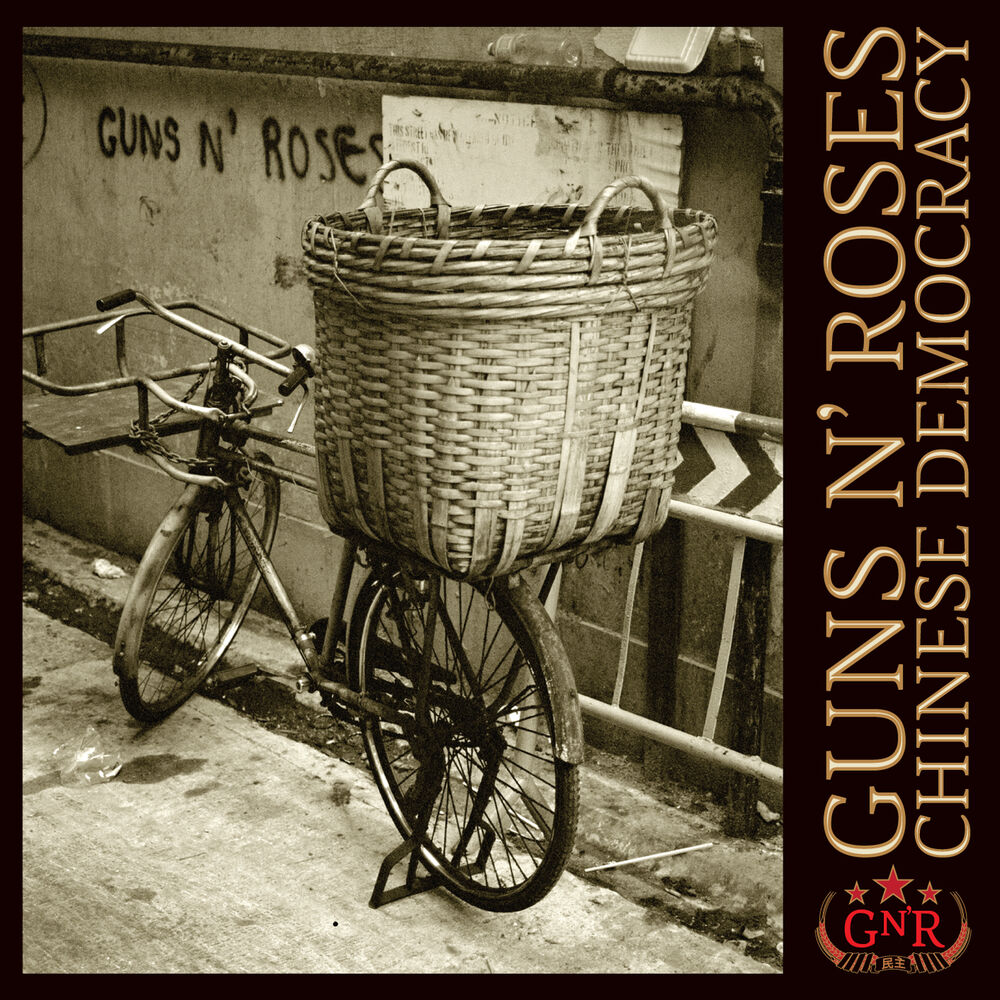
The cover features a sepia photo of a bicycle with a wicker basket against a graffitied wall with the band's name, shot in Kowloon Walled City by Terry Hardin. Above the vertically written band name and the album title are three red communist stars and the letters "GNR". Artistic director Ryan Corey said Rose conceived the bike cover early in the album's development. Rose initially approached Chinese artist Chen Zhuo to use a painting of Tiananmen Square as an amusement park, but Chen declined due to censorship concerns. Instead, Rose selected Shi Lifeng's "Controlling No. 3" for an alternate "art edition" cover. This version was used for the Rock Band 2 download and released in limited CD quantities. The alternate booklet includes Rose's essay "Fear N' Freedom: The Future of China and Western Society". The regular booklet features artwork by Shi, photos of the Hong Kong skyline, the Chinese military, and band members. In December 2008, Rose said that two alternate booklets were planned but never released, criticizing the use of an "error-filled draft" instead of the final artwork. Only the "art edition" was issued. Stinson later said executives pulled the artwork "right at the last second, when [Rose] wasn't ready."
Critical reception
According to the review aggregator Metacritic, Chinese Democracy received "generally favorable reviews" based on a weighted average score of 64 out of 100 from 28 critic scores. Ann Powers (Los Angeles Times) called it "a cyborgian blend of pop expressiveness, traditional rock bravado and Brian Wilson-style beautiful weirdness", describing the songs as "theatrical, with voicings and arrangements often taking precedence over riffs and grooves" and comparing it to a rock opera. Chuck Klosterman (The A.V. Club) praised the vocals and guitar work, saying "three songs are astonishing. Four or five others are very good" and noted the album as "the last Old media album... the last album that will matter more as a physical object than as an Internet sound file." David Fricke (Rolling Stone) described it as "audacious, unhinged and uncompromising," saying "You may debate whether any rock record is worth that extreme self-indulgence. Actually, the most rock & roll thing about Chinese Democracy is [Axl] doesn't care if you do." The magazine later ranked it 12th on its 2008 year-end list. Jon Dolan (Blender) called the music "brilliant" and "ludicrous", describing the songs as unpredictable suites blending "miasmic industrial grind, stadium rattling metal solos, electronic drift and hip-hop churn." Robert Christgau (MSN Music) said Rose "succeeds, kind of, on his own totally irrelevant terms" and that "Since he's no longer capable of leading young white males astray, this effort isn't just pleasurable artistically. It's touching on a human level. Noble, even. I didn't think he had it in him." CTV News compared the production to Phil Spector's Wall of Sound, while People called it "pure Guns N' Roses." Stephen Thomas Erlewine (Allmusic), while noting the dense production, said "Axl spent the decade-plus in the studio not reinventing but refining, obsessing over a handful of tracks, and spending an inordinate amount of time chasing the sound in his head", calling the album "strangely modest" compared to the Illusion double albums. Sarah Rodman (The Boston Globe) called the album "exciting, urgent, frenzied, heavy, melodic, quirky, melodramatic, and occasionally overbaked." Mixed reviews noted overproduction and inconsistency. Greg Kot (Chicago Tribune) said the songs "sound like lab experiments, fragments of music arranged into elaborate puzzles of sound" and it sounded like "the work of a fading rock star with far too much money and time." The Guardian found it incohesive but praised Rose's melodies, calling the production "impossibly over-stuffed." Pitchfork criticized the "dated" sound, comparing it to Oasis's 1997 album Be Here Now, calling it a "record of relatively simple, similar songs overdubbed into a false sense of complexity in a horrorshow of modern production values." Q said Rose "did himself a grand disservice" by overloading the mix "throwing everything at the wall and nailing up the stuff that didn't stick." Kitty Empire (The Observer) accused Rose of imitating Nine Inch Nails, calling it "a mish-mash of portentous digitals in search of a purpose." Jon Pareles (The New York Times) called it "a transitional album", saying "Sometime during the years of work, theatricality and razzle-dazzle replaced heart." Michael Saba (Paste) called it the "sonic equivalent of an M.C. Escher painting" and "a bottomless pit dug by disposable income, a persecution complex and egomania." Stephen Davis labeled it "the worst album ever", stating "it's so dense and multilayered... It’s as much a GNR album is [sic] there is real democracy in China... It sounds like a Rob Zombie album from 1995." The album was nominated for the Juno Award for International Album of the Year in 2009, losing to Coldplay's Viva La Vida. "If the World" was nominated for Best Original Song at the 13th Satellite Awards, losing to "Another Way to Die" by Jack White and Alicia Keys. The album was included on several publications' lists of the best and worst albums of the …
Legacy
The album's long-delayed release became its defining narrative. Spin noted that a "cottage industry" emerged around tracking its development, and suggested the only way it could have lived up to its legend was "to never come out at all". Steven Hyden (Grantland) called it "shorthand for the grandest of boondoggles", arguing that the delay overshadowed the music itself. He contrasted it with more modest and successful comeback albums by Daft Punk, David Bowie, Justin Timberlake, and My Bloody Valentine. Ultimate Classic Rock echoed this sentiment, stating the album was "fairly good" but eclipsed by its backstory. It cited artists like Bowie, Steve Perry, and Tool who avoided similar pitfalls by keeping a low profile and meeting fan expectations. The term Chinese Democracy has since become shorthand for long-delayed albums. The New York Times described it as a "loud last gasp" of the indulgent pop star era, noting the shift to a "leaner and leakier" music industry. Jim DeRogatis likened it to The Godfather Part III, a long-awaited sequel that failed to match its predecessors. Billboard labeled it a "sonic anomaly" of the time due to the mixing and lack of compression making it sound "vintage or alien to rock music fans", and said "the fundamentalist fans would never forgive Axl ... They had waited 14 years for the gustatory pleasure of Appetite for Destruction, and got an album that glittered with synths, dance beats, and orchestral arrangements... It was the hard-rock equivalent of Dylan going electric at Newport." Eddie Trunk said, "I honestly don't think old school fans have any awareness for the record... It didn't have any hits. It wasn't commercially successful. It doesn't have recurrent airplay on classic rock radio, and because of that, the only people that record is on the radar for are extremely hardcore GN'R fans." Some outlets offered retrospective praise. Complex included it on "50 Albums That Were Unfairly Hated On", praising Rose's vocals and the musicianship, and stating that the album's biggest flaw was the delays in release. Artistdirect called it "a timeless work of art". Apple Music described the album as "a guest-stacked opus orchestrated by Rose" and said "Rose uses his surly, knowing howl to ID these hard rock tunes with his fervent, often imagined, sense of injustice and works his way into quite a tizzy... an album that has taken 15 years to appear and has used 14 studios to create it could only be this grandoise: larger than life in every conceivable way." Later reassessments were more generous. Ultimate Guitar and Ultimate Classic Rock highlighted "There Was a Time" as a standout. Gary Graff found its "sprawling, indulgent insanity" more enjoyable in hindsight. Loudwire and Rolling Stone both called it "better than remembered", with Joseph Hudak naming "Catcher in the Rye" a highlight. Guitarist Bumblefoot said of the album's legacy, "people were still just going on about how it took this long to make, and it took this much money, and all that nonsense. And I always said, wait 20 years." Still, criticism persisted. No Recess compared the album to "their own version of Danzig's Blackacidevil", stating "The only thing left was to repeat or radically reinvent themselves. Chinese Democracy tries to do both, to varying degrees of 'okay, sure'." Loudwire ranked it second-to-last among GN'R albums saying, "...there was a lot of expectation and backlash built up on Chinese Democracy before it even dropped in stores", but praised tracks like "Better", "Madagascar", "Street of Dreams", "Shackler's Revenge" and "Catcher in the Rye" as standouts. NME placed it last, calling it "epic, overblown and full of noodling guitar solos". Rolling Stone's Andy Greene listed the album's creation as one of the "50 Worst Decisions in Music History", citing wasted money and fan goodwill. He later ranked it 4th among the "50 Most Disappointing Albums", saying "Despite a handful of strong songs like “Better,” “There Was a Time,” …
Tracklist
- Chinese Democracy4:43
- Shackler's Revenge3:36
- Better4:57
- Street Of Dreams4:46
- If The World4:53
- There Was A Time6:40
- Catcher In The Rye5:52
- Scraped3:30
- Riad N' The Bedouins4:10
- Sorry6:14
- I.R.S.4:27
- Madagascar5:37
- This I Love5:34
- Prostitute6:15
Listeners 0
Nobody has logged it yet. Be the first.