Sign in to mark it as listened, rate it and keep notes.
About the artist
The Band (sometimes stylized as the Band or the band) were a Canadian and American band formed in Toronto. It consisted of Canadians Rick Danko (bass guitar, guitar, vocals, fiddle), Garth Hudson (organ, keyboards, accordion, saxophone), Richard Manuel (piano, drums, vocals), and Robbie Robertson (guitar, piano, percussion), and American Levon Helm (drums, vocals, mandolin, guitar, bass guitar).
About the album
The Basement Tapes is the sixteenth studio album by the American singer-songwriter Bob Dylan and his second with the Band. It was released on June 26, 1975, by Columbia Records.
Meanings
Although The Basement Tapes reached the public in an unorthodox manner, officially released eight years after the songs were recorded, critics have assigned them an important place in Dylan's development. Michael Gray writes, "The core Dylan songs from these sessions actually do form a clear link between ... two utterly different albums.
Why it's rated so high
While removed from the public's gaze, Dylan and the Band made music very different from the recordings of other major artists. " Patrick Humphries itemizes the ways in which Dylan's songs dissented from the dominant ethos of rock culture: "While the rock world vented its spleen on parents and leaders, Dylan was singing privately about parental fidelity.
Career and historical context
By July 1966, Bob Dylan was at the peak of both creative and commercial success. Highway 61 Revisited had reached number three on the US album chart in November 1965; the recently released double-LP Blonde on Blonde was widely acclaimed. From September 1965 to May 1966, Dylan embarked on an extensive tour across the US, Australia and Europe backed by the Hawks, a band that had formerly worked with rock and roll musician Ronnie Hawkins.
Taken from Wikipedia (CC BY-SA 4.0).
The full story
The Basement Tapes is the sixteenth studio album by the American singer-songwriter Bob Dylan and his second with the Band. It was released on June 26, 1975, by Columbia Records. Two-thirds of the album's 24 tracks feature Dylan on lead vocals backed by the Band, and were recorded in 1967, eight years before the album's release, in the lapse between the release of Blonde on Blonde and the subsequent recording and release of John Wesley Harding, during sessions that began at Dylan's house in Woodstock, New York, then moved to the basement of a house nicknamed Big Pink. While most of these songs had appeared on bootleg albums, The Basement Tapes marked their first official release. The remaining eight songs, all previously unavailable, feature the Band without Dylan and were recorded between 1967 and 1975.
During his 1965–1966 world tour, Dylan was backed by the Hawks, a five-member rock group who would later become famous as the Band. After Dylan was injured in a motorcycle accident in July 1966, four members of the Hawks came to Dylan's home in the Woodstock area to collaborate with him on music and film projects. While Dylan was out of the public's eye during an extended period of recovery in 1967, he and the members of the Hawks recorded more than 100 tracks together, incorporating original compositions, contemporary covers, and traditional material. Dylan's new style of writing moved away from the urban sensibility and extended narratives that had characterized his most recent albums, Highway 61 Revisited and Blonde on Blonde, toward songs that were more intimate and which drew on many styles of traditional American music. While some of the basement songs are humorous, others dwell on nothingness, betrayal and a quest for salvation. In general, they possess a rootsy quality anticipating the Americana genre. For some critics, the songs on The Basement Tapes, which circulated widely in unofficial form, mounted a major stylistic challenge to rock music in the late sixties.
When Columbia Records prepared the album for official release in 1975, eight songs recorded solely by the Band—in various locations between 1967 and 1975—were added to 16 songs taped by Dylan and the Band in 1967. Overdubs were added in 1975 to songs from both categories. The Basement Tapes was critically acclaimed upon release, reaching number seven on the Billboard Top LPs & Tape album chart. However, the release led some critics to question the omission of some of Dylan's best-known 1967 compositions and the inclusion of material by the Band that was not recorded in Woodstock.
Background and recording
By July 1966, Bob Dylan was at the peak of both creative and commercial success. Highway 61 Revisited had reached number three on the US album chart in November 1965; the recently released double-LP Blonde on Blonde was widely acclaimed. From September 1965 to May 1966, Dylan embarked on an extensive tour across the US, Australia and Europe backed by the Hawks, a band that had formerly worked with rock and roll musician Ronnie Hawkins. The Hawks comprised four Canadian musicians—Rick Danko, Garth Hudson, Richard Manuel and Robbie Robertson—and one American, Levon Helm. Dylan's audiences reacted with hostility to the sound of their folk icon backed by a rock band. Dismayed by the negative reception, Helm quit the Hawks in November 1965 and drifted around the South, at one point working on an oil rig in the Gulf of Mexico. The tour culminated in a famously raucous concert in Manchester, England, in May 1966 when an audience member shouted "Judas!" at Dylan for allegedly betraying the cause of politically progressive folk music. Returning exhausted from the hectic schedule of his world tour, Dylan discovered that his manager, Albert Grossman, had arranged a further 63 concerts across the US that year.
Motorcycle crash
On July 29, 1966, Dylan crashed his Triumph motorcycle near his home in Woodstock, New York, suffering cracked vertebrae and a mild concussion. The concerts he was scheduled to perform had to be cancelled. Biographer Clinton Heylin wrote in 1990 on the significance of the crash: "A quarter of a century on, Dylan's motorcycle accident is still viewed as the pivot of his career. As a sudden, abrupt moment when his wheel really did explode. The great irony is that 1967—the year after the accident—remains his most prolific year as a songwriter." In a 1969 Rolling Stone interview with Jann Wenner, Dylan said, "I had a dreadful motorcycle accident which put me away for a while, and I still didn't sense the importance of that accident till at least a year after that. I realized that it was a real accident. I mean I thought that I was just gonna get up and go back to doing what I was doing before ... but I couldn't do it anymore."
Dylan was rethinking the direction of his life while recovering from a sense of having been exploited. Nine months after the crash, he told New York Daily News reporter Michael Iachetta, "Songs are in my head like they always are. And they're not going to get written down until some things are evened up. Not until some people come forth and make up for some of the things that have happened." After discussing the crash with Dylan, biographer Robert Shelton concluded that he "was saying there must be another way of life for the pop star, in which he is in control, not they. He had to find ways of working to his own advantage with the recording industry. He had to come to terms with his one-time friend, longtime manager, part-time neighbor, and sometime landlord, Albert Grossman."
Early recordings
Rick Danko recalled that he, Richard Manuel and Garth Hudson joined Robbie Robertson in West Saugerties, a few miles from Woodstock, in February 1967. The three of them moved into a house on Stoll Road nicknamed "Big Pink"; Robertson lived nearby with his future wife, Dominique. Danko and Manuel had been invited to Woodstock to collaborate with Dylan on a film he was editing, Eat the Document, a rarely seen account of Dylan's 1966 world tour. At some point between March and June 1967, Dylan and the four Hawks began a series of informal recording sessions, initially at the so-called Red Room of Dylan's house, Hi Lo Ha, in the Byrdcliffe area of Woodstock. In June, the recording sessions moved to the basement of Big Pink. Hudson set up a recording unit, using two stereo mixers and a tape recorder borrowed from Grossman, as well as a set of microphones on loan from the folk trio Peter, Paul and Mary. Dylan would later tell Jann Wenner, "That's really the way to do a recording—in a peaceful, relaxed …
Dwarf Music demos and Great White Wonder
Dylan referred to commercial pressures behind the basement recordings in a 1969 interview with Rolling Stone: "They weren't demos for myself, they were demos of the songs. I was being PUSHED again into coming up with some songs. You know how those things go." In October 1967, a fourteen-song demo tape was copyrighted and the compositions were registered with Dwarf Music, a publishing company jointly owned by Dylan and Grossman. Acetates and tapes of the songs then circulated among interested recording artists.
Peter, Paul and Mary, managed by Grossman, had the first hit with a basement composition when their cover of "Too Much of Nothing" reached number 35 on the Billboard chart in late 1967. Ian & Sylvia, also managed by Grossman, recorded "Tears of Rage", "Quinn the Eskimo" and "This Wheel's on Fire". In January 1968, Manfred Mann reached number one on the UK singles chart with their recording of "The Mighty Quinn". In April, "This Wheel's on Fire", recorded by Julie Driscoll with Brian Auger and the Trinity, hit number five on the UK chart. That same month, a version of "You Ain't Goin' Nowhere" by the Byrds was issued as a single. Along with "Nothing Was Delivered", it appeared on their country-rock album Sweetheart of the Rodeo, released in August. The Hawks, officially renamed the Band, recorded "This Wheel's on Fire", "I Shall Be Released" and "Tears of Rage" for their debut album, Music from Big Pink, released in July 1968. Fairport Convention covered "Million Dollar Bash" on their 1969 album Unhalfbricking.
As tapes of Dylan's recordings circulated in the music industry, journalists became aware of their existence. In June 1968, Jann Wenner wrote a front-page Rolling Stone story headlined "Dylan's Basement Tape Should Be Released". Wenner listened to the fourteen-song demo and reported, "There is enough material—most all of it very good—to make an entirely new Bob Dylan album, a record with a distinct style of its own." He concluded, "Even though Dylan used one of the finest rock and roll bands ever assembled on the Highway 61 album, here he works with his own band for the first time. Dylan brings that instinctual feel for rock and roll to his voice for the first time. If this were ever to be released it would be a classic."
Reporting such as this whetted the appetites of Dylan fans. In July 1969, the first rock bootleg appeared in California, entitled Great White Wonder. The double album consisted of seven songs from the Woodstock basement sessions, plus some early recordings Dylan had made in Minneapolis in December 1961 and one track recorded from The Johnny Cash Show. One of those responsible for the bootleg, identified only as Patrick, talked to Rolling Stone: "Dylan is a heavy talent and he's got all those songs nobody's ever heard. We thought we'd take it upon ourselves to make this music available." The process of bootlegging Dylan's work would eventually see the illegal release of hundreds of live and studio recordings, and lead the Recording Industry Association of America to describe Dylan as the most bootlegged artist in the history of the music industry.
Release
In January 1975, Dylan unexpectedly gave permission for the release of a selection of the basement recordings, perhaps because he and Grossman had resolved their legal dispute over the Dwarf Music copyrights on his songs. Clinton Heylin argues that Dylan was able to consent following the critical and commercial success of his album Blood on the Tracks, released that same month: "After Blood on the Tracks, The Basement Tapes no longer had the status of a final reminder of Dylan's lost genius". In 1975, as well, the Band purchased Shangri-La ranch in Malibu, California, which they transformed into their recording studio.
Engineer Rob Fraboni was brought to Shangri-La to clean up the recordings still in the possession of Hudson, the original engineer. Fraboni had worked on Dylan's Planet Waves album, with backing by the Band, and the live Dylan–Band album Before the Flood, both released in 1974. Fraboni has described Robertson as the dominant voice in selecting the final tracks for The Basement Tapes and reported that Dylan was not in the studio very often. The stereo recordings made by Hudson were remixed to mono, while Robertson and other members of the Band overdubbed new keyboard, guitar, and drum parts onto some of the 1967 Woodstock recordings. According to Fraboni, four new songs by the Band were also recorded in preparation for the album's official release, one of which, a cover of Chuck Berry's "Going Back to Memphis", did not end up being included. There is disagreement about the recording date of the other three songs: "Bessie Smith", "Ain't No More Cane" and "Don't Ya Tell Henry". While Fraboni has recalled that the Band taped them in 1975, the liner notes for the reissued versions of the Band's own albums state that these songs were recorded between 1967 and 1970. Ultimately, eight of the twenty-four songs on The Basement Tapes did not feature Dylan, several of the studio outtakes postdating the sessions at Big Pink. In justifying their inclusion, Robertson explained that he, Hudson and Dylan did not have access to all the basement recordings: "We had access to some of the songs. Some of these things came under the heading of 'homemade' which meant a Basement Tape to us." Robertson has suggested that the Basement Tapes are, for him, "a process, a homemade feel" and so could include recordings from a wide variety of sources. "The idea," he said, "was to record some demos for other people. They were never intended to be a record, never meant to be presented. It was somewhat annoying that the songs were bootlegged. The album was finally released in the spirit of 'well, if this is going to be documented, let's at least make it good quality.'"
Cover art
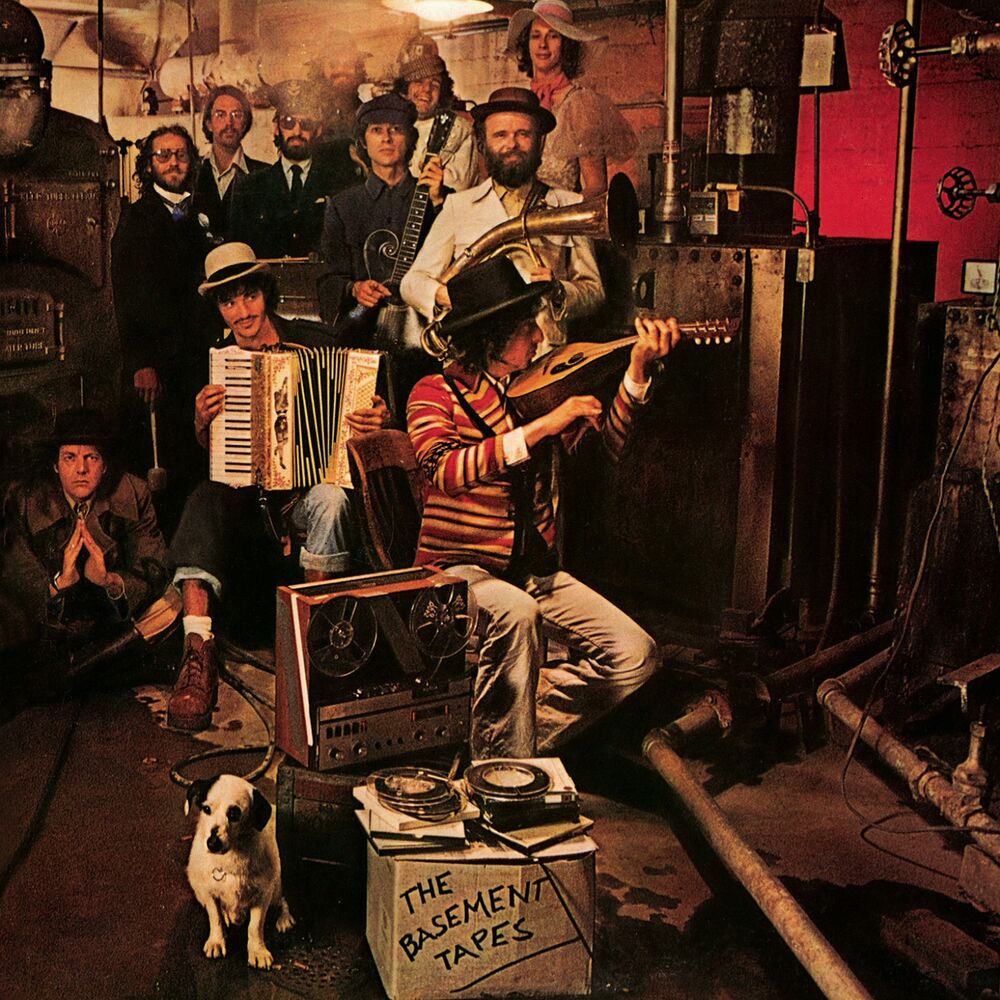
The art director/design consultant credited on the 1975 album was Bob Cato. The cover photograph for the 1975 album was taken by designer and photographer Reid Miles in the basement of a Los Angeles YMCA. It poses Dylan and the Band alongside characters suggested by the songs: a woman in a Mrs. Henry T-shirt, an Eskimo, a circus strongman and a dwarf who has been identified as Angelo Rossitto. Robertson wears a blue Mao-style suit, and Manuel wears an RAF flight lieutenant uniform. Michael Gray has identified musicians David Blue and Neil Young in the photograph. The identification of Young has been disputed by Bill Scheele who has written that Young was not present. Bill Scheele and his brother John Scheele worked with the Band from 1969 until 1976 and were present in the cover photo. Some photos by John Scheele of the 1975 Hollywood YMCA photo shoot were included in the book accompanying the 2014 release The Bootleg Series Vol. 11: The Basement Tapes Complete which was digitally mastered by Peter J. Moore for which he won the Grammy Award for Best Historical Album in February 2016.
Reception and sales
Columbia Records released The Basement Tapes on June 26, 1975. The album peaked at number seven on the Billboard Top LPs & Tape chart, and reached number …
Themes
Although The Basement Tapes reached the public in an unorthodox manner, officially released eight years after the songs were recorded, critics have assigned them an important place in Dylan's development. Michael Gray writes, "The core Dylan songs from these sessions actually do form a clear link between ... two utterly different albums. They evince the same highly serious, precarious quest for a personal and universal salvation which marked out the John Wesley Harding collection—yet they are soaked in the same blocked confusion and turmoil as Blonde on Blonde. 'Tears of Rage', for example, is an exact halfway house between, say, 'One of Us Must Know (Sooner or Later)' and 'I Dreamed I Saw St. Augustine'".
Singer-songwriter David Gray commented that the great achievement of The Basement Tapes is that Dylan found a way out of the anguish and verbal complexity that had characterized his mid-sixties albums such as Blonde on Blonde: "It's the sound of Dylan letting his guard down. 'Clothes Line Saga' and all those ridiculous songs, he's obviously just making it all up, they were having such a great time. The sound of the Band is so antiquated like something out of the Gold Rush and Dylan fits in because he's this storyteller with an ancient heart. At the time everything he did was so scrutinized, yet somehow he liberated himself from all that and enjoyed making music again. You hear an unselfconscious quality on this record which you don't ever hear again." "He mocks his own inertia and impotence", writes critic Mike Marqusee, "but with a much gentler touch than in Blonde on Blonde. In place of that album's strangled urgency, Dylan adopts a laconic humor, a deadpan tone that speaks of resignation and self-preservation in the face of absurdity and betrayal."
Robert Shelton has argued that The Basement Tapes revolves around two sets of themes. One group of songs is "tinctured with the search for salvation": "I Shall Be Released" (on the demo, but not on the album), "Too Much of Nothing", "Nothing Was Delivered", "This Wheel's On Fire", "Tears of Rage" and "Goin' To Acapulco". "'Nothing' and 'nowhere' perplex and nag" in these songs, he writes. "The 'nothing' echoes the artist's dilemma: death versus life, vacuum versus harvest, isolation versus people, silence versus sound, the void versus the life-impulse." A second group, comprising "songs of joy, signaling some form of deliverance", includes most of the remaining songs in the collection.
In his sleeve notes for the 1975 release of The Basement Tapes, Greil Marcus wrote, "What was taking place as Dylan and the Band fiddled with the tunes, was less a style than a spirit—a spirit that had to do with a delight in friendship and invention." He compared the songs to fabled works of American music: "The Basement Tapes are a testing and a discovery of roots and memory ... they are no more likely to fade than Elvis Presley's 'Mystery Train' or Robert Johnson's 'Love In Vain.'"
In 1997, after listening to more than 100 basement recordings issued on various bootlegs, Marcus extended these insights into a book-length study, Invisible Republic (reissued in 2001 under the title The Old, Weird America). In it, he quotes Robertson's memory of the recording: "[Dylan] would pull these songs out of nowhere. We didn't know if he wrote them or if he remembered them. When he sang them, you couldn't tell." Marcus calls the songs "palavers with a community of ghosts. ... These ghosts were not abstractions. As native sons and daughters they were a community. And they were once gathered in a single place: on the Anthology of American Folk Music". A collection of blues and country music recorded in the 1920s and 1930s, the Anthology—compiled by Harry Smith and originally released by Folkways Records in 1952—was a major influence on the folk music revival of the 1950s and the 1960s. Marcus suggests that Dylan's Basement Tapes shared with Smith's Anthology a sense of alchemy, "and in the alchemy is an …
Legacy
While removed from the public's gaze, Dylan and the Band made music very different from the recordings of other major artists. Andy Gill writes, "Musically, the songs were completely at odds with what was going on in the rest of the pop world, which during the long, hot summer of 1967 was celebrating the birth of the hippie movement with a gaudy explosion of 'psychedelic' music—mostly facile paeans to universal love draped in interminable guitar solos." Patrick Humphries itemizes the ways in which Dylan's songs dissented from the dominant ethos of rock culture: "While the rock world vented its spleen on parents and leaders, Dylan was singing privately about parental fidelity. While George Harrison was testifying that life went on within and without you, Dylan was taking his potatoes down to be mashed. While Mick Jagger was 2,000 light years from home, Dylan was strapping himself to a tree with roots."
This aspect of the basement recordings became obvious when Dylan chose to record his next album, John Wesley Harding, in Nashville in late 1967. The songs on that record, according to Howard Sounes, revealed the influence of Dylan's daily reading of both the Bible and the Hank Williams songbook. And its sound came as a shock to other rock musicians. As producer Bob Johnston recalled, "Every artist in the world was in the studio trying to make the biggest-sounding record they possibly could. So what does [Dylan] do? He comes to Nashville and tells me he wants to record with a bass, drum and guitar." Dylan summed up the gap: "At that time psychedelic rock was overtaking the universe and we were singing these homespun ballads."
When the Band began work on their debut album, Music from Big Pink, in a New York studio in January 1968, they employed a recording technique similar to the one they had become familiar with during The Basement Tapes sessions. As Robertson described it, "We used the same kind of mic on everything. A bit of an anti-studio approach. And we realized what was comfortable to us was turning wherever we were into a studio. Like the Big Pink technique." That technique influenced groups including the Beatles, writes Griffin, who calls their Twickenham Get Back sessions in early 1969 an effort to record "in the honest, live, no frills, no overdubs, down home way that the Hawks/Band did for The Basement Tapes".
"Listening to The Basement Tapes now, it seems to be the beginning of what is called Americana or alt country," wrote Billy Bragg. "The thing about alt.country which makes it 'alt' is that it is not polished. It is not rehearsed or slick. Neither are The Basement Tapes. Remember that The Basement Tapes holds a certain cultural weight which is timeless—and the best Americana does that as well." The songs' influence has been detected by critics in many subsequent acts. Stuart Bailie wrote, "If rock'n'roll is the sound of a party in session, The Basement Tapes were the morning after: bleary, and a bit rueful but dashed with emotional potency. Countless acts—Mercury Rev, Cowboy Junkies, Wilco, the Waterboys—have since tried to get back to that place."
For Elvis Costello, The Basement Tapes "sound like they were made in a cardboard box. I think [Dylan] was trying to write songs that sounded like he'd just found them under a stone. As if they sound like real folk songs—because if you go back into the folk tradition, you will find songs as dark and as deep as these."
In 2003, Rolling Stone magazine ranked The Basement Tapes number 291 on its list of the 500 greatest albums of all time, number 292 in a 2012 revised list, and number 335 in the magazine's 2020 list. In a special issue devoted to Dylan's work, Q magazine awarded the record five stars, its highest rating, commenting that "Dylan's work is by turns haunting, hilarious and puzzling—and all of it taps into centuries of American song".
Hip hop group Public Enemy referenced the album in their 2007 Dylan tribute song "Long and Whining Road": "From basement tapes, …
Other released Basement Tape songs
Between 1985 and 2013, Columbia issued five additional 1967 recordings by Dylan from Big Pink: take 2 of "Quinn the Eskimo (The Mighty Quinn)" on Biograph in 1985, "I Shall Be Released" and "Santa-Fe" on The Bootleg Series Volumes 1–3 (Rare & Unreleased) 1961–1991 in 1991, "I'm Not There (1956)" on the I'm Not There soundtrack in 2007, and "Minstrel Boy" on The Bootleg Series Vol. 10 – Another Self Portrait (1969–1971) in 2013. In the early 1970s, Dylan released new recordings of five compositions from The Basement Tape era: live performances of "Minstrel Boy" and "Quinn the Eskimo" from the Isle of Wight Festival on August 31, 1969, appeared on Self Portrait, and October 1971 recordings with Happy Traum of "You Ain't Goin' Nowhere", "I Shall Be Released" and "Down in the Flood" appeared on Bob Dylan's Greatest Hits Vol. II.
In 2005, the Band compilation A Musical History was released, which includes the 1967 Woodstock Band recordings "Words and Numbers", "You Don't Come Through", "Caledonia Mission", "Ferdinand the Imposter" and "Will the Circle Be Unbroken". In 1968, the Band re-recorded "This Wheel's on Fire", "Tears of Rage", "I Shall Be Released" and "Caledonia Mission" in studios in New York and Los Angeles for Music From Big Pink. Versions of other Band Basement Tape compositions, recorded in various locations between 1967 and possibly 1975, appear on Across the Great Divide and A Musical History, and as bonus tracks on the 2000 reissues of Music From Big Pink and Cahoots. Live versions by the Band of various Basement Tapes songs have also been issued: "I Shall Be Released" on Before the Flood; "Caledonia Mission" and "This Wheel's On Fire" on Rock of Ages, with "I Shall Be Released", "Down in the Flood" and "Don't Ya Tell Henry" appearing on the album's 2001 reissue; "I Shall Be Released" on The Last Waltz and "This Wheel's On Fire" on the 2002 box set release of the album; "I Shall Be Released" and "Don't Ya Tell Henry" on Live at Watkins Glen; and "Ain't No Cane on the Brazos" recorded live at the Woodstock Festival in August 1969, on Across the Great Divide.
On March 31, 2009, Legacy Records issued a remastered version of the original 1975 Basement Tapes double album, which critics praised for its improved sound quality. According to reviewer Scott Hreha, there was "something about the remastering that makes it feel more like an official album—the earlier CD version's weak fidelity unfairly emphasized the 'basement' nature of the recordings, where it now possesses a clarity that belies its humble and informal origins."
In the early 1990s, a virtually complete collection of all of Dylan's 1967 recordings in Woodstock was released on a bootleg five-CD set, The Genuine Basement Tapes. The collection, which contains over 100 songs and alternate takes, was later remastered and issued as the four-CD bootleg A Tree With Roots. On November 4, 2014, Columbia/Legacy issued The Bootleg Series Vol. 11: The Basement Tapes Complete, an official 6-CD box set containing 139 tracks, mastered by Peter J. Moore, which comprises nearly all of Dylan's basement recordings, including 30 never-bootlegged tracks. A companion 2-CD set containing highlights from the recordings, The Basement Tapes Raw, was also released.
For a comprehensive list of the 1967 Basement Tapes session recordings, see List of Basement Tapes songs.
From the Wikipedia article The Basement Tapes, available under CC BY-SA 4.0.