Tracklist
- Gotta Serve Somebody5:25
- Precious Angel6:29
- I Believe in You5:08
- Slow Train5:56
- Gonna Change My Way of Thinking5:27
- Do Right to Me Baby (Do Unto Others)3:52
- When You Gonna Wake Up5:28
- Man Gave Names to All the Animals4:25
- When He Returns4:30
Have you heard it?
Sign in to mark it as listened, rate it and keep notes.
The full story
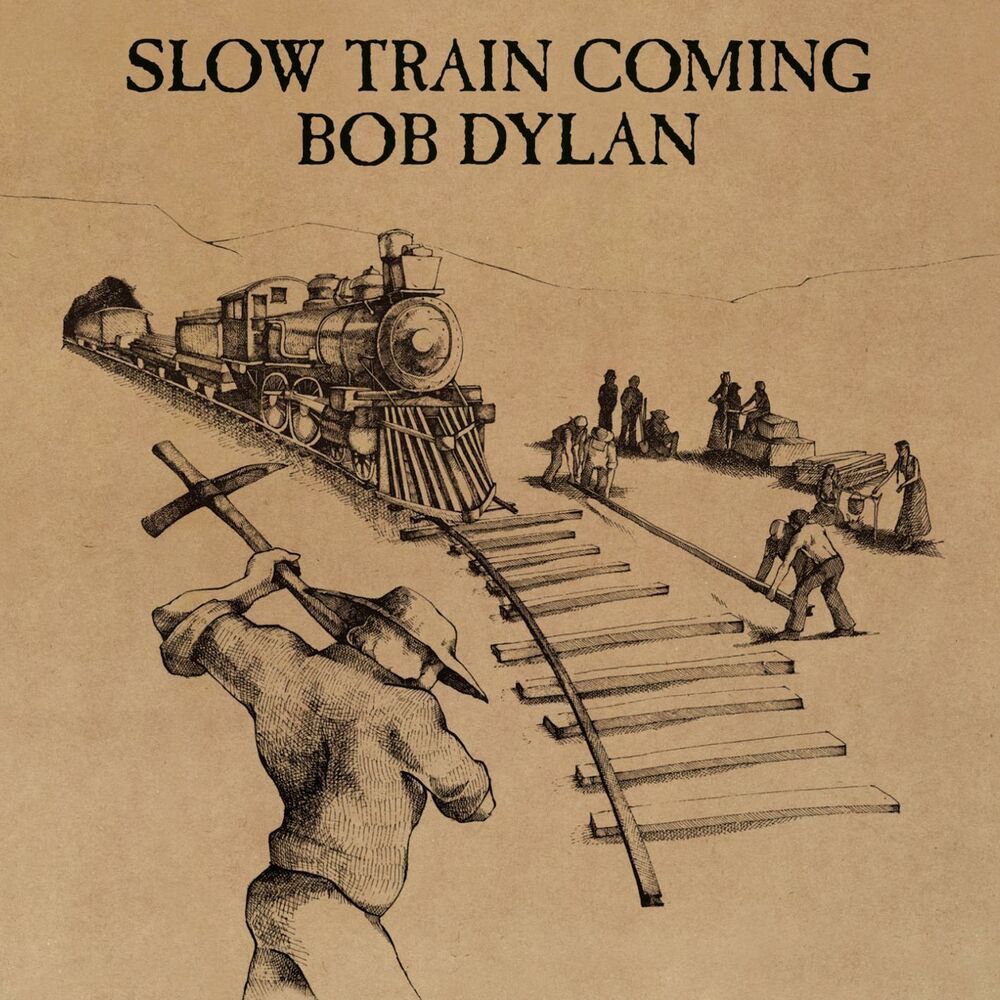
Slow Train Coming is the nineteenth studio album by American singer-songwriter Bob Dylan, released on August 20, 1979, by Columbia Records. It was Dylan's first album following his conversion to Christianity, and the songs either express personal faith, or stress the importance of Christian teachings and philosophy. The evangelical nature of the record alienated many of Dylan's existing fans; at the same time, many Christians were drawn into his fan base. Slow Train Coming was listed at No. 16 in the 2001 book CCM Presents: The 100 Greatest Albums in Christian Music. The album was generally well-reviewed by music critics, and the single "Gotta Serve Somebody" became his first hit in three years, winning Dylan the inaugural Grammy Award for Best Male Rock Vocal Performance in 1980. The album peaked at No. 2 on the charts in the UK and went platinum in the US, where it reached No. 3. A high-definition 5.1 surround sound edition of the album was released on SACD by Columbia in 2003.
Background
By November 1978, Dylan had received some of the worst reviews of his career. In late January, he finally premiered Renaldo and Clara, the part-fiction, part-concert film shot in the fall of 1975, during the first Rolling Thunder Revue tour. Though the performances were well-received, the overwhelming majority of film reviews were negative, particularly those by The Village Voice, which printed four negative reviews by four different critics. Though critical reception in the United Kingdom was kinder, with some British critics proclaiming it a major work, his most recent album, Street-Legal, was also received poorly by most American critics. Charges of sexism, poor production, and poor writing were thrown at the album. In the meantime, Dylan's latest tour was getting its own share of negative reviews, many of which reflected the negative criticism which greeted the American release of Bob Dylan at Budokan, taken from performances in February and March 1978. Yet Dylan was in good spirits, according to his own account: "I was doing fine. I had come a long way in just the year we were on the road [in 1978]." This would change on November 17 in San Diego, California. As Clinton Heylin reports, "the show itself was proving to be very physically demanding, but then, he perhaps reasoned, he'd played a gig in Montreal a month earlier with a temperature of 105." "Towards the end of the show someone out in the crowd ... knew I wasn't feeling too well," recalled Dylan in a 1979 interview. "I think they could see that. And they threw a silver cross on the stage. Now usually I don't pick things up in front of the stage. Once in a while I do. Sometimes I don't. But I looked down at that cross. I said, 'I gotta pick that up.' So I picked up the cross and I put it in my pocket ... And I brought it backstage and I brought it with me to the next town, which was out in Arizona ... I was feeling even worse than I'd felt when I was in San Diego. I said, 'Well, I need something tonight.' I didn't know what it was. I was used to all kinds of things. I said, 'I need something tonight that I didn't have before.' And I looked in my pocket and I had this cross." Dylan believed he had experienced a vision of Christ in his Tucson hotel room. "Jesus did appear to me as King of Kings, and Lord of Lords," he would later say. "There was a presence in the room that couldn't have been anybody but Jesus ... Jesus put his hand on me. It was a physical thing. I felt it. I felt it all over me. I felt my whole body tremble. The glory of the Lord knocked me down and picked me up." Heylin writes that "his state of mind may well have made him susceptible to such an experience. Lacking a sense of purpose in his personal life since the collapse of his marriage, he came to believe that, when Jesus revealed Himself, He quite literally rescued him from an early grave." "[Dylan's] conversion wasn't one of those things that happens when an alcoholic goes to Alcoholics Anonymous," David Mansfield, one of Dylan's band members and fellow-born-again Christian, would later say. "The simplest explanation is that he had a very profound experience which answered certain lifelong issues for him." Hints of Dylan's newfound faith began to appear publicly. In the final four weeks of the tour, Dylan could be seen wearing the same silver cross that catalyzed his conversion. During performances of "Tangled Up in Blue", lyrics were replaced with explicit references to the Bible. As Heylin writes, "Rather than having the mysterious lady in the topless bar quoting an Italian poet from the 13th century [sic], she was quoting from the Bible, initially from the Gospel According to Matthew. Gradually, though, the lines changed, until he settled upon a verse from Jeremiah—the one he would quote on the inner sleeve of the Saved album: 'Behold, the days come, sayeth the Lord, that I will make a new covenant with the house of Israel, and with the house of Judah' (Jeremiah 31:31)." Dylan also began …
Recording sessions
Dylan first heard Mark Knopfler when assistant and engineer Arthur Rosato played him the Dire Straits single "Sultans of Swing". Later, on March 29, 1979, Dylan caught the final show of a Dire Straits' residency at the Roxy in Los Angeles, California. Dylan approached Knopfler after the show, asking the guitarist to participate on his next album. Knopfler agreed, unaware of the religious nature of the material that awaited him. Dylan also approached Jerry Wexler to produce the upcoming sessions. "What he wanted", Wexler told interviewer Ted Fox, "was more of a tailored, big funk sound, which he didn't have on his records. He wanted a little more precision, a little more musical input. It was something he felt was time." According to Wexler, it was his, not Dylan's, initiative to bring in Knopfler: that was "the innovative part of it...Instead of going with the regular Muscle Shoals section, I changed it a little bit." Studio recording had become much more complex during the 1970s, and after his struggles recording the large ensemble performances of Street-Legal, Dylan was resolute in hiring an experienced producer he could trust. He was familiar with Wexler's celebrated work with Aretha Franklin, Wilson Pickett, Percy Sledge, Dusty Springfield, and other soul artists. "Synonymous with a small studio in Sheffield, Alabama, the sixties Atlantic recordings of Wexler defined the Muscle Shoals Sound," writes Clinton Heylin. Like Knopfler, when Wexler agreed to produce, he was unaware of the nature of the material that awaited him. "Naturally, I wanted to do the album in Muscle Shoals—as Bob did—but we decided to prep it in L.A., where Bob lived," recalls Wexler. "That's when I learned what the songs were about: born-again Christians in the old corral ... I liked the irony of Bob coming to me, the Wandering Jew, to get the Jesus feel ... [But] I had no idea he was on this born-again Christian trip until he started to evangelize me. I said, 'Bob, you're dealing with a sixty-two-year-old confirmed Jewish atheist. I'm hopeless. Let's just make an album.'" Knopfler voiced his concerns to his manager, Ed Bicknell, remarking that "all these songs are about God," but he was also impressed with Dylan's professionalism. "Bob and I ran down a lot of those songs beforehand," recalls Knopfler. "And they might be in a very different form when he's just hittin' the piano, and maybe I'd make suggestions about the tempo or whatever. Or I'd say, 'What about a twelve-string?'" When sessions were held in Alabama, Dylan retained only two members from his 1978 touring band: Helena Springs and Carolyn Dennis, both background singers. Veteran bassist Tim Drummond was hired, as was Dire Straits' drummer Pick Withers on Knopfler's recommendation. Keyboardist Barry Beckett and the Muscle Shoals Horns, both key elements of the celebrated Muscle Shoals Sound, were also brought in.” The first session was held on April 30; it proved to be very difficult. Much of the day was dedicated to recording "Trouble in Mind," a song that was ultimately left off Slow Train Coming. Wexler criticized Dylan for unnecessarily vocalizing while Dylan refused to wear headphones, adamant that they pursue a more 'live' sound even though overdubs on the 24-track recordings were virtually expected. "Bob began playing and singing along with the musicians," recalls Wexler. "We were in the first stages of building rhythm arrangements; it was too soon for him to sing, but he sang on every take anyway. I finally persuaded him to hold off on the vocals until later, when the arrangements were in shape and the players could place their licks around—not against—Bob." As the sessions wore on, Wexler's techniques seemed more accommodating. Once arrangements were set, Dylan could focus on recording a strong vocal track while subsequent overdubs would fill in the gaps. As Heylin describes it, the basic tracks with "lead vocals intact [were] laid down before Dylan's boredom threshold was reached. …
Reception and aftermath
As the album approached completion, Dylan was required to provide testimony in a defamation-of-character suit brought against him by Patty Valentine, an eyewitness to the murders described in Dylan's song "Hurricane" from Desire. In a May 22 pre-trial deposition, Dylan was asked about his wealth. "You mean my treasure on earth?" replied Dylan. He was asked about the identity of the 'fool' in "Hurricane". Dylan said the 'fool' was "whoever Satan gave power to ... whoever was blind to the truth and was living by his own truth." Five days later, Dylan's pre-trial statement was reported in The Washington Post, which also interviewed Kenn Gulliksen, who revealed to the paper that Dylan had joined the Vineyard Christian Fellowship. By June, with the album virtually finished, Dylan gave London's Capital Radio station an acetate disc of "Precious Angel", which premiered on Roger Scott's afternoon radio show. By July, the album was ready for issue, and pre-release copies of Slow Train Coming circulated through the press. New Musical Express would proclaim "Dylan & God – It's Official". In a year when Van Morrison and Patti Smith released their own spiritual works in Into the Music and Wave, respectively, Dylan's album seemed vitriolic and bitter in comparison. Critic Charles Shaar Murray wrote, "Bob Dylan has never seemed more perfect and more impressive than on this album. He has also never seemed more unpleasant and hate-filled." Greil Marcus wrote, "Dylan's received truths never threaten the unbeliever, they only chill the soul" and accused Dylan of "sell[ing] a prepackaged doctrine he's received from someone else." According to Clinton Heylin, "Marcus isolated Slow Train Coming's greatest flaw, an inevitable by-product of his determination to capture the immediacy of newfound faith in song." Robert Christgau gave a mostly positive review, grading it a B+. "The lyrics are indifferently crafted," wrote Christgau. "Nevertheless, this is his best album since Blood on the Tracks. The singing is passionate and detailed." Reviewing the album in Rolling Stone, Jann Wenner proclaimed it "one of the finest records Dylan has ever made". However, in an interview in Rolling Stone, Ann Druyan stated "The thing that I always loved about Dylan was the courage of his metaphors and the way he could cut to the bone of some kind of naked feeling. It always seemed very gutsy. And now it seems that he's turned away, he's blinded by the light, and so he looks for some easy explanation." On October 20, 1979, Dylan promoted the album with his first—and, to date, only—appearance on Saturday Night Live, performing "Gotta Serve Somebody", "I Believe in You", and "When You Gonna Wake Up". On November 1, Dylan began a lengthy residency at the Fox Warfield Theater in San Francisco, California, playing a total of fourteen dates supported by a large ensemble. It was the beginning of six months of touring North America, performing his new music to believers and his hecklers alike. Despite the mixed reactions to Dylan's new direction, "Gotta Serve Somebody" was a US Top 30 hit, and the album outsold both Blood on the Tracks and Blonde on Blonde in its first year of release despite missing the top of the charts. It even managed to place at No. 38 on The Village Voice's Pazz & Jop Critics Poll for 1979, proving he had some critical support if not universal acclaim. During this period, Dylan refused to play any of his older compositions, as well as any secular material. Though Pastor Larry Myers had assured Dylan that his old compositions were not sacrilegious, Dylan would say he would not "sing any song which hasn't been given to me by the Lord to sing". Fans wishing to hear his older songs openly expressed their disappointment. Hecklers continued to appear at his concerts, only to be answered by lectures from the stage. Dylan was firmly entrenched in his evangelical ways, and it would continue through his next album, whether his audience would follow or not. When …
Tracklist
- Gotta Serve Somebody5:25
- Precious Angel6:29
- I Believe in You5:08
- Slow Train5:56
- Gonna Change My Way of Thinking5:27
- Do Right to Me Baby (Do Unto Others)3:52
- When You Gonna Wake Up5:28
- Man Gave Names to All the Animals4:25
- When He Returns4:30
Listeners 0
Nobody has logged it yet. Be the first.