Sign in to mark it as listened, rate it and keep notes.
About the artist
Bob Dylan is an American singer-songwriter, widely regarded as one of the greatest. He transformed folk music in the 1960s by adding sophisticated, intellectual lyrics with political and philosophical depth, influencing popular culture for over 69 years.
About the album
"Love And Theft" is Bob Dylan's thirty-first studio album, released in 2001, featuring his Never Ending Tour band. It blends early Americana, blues, jazz, country, and folk, recorded with remarkable spontaneity in just 12 days.
Meanings
The album acts as a historical journey, showcasing Dylan's deep knowledge of early Americana, drawing from turn-of-the-century and 1920s styles. It explores a wide range of American song traditions, blending them into a rustic rock sound that feels timeless.
Why it's rated so high
The album won a Grammy Award for Best Contemporary Folk Album and topped numerous critics' polls, including Pazz & Jop and Rolling Stone. It is frequently cited as one of Dylan's best, with critics calling it his "immortality album" and one of the decade's finest.
Career and historical context
This album followed Dylan's Grammy-winning *Time Out of Mind* and was the first recorded with his Never Ending Tour road band, a trend that continued for subsequent albums. Its release on September 11, 2001, coincided with an unusual number of promotional interviews from Dylan.
Fun facts
It was Dylan's first number one album ever in Sweden.
The twelve songs on the album were recorded in just 12 days.
Dylan appeared in a commercial for the album with magician Ricky Jay.
He requested the commercial not be "corporate" to the director.
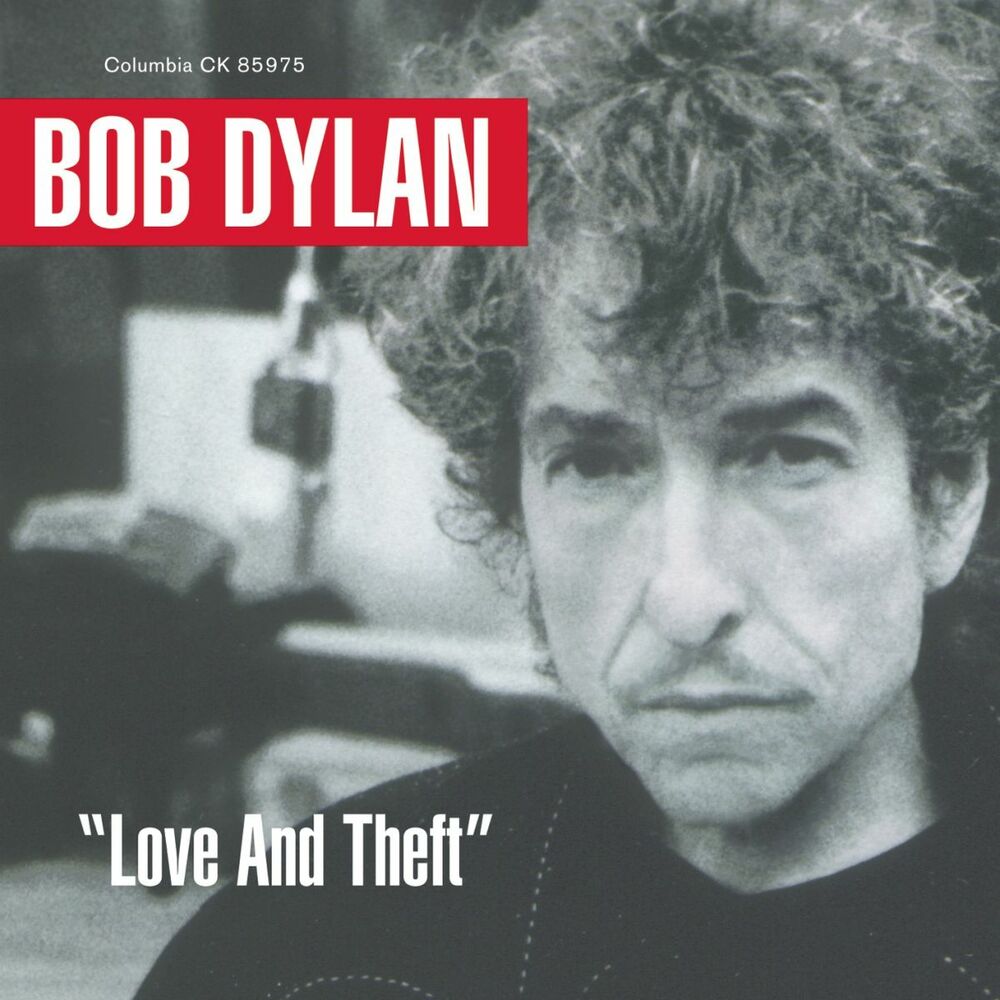
The album's cover features a black-and-white photo of Dylan with a pencil-thin moustache.
Written by AI from the album's and artist's Wikipedia articles and the archive's notes. Double-check anything important.
The full story
"Love and Theft" is the thirty-first studio album by American singer-songwriter Bob Dylan, released on September 11, 2001, by Columbia Records. It featured backing by his touring band of the time, with keyboardist Augie Meyers added for the sessions. It peaked at No. 5 on the Billboard 200, and has been certified Gold by the RIAA. The album's highest chart positions worldwide were in Norway and Sweden, where it peaked at No. 1, giving Dylan his first No. 1 album in Norway since Infidels, and his first No. 1 album ever in Sweden. A limited edition release included a separate disc with two bonus tracks recorded in the early 1960s, and two years later, on September 16, 2003, this album was remixed into 5.1 surround sound and became one of 15 Dylan titles reissued and remastered for SACD playback.
Background and recording
"Love and Theft" was the first album Dylan recorded with his Never Ending Tour road band. This is a trend that would continue with his subsequent eight studio albums. Guitarist/multi-instrumentalist Larry Campbell recalls Dylan showing him the chord changes for the new song "Po' Boy" shortly after the band had recorded Dylan's Oscar-winning original and non-album song "Things Have Changed" in 1999: "They were relatively sophisticated changes for a Bob Dylan song [...] That was the first inkling of what the material might be like—taking elements from the jazz era and adding a folk sensibility to it".
David Kemper, Dylan's drummer at the time, described in an interview how the sound of "Love and Theft" arose from lessons the band had absorbed from Dylan: "I didn't realise we were actually headed somewhere. I wasn't smart enough to realise: you are in the School of Bob. But when we went in to record "Love And Theft", I realised then, because the influences were really so old on that record. It comes from really early Americana, way back at the turn of the century, and the 1920s. And not everybody in the band was familiar with that style of playing. And I know that the songs that he would bring in would be these amazing examples of early Americana. Nobody that I know, knows as much about American music as Bob Dylan. He has spent so much time trying to understand, and collecting these songs—it was like a never stopping resource. He was always coming up with these songs or artists that I had never heard of. And then when we went in and recorded "Love And Theft" it was like, oh my God, he's been teaching us this music—not literally these songs, but these styles. And as a band, we're familiar with every one of these. That's why we could cut a song a day [...] and the album was done".
As Kemper indicated, the twelve songs on "Love and Theft" were recorded in just 12 days in May 2001 at Clinton Recording in Midtown Manhattan. The recording sessions were notable for their spontaneity. According to engineer Chris Shaw, "What surprised me was how quickly [Dylan] would abandon an arrangement when he was working. He'd say, 'What's the tempo? Let's do it in F and drop the tempo down and do it like a Western swing tune, and I want the drummer to play brushes, not drums.' And suddenly the song was completely different. Nothing was set in stone until he found that key, tempo and style that fit that vocal and that lyric".
For his part, Dylan had been interested in working with Chris Shaw when he heard Shaw had gotten his start on Public Enemy's early records. Dylan praised Shaw's work as an engineer during a press conference in Rome to promote "Love and Theft" in 2001: After complaining that previous producers had botched the recording of his vocals, he was asked if he felt it was difficult to record his voice in the studio. Dylan referenced Shaw when he responded, "I don't think so […] On this particular record we had a young guy who understood how to do it." Dylan would subsequently employ Shaw to engineer and mix his albums Modern Times and Rough and Rowdy Ways as well as various non-album tracks.
Release and promotion
Although no singles were released from the album, Dylan appeared in a 30-second commercial featuring the song "Tweedle Dee & Tweedle Dum" that appeared online on August 28, 2001, and on network television beginning on September 3, 2001. The spot, directed by Kinka Usher, shows Dylan in a tense poker game with magician Ricky Jay, actress Francine York and Dharma & Greg writer Eddie Gorodetsky. The poker setting was Dylan's idea and, according to Usher, he only made one request of the director: "He said, `You know, I just don't want it to be corporate'. And I assured him that I wasn't going to do that, I was going to shoot it like a little film. I know he's very happy with it".
Dylan also consented to what, for him, was an unusual number of interviews with press to promote the album. On July 23, 2001, he participated in a press conference at the Hotel de la Ville in Rome with reporters from Austria, Britain, Denmark, Finland, Germany, the Netherlands, Italy, Norway, Sweden and Switzerland. He was also interviewed by Edna Gundersen for USA Today, Robert Hilburn for the Los Angeles Times and Mikal Gilmore for Rolling Stone. All of these interviews appeared shortly before or shortly after the album's release on September 11, 2001.
Packaging
The album's cover features a black-and-white photograph of Dylan, sporting a then-new pencil-thin mustache, which was taken in the studio by Kevin Mazur. The back cover features a black-and-white portrait of Dylan taken by photographer David Gahr. Mazur also took the album's inside cover photo of Dylan and the "Love and Theft" band (including organist Augie Meyers). The album's art direction is credited to Geoff Gans.
Reception and legacy
The album won the Grammy Award for Best Contemporary Folk Album at the 44th Annual Grammy Awards. It was nominated for Album of the Year and the track "Honest with Me" was nominated for Best Male Rock Vocal Performance.
In a glowing review for his "Consumer Guide" column published by The Village Voice, Robert Christgau wrote: "If Time Out of Mind was his death album—it wasn't, but you know how people talk—this is his immortality album". Later, when The Village Voice conducted its annual Pazz & Jop critics' poll, "Love and Theft" topped the list, the third Dylan album to accomplish this. It also topped Rolling Stone's list. Q listed "Love and Theft" as one of the best 50 albums of 2001. Kludge ranked it at number eight on their list of best albums of 2001.
In 2003, the album was ranked number 467 on Rolling Stone's 500 Greatest Albums of All Time, climbing to number 385 in the 2012 update and dropping to number 411 in the 2020 update of the list. Newsweek magazine pronounced it the second best album of its decade. In 2009, Glide Magazine ranked it as the No. 1 Album of the Decade. Entertainment Weekly put it on its end-of-the-decade, "best-of" list, saying, "The predictably unpredictable rock poet greeted the new millennium with a folksy, bluesy instant classic".
In a 2020 list of "Bob Dylan's 10 greatest albums" in Far Out magazine, "Love and Theft" was ranked seventh. An article accompanying the list characterized the album as one in which "Dylan turns into a historian and showcases the music which moves him. It is another rootsy affair and one which feels capable of stirring up the ghosts of music past all on its own". A 2020 article at the Ultimate Classic Rock website also placed "Love and Theft" seventh in the Dylan pantheon, noting that it "plays like an attic-sweeping of songs and themes Dylan and others left behind over the years" and that it evokes "long-gone musical spirits from the other turn of the century". Finally, Glide Magazine likewise placed "Love and Theft" seventh in a comprehensive list ranking all of Dylan's albums, writing that "Dylan here pulls readers through a bevy of American song traditions" and that "each song recaptures and renews a sub-genre that influenced Dylan's career". Ian O'Riordan, in a 2021 article in the Irish Times, ranked the album sixth out of the 39, praising David Kemper's drumming and citing "Lonesome Day Blues" as his favourite track.
Johnny Cash, in a 2001 interview with The New York Times, named it as Dylan's best album.
Critic Jake Cole, in a 2021 Spectrum Culture article celebrating the album's 20th anniversary, referred to it as Dylan's most eclectic work "from the storming rock of 'Lonesome Day Blues' to the gorgeous slow-dance lounge number 'Moonlight', which points straight at Dylan's later Great American Songbook phase of the 2010s. In that sense, 'Love and Theft' might be the closest that Dylan ever came to capturing the spirit of his lauded Rolling Thunder Revue tour in the studio. If that roadshow was conceived as a way to rummage through folk tradition and feeding it into some kind of interpretive revivalism, this album codifies that approach into a freewheeling tour of blues, jazz, country and folk, all of it wrangled into a form of rock so rustic that even roots rock sounds modern compared to it".
Allegations of plagiarism
"Love and Theft" generated controversy when some similarities between the album's lyrics and Japanese writer Junichi Saga's book Confessions of a Yakuza were pointed out. Translated to English by John Bester, the book is a biography of one of the last traditional yakuza bosses in Japan. In the article published in the Journal, a line from "Floater" ("I'm not quite as cool or forgiving as I sound") was traced to a line in the book, which said "I'm not as cool or forgiving as I might have sounded." Another line from "Floater" is "My old man, he's like some feudal lord". One line in the book's first chapter is, "My old man would sit there like …