João's Music Archive
Rust Never Sleeps
← Back to the lists

Rust Never Sleeps

Neil Young
1979-06-22
Reprise
9 tracks, 38:17
Rating
–
Not heard yet
110
–Archive
96Critics
0Listeners
Average score 9611 reviews

Tracklist

  1. My My, Hey Hey (Out of the Blue) (2016 Remaster)3:47
  2. Thrasher (2016 Remaster)5:39
  3. Ride My Llama (2016 Remaster)2:30
  4. Pocahontas (2016 Remaster)3:24
  5. Sail Away (2016 Remaster)3:47
  6. Powderfinger (2016 Remaster)5:30
  7. Welfare Mothers (2016 Remaster)3:49
  8. Sedan Delivery (2016 Remaster)4:39
  9. Hey Hey, My My (Into the Black) (2016 Remaster)5:12
Listen on

Have you heard it?

Sign in to mark it as listened, rate it and keep notes.

About the artist

Neil Percival Young (born November 12, 1945) is a Canadian and American singer-songwriter and musician. Young's deeply personal lyrics and signature high tenor singing voice define his long career. Young's often distorted electric guitar playing, especially with his backing band Crazy Horse, earned him the nickname "Godfather of Grunge" and led to his 1995 album Mirror Ball with Pearl Jam.

About the album

Rust Never Sleeps is the tenth album by Canadian American singer-songwriter Neil Young and his third with American band Crazy Horse. It was released on June 22, 1979, by Reprise Records and features both studio and live tracks. Most of the album was recorded live, then overdubbed in the studio, while other songs originated in the studio.

Why it's rated so high

Reviewing for The Village Voice in 1979, Robert Christgau called Rust Never Sleeps Young's best album yet and said although his melodies are unsurprisingly simple and original, his lyrics are surprisingly and offhandedly complex. "He's wiser but not wearier", Christgau wrote, "victor so far over the slow burnout his title warns of".

Career and historical context

The album was recorded in May 1978 during solo acoustic performances at The Boarding House in San Francisco and in October 1978 during the "Rust Never Sleeps" tour, in which Young played a wealth of new material. The concert tour was divided into a solo acoustic set and an electric set with Crazy Horse. Two new songs, the acoustic "My My, Hey Hey (Out of the Blue)" and electric "Hey Hey, My My (Into the Black)" were the centerpiece of the new material.

Taken from Wikipedia (CC BY-SA 4.0).

The full story

Rust Never Sleeps is the tenth album by Canadian American singer-songwriter Neil Young and his third with American band Crazy Horse. It was released on June 22, 1979, by Reprise Records and features both studio and live tracks. Most of the album was recorded live, then overdubbed in the studio, while other songs originated in the studio. Young used the phrase "rust never sleeps" as a concept for his tour with Crazy Horse to avoid artistic complacency and try more progressive, theatrical approaches to performing live. The album peaked at No. 8 on the Billboard 200 album chart and spawned the hit single "Hey Hey, My My (Into the Black)" that peaked at No. 79 on the US Billboard Hot 100 chart. It also included one of Young's most popular and critically acclaimed songs, the enigmatic "Powderfinger". The album, along with Young's 1990 release Ragged Glory, has widely been considered a precursor of grunge music with the bands Nirvana and Pearl Jam having cited Young's heavily distorted and abrasive guitar style on the B side of the album as an inspiration.

Background

The album was recorded in May 1978 during solo acoustic performances at The Boarding House in San Francisco and in October 1978 during the "Rust Never Sleeps" tour, in which Young played a wealth of new material. The concert tour was divided into a solo acoustic set and an electric set with Crazy Horse. Two new songs, the acoustic "My My, Hey Hey (Out of the Blue)" and electric "Hey Hey, My My (Into the Black)" were the centerpiece of the new material. The overdubbed live tracks are complemented with two outtakes from Young's previous album, Comes a Time.

Writing

The album sees Young reunited with Crazy Horse, his first credited to the band since 1975's Zuma. Four of the album's eight songs date from the sessions from that previous album: "Pocahontas", "Ride My Llama", "Powderfinger" and "Sedan Delivery". Studio attempts at each of these songs from the summer of 1975 have since been released through Young's Archives series. Young explains in his memoir, Waging Heavy Peace: "The album Zuma is the first album we made with Crazy Horse after Poncho joined the band. We kept playing day after day and partying at night. We did the original "Powderfinger" and held it back. We did "Sedan Delivery" and held it back. "Ride My Llama" was completely finished and mixed and held back. Today I like listening to all of those tracks together in a compilation I call Dume that is in The Archives Volume 2."

The album's title, Rust Never Sleeps, takes its name from the song that bookends the album, titled "My My, Hey Hey (Out of the Blue)" and "Hey Hey, My My (Into the Black)". The line "It's better to burn out than it is to rust" was borrowed from a line in a song by Jeff Blackburn, Young's bandmate in The Ducks, with whom he toured in 1977. Devo vocalist Mark Mothersbaugh added the lyrics "Rust never sleeps", a slogan he remembered from his graphic arts career promoting the automobile rust proofing product Rust-Oleum. Young recalls in a 1981 Rockline interview: I think Mark had the idea in the first place. We were doing this version of "Out of the Blue" together and we were in the studio playing and Booji Boy was there and he was singing "Hey Hey, My My" and he just had a lyric sheet and it said "It's better to burn out than to rust" and he just said 'Well it's better to burn out 'cause rust never sleeps" and I thought, well all right, that makes a lot of sense to me. Young adopted Mothersbaugh's lyrics and created a new version of the song with Crazy Horse. He also adopted Mothersbaugh's lyrics for the title of his album as a metaphor about the hazards of complacency on his music career and the need to keep moving forward. Young explained in a June 1988 interview for Spin Magazine how the lyrics resonated with him, and how he felt both the record industry should be shaken up at the time, and how he applies the sentiment of the song to his style of recording:

I never met Johnny Rotten, but I like what he did to people. He pissed off a lot of people who I think needed waking up. Rock 'n' roll people, who in the Seventies were asleep and thinking they were just so fucking cool and they knew what had to happen. They were telling me why don't you make a real record. People became aware that there was more to it than perfection and overdubs, and fucking equipment and limousines back and forth to Studio B, and the other group down the hall and getting high in the bathroom with the other group that's going in and singing on their record. That's not intense enough for me. I think art is a private thing. I'm not sharing my creative moment with whoever's in the hallway. Rust implies you're not using anything, that you're sitting there and letting the elements eat you. Burning up means you're cruising through the elements so fucking fast that you're actually burning, and your circuits, instead of corroding, are fucking disintegrating. You're going so fast you're actually fucking the elements, becoming one with the elements, turning to gas. That's why it's better to burn out. The lyrics, "It's better to burn out than fade away", were widely quoted by his peers and by critics. In a 1980 interview with David Sheff from Playboy magazine, John Lennon was dismissive of the lyric and the song's reference to Johnny Rotten for what he interpreted as worship for the dead saying, "No, thank you. I'll take the living and the healthy." In 1994, Kurt Cobain quoted the lyric in his suicide note. After Cobain's death, Young vowed never to perform the song again, but reversed his stance at the request of the surviving members of …
Recording

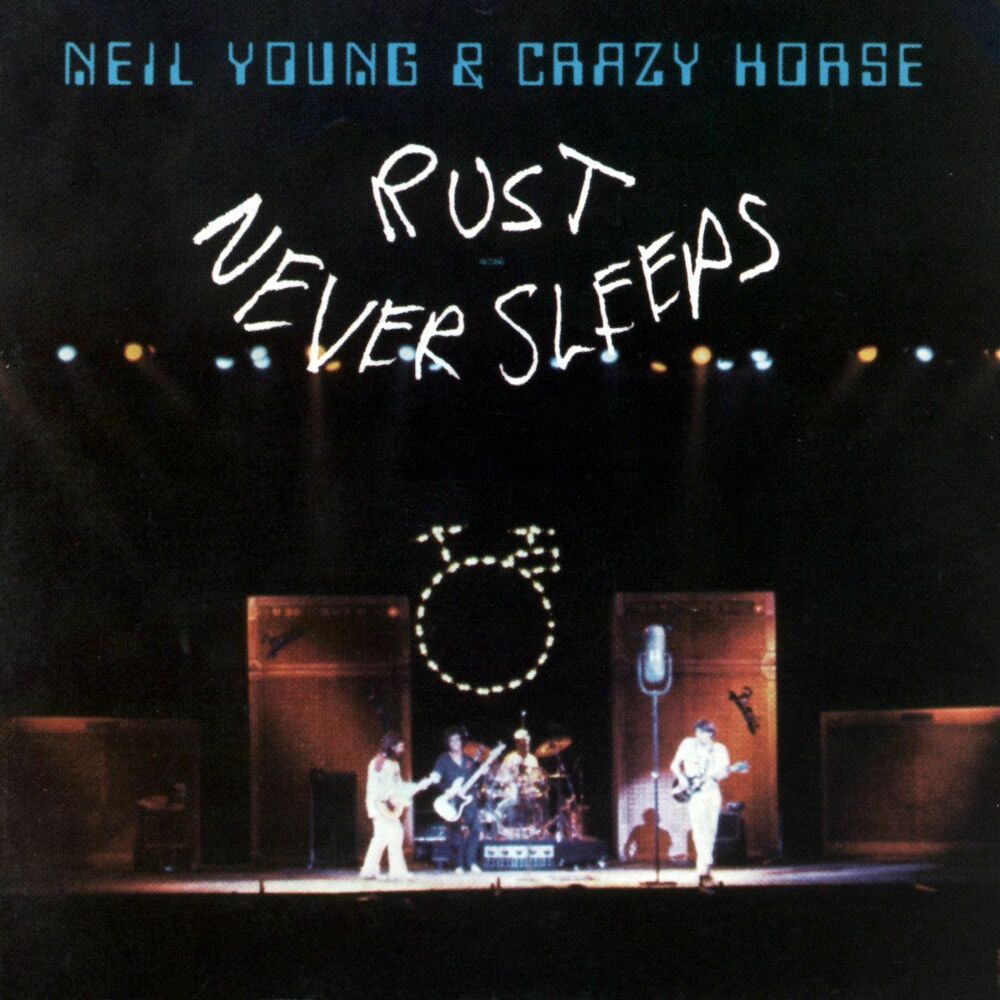
The acoustic portions of the album including, "My My, Hey Hey (Out of the Blue)", "Thrasher" and "Ride My Llama" were recorded live in San Francisco at the Boarding House between May 24 and 28, 1978. Young played ten acoustic sets over five days. Young used the occasion to play several songs in concert for the first time. In addition to the three tracks on the album he also debuted "Powderfinger", "Shots" and "The Ways of Love" and played the rarities "Out of My Mind" and "I Believe in You" on piano. "Shots" would later appear on Re·ac·tor in 1981; "The Ways of Love" would first surface on Freedom in 1989. The concert takes were overdubbed in the studio. For example, Young would later double the guitar part to "Ride My Llama" in the studio. Two songs from the album were not recorded live: "Pocahontas" had been recorded solo in August 1976 during the Hitchhiker session, with later overdubs in September 1977 at Triiad studios for the album Oceanside/Countryside, an early version of Comes a Time. "Sail Away" was also recorded at Triiad as a solo track, and received full band overdubs during the Comes a Time recording sessions in November 1977. Following the May 27 performances at The Boarding House, Young joined Devo onstage at the punk club Mabuhay Gardens. The following day, they collaborated on the first electric performance of "Hey Hey, My My (Into the Black)" at Different Fur Studios for the film Human Highway. Young would later push Crazy Horse to match Devo's intensity of performance when recording their version of the song for the album. The electric sets were recorded during the Neil Young/Crazy Horse tour in October 1978, with overdubs added later. The same performance of "Hey Hey, My My (Into the Black)" is used on both Rust Never Sleeps and Live Rust, with the former receiving significant overdubs. Audience noise is removed from the album as much as possible, although it is clearly audible at certain points, most noticeably on the opening and closing songs. Young adopted a new look for the concerts, with much shorter hair and wearing a sport coat and bolo tie. The concerts incorporated several visual stunts: ridiculously oversized amplifiers, Star Wars Jawa-inspired "road-eye" characters roaming the stage and 3D "Rust-O-Vision" glasses were given out to the audience. Young would also appear onstage alongside three large wood-carved Indian statues from the set of Human Highway. One of the statues, "Woody", would accompany Young on future tours. The 1978 tour featured an abrasive style of guitar playing influenced by the punk rock zeitgeist of the late 1970s that Young saw as a wake up call for a rock music world which, in his opinion had become predictable and overdone. The electric sets provided a reenergized response to the punk rock revolution and, were in stark contrast from Young's previous, folk-inspired album Comes a Time.

Critical reception

Reviewing for The Village Voice in 1979, Robert Christgau called Rust Never Sleeps Young's best album yet and said although his melodies are unsurprisingly simple and original, his lyrics are surprisingly and offhandedly complex. "He's wiser but not wearier", Christgau wrote, "victor so far over the slow burnout his title warns of". Paul Nelson, writing in Rolling Stone, found its first side "virtuosic" because of how Young "transcends the songs' acoustic settings with his commanding performance" and was "impressed by its themes of personal escape and exhaustion, the role of rock music, and American violence." Nelson would write that "Rust Never Sleeps tells me more about my life, my country and rock & roll than any music I've heard in years." Rust Never Sleeps was voted the second best album of 1979 in The Village Voice's annual Pazz & Jop critics poll. Christgau, the poll's creator, ranked it second on his own list for the poll, as did fellow critic Greil Marcus. The album also won Rolling Stone magazine's 1979 critics poll for Album of the Year. In a decade-end list for The Village Voice, Christgau named it the ninth best album of the 1970s. In 2000, Rust Never Sleeps was voted number 240 in the third edition of Colin Larkin's All Time Top 1000 Albums book. In 2003, it was ranked number 350 on Rolling Stone magazine's list of the 500 greatest albums of all time. Rolling Stone re-ranked the album at 351 in the list's 2012 edition, and later at number 296 in the 2020 edition. In a retrospective review, Greg Kot of the Chicago Tribune said that the acoustic and electric sides were both "astounding". AllMusic's William Ruhlmann viewed that "Young reinvigorated himself artistically by being imaginative and bold, and in the process created an exemplary album that encapsulated his many styles on a single disc with great songs—in particular the remarkable 'Powderfinger'—unlike any he had written before." Rob Sheffield, writing in The Rolling Stone Album Guide (2004), felt that "Powderfinger", "Pocahontas", "Thrasher", and "Hey Hey, My My (Into the Black)" were among Young's greatest songs.

From the Wikipedia article Rust Never Sleeps, available under CC BY-SA 4.0.

Tracklist

  1. My My, Hey Hey (Out of the Blue) (2016 Remaster)3:47
  2. Thrasher (2016 Remaster)5:39
  3. Ride My Llama (2016 Remaster)2:30
  4. Pocahontas (2016 Remaster)3:24
  5. Sail Away (2016 Remaster)3:47
  6. Powderfinger (2016 Remaster)5:30
  7. Welfare Mothers (2016 Remaster)3:49
  8. Sedan Delivery (2016 Remaster)4:39
  9. Hey Hey, My My (Into the Black) (2016 Remaster)5:12

Listeners 0

Nobody has logged it yet. Be the first.

Log a listen