João's Music Archive
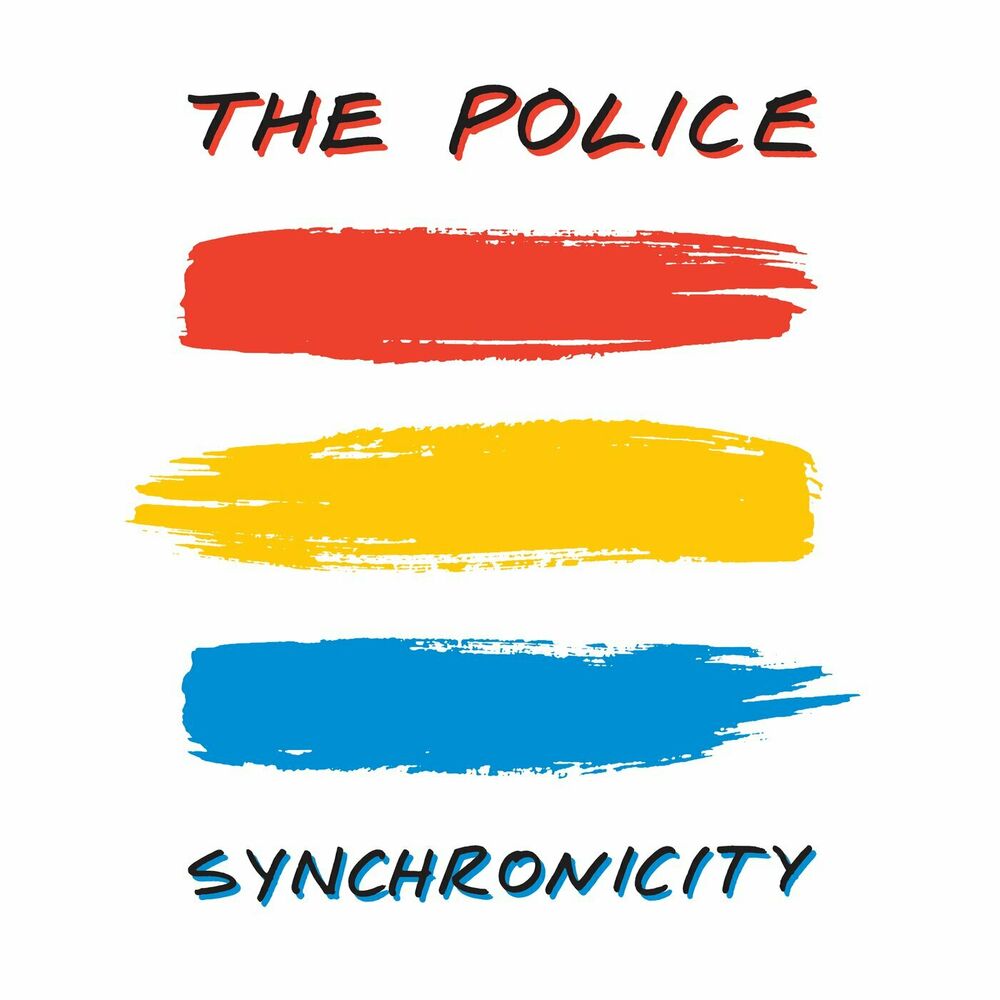
Synchronicity
← Back to the lists

Synchronicity

The Police
1983-06-01
Umc
25 tracks, 1 h 42 min
Rating
–
Not heard yet
110
–Archive
84Critics
0Listeners
Average score 8410 reviews

Tracklist

  1. Synchronicity I (Remastered 2023)3:23
  2. Walking In Your Footsteps (Remastered 2023)3:35
  3. O My God (Remastered 2023)4:00
  4. Mother (Remastered 2023)3:03
  5. Miss Gradenko (Remastered 2023)2:00
  6. Synchronicity II (Remastered 2023)5:04
  7. Every Breath You Take (Remastered 2023)4:12
  8. King Of Pain (Remastered 2023)4:57
  9. Wrapped Around Your Finger (Remastered 2023)5:13
  10. Tea In The Sahara (Remastered 2023)4:11
  11. Murder By Numbers (Remastered 2023)4:31
  12. Truth Hits Everybody (Remix)3:49
  13. Man In A Suitcase (Live At The Variety Arts Theatre, Los Angeles, USA / 16th January 1981)2:18
  14. Someone To Talk To3:04
  15. Message In A Bottle (Live At The Gusman Cultural Center, Miami, USA / 26th October 1979)4:50
  16. I Burn For You4:53
  17. Once Upon A Daydream3:31
  18. Tea In The Sahara (Live At The Omni, Atlanta, USA / 3rd November 1983)5:04
  19. Every Breath You Take (Backing Track)4:07
  20. Roxanne (Backing Track)3:12
  21. Wrapped Around Your Finger (Live At The Omni, Atlanta, USA / 3rd November 1983)5:25
  22. Every Bomb You Make3:22
  23. Walking On The Moon (Live At The Omni, Atlanta, USA / 3rd November 1983)5:01
  24. Hole In My Life (Live At The Omni, Atlanta, USA / 3rd November 1983)3:52
  25. One World (Not Three) (Live At The Omni, Atlanta, USA / 3rd November 1983)5:33
Listen on

Have you heard it?

Sign in to mark it as listened, rate it and keep notes.

About the artist

The Police were an English rock band formed in London in 1977, comprising Sting, Andy Summers, and Stewart Copeland. Emerging from the British punk scene, they quickly evolved to incorporate new wave, reggae rock, and post-punk, becoming globally popular. They are considered one of the leaders of the Second British Invasion and have sold over 75 million records worldwide.

About the album

Synchronicity is the fifth and final studio album by The Police, released in 1983. It features a reduced reggae influence, leaning into production-heavy textures and synthesizers, with some world music elements. The band recorded the basic tracks live in separate rooms, a setup chosen for optimal sound and to manage inter-band dynamics.

Meanings

The album's title and much of its material were inspired by Carl Jung's concept of synchronicity and Arthur Koestler's book, "The Roots of Coincidence." The opening track, "Synchronicity I," directly quotes Jung's title, exploring the idea of meaningful coincidences.

Why it's rated so high

Critics widely acclaimed Synchronicity for its cohesive blending of diverse genres and sonic experimentation, with Rolling Stone describing each track as a "miniature, discrete soundtrack." It won three Grammy Awards, including Best Rock Performance by a Duo or Group with Vocal, and is ranked #159 on Rolling Stone's 500 Greatest Albums of All Time. The album was inducted into the Grammy Hall of Fame and preserved in the US National Recording Registry.

Career and historical context

Released at the peak of their fame, Synchronicity became The Police's most successful album, topping charts in the UK, US, and Canada. It famously interrupted Michael Jackson's "Thriller" dominance on the US Billboard 200 and solidified their status as arguably the "biggest band in the world" before their disbandment in 1984.

Fun facts

  • Original vinyl pressings appeared black but turned opaque purple when held to light.
  • The band members recorded their parts in separate rooms, including Stewart Copeland in the dining room.
  • Sting and Stewart Copeland came to blows during the recording of "Every Breath You Take."
  • The track "Mother," written by Andy Summers, generated controversy for its unusual, off-the-wall sound.
  • Synchronicity holds the record for most consecutive weeks at number one in Canada, with 24 weeks.
Written by AI from the album's and artist's Wikipedia articles and the archive's notes. Double-check anything important.

The full story

Synchronicity is the fifth and final studio album by the English rock band the Police, released on 17 June 1983 by A&M Records. The band's most successful release, the album includes the hit singles "Every Breath You Take", "King of Pain", "Wrapped Around Your Finger", and "Synchronicity II". The album's title and much of the material for the songs were inspired by Arthur Koestler's book The Roots of Coincidence (1972). At the 1984 Grammy Awards the album was nominated for a total of five awards, including Album of the Year, and won three. At the time of its release and following the Synchronicity Tour, the Police's popularity was at such a high that they were arguably, according to BBC and The Guardian, the "biggest band in the world". Synchronicity reached number one on both the UK Albums Chart and the US Billboard 200, and sold over eight million copies in the US. The album was widely acclaimed by critics. Praise centered on its cohesive merging of disparate genres and sonic experimentation. Rolling Stone described "each cut on Synchronicity [as] not simply a song but a miniature, discrete soundtrack". It was ranked number 17 in the magazine's lists of the "100 Best Albums of the Eighties" and number 159 on the "500 Greatest Albums of All Time". In 2009, Synchronicity was inducted into the Grammy Hall of Fame. In 2023, the album was selected for preservation in the United States National Recording Registry by the Library of Congress as being "culturally, historically, or aesthetically significant".

Recording

The album's title was inspired by the Carl Jung book Synchronicity: An Acausal Connecting Principle, going so far as to quote the book's title in the lyrics of the albums first song Synchronicity I, singing "Synchronicity...a connecting principle...".

The album marked a significant reduction in the reggae influences that were a part of the band's first four studio albums, instead continuing the trend of production-heavy textures and liberal use of synthesizers featured in their previous album's hit single "Spirits in the Material World". This direction sometimes drove entire songs ("Synchronicity I", "Wrapped Around Your Finger"). The influence of world music can also be heard in songs such as "Tea in the Sahara" and "Walking in Your Footsteps". As opposed to the band's previous effort, Ghost in the Machine, the songs have no overdubbed saxophone(s). Sting explains:I enjoyed making Ghost in the Machine and playing with the tools of the studio, just building things up and sticking more vocals on. Great fun. But listening to it, I thought. "Hey, my voice on its own sounds as good as fifteen overdubs, so I'll try it on its own." And I've done the saxophone section bit now, I'm bored with it; and Andy [Summers] was into just plunking down one guitar part. I'm glad we did 'Ghost'. I don't regret it. But it was time to change the regime again.As with Ghost in the Machine, the recording for Synchronicity took place over a period of six weeks, at AIR Studios in Montserrat with the Neve 8078 console beginning in December 1982. The three band members recorded the basic tracks live in separate rooms: Stewart Copeland with his drums in the dining room (connected to the control room via video link), Sting in the control room, and guitarist Andy Summers in the actual studio. According to co-producer and engineer Hugh Padgham, this was done for two reasons: to obtain the best sound for each instrument and "for social reasons." Sting explained how this setup worked for him:In my case, it's because there is nothing worse than hearing a bass through a set of headphones. Basically, it sounds like a frog farting. I play much better when the sound coming out of the instrument is rich and warm. If we played together like that in the same room, we wouldn't be able to hear anything except the drum, because the guitarist has to have a lot of volume to hit a certain level of distortion or passion or emotion. I play in the studio next to the engineer [Hugh Padgham] so I can hear the instruments balanced and mixed roughly as they'll sound on the record.While tracking live, the band would do multiple takes of each song. Alongside Padgham, they would listen through each take and select the best parts, which would be edited together into one 'master backing track' before they recorded overdubs (including vocals, which were often bounced down to make room for other overdubs on the 24-track). During the recording of "Every Breath You Take", Sting and Copeland came to blows with each other, and Padgham nearly quit the project. The song was originally attempted with the live method, but due to numerous failed takes the song had to be assembled entirely from overdubs, including all drum parts. This album also marked Sting's first time using a sequencer, which features heavily on "Walking in Your Footsteps" (said to be the first track he programmed with it) and "Synchronicity I". It was an Oberheim DSX sequencer, which Sting seemed to enjoy pushing to its limits, and he likened it to HAL in 2001: A Space Odyssey (1968).

Final overdubs and mixing were done within two weeks at Le Studio in Morin-Heights from mid-January to February 1983 using the SSL console with automated mixing. Summers reflects on the transition from recording to mixing:"It was only after we'd taken a week off [after recording the album on Montserrat] and started hearing it back in Canada, almost for the first time, that we realized it was good. When you're recording there's this terrible, …

Release

Synchronicity was released in the United Kingdom on 17 June 1983. The album was issued on LP, CD, and cassette. Synchronicity debuted at number one on the UK Albums Chart and spent two weeks at the top position. In the United States, the album topped the Billboard 200 in late July and ultimately spent 17 nonconsecutive weeks at number one on the chart, interrupting the dominance of Michael Jackson's Thriller (1982). In Canada, the album went to number one for a record 24 (consecutive) weeks. Synchronicity's 24 weeks at number one surpassed the Saturday Night Fever soundtrack (22 consecutive weeks) for most weeks at number one all-time on the Canadian album charts. It was itself surpassed in 2012 by Adele's album 21 (35 nonconsecutive weeks.) Synchronicity still holds the record for most consecutive weeks at number one in Canada with 24. Original A&M vinyl pressings were made with a Quiex II process where the record appears black on the turntable but when held up to light turns an opaque purple. The album was reissued as a remastered gold CD in 1989 by Mobile Fidelity Sound Lab, and on SACD in 2003. On 29 May 2024, 41 years after the original release, it was announced that a deluxe 6-CD box set (plus a 4-LP box set, picture disc LP, 2-CD and 2-LP colour vinyl) would be released on 26 July to commemorate the 40th anniversary of Synchronicity. This would represent the first time that any material by the band had been given the deluxe treatment, with various editions featuring up to 55 previously unreleased tracks including all original 7” / 12” b-sides plus 11 exclusive non-album bonus tracks, 36 demos or early mixes plus a live show from the accompanying tour. The box set saw a release on 26 July 2024.

Critical reception

Professional music critics at the time of release and afterwards have been mostly positive towards the album. Richard Cook of NME called Synchronicity "a record of real passion that is impossible to truly decipher", and felt that "although [the album] magnifies the difference between Sting and Summers and Copeland it also evolves the group into a unique state: a mega-band playing off glittering experimentation against the sounding board of a giant audience. It's the sound of a group coming apart and coming together, a widescreen drama with a fascination at a molecular level. Some of the music fuses intuitive pop genius with willfully dense orchestration so powerfully it stuns. It is occasionally sensational." In Melody Maker Adam Sweeting was less enthusiastic, saying, "I would guess that devotees of this extremely sussed trio will find plenty to amuse them, and indeed Sting has sown all sorts of cryptic little clues and messages throughout his songs... However impressive bits of Synchronicity sound, I could never fall in love with a group which plans its moves so carefully and which would never do anything just for the hell of it". Reviewing the 2003 reissue, Mojo's David Buckley stated that "Synchronicity [...] was already, in the time-honoured words of rock journo cliché, 'the work of a disintegrating unit', yet 20 years on it hangs together well". Although noting what he felt was a clear gap in quality between the first and second halves of the album, AllMusic editor Stephen Thomas Erlewine concluded that the "first-rate pop" of the second half ranks among Sting's best work, while also illustrating "that he was ready to leave the Police behind for a solo career, which is exactly what he did." Tom Doyle of Mojo deems it an unusual art rock album whose content contrasted with its major success, adding that although some songs suffer from "the thin, digital reverb-y aural trends of the era," Padgham was nonetheless an ideal choice for co-producer due to his engineering of Peter Gabriel's eponymous 1980 album, "whose echoes could be heard in the marimba-led atmosphere of 'King of Pain' or the sequenced polyrhythms of 'Walking In Your Footsteps'." The track "Mother" generated controversy, with it widely being viewed as the worst track on Synchronicity. Andy Summers, who wrote the song, explained why it was put on the album: "We all have our family situations, and I had a pretty intense mother who was very focused on me. I was sort of 'the golden child,' and there I was, sort of fulfilling all of her dreams by being this pop star in The Police. I got a certain amount of pressure from her. It's not heavy - it was written kind of ironic, to be kind of funny, but crazy. It's inspired a little bit by Captain Beefheart. It's something that's really off-the-wall. It was very bizarre - I think it freaked the record company out. When the album came out, we had all the press in the world watching us and talking about it. The reviews came in, and that song got written about so much because it was so off-the-wall and so ballsy to do that, because the band was having so much commercial success." In his review of Synchronicity, Stephen Holden from Rolling Stone noted that "corrosively funny 'Mother' inverts John Lennon's romantic maternal attachment into a grim dadaist joke." PopMatters consider the song "awful". Doyle writes that the song was "boldly tracklisted midway through side one" and described Summers' lead vocal as "[involving] a manic, screaming performance that sounds as if he's auditioning to be Adrian Belew's replacement in (the similarly troubled) King Crimson."

Accolades

In the 1983 Rolling Stone readers' poll, Synchronicity was voted "Album of the Year". It was voted the fifth best album of 1983 in The Village Voice's year-end Pazz & Jop critics' poll. At the 1984 Grammy Awards ceremony, Synchronicity won the award for Best Rock Performance by a Duo or Group with Vocal, and was nominated for Album of the Year. "Every Breath You Take" won the awards for Song of the Year and Best Pop Performance by a Duo or Group with Vocals, and received a nomination for Record of the Year. In 1989, Synchronicity was ranked No. 17 on Rolling Stone's list of the 100 best albums of the 1980s. Pitchfork ranked the record at No. 55 on its 2002 list of the decade's 100 best albums. In 2006, Q placed Synchronicity at No. 25 on its list of the 40 best 1980s albums. In 2016, Paste ranked Synchronicity sixth on its list of the 50 best new wave albums, and 17th on its list of the 50 best post-punk albums. Synchronicity has appeared on numerous rankings of the greatest albums of all time. In 2000, it was listed at No. 91 in the Virgin All Time Top 1000 Albums book. In 2003, Synchronicity was ranked No. 455 on Rolling Stone's list of the 500 greatest albums of all time; the album also placed on updates of the list in 2012 (at No. 448) and in 2020 (at No. 159). In 2010, Consequence listed it as the 37th best album of all time. Synchronicity was ranked 50th in VH1's 2001 countdown of the "100 Greatest Albums of Rock & Roll", and 65th in Channel 4's "100 Greatest Albums" in 2005. The Rock and Roll Hall of Fame compiled a list of "The Definitive 200" albums in 2007, placing Synchronicity at No. 119. In 2009, Synchronicity was inducted into the Grammy Hall of Fame. In 2013, it placed at No. 13 in BBC Radio 2's "Top 100 Favourite Albums", a poll voted in by over 100,000 people. Synchronicity was included in the book 1001 Albums You Must Hear Before You Die (2005). Synchronicity was selected by the US Library of Congress for preservation in the National Recording Registry in 2023.

From the Wikipedia article Synchronicity (The Police album), available under CC BY-SA 4.0.

Tracklist

  1. Synchronicity I (Remastered 2023)3:23
  2. Walking In Your Footsteps (Remastered 2023)3:35
  3. O My God (Remastered 2023)4:00
  4. Mother (Remastered 2023)3:03
  5. Miss Gradenko (Remastered 2023)2:00
  6. Synchronicity II (Remastered 2023)5:04
  7. Every Breath You Take (Remastered 2023)4:12
  8. King Of Pain (Remastered 2023)4:57
  9. Wrapped Around Your Finger (Remastered 2023)5:13
  10. Tea In The Sahara (Remastered 2023)4:11
  11. Murder By Numbers (Remastered 2023)4:31
  12. Truth Hits Everybody (Remix)3:49
  13. Man In A Suitcase (Live At The Variety Arts Theatre, Los Angeles, USA / 16th January 1981)2:18
  14. Someone To Talk To3:04
  15. Message In A Bottle (Live At The Gusman Cultural Center, Miami, USA / 26th October 1979)4:50
  16. I Burn For You4:53
  17. Once Upon A Daydream3:31
  18. Tea In The Sahara (Live At The Omni, Atlanta, USA / 3rd November 1983)5:04
  19. Every Breath You Take (Backing Track)4:07
  20. Roxanne (Backing Track)3:12
  21. Wrapped Around Your Finger (Live At The Omni, Atlanta, USA / 3rd November 1983)5:25
  22. Every Bomb You Make3:22
  23. Walking On The Moon (Live At The Omni, Atlanta, USA / 3rd November 1983)5:01
  24. Hole In My Life (Live At The Omni, Atlanta, USA / 3rd November 1983)3:52
  25. One World (Not Three) (Live At The Omni, Atlanta, USA / 3rd November 1983)5:33

Listeners 0

Nobody has logged it yet. Be the first.

Log a listen