João's Music Archive
My Aim Is True
← Back to the lists

My Aim Is True

Elvis Costello
July 22, 1977
UMe/Elvis Costello
25 tracks, 1 h 2 min
Rating
–
Not heard yet
110
–Archive
89Critics
0Listeners
Average score 89AOTY 934 reviews

Tracklist

  1. Welcome To The Working Week1:22
  2. Miracle Man3:31
  3. No Dancing2:39
  4. Blame It On Cain2:49
  5. Alison3:18
  6. Sneaky Feelings2:09
  7. (The Angels Wanna Wear My) Red Shoes2:46
  8. Less Than Zero3:15
  9. Mystery Dance1:38
  10. Pay It Back2:33
  11. I'm Not Angry2:57
  12. Waiting For The End Of The World3:22
  13. Watching The Detectives3:43
  14. No Action (Early Version)2:15
  15. Living In Paradise (Early Version)3:00
  16. Radio Sweetheart (Outtake)2:25
  17. Stranger In The House (Outtake)3:01
  18. Welcome To The Working Week (Demo)1:26
  19. Blue Minute (Demo)1:33
  20. Miracle Man (Demo)2:22
  21. Waiting For The End Of The World (Demo)2:27
  22. Call On Me (Demo)1:59
  23. (The Angels Wanna Wear My) Red Shoes (Demo)2:01
  24. I Don't Want To Go Home (Demo)1:43
  25. I Hear A Melody (Demo)2:10
Listen on

Have you heard it?

Sign in to mark it as listened, rate it and keep notes.

About the artist

Elvis Costello, born Declan MacManus, is an English singer-songwriter celebrated for reinvigorating literate lyrical traditions with the raw energy of punk. His extensive stylistic range encompasses R&B, country, jazz, and baroque pop, earning him multiple Grammy Awards and inductions into the Rock and Roll and Songwriters Halls of Fame.

About the album

My Aim Is True is Elvis Costello's 1977 debut, recorded quickly over six four-hour sessions with uncredited American country rock band Clover. Produced by Nick Lowe, it blends new wave, pub rock, and power pop with 1950s rock and roll, R&B, and rockabilly influences.

Meanings

The album's lyrics are largely downbeat, exploring themes of revenge, guilt, relationship struggles, and politically charged situations, sometimes with misogynistic undertones. Commentators describe the words as complex, surreal, and unsympathetic, reflecting 'the unaccommodating nature of the world'.

Why it's rated so high

Upon its 1977 release, critics hailed My Aim Is True as an 'auspicious debut' and a 'classic', praising Costello's musicianship and songwriting. Retrospectively, it is considered one of the finest debut albums in music history, appearing on numerous best-of lists.

Career and historical context

This debut marked Elvis Costello's professional breakthrough, released during the rise of punk rock in England. His image was adjusted to fit the movement, and his stage name was chosen in tribute to Elvis Presley, whose death coincided with the album's chart success.

Fun facts

  • Costello recorded the album over six four-hour sessions while still working his day job as a data entry clerk.
  • The backing band, American country rock act Clover, were uncredited on the original release due to contractual difficulties.
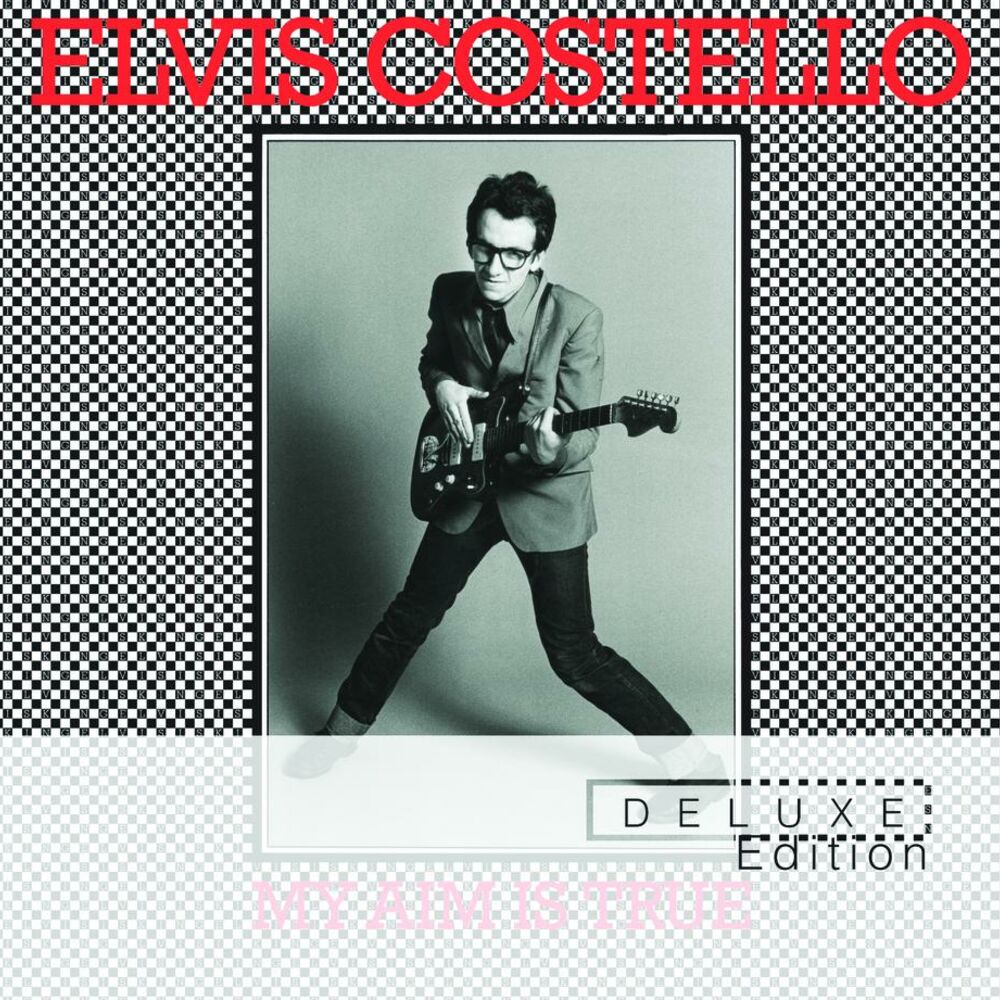
  • The album's original monochrome cover art, featuring Costello in a pigeon-toed stance, was later colourised for reissues.
  • Stiff Records ran a marketing stunt asking buyers to send in a 25-word description of why they liked the 'English' Elvis.
  • Costello reunited with the original Clover members in 2007 for the first and only live public performance of the album's songs.
Written by AI from the album's and artist's Wikipedia articles and the archive's notes. Double-check anything important.

The full story

My Aim Is True is the debut studio album by the English singer-songwriter Elvis Costello, originally released in the United Kingdom on 22 July 1977 on Stiff Records. Produced by Stiff artist and musician Nick Lowe, the album was recorded from late 1976 to early 1977 over six four-hour studio sessions at Pathway Studios in Islington, London. The backing band was the California-based country rock act Clover, who were uncredited on the original release due to contractual difficulties. At the suggestion of the label, Costello changed his name from D.P. Costello to Elvis after Elvis Presley, and adjusted his image to match the rising punk rock movement. Musically, My Aim Is True is influenced by various genres, from punk, new wave and British pub rock to elements of 1950s rock and roll, R&B and rockabilly. The more downbeat lyrics are motivated by revenge and guilt, reflecting topics from relationship struggles to politically charged situations and misogynistic characters. The original monochrome cover art, showing Costello in a pigeon-toed stance, was later colourised for reissues. The album was preceded by three singles, all of which failed to chart. By June 1977, Costello formed a new permanent backing band, the Attractions, to better match his new image and commenced live performances with them for the rest of the year. In August, My Aim Is True reached number 14 in the UK. The American version, released in November 1977 through Columbia Records, added Costello's newest single "Watching the Detectives". By then the biggest-selling import album in U.S. history, it reached number 32. On release, My Aim Is True was met with critical acclaim, with many praising Costello's musicianship and songwriting; it appeared on several year-end lists. In later decades, commentators consider it one of Costello's finest works, one of the best debut albums in music history and it has appeared on numerous best-of lists. The album was reissued in 1993, 2001 and in 2007 as a deluxe edition. A box set reissue celebrating the album's 49th anniversary was released in October 2026.

Background

Elvis Costello—under his actual name Declan MacManus—began performing in clubs and pubs in Liverpool and London in 1970. Over the years he created some demo tapes, but had little success in obtaining a recording contract. He later told Melody Maker that he "didn't have enough money to do anything with a band". According to the author Graeme Thomson, the British DJ Charlie Gillett played songs from one tape, containing future My Aim Is True songs "Blame It on Cain" and "Mystery Dance", on his show throughout the summer of 1976. The exposure garnered interest from labels, although it was rejected by Island Records, Virgin Records and American-based CBS Records. He was eventually signed to London-based Stiff Records in August 1976 by the label's co-founders Jake Riviera and Dave Robinson. He was the first artist signed to Stiff, but was the label's eleventh release.

Writing and recording

Stiff financed recording sessions for an album at Pathway Studios, an eight-track studio located in Islington, with members of the American country rock act Clover as the backing band. The band had moved to Britain after gaining a cult following there and signed to Phonogram Records. Clover's most famous members, singers Huey Lewis and Alex Call, did not participate in the recording sessions in any capacity, while the members who played on My Aim Is True — John McFee (guitar), John Ciambotti (bass), Sean Hopper (keyboards) and Mickey Shine (drums) — were not credited on the final album at the time due to contractual difficulties. (Some early marketing for the album identified Costello's backing band as "The Shamrocks", without naming any individual members.) Costello said Clover arrived in London during the punk revolution and due to appearing as "American hippies", they "just didn't fit in". The band resided at the country house Headley Grange during the period. My Aim Is True was recorded in a series of six four-hour sessions, from late 1976 to early 1977 for about £2,000. Costello kept his day job as a data entry clerk at Elizabeth Arden during the sessions; he would call in sick, travel to Headley Grange to rehearse the songs with Clover and head back to Pathway the next day to record. Costello recalled disliking the time at Headley Grange and that he and Clover had musical disagreements, but nevertheless praised their musicianship. According to Thomson, Clover were paid little for their contributions. Most of the tracks were recorded live and in first takes with little overdubbing. While Clover provided most of the instrumentation, Stan Shaw of the Hitmen played keyboards on "Less Than Zero" while Lowe produced and sang backing vocals. Regarding his guitar work, Costello stated in his memoir that at the time, he did not own his signature Jazzmaster guitar so he used a "shrill" Telecaster on the album. He also lacked substantial knowledge on guitars themselves, saying that he played his guitar unadjusted until halfway through the sessions. The majority of the songs on My Aim Is True were written in about two weeks. Most of them came from Costello's earlier demo tapes and live performances with his former band Flip City. Some tracks would appear on later albums, such as "Hand In Hand", which was written specifically for Lowe, who rejected it. More adventurous numbers such as "Hoover Factory", "Dr. Luther's Assistant", "Ghost Train" and "Stranger in the House" were also recorded during the sessions, but were omitted from My Aim Is True and instead appeared on EPs and singles. According to the biographer Brian Hinton, these tracks would have contrasted with Costello's aspiring image of a "straight talking psychopath". In the liner notes for the 1993 reissue of My Aim Is True, Costello stated that the three main outtakes from the sessions were "Radio Sweetheart", "Stranger in the House" and "Living in Paradise", the first two being left off the final track list due to differences in sound and the last being properly recorded for Costello's follow-up album This Year's Model (1978). Fellow Stiff artist and house producer Nick Lowe produced the album. Regarding his role as producer, Thomson states that Lowe's priority was to keep the feel of the songs and create appropriate atmospheres for each. Lowe himself later stated that the musicians did all the work and all he contributed was "switch[ing] everything on". He rough-mixed the tracks with engineer Barry "Bazza" Farmer, the final mix completed in a single five-hour session at Pathway on 27 January 1977.

Name change

At the time, Costello was performing under the stage name "D.P. Costello" as a tribute to his father. With "Less Than Zero" being readied for release as a single in March 1977, Robinson and Riviera decided to adjust his image to better match the rising punk rock movement. Looking like, in Clayton-Lea's words, an "average ordinary-looking computer operator …

Music and lyrics

According to the biographer Tony Clayton-Lea, Costello and Lowe aimed to create "a collection of songs that were not only of their time, but which were also rooted in classic songwriting values". As such, commentators have written that the album combines various musical genres, including new wave, British pub rock, punk rock, and power pop. William Goodman of Billboard magazine called it "rough edged and bluesy" in a style reminiscent of New Orleans, and recognised the presence of punk, rockabilly, UK pub rock, jazz and honky-tonk country. Consequence of Sound's Nick Freed wrote that the album combines elements of the British punk movement with 1950s and 1960s-style rock and roll. He found tracks like "Miracle Man", "No Dancing" and "Alison" utilise that style to create doo-wop and R&B melodies, thereby "taking the '50s and '60s ideas and adding the modern spin". The rockabilly sound is present on "Less Than Zero", "Mystery Dance" and "Sneaky Feelings". Clayton-Lea states that while it shared similarities with punk, it displayed musicianship and lyricism that were in control, showcasing a softer touch while underlined with a "unique savagery". While the music presents a wide range of styles, the lyrics are mostly downbeat, discussing topics such as "deceit, sarcasm, bitterness, disdain, scorn [and] disgust". In an interview with Nick Kent of the NME, Costello stated that the songs are motivated solely by "revenge and guilt". The biographer David Gouldstone writes that the album's primary theme is "the unaccommodating nature of the world", which is explored in two distinct ways: "the personal songs as the microcosm, and the public as the macrocosm". The lyrics range from complex and surreal ("Waiting for the End of the World") to unsympathetic ("Less Than Zero") and misogynistic ("I'm Not Angry"). Dave Schulps of Trouser Press described the album as "12 songs of revenge, guilt, jealousy, humiliation and rage". Goodman found the lyrics and production matches a bedroom performance, a sentiment echoed by LeMay, who similarly stated that Lowe's production has a "latent energy" that grants the album "all the immediacy of a live show". The painter and art critic Julian Bell wrote that Costello's work "relies heavily on being between emotions, between sensations, ideas [and] informations." Regarding Costello's vocal performance on the record, Gouldstone writes that his directness contributes to listeners' constant interest: "he continually grabs us by the shirtfront and harangues us, and we are sucked into the vortex."

Side one

The opening track, "Welcome to the Working Week", expresses frustration at the ruthlessness of business. The lyrics are directed at "you", which Gouldstone analyses as the song's female character, the listener or the world itself. With a runtime of only 82 seconds, the song contains a punk-style beat and handclaps and utilises elements of doo-wop and new wave. Compared to the previous track, "Miracle Man" deals with the relationship between a man and a woman rather than society. Like the next track "No Dancing", "Miracle Man" concerns a man dominated by his female companion. "No Dancing" contains a Phil Spector-type beat and various key changes, which was a rarity in Costello's early work. Costello stated that he was attempting to merge a "Merseybeat bridge" into "He's a Rebel" by Gene Pitney. Unlike other tracks on the album, the song's narrator is primarily observant, only directly appearing in the first verse. Commentators have analysed "dancing" on the record as a metaphor for sex, while Gouldstone goes further and writes that Costello is implying a lack of world order and harmony. Returning to the lyrical themes of the opening track is "Blame It on Cain", although Costello is more specific in this track, targeting entities such as "government burglars" and the radio. According to Gouldstone, the "it" in the chorus is not explicitly stated, only that it must be blamed on Cain. Taking the name Cain …

Packaging and artwork

The album cover was designed by Barney Bubbles who, like Clover, was uncredited on the sleeve. It depicts a checkerboard pattern (surrounding the photo of Costello) on which the phrase "Elvis Is King" is written, which Hinton states was intended as a parody of Bridget Riley's Swinging Sixties op art paintings. In the centre, Costello dons his new look and stands in a stiff, pigeon-toed pose clutching a Fender guitar with his large shadow behind him. The author Mick St. Michael commented: "This fellow looked like he'd find it hard to aim a paper aeroplane." According to Costello, the final shot was one of the only usable images due to the comical nature during the photo session. He struck a similar pose in the photo on the back of the original sleeve, where he appeared in monochrome against a coloured background while his head appeared disproportionately large. Gouldstone compares his look to "a demented version" of Brains from the 1960s British science fiction series Thunderbirds, actor Woody Allen and Piggy from Lord of the Flies (1954). Initially, the cover art was in black-and-white on the front and came in four different colours; later reissues added seven additional variants. The first pressings of the record included a flyer that read "Help Us Hype Elvis", which asked buyers to send in a 25-word description of "why they liked the 'English' Elvis". According to Hinton, the first 1,000 purchasers earned them a free copy of the LP to be sent to a friend of their choice. The idea originated from Warner Bros. Records' attempts to gain American musician Van Dyke Parks a larger audience.

Release and aftermath

Singles

Stiff issued "Less Than Zero" as a single on 11 March 1977, backed by the outtake "Radio Sweetheart". Despite receiving critical praise, the single failed to reach the UK charts. "Alison" followed on 14 May, backed by "Welcome to the Working Week", which also did not chart. In early July, Stiff released "(The Angels Wanna Wear My) Red Shoes" as a single, backed by "Mystery Dance"; it lacked a picture sleeve and failed to chart. Regarding the poor commercial performances, Costello recalled: "I remember it being very demoralising, feeling that my only contact with the world was those singles, and those people who I didn't know or I'd never met had to make or break of it…that was very depressing." Nevertheless, he continued to garner attention from music journalists, including Melody Maker's Allan Jones and the NME's Nick Kent, who gave positive assessments to live shows in May and June. Costello also refused to give biographical details in interviews, even telling Sounds magazine's John Ingham he did not want to be photographed. Costello left his day job at Elizabeth Arden on 5 July. Initially intended for release shortly after the first single, My Aim Is True was delayed to July while Stiff resolved a distribution dispute with Island Records. In the meantime, Costello wanted to form a permanent backing band that better fitted his aspiring image compared to the laid-back approach of Clover. The first person hired was drummer Pete Thomas, followed by bassist Bruce Thomas (no relation). Around this time, Costello's new tracks "Watching the Detectives" and "No Action", were quickly recorded at Pathway with bassist Andrew Bodnar and drummer Steve Goulding, with organ and piano overdubs by Steve Nieve. "Watching the Detectives", influenced by the Clash's debut album, was a departure from the sound of My Aim Is True, displaying reggae-style rhythms. Costello later called it his "first real record". The song was issued as a single in the UK on 14 October 1977, backed by live versions of "Blame It on Cain" and "Miracle Man".

Live performances

Stiff issued My Aim Is True in the UK on 22 July 1977, with the catalogue number SEEZ 3. By the time it came out Costello was performing with his new backing band, donned the Attractions. Shortly after its release, Costello and the Attractions performed an unauthorised show outside a Columbia Records convention that gathered executives from around the world. Partly due to the antics of Riviera, Costello was arrested and charged with obstruction, fined £5 and released from the police station in time for a gig later that evening. The stunt attracted the attention of executive Greg Geller, who was integral in Costello's signing to Columbia in the United States months later. To support My Aim Is True, Costello and the Attractions conducted a short tour throughout August 1977. The gigs took place in major cities throughout Britain, alongside a residency at the Nashville Rooms in London. The setlist consisted mostly of My Aim Is True tracks plus various new songs. In the middle of the tour, Elvis Presley died of a heart attack on 16 August. Presley's death had an immediate impact on Costello: British newspapers Daily Mail and Daily Observer cancelled their planned features on the artist while Stiff ran a new slogan for the label that read "The King Is Dead, Long Live the King". According to Thomson, Presley's death helped earn Costello more stature in the music press, with his name becoming "the mood of the zeitgeist". Four days after his death, My Aim Is True reached number 14 on the UK Albums Chart. On 3 October 1977, Costello and the Attractions embarked on another tour with other Stiff artists, including Lowe and Wreckless Eric, dubbed the Greatest Stiffs Live Tour. It was plagued with disorder and self-inflicted sabotage, partly due to Costello's refusal to play songs from My Aim Is True, declaring "If you wanna hear the old songs, buy the fucking record;" he reversed this stance …

Critical reception

My Aim Is True received rave reviews from British and American music journalists on release. Writing for Trouser Press, Dave Schulps hailed My Aim Is True as 1977's "most auspicious debut album", praising Costello's musicianship and songwriting, concluding he has "produced a classic in his first try". Chas de Whalley of Sounds called Costello "a songwriter of rare sensitivity and talent" but had trouble getting a grip with the songs, nevertheless concluding: "Like a flower, Elvis' debut album is opening up into something of metallic beauty." In Melody Maker, Allan Jones wrote that "hell, you can dance to it, swoon and romance with it, smooch and romance to it". He further noted the record contained "enough potential hit singles to stock a bloody juke-box", concluding "I can think of only a few albums released this year that rival its general excellence." Roy Carr of the NME came across "sexual psychoanalysis set to a dozen superb juke joint anthems ... a Seventies interpretation of Sixties rhythm and roll," while the songs "spill over with emotional torture and melodrama". He commented that "Costello must have taken a lot of emotional knocks to come up with such a powerful album. To the extent that one is reticent to guess to what lengths he may have to go to enact a second instalment." Several reviewers praised Costello as an artist. Greil Marcus of Rolling Stone wrote: "How far Costello can go ... remains to be seen, but I have a feeling that once he is heard, he is going to shake up a lot of his erstwhile peers and make many musicians whom he would not consider his peers seem quite irrelevant." In Stage Life, Jeffrey Morgan wrote that at only 22 years old, Costello "gashed a line in his soul using rock 'n' roll as the blade", creating an LP that, as "flawed as it is, cannot be ignored". Sam Sutherland of High Fidelity hailed Costello as a "new wave rock classicist", creating an album that "rediscovers the raw vitality of rock" in the midst of '70s pop. He also called Lowe's production "exciting" and "deliberately crude". Meanwhile, Robin Denselow of The Guardian considered the lyrics the best from a British artist in years. The Philadelphia Inquirer gave My Aim Is True three out of four stars, also praising the lyrical content and felt Costello would achieve a commercial breakthrough. Writing for Creem, Mitchell Cohen hailed My Aim Is True as one of the year's best albums and praised the songs for their "memorable" choruses and strong ideas. He criticised the misogynistic lyrics, which he compared to the mid-1960s material of Mick Jagger, concluding that Costello has "some way to go before his emotional maturity matches his prodigious artistic skill". In The Village Voice, Robert Christgau wrote: "I like the nerdy way this guy comes on, I'm fascinated by his lyrics, and I approve of his rock and roll orientation." He negatively compared Costello to Jackson Browne in that "he's a little boring", which he states comes from an "overconcentration on lyrics" and can be solved by "a healthy relationship with a band". Danny Baker in ZigZag magazine, who also made comparisons to Browne in his review, simply called My Aim Is True a "good, good album". In The Village Voice's annual Pazz & Jop critics' poll of the year's best albums, My Aim Is True finished at number two, behind the Sex Pistols' Never Mind the Bollocks. It further placed in other year-end lists by Rolling Stone, NME (3) and Sounds (9).

Retrospective reviews

In later decades, My Aim Is True has received critical acclaim, with some naming it one of the best debut albums in rock history. Terry Staunton of Record Collector magazine summarised: "As opening salvos go, My Aim Is True has to be one of the most important, impressive and enduring debuts of all time." Senior AllMusic editor Stephen Thomas Erlewine wrote: "Costello went on to more ambitious territory fairly quickly, but My Aim Is True is a phenomenal debut, capturing a songwriter and musician whose words …

Legacy

In lists ranking Costello's albums, My Aim Is True has consistently ranked as one of Costello's best. In 2021, writers for Stereogum placed it at number six, calling it "one of rock music's great opening salvos". A year later, writing for Spin magazine, Al Shipley placed it at number two, behind This Year's Model, stating that had he not made another record after My Aim Is True, he would "still be a legend". The same year, Michael Gallucci of Ultimate Classic Rock also placed it at number two, behind This Year's Model. He noted Clover's lack of force compared to the Attractions, but nevertheless wrote that fewer have arrived with debuts as "instantly significant" as My Aim Is True. On 8 November 2007, Costello reunited with the members of Clover from the original recording sessions to perform the songs from My Aim Is True. This marked the first (and to date only) live public performances of these songs by the original ensemble that recorded them. The event took place at the Great American Music Hall in San Francisco, and was a benefit for the Richard de Lone Special Housing Fund, which assists those with Prader–Willi syndrome.

Reissues

My Aim Is True was first released on CD through Columbia and Demon Records in July 1986. Its first extended reissue came in October 1993 through Demon in the UK and Rykodisc in the US, which featured nine bonus tracks and extensive liner notes written by Costello himself. In 2001, it was again reissued on CD by Rhino Entertainment, featuring the original album on disc one and a bonus disc of demos, live versions and outtakes, along with a new set of more elaborate Costello-written liner notes; all nine bonus tracks from the 1993 reissue were included with an added four. LeMay considers this reissue the most essential for the album itself.

2007 Deluxe Edition

Six years later, My Aim Is True was reissued again by Universal/Hip-O on 11 September 2007 in a single-disc "Original Masters" package and a two-disc deluxe edition comprising 48 tracks, 26 previously unreleased. This package features the original album, outtakes and solo demos on disc one and a complete live show (with soundcheck) recorded on 7 August 1977 at the Nashville Rooms in London on disc two. The tracks from the live show were mostly from My Aim Is True, with some that appeared on This Year's Model, while the demos are previously unreleased tracks including "Blue Minute", "Call on Me", "I Don't Want to Go Home" and "I Hear a Melody". Hip-O hailed the deluxe edition as "the most definitive version of My Aim Is True yet!" Despite this, the deluxe edition received mixed reviews. LeMay felt it was inferior to the previous reissues, stating that it "lacks the reverent and enthusiastically geeky perspective of the Rhino reissue". He further noted the absence of several tracks and in-depth liner notes present on the other reissues. Erlewine similarly questioned the release of the deluxe edition, as he felt it was superfluous following the Rhino reissue. He nevertheless stated that hardcore fans would appreciate the new material, albeit having to purchase an album they had likely already purchased.

49th Anniversary Edition

To celebrate the album's 49th anniversary, My Aim Is True was released as an expanded box set on 2 October 2026 through UMe. Discussing why he chose to release it for the 49th anniversary, Costello stated in the liner notes: "When first proposed, I thought the whole idea of celebrating a 50th Anniversary of My Aim Is True was preposterous. It made my teeth itch. It couldn't just be set up like a venerable object in a glass case." Subtitled 49th Anniversary Edition, the set spans five discs, 104 tracks in total, 52 of which are previously unreleased. The first disc features a new remaster of the original album, combining the UK and US track listings; the second features recordings from 1975 and 1976 that predate the My Aim Is True recording sessions; the third contains demos and outtakes from the album; the fourth features live performances from Costello's earliest shows with the Attractions; and the fifth disc presents Costello's 2007 reunion show with the members of Clover.

From the Wikipedia article My Aim Is True, available under CC BY-SA 4.0.

Tracklist

  1. Welcome To The Working Week1:22
  2. Miracle Man3:31
  3. No Dancing2:39
  4. Blame It On Cain2:49
  5. Alison3:18
  6. Sneaky Feelings2:09
  7. (The Angels Wanna Wear My) Red Shoes2:46
  8. Less Than Zero3:15
  9. Mystery Dance1:38
  10. Pay It Back2:33
  11. I'm Not Angry2:57
  12. Waiting For The End Of The World3:22
  13. Watching The Detectives3:43
  14. No Action (Early Version)2:15
  15. Living In Paradise (Early Version)3:00
  16. Radio Sweetheart (Outtake)2:25
  17. Stranger In The House (Outtake)3:01
  18. Welcome To The Working Week (Demo)1:26
  19. Blue Minute (Demo)1:33
  20. Miracle Man (Demo)2:22
  21. Waiting For The End Of The World (Demo)2:27
  22. Call On Me (Demo)1:59
  23. (The Angels Wanna Wear My) Red Shoes (Demo)2:01
  24. I Don't Want To Go Home (Demo)1:43
  25. I Hear A Melody (Demo)2:10

Listeners 0

Nobody has logged it yet. Be the first.

Log a listen