João's Music Archive
Parallel Lines
← Back to the lists

Parallel Lines

Blondie
1978-09-08
Chrysalis\EMI Records
12 tracks, 38:28
Rating
–
Not heard yet
110
–Archive
91Critics
0Listeners
Average score 91Pitchfork 9.711 reviews

Tracklist

  1. Hanging On The Telephone2:22
  2. One Way Or Another3:31
  3. Picture This2:56
  4. Fade Away And Radiate3:57
  5. Pretty Baby3:16
  6. I Know But I Don't Know3:53
  7. 11:593:19
  8. Will Anything Happen2:55
  9. Sunday Girl3:06
  10. Heart Of Glass3:49
  11. I'm Gonna Love You Too2:03
  12. Just Go Away3:21
Listen on

Have you heard it?

Sign in to mark it as listened, rate it and keep notes.

About the artist

Blondie is an American rock band formed in New York City in 1974 by singer Debbie Harry and guitarist Chris Stein. Emerging from the CBGB punk scene, they pioneered early new wave, later achieving global commercial success. The band was inducted into the Rock and Roll Hall of Fame in 2006, selling over 40 million records worldwide.

About the album

"Parallel Lines" is Blondie's third studio album, released in 1978, marking a shift from new wave towards a "pure pop" sound. Recorded in six weeks with producer Mike Chapman, the album features refined melodics, including the disco-infused "Heart of Glass". Chapman's demanding approach, despite band tensions, resulted in a polished and commercially successful record.

Meanings

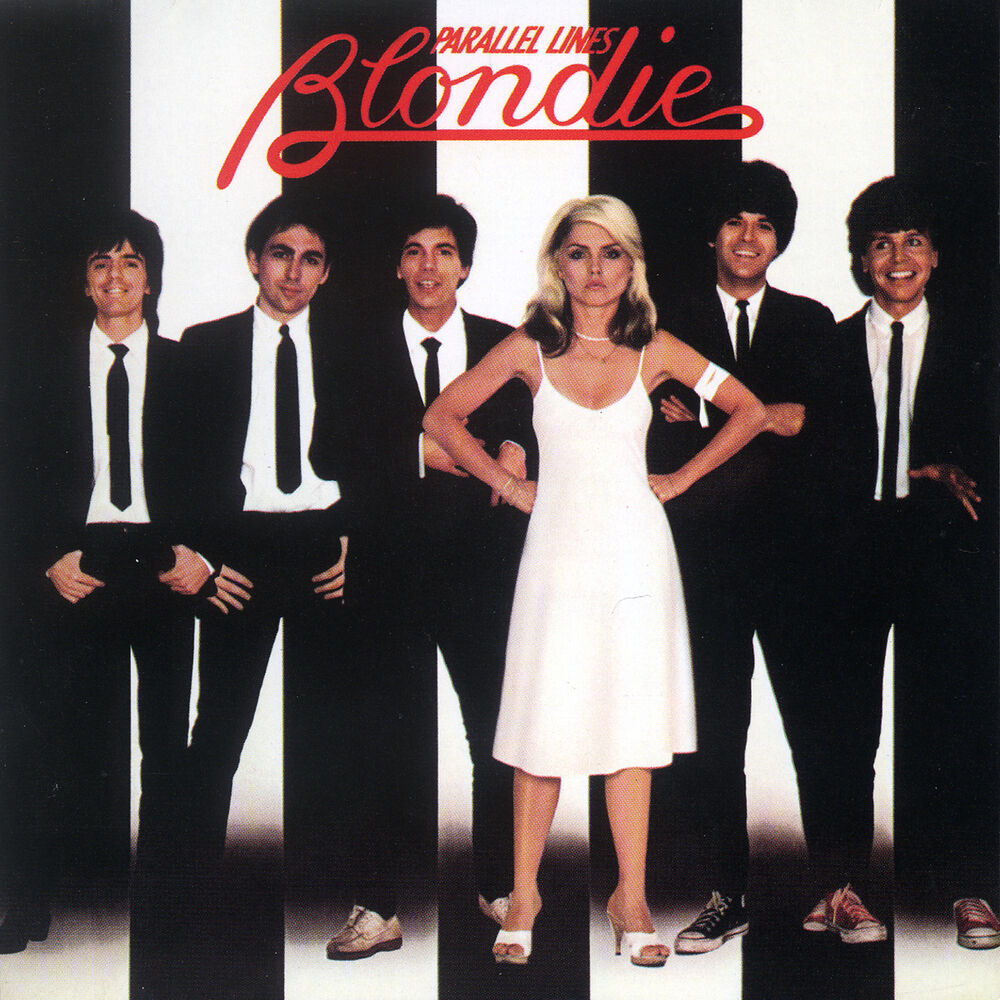
Lyrically, the album moved towards "romantic fatalism", departing from earlier "cartoonish postmodernist referencing". The title comes from an unused track, whose lyrics were included in the first vinyl edition. Its iconic cover, chosen by their manager, features the band against black and white bars, with Debbie Harry defiantly contrasting the suited male members.

Why it's rated so high

The album received universal acclaim, with critics calling it a "perfect album in 1978" and a "creative and commercial masterpiece". It is credited with popularising the look and sound of 1980s new wave, showcasing Debbie Harry's vocal depth and complexity. "Parallel Lines" was selected for preservation in the National Recording Registry in 2024 for its cultural and historical significance.

Career and historical context

Released in 1978, "Parallel Lines" was Blondie's international breakthrough, selling an estimated 20 million copies worldwide. It launched them into global chart dominance, following their earlier underground and UK-only successes. The album's success, particularly with "Heart of Glass", turned the band into bona fide superstars in the US and UK.

Fun facts

  • Producer Mike Chapman described the band as "the worst band I ever worked with" in terms of musical ability.
  • Debbie Harry would sometimes disappear into the bathroom in tears for several hours during recording sessions.
  • Bassist Nigel Harrison once threw a synthesizer at Mike Chapman due to his perfectionist demands.
  • Many classic songs on the album, like "Sunday Girl", were unfinished when vocal parts were recorded.
  • King Crimson leader Robert Fripp makes a guest appearance on guitar on the track "Fade Away and Radiate".
Written by AI from the album's and artist's Wikipedia articles and the archive's notes. Double-check anything important.

The full story

Parallel Lines is the third studio album by American rock band Blondie, released on September 8, 1978, by Chrysalis Records. An instant critical and commercial success, the album reached No. 1 on the UK Albums Chart in February 1979 and proved to be the band's commercial breakthrough in the United States, where it reached No. 6 on the Billboard 200 in April 1979. In Billboard magazine, Parallel Lines was listed at No. 9 in its top pop albums year-end chart of 1979. The album spawned several successful singles, notably the international hit "Heart of Glass".

Background

Blondie's second studio album, Plastic Letters (1977), was their last album produced by Richard Gottehrer, whose sound had formed the basis of Blondie's new wave and punk output. During a tour of the west coast of the US in support of Plastic Letters, Blondie encountered Australian producer Mike Chapman in California. Peter Leeds, Blondie's manager, conspired with Chrysalis Records to encourage Chapman to work with Blondie on new music. Drummer Clem Burke recalls feeling enthusiastic about the proposition, believing Chapman could create innovative and eclectic records. However, lead vocalist Debbie Harry was far less enthusiastic about Chapman's involvement as she knew him only by reputation; according to Chapman, her animosity towards him was because "they were New York. [He] was L.A.". Harry's cautiousness abated after she played Chapman early cuts of "Heart of Glass" and "Sunday Girl" and he was impressed.

Recording

In June 1978 the band entered the Record Plant in New York to record their third album, and first with Chapman. However, Chapman found the band difficult to work with, remembering them as the worst band he ever worked with in terms of musical ability, although praising Frank Infante as "an amazing guitarist". Sessions with Chris Stein were hampered by his being stoned during recording, and Chapman encouraged him to write songs rather than play guitar. Similarly, according to Chapman, Jimmy Destri would prove himself to be far better at songwriting than as a keyboardist, and Clem Burke had poor timing playing drums. As a result, Chapman spent time improving the band, especially Stein with whom Chapman spent hours rerecording his parts to ensure they were right. Bassist Nigel Harrison became so frustrated with Chapman's drive for perfection that he threw a synthesizer at him during recording. Chapman recalls the atmosphere at the Record Plant in an interview for Sound on Sound:

The Blondies were tough in the studio, real tough. None of them liked each other, except Chris and Debbie, and there was so much animosity. They were really, really juvenile in their approach to life—a classic New York underground rock band—and they didn't give a fuck about anything. They just wanted to have fun and didn't want to work too hard getting it. Chapman took an unorthodox approach when recording with Harry whom he describes as "a great singer and a great vocal stylist, with a beautifully identifiable voice. However ... also very moody". Chapman was far more cautious of demanding much from Harry as he saw her as a highly emotional person who would vest these emotions in the songs they made. He remembers Harry disappearing into the bathroom in tears for several hours at a time during recording. During a day of recording, Harry sang two lead parts and some harmonies, less work than she did previously with Gottehrer. This was due to Chapman encouraging her to be cautious about the way she sang, particularly to recognise phrasing, timing and attitude. Blondie recorded Parallel Lines in six weeks, despite being given six months by Terry Ellis, co-founder of Chrysalis Records, to do so. For the drums, a traditional set-up was used and Chapman fitted Neumann microphones to the toms, snare and hi-hat, as well as several above the site. When recording, Chapman would start with the bass track, which was difficult to record at the time, by way of "pencil erasing". Chapman explained in an interview for Sound on Sound, "that meant using a pencil to hold the tape away from the head and erasing up to the kick drum. If a bass part was ahead of the kick, you could erase it so that it sounded like it was on top of the kick. That's very easy to do these days, but back then it was quite a procedure just to get the bottom end sounding nice and tight." A combination DI/amp method was used to record Harrison's bass and Destri's synthesizer. Shure SM57 and AKG 414 microphones were used to capture Infante's Les Paul guitar. King Crimson leader Robert Fripp makes a guest appearance on guitar on "Fade Away and Radiate". After the basic track was complete, Chapman would record lead and backing vocals with Harry. However, this process was hampered by many songs not being written in time for the vocals to be recorded. "Sunday Girl", "Picture This" and "One Way Or Another" were all unfinished during the rehearsal sessions. When recording vocal parts, Chapman remembers asking Harry if she was ready to sing, only for her to reply "Yeah, just a minute" as she was still writing lyrics down. Chapman notes that many "classic" songs from the album were created this way. During the last session at the Record Plant, the band were asleep on the floor only to be awakened at six o'clock in the morning by Mike Chapman and his engineer Peter Coleman leaving for Los Angeles with the tape tracks. Despite Blondie's belief that Parallel Lines would resonate with a wider audience, Chrysalis …

Music and lyrics

According to music journalist Robert Christgau, Parallel Lines was a pop rock album in which Blondie achieved their "synthesis of the Dixie Cups and the Electric Prunes". Its style of "state-of-the-art pop/rock circa 1978", as AllMusic's William Ruhlmann described it, showed Blondie deviating from new wave and emerging as "a pure pop band". Ken Tucker believed the band had eschewed the "brooding artiness" of their previous albums for more hooks and pop-oriented songs. Chapman later said, "I didn't make a punk album or a New Wave album with Blondie. I made a pop album." The album's eleven pop songs have refined melodics, and its sole disco song, "Heart of Glass", features jittery keyboards, rustling cymbals by drummer Clem Burke, and a circular rhythm. Burke credited Kraftwerk and the soundtrack to the 1977 film Saturday Night Fever as influences for the song and said that he was "trying to get that groove that the drummer for the Bee Gees had". Lyrically, Parallel Lines abandoned what Rolling Stone magazine's Arion Berger called the "cartoonish postmodernist referencing" of Blondie's previous new wave songs in favor of a "romantic fatalism" that was new for the band. "Sunday Girl" deals with the theme of teen loneliness. Music critic Rob Sheffield said that the lyric "dusty frames that still arrive / die in 1955", in "Fade Away and Radiate", is the "best lyric in any rock'n'roll song, ever, and it's still the ultimate statement of a band that always found some pleasure worth exploiting in the flashy and the temporary."

Title and packaging

Parallel Lines took its name from an unused track written by Harry, the lyrics of which were included in the first vinyl edition of the album. The cover sleeve image was photographed by Edo Bertoglio and was chosen by Blondie's manager, Peter Leeds, despite being rejected by the band. The photo shows the band in front of a background made up of alternating black and white vertical bars, with the male members of the band posing in matching dress suits and smiling broadly in contrast to Harry who poses defiantly with her hands on her hips while wearing a white dress and high heels. According to music journalist Tim Peacock, the cover became "iconic – and instantly recognisable".

Release and promotion

The album was released by Chrysalis in September 1978, to international success. The album entered the Billboard 200 album chart the week ending September 23, 1978, at No. 186, reflecting retail sales during the survey period ending September 10, 1978. In the United Kingdom, it entered the albums chart at No.13, eventually reaching the no.1 spot in February 1979 after the band had scored hits with the singles "Picture This" (UK #12), "Hanging on the Telephone" (UK #5), and "Heart of Glass" (UK #1). "Sunday Girl" was released in the UK as a fourth single from the album in May 1979 and also reached no.1, and Parallel Lines became the UK's biggest selling album of the year. Blondie embarked on a sold-out tour of the UK and appeared at an autograph signing event for Our Price Records on Kensington High Street; according to Peacock, it "descended into Beatlemania-esque chaos when the band were mobbed by thousands of fans". Parallel Lines was also a commercial success elsewhere in Europe, Australia, and the United States, where the band had struggled to sell their previous records. "Heart of Glass" became their first number-one hit on the American Billboard Hot 100, with help from a promotional video directed by Stanley Dorfman depicting Blondie in a performance of the song at a fashionable nightclub in New York. The single was "responsible for turning the band into bona fide superstars", Peacock said.

Critical reception

The album was met with universal acclaim from critics. Writing in The Village Voice in 1978, Robert Christgau said although Blondie still could not write a perfect hit single, the record was a consistent improvement over Plastic Letters. Years later, he wrote in Blender that it was "a perfect album in 1978" and remained so with "every song memorable, distinct, well-shaped and over before you get antsy. Never again did singer Deborah Harry, mastermind Chris Stein and their able four-man cohort nail the band's signature paradoxes with such unfailing flair: lowbrow class, tender sarcasm, pop rock." New York Times critic John Rockwell named Parallel Lines the eighth best album of 1978. Daryl Easlea from BBC Music, who felt the record combined power pop and new wave styles, credited Mike Chapman's production and flair for pop songwriting for helping make Parallel Lines an extremely popular album in the United Kingdom, where it was a number-one hit and charted for 106 weeks during the late 1970s. Q magazine called the album "a crossover smash with sparkling guitar sounds, terrific hooks and middle-eights more memorable than some groups' choruses." Clem Burke included Parallel Lines in the list of his favorite punk albums.

Accolades

In 2024, Parallel Lines was selected for preservation in the National Recording Registry by the Library of Congress as being "culturally, historically, or aesthetically significant".

Legacy

In a retrospective appraisal of 1970s post-punk albums, Spin magazine's Sasha Frere-Jones said Parallel Lines may have been "the perfect pop-rock record" and Blondie's best album. Christian John Wikane from PopMatters later called it "a creative and commercial masterpiece by Blondie ... indisputably one of the great, classic albums of the rock and roll era." In the opinion of Pitchfork critic Scott Plagenhoef, the album popularized "the look and sound of 1980s new wave" with classic songs that showcased the depth and complexity of Harry's sexuality and singing. Sal Cinquemani from Slant Magazine was also impressed by her singing, which he felt varied from "purring like a kitten and then building to a mean growl", and cited "Heart of Glass" as the album's best track because of her "honey-dipped vocal". In 2000, Parallel Lines was voted number 57 in Colin Larkin's book All Time Top 1000 Albums. Three years later, it was ranked at number 140 on Rolling Stone's list of the 500 greatest albums of all time, maintaining the rating in a 2012 revised list, and moved slightly down to number 146 in the 2020 revision; an accompanying essay said the album was "where punk and New Wave broke through to a mass U.S. audience". It has also been placed at number 18 and 45 on NME's 100 Best Albums of All Time (2003) and 500 Greatest Albums of All Time (2013) lists, respectively; number 7 on Blender's 100 Greatest American Albums of All Time; number 94 on Channel 4's 2005 list of the 100 greatest albums of all time; and number 76 on Pitchfork's list of the best albums from the 1970s. Slant Magazine included it on their 2003 list of 50 Essential Vital Pop Albums.

Reissues

The album was reissued and remastered in 2001 along with Blondie's back catalog, and featured four bonus tracks: a 1978 version of "Once I Had a Love", a live cover of T. Rex's song "Bang a Gong (Get It On)", and two live tracks taken from the Picture This Live live album. On June 24, 2008, an expanded 30th Anniversary Edition of the album was released, which featured new artwork and bonus tracks along with bonus DVD. The liner notes once again featured lyrics to the unfinished "Parallel Lines" song. The Parallel Lines 30th Anniversary Edition included the 7″ single version of "Heart of Glass", the French version of "Sunday Girl" and some remixes, plus a DVD with albums, promo videos and TV performance. The band also launched a world tour of the same name in 2008 to promote the re-release and celebrate the event.

From the Wikipedia article Parallel Lines, available under CC BY-SA 4.0.

Tracklist

  1. Hanging On The Telephone2:22
  2. One Way Or Another3:31
  3. Picture This2:56
  4. Fade Away And Radiate3:57
  5. Pretty Baby3:16
  6. I Know But I Don't Know3:53
  7. 11:593:19
  8. Will Anything Happen2:55
  9. Sunday Girl3:06
  10. Heart Of Glass3:49
  11. I'm Gonna Love You Too2:03
  12. Just Go Away3:21

Listeners 0

Nobody has logged it yet. Be the first.

Log a listen