Tracklist
- Big Love (2017 Remaster)3:43
- Seven Wonders (2017 Remaster)3:42
- Everywhere (2017 Remaster)3:46
- Caroline (2017 Remaster)3:53
- Tango in the Night (2017 Remaster)4:02
- Mystified (2017 Remaster)3:09
- Little Lies (2017 Remaster)3:41
- Family Man (2017 Remaster)4:07
- Welcome to the Room... Sara (2017 Remaster)3:42
- Isn't It Midnight (2017 Remaster)4:13
- When I See You Again (2017 Remaster)3:49
- You and I, Pt. II (2017 Remaster)2:39
Have you heard it?
Sign in to mark it as listened, rate it and keep notes.
The full story
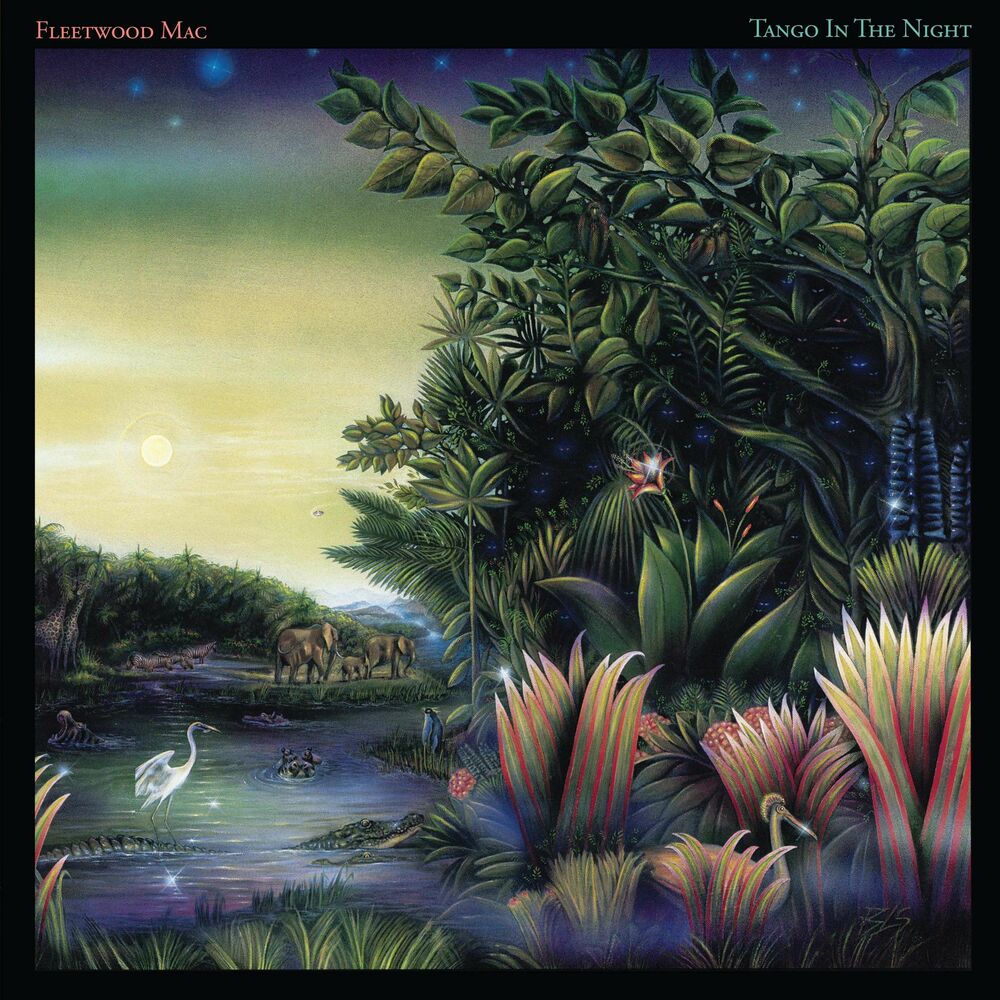
Tango in the Night is the fourteenth studio album by the British-American rock band Fleetwood Mac, released on 13 April 1987 by Warner Bros. Records. It is the fifth and final studio album with the band's most successful lineup of Lindsey Buckingham, Mick Fleetwood, Christine McVie, John McVie, and Stevie Nicks, though Christine McVie would make guest appearances on the band's 2003 album, Say You Will. This lineup did not reconvene again for another album until 1997's live album The Dance. Produced by Buckingham with Richard Dashut, Tango in the Night began as one of Buckingham's solo projects, but in 1985, the production had morphed into Fleetwood Mac's next record. It contains several hit singles, including four US top 20 hits: "Big Love" (No. 5), "Seven Wonders" (No. 19), "Little Lies" (No. 4), and "Everywhere" (No. 14). Two additional songs, "Family Man" (No. 90) and "Isn't It Midnight", were released as singles to lower chart success. Tango in the Night has sold over 15 million copies worldwide. In March 2017, remastered deluxe editions of Tango in the Night were released, the first as a double-CD set and the second as a 3CD/1DVD/1-LP boxset.
Background
After the completion of the Mirage Tour in 1982, four members of Fleetwood Mac released five solo albums, with varying degrees of success. Mick Fleetwood, Christine McVie, and Lindsey Buckingham each released one, while Stevie Nicks issued two. Buckingham described the band as being "a bit fragmented" during the mid-1980s. In 1985, Christine McVie was hired to record a cover of Elvis Presley's "Can't Help Falling in Love" for the soundtrack of the movie A Fine Mess. Richard Dashut, who had engineered and produced Rumours, Tusk, and Mirage, was brought in to assist with the song's production, and Greg Droman served as the audio engineer. Buckingham, Fleetwood, and John McVie were enlisted to supply the instrumentation, and they recorded the song in August 1985. Reenergized by this effort, the band began plans for their next studio album the following month. Buckingham was working on his third solo album with Droman during the initial stages of Tango in the Night and split his time between both projects. Fleetwood Mac originally intended to hire an outside producer for the recording sessions. They first worked with Nile Rodgers, but the collaboration fell through. Producer Mo Ostin then paired the band with Jason Corsaro, who had worked with the Power Station. The band booked Studio One and rehearsed for a week without Nicks, who was in Australia touring with Tom Petty and Bob Dylan. Corsaro also proved unsatisfactory, and Fleetwood Mac finally resorted to having Buckingham and Dashut produce, with Droman serving as engineer. Buckingham then paused progress on his solo album and transferred some of its planned tracks to Tango in the Night.
Recording
After the release of Mirage, John McVie had spent much of his time sailing the Caribbean island of Saint Thomas and barely played bass in the years leading up to the making of Tango in the Night. In an attempt to be more productive in the studio, he quit drinking cold turkey, though this proved to be unsuccessful, and he grew concerned that he had lost his ability to play. Mick Fleetwood stated that his cocaine use during the recording of Tango in the Night was worse than the Rumours sessions; Buckingham placed a Winnebago in his driveway for Fleetwood and his friends when their drug use impeded productivity in the recording studio. Three months were spent recording the backing tracks at Rumbo Recorders, later moving to Buckingham's newly built home studio, named the Slope, for the rest of the production. Dashut and Droman recalled that the album's recording sessions were particularly tedious, even by Fleetwood Mac standards. The band recorded certain instrumental parts while the tape was slowed down to half-speed to find suitable textures. This would double the song's duration, which made for "a brutal ten minutes to listen to", according to Droman. By recording in half-speed, they managed to make each song sound "open and airy". "When you record something really slow and you speed it up [back to normal speed], all the harmonics get shifted up. You end up with this high end, this tinkly little high end, that wouldn't exist [otherwise]. There's not another way you could get that, at least back then." Buckingham created most of the album's vocal harmonies through extensive overdubbing and also utilised the Fairlight CMI for additional sonic textures. Although the record took eighteen months to complete, Stevie Nicks spent a total of two weeks in the studio with the band. She was promoting Rock a Little throughout this period and sent the band demos while she was on tour. One of those songs, "Welcome to the Room... Sara", was inspired by her thirty-day stay at the Betty Ford Center to overcome her cocaine addiction in October 1986 (Nicks used the pseudonym "Sara Anderson" when she checked into the facility). When Nicks did go to the studio, she often felt unmotivated: "I can remember going up there and not being happy to even be there... I didn't go very often." Vocal sessions took place in Buckingham's master bedroom, where Nicks frequently recorded her parts for Buckingham and McVie's songs under the influence of alcohol; Buckingham deleted most of Nicks' vocals after she left the studio. She later said, "I'm not blaming him for that because I'm sure they totally sucked. Vocals done when you're crazy and drinking a cup of brandy probably aren't usually going to be great." On certain songs, Buckingham "pull[ed] performances out of words and lines" from various sources to make some of the vocals sound like Nicks. During the album's sequencing, "When I See You Again" was planned to be the closing track, but the band deemed it "too down and depressing", so Christine McVie took an existing instrumental track from Buckingham and wrote some words to accompany it, resulting in the creation of "You and I, Part II".
Composition
Some of Buckingham's compositions on Tango in the Night, including "Big Love" and "Family Man", were originally developed for his shelved solo album. These songs were mostly complete by the time Buckingham presented them to the band, although he recalled that "Family Man" was "sweetened up" during the mixing process. The band also sifted through Buckingham's demos and selected "Caroline", which he had written a few years prior. McVie composed and recorded several of her demos on a 16-track machine at her home studio. Three songs on the album were co-written by Buckingham and Christine McVie. One of those songs, "Mystified", began with a melody from McVie, which Buckingham further developed at his home studio. McVie remarked that the two "didn't sit down at a piano and decide the chords together" but believed that the creative process during Tango in the Night was more collaborative than their past efforts.
Release
Tango in the Night was released on 13 April 1987. To promote the album, MTV aired a series of interviews with the band during an event dubbed the "Mac Attack promotional weekend", during which the music video for "Big Love" was premiered. Shortly after the release of Tango in the Night, a band meeting was held at Christine McVie's house to discuss the accompanying tour. During the meeting, Buckingham announced his departure, which infuriated Nicks. She physically attacked him, and the ensuing fight between the two spilled into the street. Fleetwood noted that the album "was well received. Somewhat sadly, the kudos of that was never really fully attributed to Lindsey because he wasn't present... He was coerced and persuaded to do that album—mainly by me. And, to his credit, he put aside everything that he'd dreamt of doing, including making his own album, for Fleetwood Mac, but then realised that he'd made a mistake... Lindsey was not being heard. We just didn't get it." Buckingham partially attributed his decision to leave Fleetwood Mac to the rigours of touring, which he believed would have exacerbated the interpersonal turbulence experienced in the studio. He later said, "Compared to making an album, in my experience, going on the road will multiply the craziness by times five. I just wasn't up for that." He later reflected that at the time of the album's release, "everybody was leading their lives in a way that they would not be too proud of today". Following Buckingham's departure, guitarists and vocalists Rick Vito and Billy Burnette were hired to replace him on the subsequent tour, and they would remain part of the band's lineup for the next album, Behind the Mask (1990).
Deluxe edition
A deluxe edition of Tango in the Night was issued on 31 March 2017, to celebrate the album's 30th anniversary. Included in the set were three CDs, divided into the original album with remastered sound, rare and unreleased recordings, and 12" remixes; a 180-gram vinyl LP; and a DVD, with different music videos and a high-resolution stereo version of the album. Disc two of the collection features the B-sides "Ricky", "Down Endless Street", and "Book of Miracles"; both halves of "You and I", released and combined for the first time; and demos, alternate versions, and other recordings. The third disc features multiple remixes of "Big Love", "Seven Wonders", "Little Lies", "Family Man", and "Everywhere", either done by Arthur Baker or John "Jellybean" Benitez.
Critical reception
Tango in the Night received mixed reviews upon release. Billboard called Buckingham "the driving force" behind the album and said that the other songwriters offered "impressive" material. They also thought that the album lacked "obvious single choices". Cashbox described it as a showcase of the band's "progressive vision of pop craftsmanship". Steve Hochman of the Los Angeles Times singled out Buckingham's production work, saying that "relatively conventional material [such] as McVie's straight rocker, 'Isn't It Midnight' and Nicks' dreamy 'When I See You Again' benefit from the subtly bizarre undercurrents Buckingham creates." Robert Christgau thought that the album was an improvement over Mirage but failed to live up to the quality of the band's 1975 eponymous release and Rumours. Peter Kane of Sounds was more critical of the album, saying that the band was "going through the motions" with "puerile lyrics and little twiddly keyboard hooks instead of actual tunes." Alexis Petridis of The Guardian wrote that the album "seems even more deserving of the 'flawed masterpiece' tag than Tusk". Ivy Nelson of Pitchfork was complimentary of Buckingham and McVie's songs but reserved some criticism for Nicks, saying, "Her voice, invariably hoarse after years of cocaine abuse, often warps or fails the already incomplete material." Mojo described the album as "a perfect Mac showcase for McVie and Buckingham's musical partnership". Alex Henderson of AllMusic praised Buckingham's contributions to the album, saying that his "thoughtful use of synthesizers were a major asset" and that he "consistently [brought] out the best in his colleagues on this superb album".
Commercial performance
Tango in the Night is the band's second-biggest-selling studio album after the phenomenally successful Rumours, which was released ten years earlier. The intervening albums, Tusk (1979) and Mirage (1982), although big sellers in key territories, had not matched their predecessor's success. Tango in the Night was a worldwide hit, with several singles gaining global popularity. Six weeks after its release, the album had sold 1.5 million copies internationally. Tango in the Night was a success in the United States, where it peaked at No. 7 on the Billboard 200 for three weeks, spending more than seven months within the top 20 and more than ten months within the top 40. It was certified 3× Platinum in October 2000 for selling three million copies. Four singles reached the Billboard top 20: "Big Love" (No. 5), "Little Lies" (No. 4), "Everywhere" (No. 14), and "Seven Wonders" (No. 19). The album was particularly successful in the UK, where it reached No. 1 three times during 1987–88 for a total of five weeks and spent more than eight months within the top 10 of the UK albums chart. It is the seventh-biggest-selling record of the 1980s in the UK, being certified 9 × Platinum (2.7 million copies), and it is still currently one of the UK's top 100 best-selling albums of all time. Three singles were top 10 hits in Britain: "Big Love" (No. 9), "Little Lies" (No. 5), and "Everywhere" (No. 4). A total of six singles were eventually taken from Tango in the Night over a period of fifteen months. The record spent 115 weeks in the top 75 of the UK Albums Chart. "Big Love", "Seven Wonders", "Little Lies", "Family Man", and "Everywhere" were all released as extended 12" remixes in most territories. Christine McVie's "Little Lies" and "Everywhere" in particular appear on several 1980s compilation albums.
Tracklist
- Big Love (2017 Remaster)3:43
- Seven Wonders (2017 Remaster)3:42
- Everywhere (2017 Remaster)3:46
- Caroline (2017 Remaster)3:53
- Tango in the Night (2017 Remaster)4:02
- Mystified (2017 Remaster)3:09
- Little Lies (2017 Remaster)3:41
- Family Man (2017 Remaster)4:07
- Welcome to the Room... Sara (2017 Remaster)3:42
- Isn't It Midnight (2017 Remaster)4:13
- When I See You Again (2017 Remaster)3:49
- You and I, Pt. II (2017 Remaster)2:39
Listeners 0
Nobody has logged it yet. Be the first.