Tracklist
- Sail On, Sailor (Remastered 2000)3:19
- Steamboat (Remastered 2000)4:33
- California Saga (Big Sur) (Remastered 2000)2:56
- California Saga (The Beaks Of Eagles) (Remastered 2000)3:49
- California Saga (California) (Remastered 2000)3:20
- The Trader (Remastered 2000)5:05
- Leaving This Town (Remastered 2000)5:49
- Only With You (Remastered 2000)2:58
- Funky Pretty (Remastered 2000)4:09
- Mt. Vernon And Fairway (Theme) (Remastered 2000)1:34
- I'm The Pied Piper (Instrumental / Remastered 2000)2:21
- Better Get Back In Bed (Remastered 2000)1:38
- Magic Transistor Radio (Remastered 2000)1:42
- I'm The Pied Piper (Remastered 2000)2:08
- Radio King Dom (Remastered 2000)2:40
Have you heard it?
Sign in to mark it as listened, rate it and keep notes.
The full story
Holland is the nineteenth studio album by American rock band the Beach Boys, released January 8, 1973, on Brother/Reprise. It is their first album recorded without Bruce Johnston since 1965, their second with Blondie Chaplin and Ricky Fataar, and their final studio album created under the de facto leadership of Carl Wilson and manager Jack Rieley. The LP was originally packaged with a bonus EP, Mount Vernon and Fairway, which consisted of a 12-minute fairy tale written and produced by Brian and Carl Wilson. Per its title, Holland was recorded over the summer of 1972 at a barn in Baambrugge, near Amsterdam, where the band members and their entourage had decamped for several months in the pursuit of creative inspiration. Recording the album was an unprecedented and extremely costly venture, as the group had commissioned their engineers to renovate the barn, which had housed an existing studio, using components from the band's studio in Los Angeles that were dismantled, shipped to the Netherlands in crates, and then reassembled. Ultimately, only the album's basic tracks were recorded in the Netherlands, with the band finishing off the record in late 1972 at Village Recorders in Los Angeles. Total expenses were estimated at $250,000 (equivalent to $1.92 million in 2025). Holland received generally favorable reviews. It peaked at number 36 in the US and number 20 in the UK, and it produced two singles: "Sail On, Sailor" and "California Saga/California". Subsequently, the band recorded little in the studio for the next two years. Instead, they released the live album The Beach Boys in Concert (1973), and did not follow up with another studio album until 15 Big Ones (1976). In 2022, an expanded version of Holland was packaged within the compilation Sail On Sailor – 1972.
Background
In late December 1970, the Beach Boys played three concert dates in Rotterdam and Amsterdam as part of a short European tour. On the first date, which had been scheduled to begin at 12:30 a.m., the band arrived four hours late due to a missed flight, and were surprised to find that the concert hall venue, the De Doelen, Rotterdam, was still packed with attendees. Furthermore, the audience shouted for the group to perform their new songs, rather than their past hits. Carl Wilson told a local magazine, "I love this audience. Our last albums [20/20 and Sunflower] sold poorly in the US, our financial situation is disastrous – and here we have success. I like this country." Reports from this period suggested that the group were planning to move from Los Angeles to Britain once their recording commitments were finished. In one report, manager Jack Rieley said they were "definitely leaving Los Angeles because of the smog." Later, Rieley told Rolling Stone, "I wanted to [shift our base] and so did Carl. [Holland] seemed like an interesting place. But most importantly, I felt that The Beach Boys had to do a record outside of California, to get away from that whole scene, find a new scene, and create in that new scene."
During the recording of Carl and the Passions – "So Tough", in late February 1972, the band returned to the Netherlands to film a promotional clip for their forthcoming single, "Marcella", and play a televised concert at the RAI Congrescentrum. There, the group decided on the Netherlands as the venue for their next recording project, and where they would set up headquarters for the next several months. A few days later, the band announced drummer Ricky Fataar and guitarist Blondie Chaplin as new additions to their official line-up. Bruce Johnston, who had joined in 1965, resigned from the group in April 1972. The band had expected to record their Netherlands-based album at a local studio, however, the country's few studios were already overbooked. To get around this, the group commissioned their engineer, Steve Moffit, to design and construct a portable mixing desk – something which had never been done before – and have it shipped to their Netherlands base. This meant dismantling the band's private studio located in Brian Wilson's home. Later, at the end of May, Moffit discovered a barn in Baambrugge, within 10 miles of Amsterdam, that housed an existing recording studio, which he then converted for the band's own purposes. The group also tasked their publicist, Bill DeSimone, with finding eleven houses for the Beach Boys' entourage, unaware that the Netherlands had suffered from a chronic housing shortage. After two weeks, he successfully secured four houses for the group. From May 5 to June 3, the group toured Europe and the UK while using their new homes and offices around Amsterdam as a base. Members of the group and their entourage – which included several wives, girlfriends, and relatives; Rieley and his dog; engineers Moffitt, Gordon Rudd, and Jon Parks; assistant Russ Mackie, and secretary Carol Hess and her husband – took residence at various locations within a 30-mile radius of central Amsterdam. Carl and Chaplin lived in Hilversum; Fataar lived in Vreeland; and Mike Love and Al Jardine lived in Bloemendaal. Brian, who had long resisted making the trip, ultimately settled in Laren with his wife Marilyn, their two children Carnie and Wendy, Marilyn's sister Diane Rovell, and a housekeeper. It took three attempts for Brian to successfully get on the flight from Los Angeles to Amsterdam.
Production
The sessions in Holland lasted from June 3 to August 15, 1972, at the BBC 2 Baambrugge studio near Amsterdam. Initially, the studio was in a non-functioning state, as there was not enough time to test the equipment shipped from Los Angeles before the group were due to record. According to biographer Steven Gaines, Moffit "spent eighteen hours a day for the next four and a half weeks trying to get the equipment running. This ruined the touring schedule the Beach Boys expected to keep in Europe, severely limiting the needed income to cover the expense of living in Holland." Al Jardine remembered, "It was rough being in Holland. We were working 24/7 in a small homemade rebuilt piecemeal little studio in a garage next to a cow pasture. Yeah, it was rough. We didn't even have the correct electricity [...] so that kind of affected the sound of our equipment. It was a mixed blessing."
According to Fataar, "Everybody would come in with a piece of a song or a completed song and kind of play around with it and then figure out how we wanted to record it. It was very casual." Carl produced every track on Holland, except for the songs by Dennis Wilson, which Dennis produced himself. In the middle of recording, Dennis moved to the Canary Islands, opting to return to the studio only for certain sessions. Biographer Jon Stebbins explains that Dennis had not felt "comfortable living in Holland". Brian did not join most of his bandmates' sessions, instead preferring to work alone on late nights. Fataar said, "I can't even remember seeing him in the studio in Holland. Everyone had their own family situation and we'd just go to work and occasionally see each other. It wasn't like a one-big-family thing." Carl recalled, "It was a very creative time for me. Brian had me working on the album very hard so he could have some time for himself. He wasn't really up for doing much, as far as going into the studio every day." Biographer Peter Ames Carlin writes,
Most days [Brian] avoided making the drive over to the studio in Baambrugge, choosing instead to sit in his house while peering out at the countryside, often dulling his senses with pot and glasses of hard apple cider. When Brian did drive off in his rented Mercedes, there was no telling where he might go or what condition he'd be in when he got back. One day he got so drunk that he wrapped the car around a telephone pole. The Mercedes was totaled, but Brian staggered out of the smoking wreckage without a scratch. At the end of the Holland stay, in early August, the band attended a party hosted by the Dutch record company Bovema Negram, where Rieley announced to local journalists that the Beach Boys' next release would be a double album titled Holland. However, only the album's basic tracks were recorded in Holland; the band subsequently returned to California for further recording. Rieley stayed behind, intending from this point onward to manage the group from his office in Amsterdam. From late September through early October, the band refined the tracks at Village Recorders in Los Angeles, and a master was assembled on October 9. It was expected that the album would be released on November 5, but this motion was halted by Reprise/Warner Bros. executives who felt that the LP was a weak effort and lacked a hit single. The band were displeased; Gaines quoted one Warner Bros. executive as saying, "It was bloodshed. Everybody went wild." To satisfy the record company, the group recorded one more song, "Sail On, Sailor", after which the album was remastered and completed in late November. Production expenses for Holland totaled $250,000 (equivalent to $1.92 million in 2025). Rieley remarked of the exorbitant cost, "Someday accounting will face a column just titled 'Holland.'"
Packaging and bonus disc
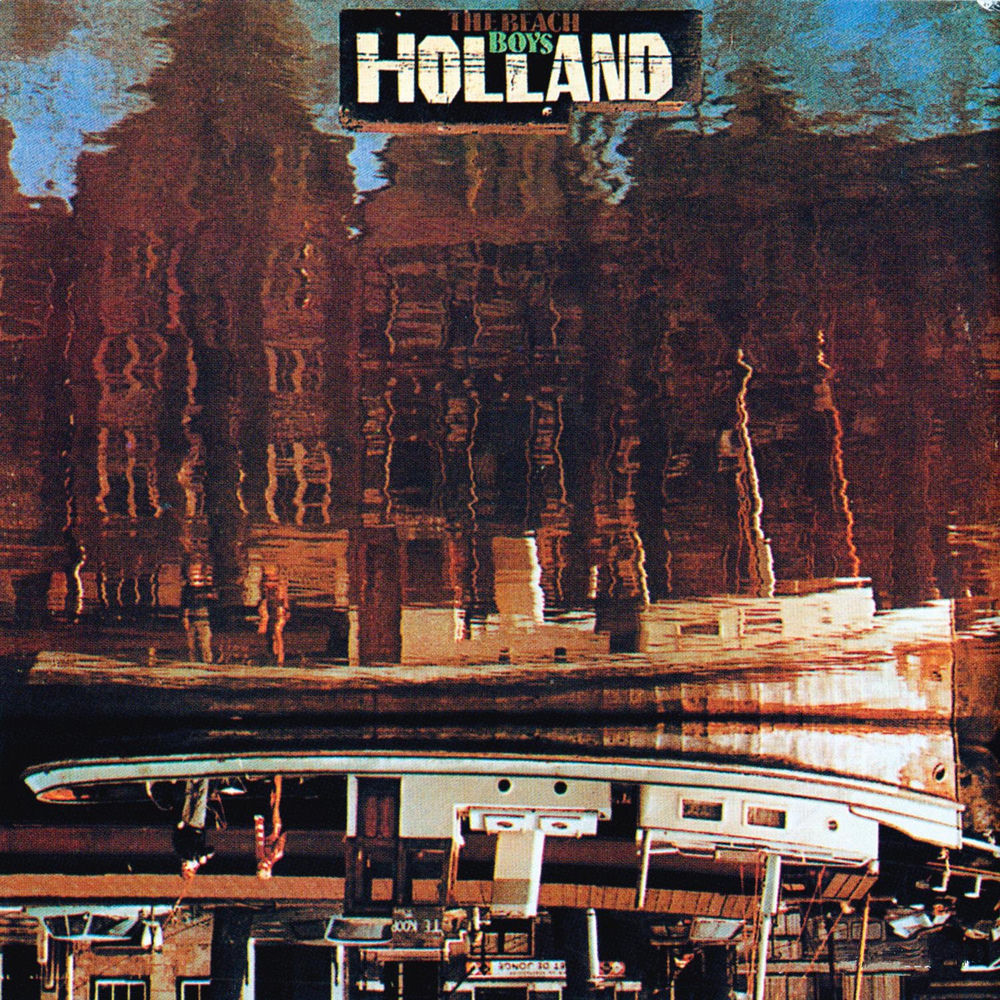
The front cover depicts (upside down) a tugboat in the Kromme Waal, a canal in central Amsterdam. Holland was packaged with a 12-page booklet that provided a historical overview of the album's making, plus a bonus EP, Mount Vernon and Fairway, that Brian and Carl had produced during the Holland sessions. The EP represented a compromise, as Brian had wanted Mount Vernon and Fairway featured on the album, a proposal that his bandmates had vetoed.
Release
Released on January 8, 1973, Holland peaked at number 36 in the U.S. and number 20 in the UK. Despite having a lower chart showing, the record outsold Carl and the Passions. Lead single "Sail On, Sailor" (backed with "Only with You") was issued in February and reached number 79. In the UK, the lead single was "California Saga/California" (backed with "Sail On, Sailor"), reaching number 75. In March, the band remixed and overdubbed new vocals onto "California Saga/California" for a U.S. single release. Released in May, the single (backed with "Funky Pretty") reached number 84. From March 7 to May 17, the Beach Boys embarked on a ten-week U.S. tour with a supporting band that included guitarist Billy Hinsche, keyboardist Carlos Munoz, drummer Joe Pollard, bassist Ed Carter, and percussionist Richard "Didymus" Washington. Their set list included "Funky Pretty", "Leaving This Town", "California Saga/California", and "Sail On, Sailor". According to music historian Keith Badman, critics noted "some unusually long pauses between each song and the group's sometimes negative reaction to any audience requests for oldies." Brian Wilson, who last appeared with his bandmates in concert in 1970, briefly joined them onstage during their encore at the Hollywood Palladium on April 20. Over the next two years, the group maintained a touring regimen, but recorded very little in the studio. On November 19, Warner/Reprise issued The Beach Boys in Concert, a live double album that became the band's best-selling release on the label. It included live performances of "Sail On, Sailor", "The Trader", "Leaving This Town", "Funky Pretty", and the Holland outtake "We Got Love".
Critical reception
Contemporary
Holland received generally favorable reviews at the time of release. Rolling Stone's Jim Miller, who was displeased with Carl and the Passions, praised Holland for its "occasionally unnerving simplicity of viewpoint [and] its frequently ornate perfection." The magazine later ranked it among the five best albums of 1973. Robert Christgau of The Village Voice praised the sound quality of Holland, but believed that the album had strayed too far from what the Beach Boys did best, stating, "I suppose that in time their tongue-tied travelogue of Big Sur may seem no more escapist than 'Fun Fun Fun', but who'll ever believe it's equally simple, direct, or innocent?" In Britain, Melody Maker's Richard Williams wrote, "I expect more from the Beach Boys than from anyone else. Holland has the goods."
Retrospective
Holland became regarded by many fans as the Beach Boys' "last, high-quality original album". Music journalist Peter Doggett opined, "After the false start of Carl And The Passions, Holland proved that the Beach Boys could function as a creative rock band beyond the self-imposed limits of their 60s hits." Mojo's Danny Ecleston referred to Holland as his favorite Beach Boys album, as well as their "least-heard (and certainly last) great record." The album has been included in some opinion polls and rankings.
In 1999, it was ranked number 21 in The Guardian's list of the "Top 100 Albums That Don't Appear in All the Other Top 100 Albums of All Time". In 2000, it was voted number 648 in the third edition of Colin Larkin's All Time Top 1000 Albums. In 2007, it was ranked number 100 in OOR Magazine's list of the "100 Best Albums of All Time". Less favorably, AllMusic reviewer John Bush rued that Holland was a "surprisingly weak" effort. Douglas Wolk of Blender thought that the band "got way self-indulgent, recording poetry, flutes and Moog solos." Among biographers, Stebbins called the record "a very respectable effort", though "not of the caliber of Pet Sounds or Sunflower". John Tobler praised the "California Saga" trilogy and "The Trader", but decreed, "some of the [other] tracks were less than exceptional". Brian's 2016 memoir, I Am Brian Wilson, states of Holland: "There are some great songs on that record. 'Steamboat' kicks ass. I really like 'Only with You' and 'Funky Pretty', too. It's a damned good album no matter where or how we made it."
Influence
Elvis Costello ranked the album as one of his favorite records of all time. Tom Petty penned liner notes for the 2000 CD reissue, in which he described the album as "beautiful" and singled out "The Trader" as the album's "centerpiece". Primal Scream covered the Holland outtake "Carry Me Home". Camper Van Beethoven stated that Holland was an enormous inspiration on their 2013 album La Costa Perdida.
Tracklist
- Sail On, Sailor (Remastered 2000)3:19
- Steamboat (Remastered 2000)4:33
- California Saga (Big Sur) (Remastered 2000)2:56
- California Saga (The Beaks Of Eagles) (Remastered 2000)3:49
- California Saga (California) (Remastered 2000)3:20
- The Trader (Remastered 2000)5:05
- Leaving This Town (Remastered 2000)5:49
- Only With You (Remastered 2000)2:58
- Funky Pretty (Remastered 2000)4:09
- Mt. Vernon And Fairway (Theme) (Remastered 2000)1:34
- I'm The Pied Piper (Instrumental / Remastered 2000)2:21
- Better Get Back In Bed (Remastered 2000)1:38
- Magic Transistor Radio (Remastered 2000)1:42
- I'm The Pied Piper (Remastered 2000)2:08
- Radio King Dom (Remastered 2000)2:40
Listeners 0
Nobody has logged it yet. Be the first.