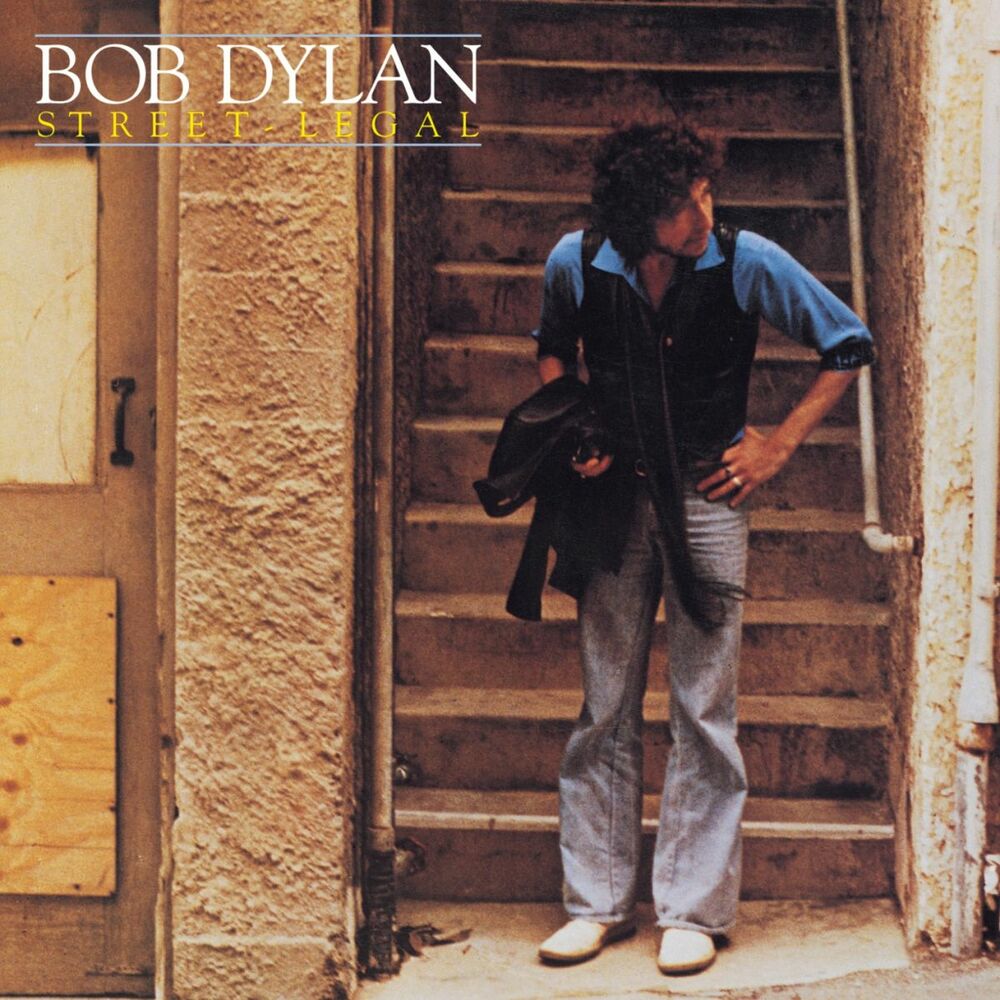
Tracklist
- Changing of the Guards6:37
- New Pony4:30
- No Time to Think8:22
- Baby, Stop Crying5:19
- Is Your Love in Vain?4:32
- Señor (Tales of Yankee Power)5:42
- True Love Tends to Forget4:14
- We Better Talk This Over4:03
- Where Are You Tonight? (Journey Through Dark Heat)6:16
Have you heard it?
Sign in to mark it as listened, rate it and keep notes.
The full story
Street-Legal is the eighteenth studio album by American singer-songwriter Bob Dylan. It was released on June 15, 1978, through Columbia Records. The album was produced by Don DeVito and recorded at Rundown Studios, Dylan's own makeshift recording space. A diversion from the sound of previous albums, the record features the use of a large pop rock band including backing vocalists and horns. Upon release, Street-Legal received harsh reviews from the American press, but critics in the UK were more positive. Retrospective reviews are also much more positive, though it continues to receive criticism for its production. In the US, the album was less commercially successful than Dylan's past few releases, though it still reached the top 10. The lead single, "Baby, Stop Crying", failed to chart in America but was a top 15 hit in the UK. DeVito remixed the album in 1999, which has led to further positive critical reevalution.
Writing and recording
According to biographer Clinton Heylin, Dylan undertook three "distinct" periods of songwriting prior to the recording of Street-Legal. The first of these is a group of compositions inspired by his recent divorce; a song entitled "I'm Cold" is the only known remnant from these writing sessions. The second is the only group to be represented on the final album, a collection of songs written in the summer of 1977 on Dylan's Minnesota farm. The third is a group of co-writes with backing vocalist Helena Springs written in the spring and summer of 1978, with a few of the earlier songs from this partnership being under consideration for, but ultimately excluded from, Street-Legal. Heylin also notes the existence of a fourth group of songs written later in 1978, demoed at tour rehearsals for a prospective follow-up to Street-Legal but ultimately never used following Dylan's conversion to Christianity. On December 26, 1977, Dylan would partake in a session at Rundown where he would run through the songs for Street-Legal on piano. Many of these compositions were still works in progress. For instance, the melody of "No Time to Think" was "quite different" from its final form, and the lyrics contained inconsistent numbers of lines within verses. Heylin believes "True Love Tends to Forget" and "We Better Talk This Over" to be companion songs, due in part to Dylan playing them back-to-back at this session. Both songs were also still works in progress, though the latter was closer to completion than the former. "Is Your Love in Vain?" was absent from this session, but would become the first Street-Legal composition played in concert, and the only to be debuted live before the release of the album.
The songs included on the album were to be registered through a newly-formed publishing company, Special Rider Music, and the new album would be Dylan's first under a "recently renegotiated" contract with Columbia. When asked in a 1978 interview if his new songs referenced his recent divorce, Dylan stated "we were breaking up for a long time. So [the next album] doesn't reflect too much of that." According to Heylin, "Changing of the Guards" was not only "definitely" the first song recorded for Street-Legal, but also that there exists "a goodly amount of circumstantial evidence" that it was also the earliest-written composition on the record. "Where Are You Tonight? (Journey Through Dark Heat)" is another song "almost certainly conceived" at Dylan's farm, which he then "atypically spen[t] sixth months fine-tuning". A song entitled "First to Say Goodbye" was mentioned in a Melody Maker report discussing rehearsals for the upcoming tour, but does not appear on tapes from those sessions. Heylin suggests the title may match a song recorded at the December 1977 session but not included on the album; Dylan also mentioned a song entitled "Her Version of Jealousy" in a March 1978 interview, but no recordings have ever been released. Another Dylan–Springs collaboration, "Stop Now" appears to have been under heavy consideration for the album's final tracklisting, but was not included. With a tour booked to start in June, and the band expecting a break in the interim between recording and touring, the album needed to be recorded quickly. The record would ultimately be recorded within a week in April at Rundown Studios, Dylan's makeshift studio in Santa Monica. Dylan had originally intended to reunite with producer Bob Johnston and record the album at the Record Plant in Sausalito, California. However, he was unable to book "convenient" dates at the studio, so the decision was made to instead record the album at Rundown. Dylan himself later recalled that he did not want to record there, but had to out of necessity. Dylan desired a "naturalistic approach to recording that maintained the interplay between each musician", with Arthur Rosato (listed on the album sleeve as "second-in-command") later remarking that despite the fact that recording an album live in …
Music and lyrics
Sounes describes the songs on Street-Legal as being "concerned primarily with the travails of love", with their "autobiographical references" being obscured by "dense imagery" and references to Tarot and astrology. Shelton considers the collection to be one of Dylan's "most overtly autobiographical" records, containing themes of "loss, searching, estrangement and exile" while also foreshadowing Dylan's conversion to Christianity and the gospel albums which would follow. Writer Michael Gray agrees that the album predicts Dylan's later religious music, as well as noting the multitude of personalities contained within its compositions. Gray notes betrayal as a central theme on the record, opining the album deals both with "Dylan's being betrayed like Christ", and his "need to abandon woman's love". Jeremy Winograd divides the album's tracks into two lyrical categories: one being "cranky, bitchy songs about Dylan's divorce", and the other being "long, convoluted epics that take obscure Dylanesque wordplay to a whole new level." Musically, Street-Legal is a diversion from previous Dylan albums in its use of an expanded band lineup including backing vocalists and the use of a horn section. Some reviewers have noted a stronger pop influence and have described the musicianship as "slick" and "professional". Jim Beviglia of American Songwriter describes the record's musical aesthetic as a "big-band rock sound" similar to the contemporary work of Bruce Springsteen and Bob Seger. Winograd says Street-Legal "marks the time when Dylan decided for exactly one album to become a big band, Vegas-style adult pop crooner". Mansfield described the sound of the band as "like Bob Dylan meets Phil Spector". Contrasting these more commercial arrangements is the sound quality and production of the album, which has come under much criticism. Sounes describes its sound as "like it had been recorded under wet cardboard", while Heylin characterizes the record's sound quality as a "twenty-four track morass".
Side one
The album opens with "Changing of the Guards", considered by Winograd to be its "most ostensibly Dylanesque cut" due to its use of "wailing organ and verse–verse-verse folk song structure." Heylin describes the lyrics as a "Babylonian narrative of lust and betrayal, to a period of mortal combat". Shelton notes the "confound[ing]" and enigmatic nature of the lyrics, while Sounes highlights its references to Tarot as one of the record's prime instances of Dylan disguising his songs' autobiographical references. Heylin notes similarities between the song's verse structure and that of the previous album's "Black Diamond Bay", while also picking out lyrical references to Tom Paxton's "Peace Will Come" and Robert Johnson's "Last Fair Deal Gone Down". Michael Gray interprets the song as "Dylan reflecting on his own career", while exhibiting the album's theme of betrayal, in this case inflicted not by a romantic partner, but the world as a whole. Gray opines that later in the song, Dylan both addresses his record label and Sara, while other lyrics foreshadow his religious conversion. "New Pony" is a blues which many, including some in Dylan's band, have theorized refers to Dylan's relationship with Springs. Musical characteristics of the track include backing vocalists repeating the phrase "How much longer?", in addition to "muscular drumming pinning down" the song's "12-bar structure". Brian Hinton describes the song as "certainly part inspired by Son House's 'Pony Blues' with a bit of satanism thrown in", while Gray considers it to be the "dark, spiteful corollary" of the similarly blues-influenced "Buckets of Rain" (from Blood on the Tracks). Gray also highlights the juxtaposition of Dylan's "sexy, sleazy" vocal performance with the "gospel plea for deliverance" offered by the backing vocalists as a prime example of the album's "tussle between flesh and spirit". "No Time to Think" is the album's longest track, described by Heylin as an …
Release and reception
In Europe, Street-Legal was released amidst much media hype, due to its release date being just two days after the beginning of Dylan's first European tour in twelve years. "Baby, Stop Crying" was released as a single and became a top 10 hit throughout Europe. In the UK, the album reached number two during a 20-week chart stay. However, the album stalled at number 11 in the US, breaking a streak of number-one studio albums, and "Baby, Stop Crying" failed to chart on the Billboard Hot 100.
Contemporary reviews
After the twin critical successes of Blood on the Tracks and Desire, US reviews for Street-Legal were scathing. In a review for Rolling Stone, Greil Marcus disparaged the album, calling much of its material "dead air, or close to it" while criticizing the vocals as "utterly fake". Marcus dismissed "Is Your Love in Vain?" and "Baby, Stop Crying" as "wretched performances", while opining that its "most musically striking number", "Señor (Tales of Yankee Power)", is "really just a pastiche of the best moments of the Eagles' Hotel California." Robert Christgau gave the album a rating of C+, dismissing its "leaden tempos" and "opress[ed]" melodies, while considering the record as a whole to be "devoid not just of humor but of lightness". The UK press was much more receptive. Record Business found the record to be "a work of considerable overall strength" and a "worthy" successor to Blood on the Tracks and Desire. The publication praised Dylan's use of female soul vocalists and "exhilirating R&B brass", while also identifying a return to the "anguished, personal, visionary imagery" of Highway 61 Revisited (1965). Barry Cain of Record Mirror rated the album four stars out of five, stating that while the record "ain't no leather bound, gold embossed classic", it "sure as hell would make a good movie", and contains songs which "paint disquieting scenarios that slither before the eyes kaleidoscope amoebas". NME writer Angus Mackinnon deemed Street-Legal to be Dylan's second major work of the decade, praising the musicianship and finding the songwriting to be "suffused with a rare compassion and tenderness" and evident of Dylan's ability to "effortlessly generalise the particular and particularise the general". Mackinnon compared the record favorably to Desire, finding it reminded them of "Dylan's continued relevance as a commentator and communicator".
Retrospective reviews
Retrospective reviews are also more positive. AllMusic's Stephen Thomas Erlewine dismissed the production, which he found conflicted with the tone of the songs, but also argued that the material "deserve[s] close attention" and contains writing "as dense as anything Dylan had written since before his motorcycle accident". In his Paste retrospective, Melis chalked up much of the album's artistic success to Dylan's attempts to "meld the artist listeners had come to know with the sounds he aimed to explore", as well as his "knack for stepping into an adjacent genre and not missing a single brilliant beat". While Melis acknowledged the "fair criticisms" levied at the record's "rushed recording" and "sloppy production", he ultimately argued the album "captures a still-fearless artist unafraid to take musical risks as his personal life comes crashing down around him". Jim Beviglia of American Songwriter also asserts that Street-Legal is an "overlooked gem", opining that the criticisms of sexism and of the record's arrangements are misguided. Beviglia posits that the musical setting of the record "add[s] to the drama and urgency of Dylan's narratives" in songs such as "Changing of the Guards" and "Baby, Stop Crying", while arguing for separation between the narrator of "Is Your Love in Vain?" and Dylan's own views, also noting that "what really comes through in the song is the narrator’s touching tentativeness to put himself out there for his heart to potentially be broken". Chris Shields of the St. Cloud Times praised Street-Legal for combining the "colorful …
Tracklist
- Changing of the Guards6:37
- New Pony4:30
- No Time to Think8:22
- Baby, Stop Crying5:19
- Is Your Love in Vain?4:32
- Señor (Tales of Yankee Power)5:42
- True Love Tends to Forget4:14
- We Better Talk This Over4:03
- Where Are You Tonight? (Journey Through Dark Heat)6:16
Listeners 0
Nobody has logged it yet. Be the first.