João's Music Archive
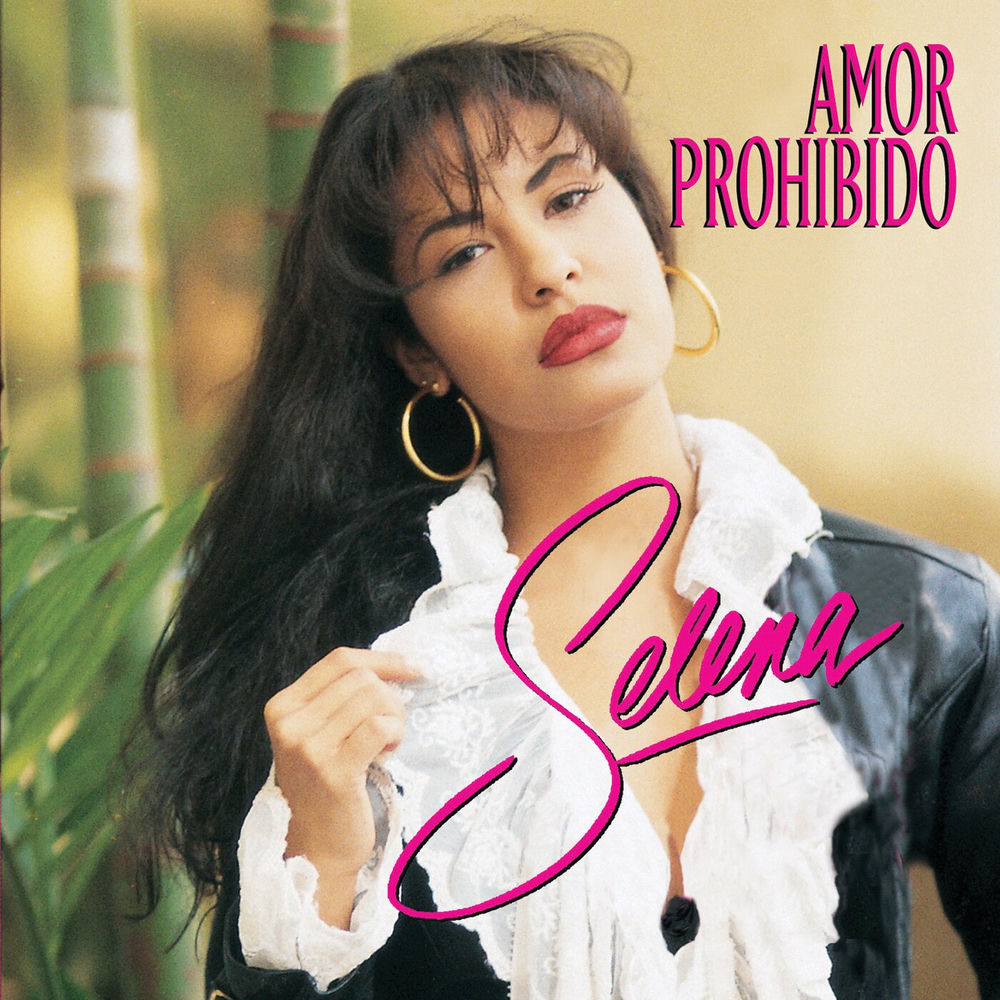
Amor Prohibido
← Back to the lists

Amor Prohibido

Selena
1994-03-22
EMI Latin
12 tracks, 1 h 0 min
Special pressing
Pink Translucent, 30th Anniversary
Rating
–
Not heard yet
110
–Archive
85Critics
0Listeners
Average score 85Pitchfork 9.16 reviews

Tracklist

  1. Amor Prohibido2:50
  2. No Me Queda Más3:18
  3. Cobarde2:50
  4. Fotos Y Recuerdos2:34
  5. El Chico Del Apartamento 5123:26
  6. Bidi Bidi Bom Bom (1994 Version)3:27
  7. Techno Cumbia3:45
  8. Tus Desprecios3:22
  9. Si Una Vez2:46
  10. Ya No3:53
  11. Donde Quiera Que Estés4:30
  12. Spoken Liner Notes By The Band And Family24:03
Listen on

Have you heard it?

Sign in to mark it as listened, rate it and keep notes.

About the artist

Selena Quintanilla-Pérez (Latin American Spanish: [seˈlena kintaˈniʝa ˈpeɾes]; April 16, 1971 – March 31, 1995), known mononymously as Selena, was an American singer-songwriter, fashion designer, and business owner. Known as the "Queen of Tejano Music", she is known for her contributions to popular music and fashion, which made her one of the most celebrated Mexican-American entertainers of the late 20th century.

About the album

Amor Prohibido (English: Forbidden Love) is the fourth studio album by American singer Selena, released on March 22, 1994, by EMI Latin.

Meanings

Amor Prohibido contains a more diverse collection of musical styles than Selena's previous work, ranging from ranchera to hip-hop music. Music critics believe it is an album of various genres accessible to both traditional and contemporary Latin music fans. Jeff Young, then-EMI Latin's sales director, labeled Amor Prohibido as "Pop International", which Mark Schone of Newsday believed was a ploy by the company to broaden Selena's appeal.

Why it's rated so high

The vast majority of contemporary reviews were positive. Critics at The New York Times overwhelmingly praised the album: Peter Watrous felt it stayed honest to her "country, working-class constituency" and Greg Kot praised its "contemporary snap", while Joe Nick Patoski hailed Amor Prohibido as a "watershed" recording from a supergroup at the top of its game.

Career and historical context

Following the release of Selena's third studio album Entre a Mi Mundo and the launch of a clothing boutique in 1993, the singer and her band began working on Amor Prohibido. Having achieved the success and fan base that EMI Latin's president Jose Behar was seeking, Behar aimed to capitalize on Selena's broad appeal with the next studio release. B.

Taken from Wikipedia (CC BY-SA 4.0).

The full story

Amor Prohibido (English: Forbidden Love) is the fourth studio album by American singer Selena, released on March 22, 1994, by EMI Latin. Having reached a core fan base, the label aimed to broaden her appeal with the next studio release. Finding it challenging to write a follow-up hit after "Como la Flor" (1992), Selena's brother A. B. Quintanilla enlisted the assistance from band members Ricky Vela and Pete Astudillo with writing the album's songs. The resulting album has a more mature sound featuring experimental production that blends diverse musical styles from ranchera to hip-hop music. Amor Prohibido is a Tejano cumbia album modernized with a synthesizer-rich delivery using a minimalist style that was quintessential in early 1990s Tejano music. The album's songs deal with dysfunctional and volatile relationships; its lyrics explore unrequited love, infidelity, and social division. With relatively few love songs, Amor Prohibido narrates a woman's struggles and triumphs following unsuccessful relationships with men who struggle with commitment. The album continued the singer's streak of number-one singles on the United States Billboard Hot Latin Songs chart with the title track "Amor Prohibido"— which became the most successful US Latin single of 1994, a feat she repeated the following year with "No Me Queda Más". Along with the latter, "Bidi Bidi Bom Bom" and "Fotos y Recuerdos" also topped the US Latin chart, and together with "Si Una Vez" are regarded as Selena's signature recordings. When the album tour broke attendance records at the Houston Astrodome and attracted a record-breaking crowd at Miami's Calle Ocho Festival, Selena became recognized as one of the biggest US Latin touring acts at that time. Amor Prohibido became the first Tejano record to peak at number one on the Billboard Top Latin Albums chart, remaining in the top five for 98 consecutive weeks. The album holds the record for most weeks at number one on Billboard's Regional Mexican Albums chart at 97 nonconsecutive weeks, as well as crowning the chart in four different calendar years. Amor Prohibido received critical acclaim: it is considered to be Selena's best work and her band's "crowning achievement". The album's sound received the highest acclaim, it was noted by critics to have retained its innovative spirit well into the 21st century. Amor Prohibido is credited with catapulting Tejano music into mainstream success resulting in sales to listeners previously unfamiliar with the genre. Amor Prohibido was nominated for Best Mexican-American Album at the 37th Grammy Awards. The record took Album of the Year honors at the 1995 TMA's and the Lo Nuestro Award for Best Regional Mexican Album. On March 31, 1995, Selena was murdered by her friend and former manager of her Selena Etc. boutiques, Yolanda Saldívar. The record re-entered the Billboard 200 chart, peaking at number 29 and was certified gold by the Recording Industry Association of America (RIAA). Within three weeks, …

Production and development

Background

Following the release of Selena's third studio album Entre a Mi Mundo and the launch of a clothing boutique in 1993, the singer and her band began working on Amor Prohibido. Having achieved the success and fan base that EMI Latin's president Jose Behar was seeking, Behar aimed to capitalize on Selena's broad appeal with the next studio release. The label was keen to use a Grammy Award-winning producer instead of the singer's brother, A.B. Quintanilla. A.B. knew Selena's musical tastes and vocal range, though he found that he needed to outdo himself to remain her principal record producer. He found it challenging to meet expectations after the commercial success of Entre a Mi Mundo and its career-launching single "Como la Flor". When A.B. met with record executives in New York City and Nashville, they pressured him to come up with another successful song. He felt it was important that the music he produced for Selena remain fresh. He stressed that writing a successful song following "Como la Flor" was infeasible—as he expressed to Billboard, "you don't try to outdo a hit, you just write another hit". As with previous albums, A.B. enlisted Selena y Los Dinos band members, Pete Astudillo and Ricky Vela, to help with the writing process. The result included a mature sound for Selena with experimental recording and production than her previous works. It was the final album featuring production and songwriting by Astudillo, who subsequently parted with Los Dinos to pursue a solo career.

Recording

Amor Prohibido was recorded at Manny Guerra's studio in San Antonio, Texas, and was engineered by Brian "Red" Moore. The production of Amor Prohibido lasted six months beginning on September 17, 1993. The recording schedule was squeezed in around touring commitments and the opening of Selena's boutiques, as Selena's husband and guitarist Chris Pérez recalled: "I don't even know how we managed to find time to make the next album." According to Vela, progress stalled and the band had to rush to finish production because of an approaching deadline. The first day of recording, which lasted until four in the morning, began with the sequencing of the keyboards. The following days concluded with the band recording their respective parts before Selena recorded her vocals. It then took two weeks to complete post-production. Vela said that it was common for the band to rehearse all of the music in advance of the recording sessions, as the band's production sequence remained unchanged for Amor Prohibido. Selena and the band recorded their parts in the studio after they had first perfected them during pre-production. A.B. would then arrange and mix them, using an AKAI MPC60 II for timing and tempo control before studio mixing instruments were used. It took two weeks for Selena to record the album's ten tracks. Pérez provided an evocative account of working with Selena during the sessions for Amor Prohibido. Pérez wrote how Selena never complained in the studio, adding that the singer was never recalcitrant towards changes. Selena would often arrive at the studio during the album's production, "hum her part a little", and then proceeded to the mall informing the band not to worry because she would "know what to do when [the band is] ready to record." Nevertheless, Pérez explained that the band never had to approach Selena on changes in the studio as she disciplined herself and tracked her vocals while requesting a second take in order to "add little harmonies she'd create" during recording. A.B. described his own creative process during the sessions in a 1994 interview with KMOL. He would use a tape recorder to hum a melody before creating a title and concept of a song. If he caught himself humming a tune the next day "then it's catchy", otherwise he "wouldn't use it." A.B. also requested material from Rena Dearman, former keyboardist of the group, who provided several songs. A.B. favored "I'll Be Alright" and wanted Selena to …

Composition

Amor Prohibido contains a more diverse collection of musical styles than Selena's previous work, ranging from ranchera to hip-hop music. Music critics believe it is an album of various genres accessible to both traditional and contemporary Latin music fans. Jeff Young, then-EMI Latin's sales director, labeled Amor Prohibido as "Pop International", which Mark Schone of Newsday believed was a ploy by the company to broaden Selena's appeal. Musicologist Matt Doeden found the album as having "a new sound" whose aim was to appeal to a broad audience. Perone found the mixture of compositions on the album to be rock and dance music, and according to Frank Hoffman in the Encyclopedia of Recorded Sound, the album exhibited the band's broad range of styles. Newsweek found the music in Amor Prohibido to have combined house music, cumbia, rock, dancehall, and new wave that was modernized in a kaleidoscopic form that embodied postmodern maelstrom of the mid-'90s. Amor Prohibido diverged from Selena's "stock-in-trade contemporary Tex-Mex sound." Mario Tarradell of The Dallas Morning News, however, believed the title track and "Bidi Bidi Bom Bom" contained Selena's cheerful and enthusiastic personality that were prevalent in previous recordings. The album's musical influences include salsa, funk, R&B, bubblegum pop, teen pop, pop ballads, techno, a fusion of reggae and dancehall, rock, polka, conjunto, flamenco, mariachi, corridos, and Tejano cumbia. Tejano cumbia is used heavily throughout Amor Prohibido. Author Ed Morales noticed its representation of the "cumbia sound" already established by Tejano band La Mafia, though Donald Clarke found Selena's delivery to be more of a modernized synthesizer-rich sound. While Amor Prohibido is a cross-cultural musical fusion, it remains an authentic Tejano recording, which uses a minimalist style that was quintessential in early 1990s Tejano music. Selena called the recordings on Amor Prohibido as "love songs [or songs about] getting your heartbroken". Lyrically, the title track "Amor Prohibido" encapsulates the social divide between a poverty-stricken woman and the man of unreachable rank with whom she has fallen in love. The lyrics have been analyzed by authors, musicologists, and critics, who found them relevant to issues facing the LGBT community. They are ambiguous, and have been interpreted to portray prohibited romance between same-sex couples, modern society's views of romantic relationships, and to Romeo & Juliet. A review in The Monitor felt that the lyrics portrayed the forbidden love that Selena and Pérez hid from her overbearing father. Musically, the titular song is "an emotional uptempo ballad" which showcases the singer's "passionate side". In "Cobarde", the protagonist calls her partner a "coward" upon learning on his inability to face her after feeling reticent about his affair. Two other tracks, "Ya No" and "Si Una Vez", delve into heartaches of failed relationships with the protagonist in the former song angrily refusing to take back a cheating partner. Selena's vocals were called "strong [and] raspy" in "Si Una Vez". Suzette particularly liked because Selena gave "that attitude" in the song. "Tus Desprecios" has a storyline typical of mariachi recordings, concerning dysfunctional and volatile relationships. The track uses the traditional Tejano conjunto (small band) style and includes a trilling accordion motif. On the day Selena recorded the song, she was suffering from a bronchitis episode. Perone wrote that the song showed Selena's ease with pop, Latin, and Tejano styles. Writing for The Miami Herald, Mario Tarradell described "Tus Desprecios" and "Si Una Vez" as having a more traditional Tejano sound than the rest of the tracks on Amor Prohibido but found them riddled with synthesizers and digital processing. Another track, "No Me Queda Más", uses the identical style of ranchera songs, with the female singer agonizing over the end of a relationship. The lyrics explore an …
Release and promotion

Amor Prohibido was released in the United States on March 22, 1994. The release followed a recording contract with EMI Latin's pop division SBK Records, who aimed Selena to crossover into mainstream American pop music, in November 1993. After this news reached Billboard magazine, Amor Prohibido was given a spotlight feature in its album reviews which called its release a continuation of her "torrid streak." While Mark Holston of Hispanic magazine, wrote that the album's release reinforced her reputation as one of the leading Hispanic singers of the 1990s. With EMI Latin's president Jose Behar requesting enhancements to their commercial appeal, the band gave Argentine arranger Bebu Silvetti the song "No Me Queda Más" to be reworked into a pop-style track for its single release in October 1994. Amor Prohibido was subsequently re-released with a red sticker indicating that it included a "new version" of the song. In a Billboard interview, Behar said that "No Me Queda Más" was "internalized" without affecting the originality of its recording. During the twenty-year celebration of Selena releasing music, Amor Prohibido was repackaged and was made available for physical and digital purchase on September 22, 2002. The limited-edition version included Selena's duet with the Barrio Boyzz on their 1994 single "Donde Quiera Que Estés", music videos for "Amor Prohibido" and "No Me Queda Más", as well as spoken liner notes containing commentary and recollections of each track provided by the singer's family, friends, and her band. After featuring on "Donde Quiera Que Estés", Selena went on a mini-tour with the Barrio Boyzz that enabled her to visit New York City, Argentina, Puerto Rico, the Dominican Republic, and Central America, where she was not well known. In September 1994, Selena sold out the 10,000 seats D.C. Armory in Washington, DC, with mostly Central Americans in attendance. Daniel Bueno, who organized the event, told The Washington Post that Central Americans loathe Tejano music and thought that the addition of reggae and tropical music into her repertoire had helped her appeal to Central Americans. Nelly Carrion, a journalist for the Washington Hispanic, expressed how the audience resonated emotionally towards Selena's performance and stressed how people were desperate to touch Selena, forcing her act to be suspended. Selena made several appearances on television and in live shows to promote Amor Prohibido. Most notably, her performance at the Houston Astrodome on February 26, 1995, has been called one of her best. The event was critically praised for breaking attendance records set by country music musicians Vince Gill, Reba McEntire, and George Strait. Her performance in the Astrodome was emulated by Jennifer Lopez in her role as the singer in the 1997 biopic. The singer appeared at the Calle Ocho Festival in Miami, with an estimated 100,000 in attendance breaking previous audience records. Her performance on a November 1994 episode of Sabado Gigante was ranked among the most memorable moments in the show's 53-year history. Selena performed "Bidi Bidi Bom Bom", "No Me Queda Más", "El Chico del Apartamento 512", and "Si Una Vez" on the Johnny Canales Show, which was later released as part of the host's "favorite songs" on DVD. Selena's performance of "Bidi Bidi Bom Bom" on July 31, 1994, at Six Flags AstroWorld was the subject of a video released by the Houston Chronicle for their segment "On This Forgotten Day". Ramiro Burr, of Billboard, called the singer's tour for her album a "tour de force". The concerts established Selena as one of Latin music's most successful contemporary acts.

Singles

Tracks released from the album continued the singer's streak of US number-one singles. The title track, "Amor Prohibido", was the album's lead single released on April 13, 1994. The song peaked at number one on the Billboard Hot Latin Songs chart the week ending June 11 – her first number one as a solo artist – and remained atop …

Critical reception

Reviews

The vast majority of contemporary reviews were positive. Critics at The New York Times overwhelmingly praised the album: Peter Watrous felt it stayed honest to her "country, working-class constituency" and Greg Kot praised its "contemporary snap", while Joe Nick Patoski hailed Amor Prohibido as a "watershed" recording from a supergroup at the top of its game. Others, such as AllMusic's Stephen Thomas Erlewine, musicologist James Perone, and music editor Mario Tarradell panned the album initially before coming to view Amor Prohibido positively. Tarradell called Selena "Miss Mexican Lite" and criticized the lack of songs true to regional Mexican music, before calling the album "delightfully infectious". Perone felt the album sounded dated, despite providing ample evidence of the singer's appeal, whereas Erlewine characterized Amor Prohibido as "slightly uneven" and praised Selena's success at recording the weaker material. Erlewine would later describe Amor Prohibido as Selena's strongest album, and an effective introduction to her work that highlighted her successful interpretation of the Tejano sound. Walter Martinez from Latin Style opined that Amor Prohibido contained tracks that deviated from regional Mexican or Tejano music. In response to Martinez's observation, Selena explained that she and the band experimented with Amor Prohibido, but songs like "Cobarde" still encompassed elements of Tejano and norteño music. Selena attributed her success to the diverse genres that she and the band explored in their albums while maintaining a "Mexicano" essence. With Amor Prohibido, Selena noted that the album possessed a pop ambiance, influenced by her exposure to both English and Spanish music during her formative years. She concurred that the album is not strictly "hard-core Tex-Mex or Mexican", which she perceived as a key factor in her and her band's success, as their distinctive sound strayed from tradition. The album's sound received positive reviews. Described by author Ed Morales as a "subtle evolution", and by The Dallas Morning News as "delightfully infectious, hummable [and] ultra radio-friendly", the tracks were summarized and praised by The Monitor as "romantic, charming and ebullient." Billboard characterized the album's sound to be transparent for those unfamiliar with its musical diversity, while the Houston Chronicle marveled Amor Prohibido's ability at retaining its innovative sound well into the 21st century; a sound which was "light years ahead" of the singer's contemporaries. The singer's "seductive alto" was described as at a peak of expression. The San Antonio Express-News collectively praised the band as being at their "creative peak", while A.B.'s production was highlighted by the Rolling Stone who labeled it the "Selena sound" that would have made the singer a dominant force on the music charts had it not been for her death. Amor Prohibido hinted of a "pop potential", an opinion echoed by author Matt Doeden, who felt that the recording exhibited Selena's potential to become the genre's first pop musician. Many critics found Amor Prohibido to have been Selena's best work, calling it her band's "crowning achievement." Other reviews called the work the singer's "blockbuster album", her signature album, a "career-defining" release, her "most interesting" and "sleekest" record, a "desert island album" for fans, calling it a "notch up" in her career, a "landmark", a "victory" recording, a "sultry, regional anthem." and an "overnight sensation".

Recognition

At the time of its release, Amor Prohibido was regarded as very popular in Hispanic communities, albeit one that exemplified a generational split within the Tejano market at the time. Musicians found contemporary Tejano more sophisticated and noticed that it was unnecessary to explore their roots to have successful recordings. A.B.'s musical production of fusing and blending urban musical compositions in Amor Prohibido, revolutionized Tejano …

Commercial performance

Posthumous commercial performance

Media attention had helped increased sales of Amor Prohibido as well as her back catalogue. As a result, EMI Latin increased the production of the singer's albums at their Los Angeles, California, and Greensboro, North Carolina plants. In the hours immediately after her death, it was the most requested album by people in music stores looking for her work. An Austin, Texas music retailer expressed how Amor Prohibido sold more units in the first month following her death "than it did the entire year it was out." This was echoed by a music wholesaler in Manhattan, who constantly sold out of Selena's albums the same day they received them, telling the local newspaper that "It used to be just the Mexicans [in Manhattan]. Now everybody likes her." In McAllen, Texas, music shops reported that people bought the singer's earlier works than Amor Prohibido, citing that "most fans already have her latest [album]". Music stores in Washington, DC, reportedly sold out of Amor Prohibido within days of her murder. The album reached number one for the fifth time on April 15, 1995, with sales of 12,040 units - a 580% increase over the previous week. The record subsequently re-entered the Billboard 200 chart at number 92 and at number one on the Regional Mexican Albums chart. The album sold an additional 28,238 units (a 136% increase) and rose to number 36 on the Billboard 200 chart. Amor Prohibido peaked at number 29 during its fifth week on the Billboard 200. The event was "a rare feat" for a non-English album in the United States. The album jumped from number 20 to number six on the list of the best-selling albums in Southern California in the week following her death. The recording eventually ranked second on their list of the best-selling albums in the state. In a June 1995 report, Amor Prohibido was the second best-selling record in Puerto Rico. Amor Prohibido and her 1992 studio album Entre a Mi Mundo, rose 1,250% in sales in the eight weeks following her murder. The album helped increase local record shops in Texas who were "selling more than when [Selena] was alive". Amor Prohibido remained at number one on the Top Latin Albums chart for 16 weeks following her death until the release of her crossover album Dreaming of You replaced it on August 5. The album remained behind Dreaming of You for seven weeks. By the end of 1995, Amor Prohibido ranked second to Dreaming of You for the best-selling Latin album for that year, and remained the best-selling regional Mexican recording for three consecutive years. After 98 weeks the album dropped from the top five on the Top Latin Albums chart, though it remained within the top ten for 12 additional weeks. Amor Prohibido holds the record for most weeks at number one on the Regional Mexican Albums chart at 97 weeks, and is the only album to reach number one in four different calendar years. Amor Prohibido became the ninth best-selling Latin album of 1996, and ranked as the second best-selling Latin catalog album of 1997, while in 1998 it placed third. Billboard's revised catalog criteria made it ineligible for the Top Latin Albums and Regional Mexican Albums chart on January 18, 1997. The album was removed from the list and began charting on the newly formed Latin Catalog Albums chart positioned at number two. Since 1997, the album has spent 13 nonconsecutive weeks at number one on the Top Latin Catalog Albums chart including three weeks in 2010. Following another revision to its Latin albums charts, Billboard removed its two-decade-long ban of catalog albums in its chart beginning with the February 11, 2017 list; Amor Prohibido re-entered the Top Latin Albums and Regional Mexican Albums chart after 20 years. Still popular today, Nielsen SoundScan reported that Amor Prohibido was the ninth best-selling Latin record of 2016. After its revision, Amor Prohibido reclaimed the number one position on the Regional Mexican Albums chart in May 2017. Amor Prohibido was …

From the Wikipedia article Amor Prohibido, available under CC BY-SA 4.0.

Tracklist

  1. Amor Prohibido2:50
  2. No Me Queda Más3:18
  3. Cobarde2:50
  4. Fotos Y Recuerdos2:34
  5. El Chico Del Apartamento 5123:26
  6. Bidi Bidi Bom Bom (1994 Version)3:27
  7. Techno Cumbia3:45
  8. Tus Desprecios3:22
  9. Si Una Vez2:46
  10. Ya No3:53
  11. Donde Quiera Que Estés4:30
  12. Spoken Liner Notes By The Band And Family24:03

Listeners 0

Nobody has logged it yet. Be the first.

Log a listen