João's Music Archive
Ride the Lightning
← Back to the lists

Ride the Lightning

Metallica
July 27, 1984
Blackened Recordings
25 tracks, 2 h 21 min
Rating
–
Not heard yet
110
–Archive
91Critics
0Listeners
Average score 91AOTY 92Pitchfork 10.010 reviews

Tracklist

  1. Fight Fire With Fire (Remastered)4:44
  2. Ride The Lightning (Remastered)6:36
  3. For Whom The Bell Tolls (Remastered)5:09
  4. Fade To Black (Remastered)6:57
  5. Trapped Under Ice (Remastered)4:04
  6. Escape (Remastered)4:23
  7. Creeping Death (Remastered)6:35
  8. The Call Of Ktulu (Remastered)8:53
  9. The Ecstasy of Gold1:35
  10. Fight Fire With Fire (Live at The Hollywood Palladium, Los Angeles, CA – March 10th, 1985)4:38
  11. Ride The Lightning (Live at The Hollywood Palladium, Los Angeles, CA – March 10th, 1985)7:08
  12. Phantom Lord (Live at The Hollywood Palladium, Los Angeles, CA – March 10th, 1985)5:04
  13. (Anesthesia) – Pulling Teeth (Live at The Hollywood Palladium, Los Angeles, CA – March 10th, 1985)3:34
  14. For Whom The Bell Tolls (Live at The Hollywood Palladium, Los Angeles, CA – March 10th, 1985)4:29
  15. No Remorse (Live at The Hollywood Palladium, Los Angeles, CA – March 10th, 1985)6:23
  16. Fade To Black (Live at The Hollywood Palladium, Los Angeles, CA – March 10th, 1985)7:14
  17. Seek & Destroy (Live at The Hollywood Palladium, Los Angeles, CA – March 10th, 1985)7:05
  18. Creeping Death (Live at The Hollywood Palladium, Los Angeles, CA – March 10th, 1985)5:54
  19. Am I Evil? (Live at The Hollywood Palladium, Los Angeles, CA – March 10th, 1985)3:39
  20. Motorbreath (Live at The Hollywood Palladium, Los Angeles, CA – March 10th, 1985)3:18
  21. Am I Evil? (Remastered)7:50
  22. Blitzkrieg (Remastered)3:36
  23. Ride The Lightning (Studio Demo)6:47
  24. When Hell Freezes Over (The Call of Ktulu) (Studio Demo)8:41
  25. Creeping Death (Studio Demo)7:10
Listen on

Have you heard it?

Sign in to mark it as listened, rate it and keep notes.

About the artist

Metallica, an American heavy metal band formed in Los Angeles in 1981, became a founding member of thrash metal's 'big four'. Known for their fast tempos and aggressive musicianship, they are now based in San Francisco and are one of the most commercially successful bands ever.

About the album

Released in 1984, 'Ride the Lightning' is Metallica's second studio album, recorded in three weeks in Copenhagen. It marked a significant musical evolution for the band, incorporating acoustic guitars, complex harmonies, and extended instrumentals beyond their debut's fast tempos.

Meanings

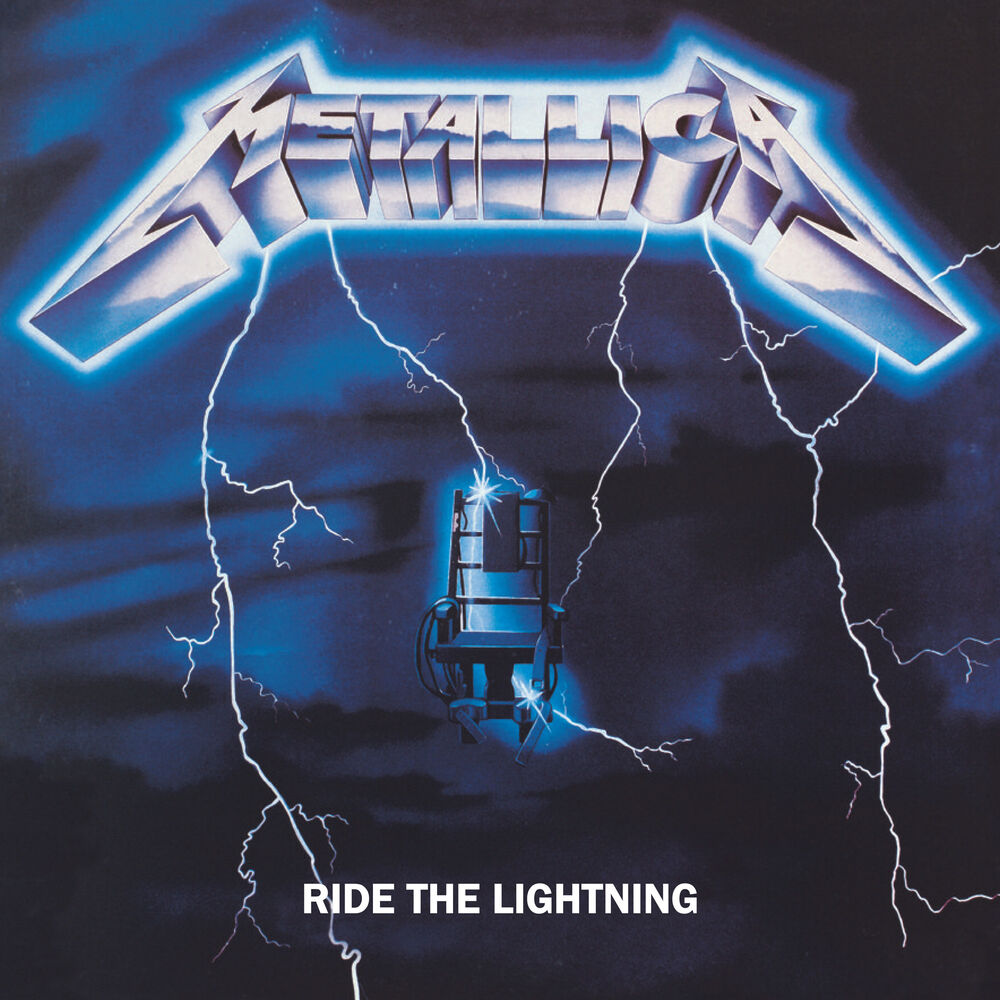
The album's title comes from Stephen King's novel 'The Stand', referring to execution by electric chair, a theme reflected in the cover art. Lyrically, it explores themes like nuclear annihilation, the criminal justice system, and suicide, showcasing increased sophistication.

Why it's rated so high

Critics widely praised 'Ride the Lightning' as an ambitious effort that redefined thrash metal, expanding its boundaries with sophistication and brutality. It is considered an all-time metal classic, noted for its lasting impact on the genre and its rich musical imagination.

Career and historical context

This album sits early in Metallica's career, showcasing their rapid musical development after 'Kill 'Em All' and before major commercial success. Despite financial struggles during its creation, it led to a deal with Elektra Records, setting the stage for their future iconic releases.

Fun facts

  • The band members often slept in the studio and recorded at night because they could not afford a hotel.
  • Part of Metallica's gear was stolen in Boston, leading Anthrax to lend them equipment for their shows.
  • The chromatic introduction to 'For Whom the Bell Tolls' is Cliff Burton's bass, often mistaken for an electric guitar.
  • It is the last album to feature songwriting contributions from former guitarist Dave Mustaine.
  • 'Fade to Black' was released as a promotional single in phosphorescent green.
Written by AI from the album's and artist's Wikipedia articles and the archive's notes. Double-check anything important.

The full story

Ride the Lightning is the second studio album by the American heavy metal band Metallica, released on July 27, 1984, by the independent record label Megaforce Records. The album was recorded in three weeks with producer Flemming Rasmussen at Sweet Silence Studios in Copenhagen, Denmark. The artwork, based on a concept by the band, depicts an electric chair being struck by lightning flowing from the band logo. The title was taken from a passage in Stephen King's novel The Stand, in which a character uses the phrase to refer to execution by electric chair. Although rooted in the thrash metal genre, the album showcased the band's musical growth and lyrical sophistication. Bassist Cliff Burton introduced the basics of music theory to the band and had more input in the songwriting. Beyond the fast tempos of its debut Kill 'Em All, Metallica broadened its approach by employing acoustic guitars, extended instrumentals, and more complex harmonies. The overall recording costs were paid by Metallica's European label Music for Nations because Megaforce was unable to cover it. It is the last album to feature songwriting contributions from former lead guitarist Dave Mustaine, and the first to feature contributions from successor Kirk Hammett. Ride the Lightning received a highly positive response from music critics, who saw it as a more ambitious effort than its predecessor. Metallica promoted the album on the Bang That Head That Doesn't Bang European tour in late 1984, and on its North American leg in the first half of 1985. The band performed at major music festivals such as Monsters of Rock and Day on the Green later that year. Two months after its release, Elektra Records signed Metallica to a multi-year deal and reissued the album. Ride the Lightning peaked at number 100 on the Billboard 200 with virtually no radio exposure and has since reached number 48. Although 75,000 copies were initially pressed for the American market, the album sold half a million by November 1987. It was certified 6× platinum by the Recording Industry Association of America (RIAA) in 2012 for shipping six million copies in the United States. Many rock publications have ranked Ride the Lightning on their best album lists, saying it had a lasting impact on thrash metal. The album was remastered and reissued as an expanded box set in 2016.

Background and recording

Metallica released its debut album, Kill 'Em All, on the independent label Megaforce Records on July 25, 1983. The album helped to establish thrash metal, a heavy metal subgenre defined by its brisk riffs and intense percussion. After finishing its promotional tour, Metallica began composing new material, and from September, began performing the songs that were to make up Ride the Lightning at concerts. Because the band had little money, its members often ate one meal a day and stayed at fans' homes while playing at clubs across the United States. An incident occurred when part of Metallica's gear was stolen in Boston, and Anthrax lent Metallica some of its equipment to complete the remaining dates. When not gigging, the band stayed in a rented house in El Cerrito, California, called the Metallica Mansion. Hetfield gradually built confidence as lead vocalist and kept his original role. Metallica started recording on February 20, 1984, at Sweet Silence Studios in Copenhagen, Denmark. The album was co-produced by Flemming Rasmussen, the founder of Sweet Silence Studios. Drummer Lars Ulrich chose Rasmussen because he liked his work on Rainbow's Difficult to Cure (1981) and was keen to record in Europe. Rasmussen, who had not heard of Metallica, agreed to work on the album, even though his studio employees questioned the band's talent. Rasmussen listened to Metallica's tapes before the members arrived and thought the band had great potential. Metallica rehearsed the album's material at Mercyful Fate's practice room in Copenhagen.

Before entering the studio, Metallica collected ideas on "riff tape" recordings of various jam sessions. Hetfield and Ulrich went through the tapes and selected the strongest riffs to assemble into songs. Together, they record the basic tracks live - only rhythm guitar and drums - with Kirk Hammett and Cliff Burton adding their parts later. Rasmussen, with the support of drum roadie Flemming Larsen, taught the basics of timing and beat duration to Ulrich, who had a tendency to increase speed and had little knowledge of rhythm theory. Drums were recorded in an empty warehouse at the back of the studio, which was not soundproof, and caused reverberation. Although four tracks were already arranged, the band members were not used to creating songs in the studio, as they had not done so for Kill 'Em All. "For Whom the Bell Tolls", "Trapped Under Ice", and "Escape" were written mostly in Copenhagen, and the band put finishing touches on "Fight Fire with Fire", "Ride the Lightning", "Creeping Death", and "The Call of Ktulu", which had already been performed live. Lead guitarist Kirk Hammett took the album's name from a passage in Stephen King's novel The Stand. The cover art, displaying an electric chair in the midst of lightning bolts, was conceived before recording began. Metallica initially had difficulty recording because gear was stolen three weeks before the band arrived in Copenhagen. The band members slept in the studio by day as they could not afford a hotel and recorded by night, because the studio was booked by other artists during the daytime. Because the group was looking for a major label deal, several A&R representatives from different labels visited the studio. At first, it seemed that Metallica was going to sign with Bronze Records, but the deal was canceled, because Bronze executive Gerry Bron did not appreciate the work done at Sweet Silence Studios, and wanted the US edition to be remixed by engineer Eddie Kramer, and even considered re-recording the album in another studio. Metallica was put off by Bron's failure to share the band's artistic vision and decided to look for another label for the US release, though Bronze had already advertised Metallica as one of its bands. Metallica had to record quickly because of European shows scheduled 29 days after entering the studio. Recording finished on March 14, and Megaforce released the album on July 27. Although the original album budget was …

Music and lyrics

Music writers opine that Ride the Lightning exhibits greater musical maturity, with sonically broader songs than Kill 'Em All, which was noted for its one-dimensional sound. This development is partially because of bassist Cliff Burton's knowledge of music theory. He showed Hetfield how to augment core notes with complementary counter-melodies and how basic guitar harmony works, which reflected on the song compositions. Hetfield developed more socially aware lyrics, as well as ominous and semi-philosophical references. Ulrich explained that Metallica opted not to rely strictly on fast tempos as on the previous album, but to explore other musical approaches that sounded powerful and heavy. Grinder magazine's Kevin Fisher summarized the album as "ultimate thrash, destruction and total blur" that reminded him of the speed and power of Kill 'Em All. Music journalist Martin Popoff observed that Ride the Lightning offered "sophistication and brutality in equal measure" and was seen as something new at the time of its release. Discussing the album's lyrical content, philosopher William Irwin wrote: "After Kill 'Em All, the rebellion and aggression became much more focused as the enemy became more clearly defined. Metallica was deeply concerned about various domains in which the common man was wrongfully yet ingeniously deceived. More precisely, they were highly critical of those in power".

The major-key acoustic introduction to "Fight Fire with Fire" displays Metallica's evolution towards a more harmonically complex style of songwriting. The fastest Metallica song in terms of picking speed, it is driven by nimbly tremolo-picked riffs in the verses and chorus. The extended solo at the end dissolves in a sound effect of a vast nuclear explosion. The main riff was taped during the Kill 'Em All Tour and the acoustic intro was something Burton was playing on acoustic guitar at the time. The lyrical themes focused on nuclear annihilation, and specifically critiques the doctrine of Mutual Assured Destruction. "Ride the Lightning" is Metallica's first song to have emphasized the misery of the criminal justice system. The lyrics are in the perspective of a death row inmate anticipating execution by the electric chair. The song, one of the two album tracks that credits Mustaine, begins in a mid-tempo which gradually accelerates as the song progresses. One of the riffs, originally composed by Mustaine, was simplified. It features an instrumental middle section highlighted by Hammett's soloing. According to Hetfield, the song is not a criticism of capital punishment, but a tale of a man sentenced to death for a crime he did not commit, as in the opening lyrics: "Guilty as charged/But damn it/It ain't right". The song would later be covered by Mustaine's own band, Megadeth, in 2026.

"For Whom the Bell Tolls" begins with a bell tolling, followed by a marching riff and high-register bass melody. The chromatic introduction, which Burton wrote before he joined Metallica, is often mistaken for an electric guitar but is actually Burton's bass guitar augmented with distortion and a wah-wah pedal. The lyrics were inspired by Ernest Hemingway's 1940 novel of the same name, which explores the horror and dishonor of modern warfare. "Fade to Black" is a power ballad with lyrics about suicide. Hetfield wrote the words because he felt powerless after the band's equipment was stolen before the January 1984 show in Boston. Musically, the song begins with an acoustic guitar introduction overlaid with electric soloing. The song becomes progressively heavier and faster, ending with multi-layered guitar solos. The ballad's arpeggiated chords and reserved singing was incongruous for thrash metal bands at the time and disappointed some of Metallica's fans. The song's structure foreshadows later Metallica ballads, "Welcome Home (Sanitarium)", "One", and "The Day That Never Comes". "Fade to Black" was released as a promotional single in 1984, in phosphorescent green. …

Release

Ride the Lightning was released on July 27, 1984. Megaforce initially pressed 75,000 copies of the album for the US market, while Music for Nations serviced the European market. By late 1984, 85,000 copies of Ride the Lightning had been sold in Europe, resulting in Metallica's first cover story for Kerrang! in its December issue. The album peaked at number 100 on the Billboard 200 with no radio exposure. Ride the Lightning went gold by November 1987 and in 2012 was certified 6× platinum by the Recording Industry Association of America (RIAA) for six million copies shipped in the US. After signing Metallica, Elektra released the single "Creeping Death" in a sleeve depicting a bridge and a skull painted grey and green. The single appeared with a B-side titled Garage Days Revisited made up of covers of Diamond Head's "Am I Evil?" and Blitzkrieg's "Blitzkrieg". Elektra also released "For Whom the Bell Tolls" and "Fade to Black" as promotional singles in 1984; the former in two versions, an edit on side A and the album version on side B, and the latter only the album version.

Reception and legacy

Ride the Lightning received widespread acclaim from music critics. According to Q magazine, the album confirmed Metallica's status as the leading heavy metal band of the modern era. The magazine credited the group for redefining the norms of thrash metal with "Fade to Black", the genre's first power ballad. British rock magazine Kerrang! stated that the album's maturity and musical intelligence helped Metallica expand heavy metal's boundaries. Greg Kot of the Chicago Tribune described Ride the Lightning as a more refined extension of the group's debut. In a retrospective review, Sputnikmusic's Channing Freeman named it as one of the few albums that can be charming and powerful at the same time. He praised Hetfield's vocal performance and concluded that Metallica was "firing on all cylinders". AllMusic's Steve Huey saw the album as a more ambitious and remarkable effort than Kill 'Em All. He called Ride the Lightning an "all-time metal classic" because of the band's rich musical imagination and lyrics that avoided heavy metal cliches. The Rolling Stone Album Guide viewed the album as a great step forward for the band and as an album that established the concept for Metallica's following two records. Colin Larkin, writing in the Encyclopedia of Popular Music, singled out "For Whom the Bell Tolls" as an example of Metallica's growing music potential. Popoff regards Ride the Lightning as an album where "extreme metal became art". "This literally was the first album since (Judas Priest's 1976) Sad Wings of Destiny where the rulebook has changed. This was a new kind of heaviness; the soft, billowy but explosive production was amazing, the speed was superhuman", stated Popoff. Reviewing the 2016 reissue, Jason Anderson of Uncut considers Ride the Lightning the second best Metallica album which set the pace for metal in the years to come. The album, along with Kill 'Em All, was reissued in 2016 as a boxed set including demos and live recordings. Many rock publications have ranked Ride the Lightning on their best album lists. The album placed fifth on IGN Music's "Top 25 Metal Albums" list. Spin listed it as a thrash metal essential, declaring it "the thrashiest thrash ever". According to Guitar World, Ride the Lightning "didn't just change the band's trajectory—it reset the course of metal itself". Corey Deiterman of the Houston Press considers Ride the Lightning the most influential Metallica album, saying it had a lasting impact on genres such as crossover thrash and hardcore punk. In 2017, it was ranked 11th on Rolling Stone's list of "100 Greatest Metal Albums of All Time". In a 1991 interview, Jason Newsted stated that Ride the Lightning was next to Metallica, "the best album ever".

From the Wikipedia article Ride the Lightning, available under CC BY-SA 4.0.

Tracklist

  1. Fight Fire With Fire (Remastered)4:44
  2. Ride The Lightning (Remastered)6:36
  3. For Whom The Bell Tolls (Remastered)5:09
  4. Fade To Black (Remastered)6:57
  5. Trapped Under Ice (Remastered)4:04
  6. Escape (Remastered)4:23
  7. Creeping Death (Remastered)6:35
  8. The Call Of Ktulu (Remastered)8:53
  9. The Ecstasy of Gold1:35
  10. Fight Fire With Fire (Live at The Hollywood Palladium, Los Angeles, CA – March 10th, 1985)4:38
  11. Ride The Lightning (Live at The Hollywood Palladium, Los Angeles, CA – March 10th, 1985)7:08
  12. Phantom Lord (Live at The Hollywood Palladium, Los Angeles, CA – March 10th, 1985)5:04
  13. (Anesthesia) – Pulling Teeth (Live at The Hollywood Palladium, Los Angeles, CA – March 10th, 1985)3:34
  14. For Whom The Bell Tolls (Live at The Hollywood Palladium, Los Angeles, CA – March 10th, 1985)4:29
  15. No Remorse (Live at The Hollywood Palladium, Los Angeles, CA – March 10th, 1985)6:23
  16. Fade To Black (Live at The Hollywood Palladium, Los Angeles, CA – March 10th, 1985)7:14
  17. Seek & Destroy (Live at The Hollywood Palladium, Los Angeles, CA – March 10th, 1985)7:05
  18. Creeping Death (Live at The Hollywood Palladium, Los Angeles, CA – March 10th, 1985)5:54
  19. Am I Evil? (Live at The Hollywood Palladium, Los Angeles, CA – March 10th, 1985)3:39
  20. Motorbreath (Live at The Hollywood Palladium, Los Angeles, CA – March 10th, 1985)3:18
  21. Am I Evil? (Remastered)7:50
  22. Blitzkrieg (Remastered)3:36
  23. Ride The Lightning (Studio Demo)6:47
  24. When Hell Freezes Over (The Call of Ktulu) (Studio Demo)8:41
  25. Creeping Death (Studio Demo)7:10

Listeners 0

Nobody has logged it yet. Be the first.

Log a listen