João's Music Archive
Bringing It All Back Home
← Back to the lists

Bringing It All Back Home

Bob Dylan
1965-03-22
Columbia
11 tracks, 46:48
Rating
–
Not heard yet
110
–Archive
97Critics
0Listeners
Average score 977 reviews

Tracklist

  1. Subterranean Homesick Blues2:18
  2. She Belongs to Me2:47
  3. Maggie's Farm3:55
  4. Love Minus Zero2:49
  5. Outlaw Blues3:02
  6. On the Road Again2:35
  7. Bob Dylan's 115th Dream6:31
  8. Mr. Tambourine Man5:25
  9. Gates of Eden5:41
  10. It's Alright, Ma (I'm Only Bleeding)7:31
  11. It's All Over Now, Baby Blue4:14
Listen on

Have you heard it?

Sign in to mark it as listened, rate it and keep notes.

About the artist

Bob Dylan is an American singer-songwriter, widely regarded as one of the greatest songwriters of all time. He infused early 1960s folk music with sophisticated lyrical techniques, drawing from classic literature and poetry. His lyrics, incorporating political, social, and philosophical influences, defied pop conventions and appealed to the burgeoning counterculture.

About the album

Released in April 1965, 'Bringing It All Back Home' is Bob Dylan's fifth studio album and his first to incorporate electric instrumentation. The album is famously split, with an electric rock and roll band backing Dylan on the first side, and mainly acoustic songs on the second. It marked a shift from protest music to more surreal, complex lyrics.

Meanings

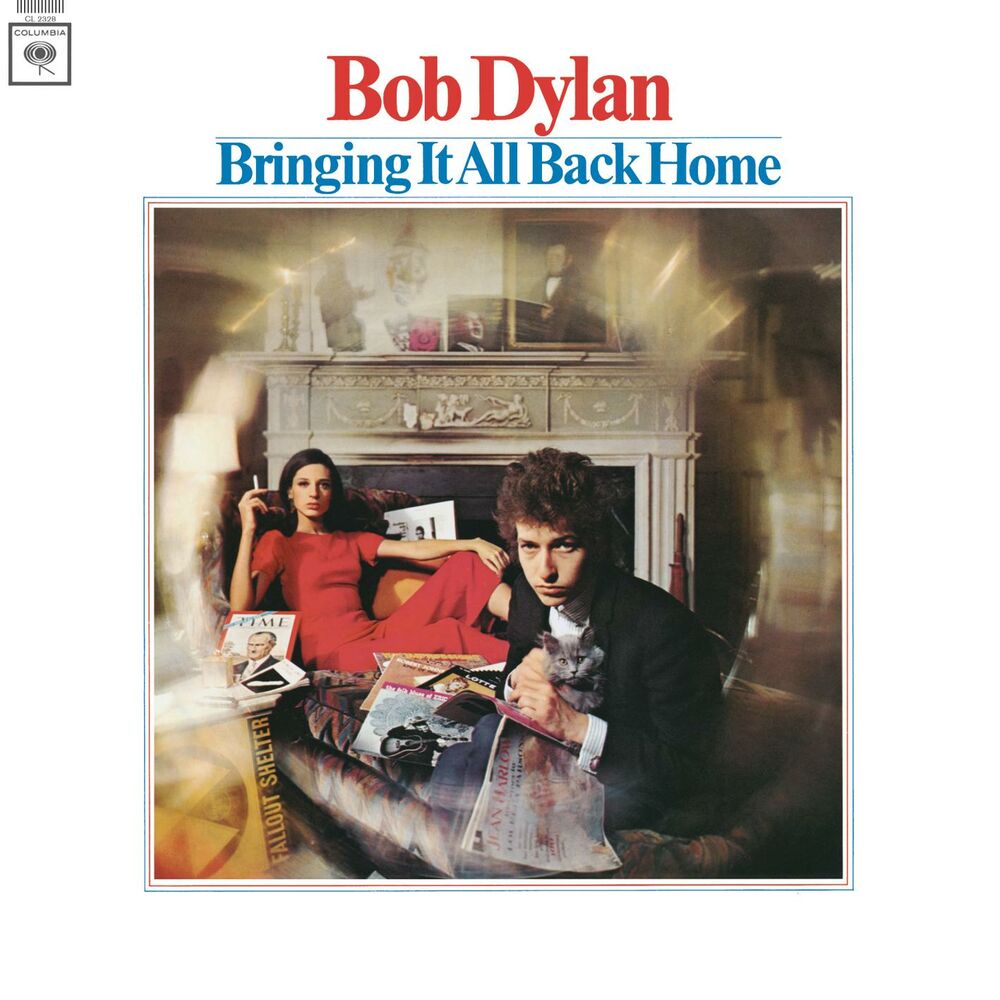
The album's lyrics moved towards surrealism and stream-of-consciousness writing, departing from his earlier protest songs. The cover features Sally Grossman, various LPs by artists like Robert Johnson and Ravi Shankar, and a copy of the I Ching, suggesting a rich cultural backdrop. Dylan is pictured holding his cat, named Rolling Stone.

Why it's rated so high

Widely regarded as one of rock history's greatest albums, 'Bringing It All Back Home' was ranked #181 on Rolling Stone's 2020 list of the 500 Greatest Albums of All Time. Clinton Heylin called it "possibly the most influential album of its era," noting its impact on contemporary popular song. It was inducted into the Grammy Hall of Fame in 2006.

Career and historical context

This album marked a pivotal moment in Dylan's career, as he controversially embraced electric instrumentation, alienating some folk purists. It was his first LP to break into the US Top 10, reaching No. 6 on Billboard's Pop Albums chart. Its release coincided with the end of his extensive touring with Joan Baez, signalling a new musical direction.

Fun facts

  • Dylan wrote many songs for the album in Woodstock, often typing late at night.
  • He met The Beatles for the first time in New York, influencing his rock sound.
  • Producer Tom Wilson initially tried overdubbing a 'Fats Domino thing' onto an acoustic 'House of the Rising Sun'.
  • The album cover features Sally Grossman, wife of Dylan's manager, lounging in the background.
  • Dylan's cat on the cover was named Rolling Stone, and his cufflinks were a gift from Joan Baez.
Written by AI from the album's and artist's Wikipedia articles and the archive's notes. Double-check anything important.

The full story

Bringing It All Back Home is the fifth studio album by the American singer-songwriter Bob Dylan. Released by Columbia Records in April 1965, the album was Dylan's first to incorporate electric instrumentation. It was so different from his earlier work that it caused controversy and divided the contemporary folk scene. On the first half of the album—the songs on side one of the original LP—Dylan is backed by an electric rock and roll band. The second half features mainly acoustic songs. The album abandons the protest music of Dylan's previous records for more surreal, complex lyrics. The album reached No. 6 on Billboard's Pop Albums chart, the first of Dylan's LPs to break into the US Top 10. It topped the UK charts later that spring. The first track, "Subterranean Homesick Blues", became Dylan's first single to chart in the US, peaking at No. 39. Bringing It All Back Home has been described as one of the greatest albums of all time by multiple publications. In 2003, it was ranked number 31 on Rolling Stone's list of the "500 Greatest Albums of All Time"; it was ranked number 181 in the 2020 edition.

Recording

Dylan spent much of the summer of 1964 in Woodstock, a small town in upstate New York where his manager, Albert Grossman, had a place. When Joan Baez went to see Dylan that August, they stayed at Grossman's house. Baez recalls that "most of the month or so we were there, Bob stood at the typewriter in the corner of his room, drinking red wine and smoking and tapping away relentlessly for hours. And in the dead of night, he would wake up, grunt, grab a cigarette, and stumble over to the typewriter again." Dylan already had one song ready for his next album: "Mr. Tambourine Man" was written in February 1964 but omitted from Another Side of Bob Dylan. Another song, "Gates of Eden", was written earlier that year, appearing in the original manuscripts to Another Side of Bob Dylan; it's unclear whether subsequent lyrical changes were made that August in Woodstock. At least two songs were written that month: "If You Gotta Go, Go Now" and "It's Alright, Ma (I'm Only Bleeding)". Dylan's lyrics became increasingly surreal, and his prose grew more stylistic, often resembling stream-of-consciousness writing. Letters he wrote in 1964 became increasingly intense and dreamlike as the year wore on. Dylan returned to the city, and on August 28, he met the Beatles for the first time in their New York hotel. The meeting influenced Dylan, whose next three albums would invoke a rock sound. Dylan would remain on good terms with the Beatles, and as biographer Clinton Heylin writes, "The evening established a personal dimension to the very real rivalry that would endure for the remainder of a momentous decade." Dylan and producer Tom Wilson were soon experimenting with their own fusion of rock and folk music. The first unsuccessful test involved overdubbing a "Fats Domino early rock & roll thing" over Dylan's earlier, acoustic recording of "House of the Rising Sun", according to Wilson. This took place in the Columbia 30th Street Studio in December 1964. It was quickly discarded, though Wilson would more famously use the same technique of overdubbing an electric backing track to an existing acoustic recording with Simon & Garfunkel's "The Sound of Silence". In the meantime, Dylan turned his attention to another folk-rock experiment conducted by John P. Hammond, an old friend and musician whose father, John H. Hammond, originally signed Dylan to Columbia. Hammond was planning an electric album around the blues songs that framed his acoustic live performances of the time. To do this, he recruited three members of the Hawks, an American/Canadian bar band he met the previous year: guitarist Robbie Robertson, drummer Levon Helm, and organist Garth Hudson. (The Hawks would go on to become the Band.) Dylan was very aware of the resulting album, So Many Roads; according to his friend, Danny Kalb, "Bob was really excited about what John Hammond was doing with electric blues. I talked to him in the Figaro in 1964 and he was telling me about John and his going to Chicago and playing with a band and so on…" However, when Dylan and Wilson began work on the next album, they temporarily refrained from electric experimentation. The first session, held on January 13, 1965, in Columbia's Studio A in New York, was recorded solo, with Dylan playing piano or acoustic guitar. Ten complete songs and several song sketches were produced, nearly all of which were discarded. Take one of "Bob Dylan's 115th Dream" would be used for the album, but three would eventually be released: "I'll Keep It With Mine" on 1985's Biograph, and "Farewell Angelina" and an acoustic version of "Subterranean Homesick Blues" on 1991's The Bootleg Series Volumes 1–3 (Rare & Unreleased) 1961–1991. Other songs and sketches recorded at this session: "Love Minus Zero/No Limit", "It's All Over Now, Baby Blue", "She Belongs to Me", "On the Road Again", "If You Gotta Go, Go Now", "You Don't Have to Do That", "California," and "Outlaw Blues", all of which were original compositions. Dylan and Wilson held …

Artwork

The album's cover, photographed by Daniel Kramer with an edge-softened lens, features Sally Grossman (wife of Dylan's manager Albert Grossman) lounging in the background. There are also artifacts scattered around the room, including LPs by the Impressions (Keep On Pushing), Robert Johnson (King of the Delta Blues Singers), Ravi Shankar (India's Master Musician), Lotte Lenya (Sings Berlin Theatre Songs by Kurt Weill) and Eric Von Schmidt (The Folk Blues of Eric Von Schmidt). Dylan had "met" Schmidt "one day in the green pastures of Harvard University" and would later mimic his album cover pose (tipping his hat) for his own Nashville Skyline four years later. A further record, Françoise Hardy's EP J'suis D'accord, was on the floor near Dylan's feet but can only be seen in other shots from the same photo session, as well as a copy of the Wilhelm/Baynes version of I Ching. Visible behind Grossman is the top of Dylan's head from the cover of Another Side of Bob Dylan; under her right arm is the magazine Time with President Lyndon B. Johnson as "Man of the Year" on the cover of the January 1, 1965 issue. There is a harmonica resting on a table with a fallout shelter (capacity 80) sign leaning against it. Above the fireplace on the mantle directly to the left of the painting is the Lord Buckley album The Best of Lord Buckley. Next to Lord Buckley is a copy of GNAOUA, a magazine devoted to exorcism and Beat poetry edited by poet Ira Cohen, and a glass collage by Dylan called "The Clown" made for Bernard Paturel from colored glass Bernard was about to discard. Dylan sits forward holding his cat (named Rolling Stone) and has an opened magazine featuring an advertisement on Jean Harlow's Life Story by the columnist Louella Parsons resting on his crossed leg. The cufflinks Dylan wore in the picture were a gift from Joan Baez, as she later referenced in her 1975 song "Diamonds & Rust". Daniel Kramer received a Grammy nomination for best album cover for the photograph. On the back cover (also by Kramer), the woman massaging Dylan's scalp is the filmmaker and performance artist Barbara Rubin.

Release

Bringing It All Back Home was released in April 1965 by Columbia Records. The mono version of Bringing It All Back Home was re-released in 2010 on The Original Mono Recordings, accompanied by a booklet containing a critical essay by Greil Marcus. A high-definition 5.1 surround sound edition of the album was released on SACD by Columbia in 2003.

Reception

The release of Bringing It All Back Home coincided with the final show of a joint tour with Joan Baez. By this time, Dylan had grown far more popular and acclaimed than Baez, and his music had radically evolved from their former shared folk style in a totally unique direction. It would be the last time they would perform extensively together until 1975. (She would accompany him on another tour in May 1965, but Dylan would not ask her to perform with him.) The timing was appropriate as Bringing It All Back Home signaled a new era. Dylan was backed by an electric rock and roll band—a move that further alienated him from some of his former peers in the folk music community. The album reached No. 6 on Billboard's Pop Albums chart, the first of Dylan's LPs to break into the US top 10. It also topped the UK charts later that spring. The first track, "Subterranean Homesick Blues", became Dylan's first single to chart in the US, peaking at No. 39.

Legacy

Bringing It All Back Home is regarded as one of the greatest albums in rock history. In 1979 Rolling Stone Record Guide critic Dave Marsh wrote: "By fusing the Chuck Berry beat of the Rolling Stones and the Beatles with the leftist, folk tradition of the folk revival, Dylan really had brought it back home, creating a new kind of rock & roll [...] that made every type of artistic tradition available to rock." Clinton Heylin later wrote that Bringing It All Back Home was possibly "the most influential album of its era. Almost everything to come in contemporary popular song can be found therein." In 2003, the album was ranked number 31 on Rolling Stone magazine's list of the "500 Greatest Albums of All Time", maintaining the rating in a 2012 revised list. It moved down to number 181 on the 2020 list. The album was inducted into the Grammy Hall of Fame in 2006. In a 1986 interview, film director John Hughes cited it as so influential on him as an artist that upon its release (while Hughes was still in his teens), "Thursday I was one person, and Friday I was another." The album was included in Robert Christgau's "Basic Record Library" of 1950s and 1960s recordings—published in Christgau's Record Guide: Rock Albums of the Seventies (1981)—and in Robert Dimery's music reference book 1001 Albums You Must Hear Before You Die (2010). It was voted number 189 in the third edition of Colin Larkin's book All Time Top 1000 Albums (2000). Hip-hop group Public Enemy reference it in their 2007 Dylan tribute song "Long and Whining Road": "It's been a long and whining road, even though time keeps a-changin' / I'm a bring it all back home".

From the Wikipedia article Bringing It All Back Home, available under CC BY-SA 4.0.

Tracklist

  1. Subterranean Homesick Blues2:18
  2. She Belongs to Me2:47
  3. Maggie's Farm3:55
  4. Love Minus Zero2:49
  5. Outlaw Blues3:02
  6. On the Road Again2:35
  7. Bob Dylan's 115th Dream6:31
  8. Mr. Tambourine Man5:25
  9. Gates of Eden5:41
  10. It's Alright, Ma (I'm Only Bleeding)7:31
  11. It's All Over Now, Baby Blue4:14

Listeners 0

Nobody has logged it yet. Be the first.

Log a listen